
The Future Farmers of Citrus County
By: Ken Marotte, Citrus County Historical Society
The annual Citrus County Fair will be kicking off next week. In addition to the usual carnival food and amusement rides, you’ll see a dedicated group of youths proudly wearing blue jackets with a time-honored logo on the back. They’ll be tending to farm animals and displaying produce that they hope will win a Blue Ribbon. This is the story of the Citrus chapters of the FFA – the Future Farmers of America.
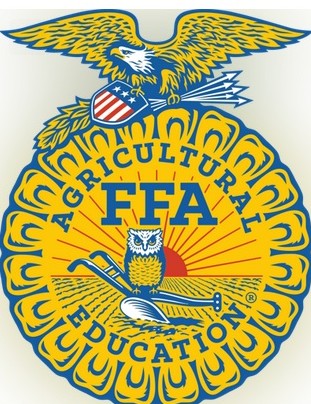
The FFA Movement in Florida
The national Future Farmers of America (FFA) organization grew out of a movement in the Mid-West during the late 1920’s. In light of the extensive agricultural presence in Florida, it’s no surprise that local FFA chapters were established in Florida by 1929.
While the focus of the group was devoted to vocational agriculture for young boys, the goals of the group were also geared toward instilling moral values while still having fun. The Florida State FFA stated that some of the goals of the organization included “to create and nurture a love of country life; to promote thrift; to provide recreation and educational entertainment through agricultural and athletic contests, vacation tours, father and son banquets; to establish the confidence of the farm boy in himself and his work; and to promote scholarship and rural leadership.”
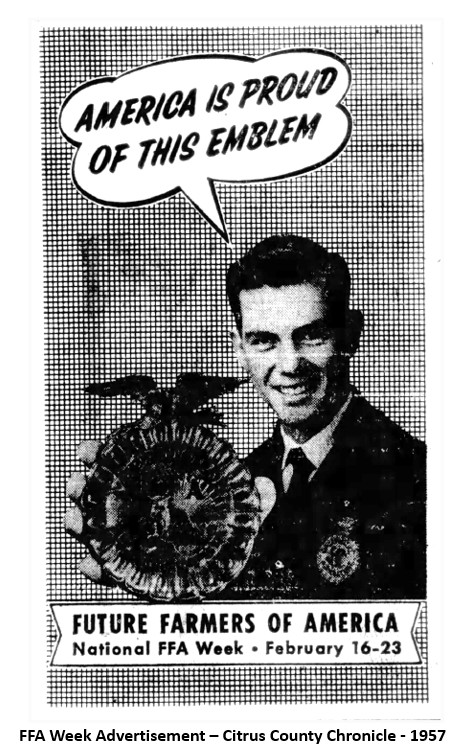
There were three levels of membership at the State level: Green Hand; Florida Farmer; and Florida Planter. Members had to pass series of tests and achieve defined goals before they could be nominated for advancement to the next level.
The national organization designated the days surrounding the Washington’s Birthday holiday as “FFA Week” for special activities. In addition to his leadership during the early days of the United States, Washington was heralded by FFA leadership as one of the pioneers of advanced farming practices on his Mt. Vernon estate. It was popularly believed that he was one of the first farmers to practice contour planting, soil conservation, crop rotation and fertilization. (Although some of these claims may have originated in the creative mind of Parson Weems).
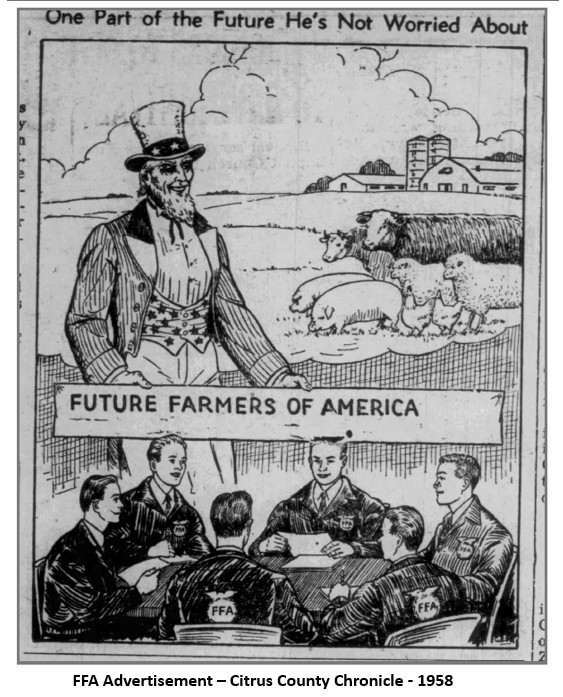
By the 1930’s there were two local FFA chapters existing in the High Schools of Citrus County.
Earning Your Agricultural Stripes
Members were expected to develop a plan for a unique agricultural project during the upcoming year. For some boys, their goal might include using advanced practices to grow a champion steer. Other youths might plan to increase crop yields through new growing techniques.
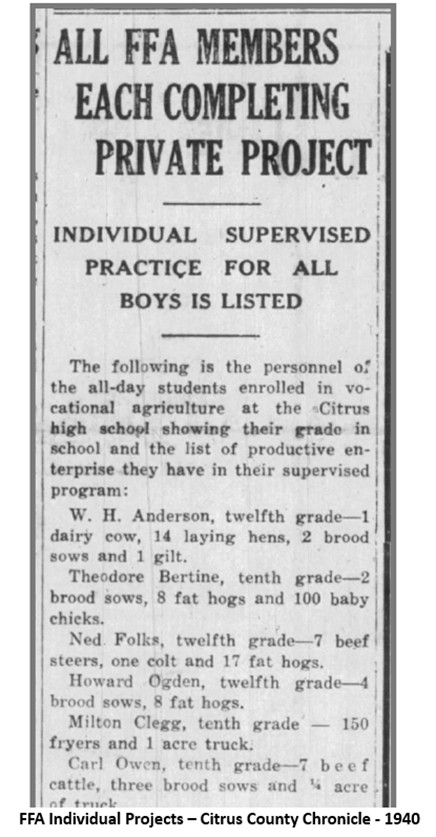
The projects were monitored under the watchful eyes of the vocational agricultural teachers at the schools. They offered guidance and suggestions to the students throughout the years. They served as judges who selected the best projects for advancement to competitions at the State and National FFA levels. Henry Hewitt (Citrus High School) and DeWitt Crawford (Crystal River High School) were particularly instrumental in the growth of FFA during the 1950’s and 1960’s.
The FFA Rodeo
One of the more popular FFA activities was their amateur rodeo in the 1950’s. Rather than engage a group of professional riders, local “cowboys” competed for the title of “King of the Rodeo” in the early 1950’s. Boys were encouraged to test their skills in “calf roping, bull riding, bronc riding, wild cow milking, bull dogging, and steer riding.”
The grand champion during those early years was Hernando’s Major Bellamy . As an adult, he became a successful rancher and served on the Citrus County Board of County Commissioners.
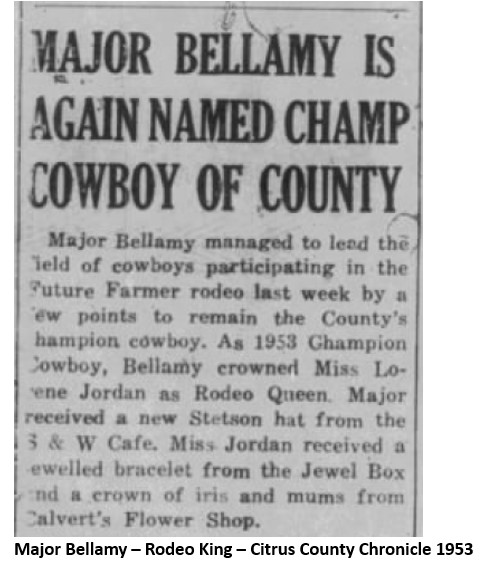
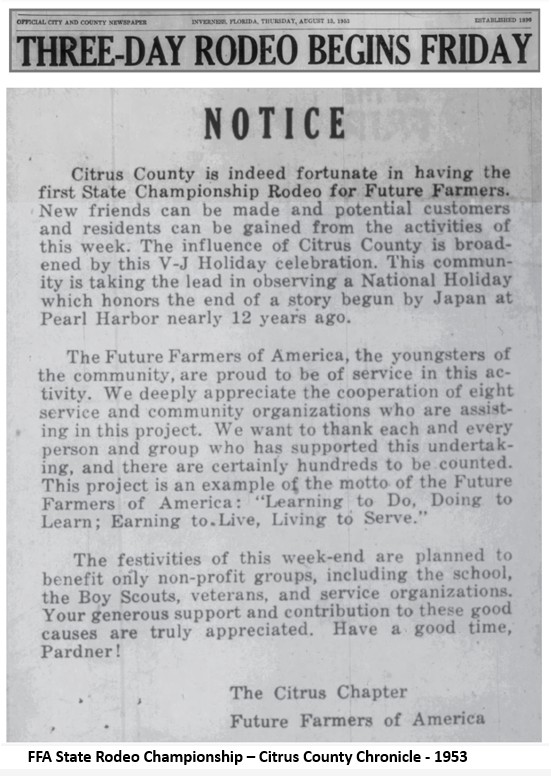
The local event proved to be so popular that the Citrus County chapters were awarded their bid to serve as the host for the inaugural Florida State FFA Rodeo Championships. The three-day event required community-wide support and was deemed a great success. Proceeds were used to defray event expenses and the remainer was donated to local non-profit charities.
Community Support for the FFA
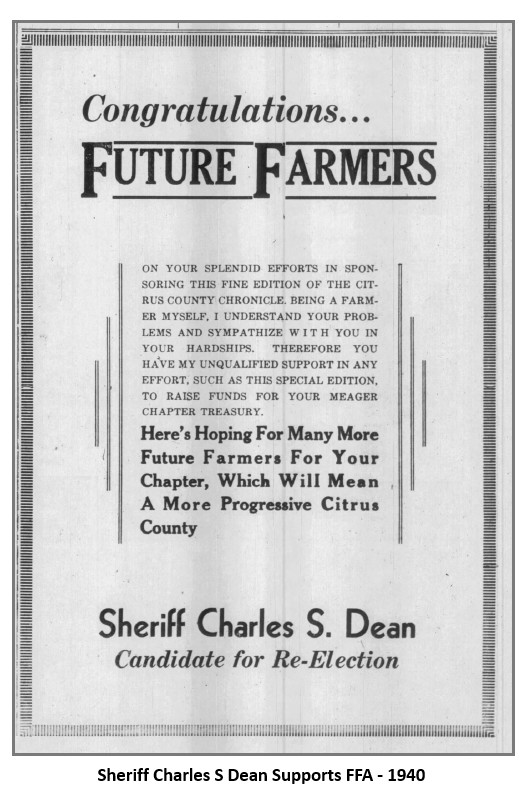
The Citrus County business community and government leaders were enthusiastic supporters of the FFA. The Board of County Commissioners leased over 65 acres of land near the Crystal River airport to the local FFA chapter so the boys could implement extensive testing of agricultural enhancements.
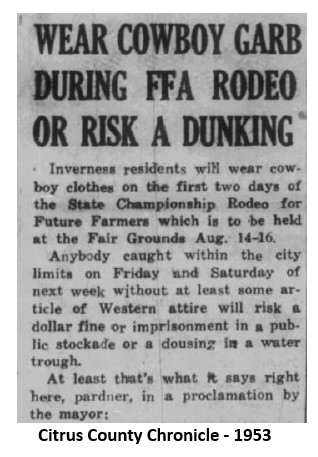
The Mayor of Inverness, Donald Bradshaw, issued a proclamation that all residents had to wear at least one item of Western wear during the week of the FFA Rodeo or be subjected to “jail” or “public dunking”. Offenders could commute their sentence through a generous donation to the FFA’s fund.
More than Agriculture
While the focus of the FFA was agriculture, activities aimed at personal development and physical education were also offered to members. You may be surprised to learn that Public Speaking was one of the events where Citrus County boys excelled. Perhaps inheriting some of his father’s legendary oratorical skills, “Butch” Williams won a number of speaking awards. (He was the son of Francis “Cowboy” Williams, who was sought across the State as a popular Anti-Communist speaker).
The Citrus “Parliamentary Procedure” team won awards at the State level. The boys were encouraged to compete in such diverse events such as fiddling, pitching, harmonica playing, quartette singing, and horse shoe pitching. Crystal River FFA member Earl Williams took First Place in the 1939 FFA Underwater Swimming contest.
FFA Sponsors Hewitt and Crawford instructed boys on developing radio and television programs devoted to agricultural topics.
Community Service
FFA members tackled community-service projects across the county. A team of FFA boys installed a set of bleachers at the old Citrus High school athletic field so fans would be welcome to cheer for the home team. They built bleachers for the basketball team a few years later.
Back in the days when toys were hand-made, the boys from the FFA repaired broken toys so needy children would find presents under the Christmas tree.
Crystal River FFA chapter members plowed the area around the High School and Elementary School in 1959 and completely reseeded with grass and installed landscaping that had been donated by local merchants.
A registry of members willing to do odd jobs for local residents was created and services were offered for free or reasonable rates. The boys offered to cut grass, spray fields or even drive tractors for anyone needing help. Any proceeds were donated to the chapter so everyone could have official FFA jackets.
Girls Join the FFA
In accordance with the traditional roles of the period, membership in the FFA was restricted to boys. Development programs for girls were under the auspices of the 4-H “Tomato Clubs”, county Demonstration Clubs or Home Economics classes in High School.
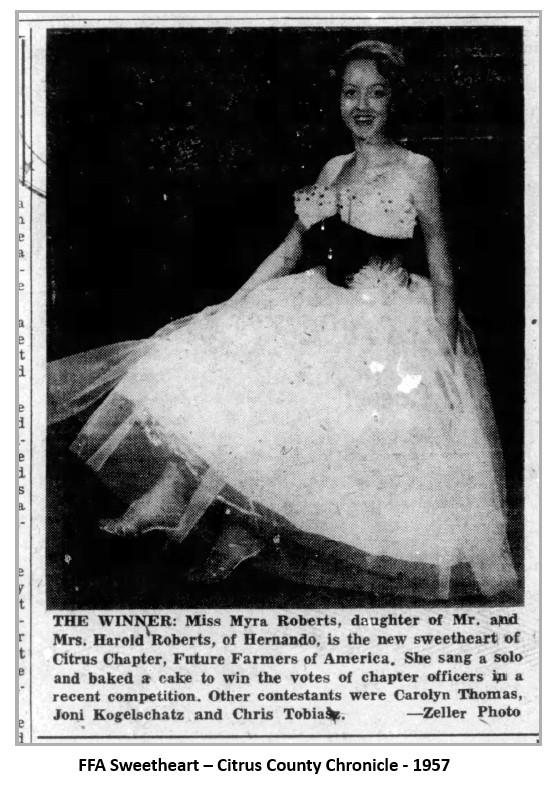
A contest was held every year for a girl to be crowned as the “FFA Sweetheart”. Rather than a standard swimsuit beauty contest, candidates were judged on their stage appearance, personality and talents. Some contestants played piano, danced, performed skits or sang popular songs. Many girls modelled dresses that they had made for themselves. Others baked cakes and offered samples to the judges for evaluation (this proved to be shrewd choice for some eventual winners).
It became apparent that many of the girls in FFA families could ride horses and rope cattle just as well as their brothers. In many cases, they had ridden in the saddle since they were toddlers and demonstrated proficiency in many of the traditional “male” roles on the farm. The national Future Farmers of America organization voted to invite girls to join their ranks in 1969.
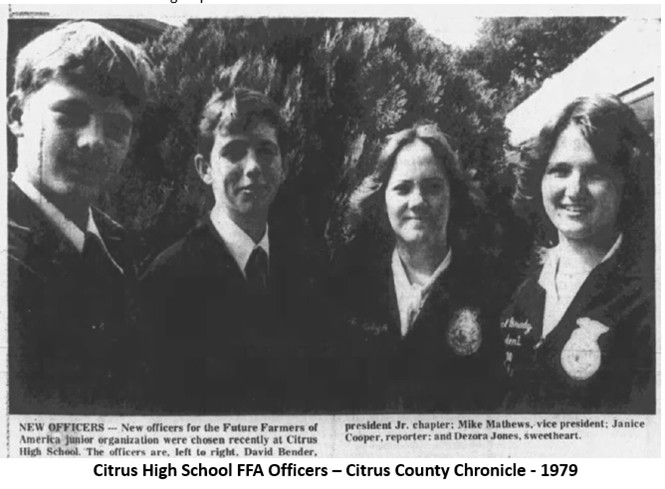
The local chapters followed suit and with a few years, girls were also sporting the familiar blue jackets at the Citrus County Fair. By 1973, they joined the governing board of the local FFA chapters and served as officers in those groups.
Note:
We can’t forget the contributions that local 4-H’ers have made to agricultural life in Citrus County. My previous article covering the 4-H clubs can be found at : https://cccourthouse.org/the-growth-of-4-h-in-citrus-county/
Ken Marotte writes for the Citrus County Historical Society. He can be reached via email at kenmarottejr@gmail.com if you have any comments, questions or suggestions.