
The Growth of 4-H in Citrus County
By: Ken Marotte, Citrus County Historical Society
Originating from humble beginnings, today’s Citrus County 4-H program has grown to encompass 18 different clubs covering a wide variety of interests. This article explores the evolution of the 4-H program from Corn & Tomato Clubs to a nationwide network of clubs designed to further youth’s expertise in traditional agricultural fields as well as advanced science topics and personal development.

The Corn and Tomato Clubs
The idea for an agricultural-focused youth outreach program began in the Midwest during the early 1900’s and gradually spread across the country. The intent was to provide advanced farming concepts and social connection to the next generation of leaders in rural communities. The boys were enrolled in “Corn Clubs” which focused on new ways to increase crop yields by using new techniques. Competitions arose and winners were judged on the yield of their corn crop in consideration of the size of their field and the cost to produce the crop.
Girls were encouraged to join “Tomato Clubs”. New members learned the best ways to grow tomatoes during their first year. The second year’s garden included tomatoes and one other crop. By the third year a field might include tomatoes, beans, beets and other seasonal crops. By the time a girl graduated from high school she would have started a permanent garden or orchard.
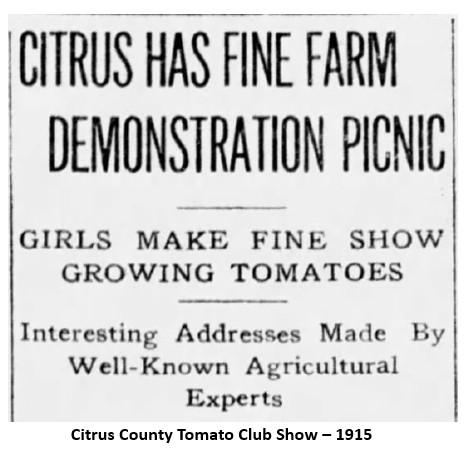
Over 1,000 people attended the 1915 Citrus County Corn and Tomato Demonstration Picnic in Lecanto. The girls who entered the competition were tasked with growing as many pounds of tomatoes as possible in a one-tenth acre plot. Lucille Scruggs was the runner-up with 1,089 pounds. Cora Landrum outpaced the entire group with an amazing 3,018 pounds. After deducting expenses, she cleared a profit of $35 (over $1,000 in today’s dollars)
In the boys “Corn Club” division, George Priest beat all other competitors with a yield of 63 bushels per acre.
The clubs were organized under the auspices of the Citrus County School Department during those early days. County Extension staff would lend their support and guidance but Superintendent Robert Turner provided leadership for the Clubs during that time.
At the opening of the 1917 Citrus County Fair, boys were offered participation in the Peanut Club, Pig Club, and Cattle Club as well as the Corn Club. Girl’s opportunities had expanded to include a Canning Club which was viewed as a patriotic activity given America’s potential involvement in World War I.
The Birth of 4-H
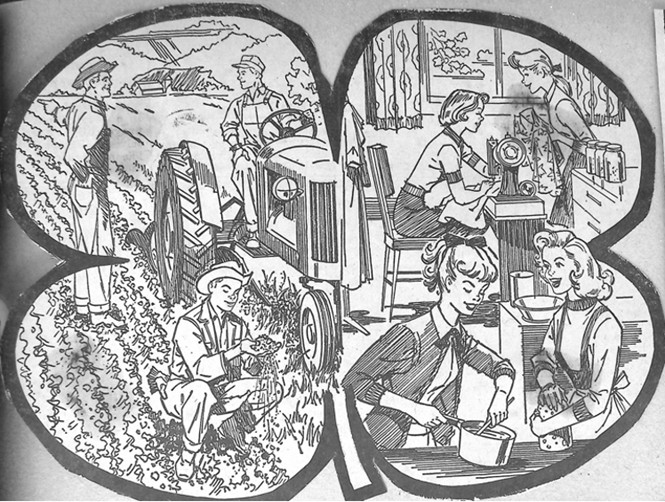
The distinctive 4-H cloverleaf design was reportedly created in 1912. It symbolized the Head, Heart, Hands and Health focus of the group. Gradually the various Corn and Tomato Clubs were incorporated into the national 4-H movement. Citrus County followed suit in the mid-1920’s. The clubs were reassigned to the leadership of the County Extension agent, although the schools continued to support the clubs as extra-curricular activities.
Personal development and leadership skills, such as public speaking, grooming and dressmaking were added to the roster of 4-H club’s activities
The Great Depression and 4-H in Citrus County
The economic calamity now known as “The Great Depression” hit small rural counties particularly hard. The Extension Service expanded the canning activities of the ladies Home Demonstration group. Girls in the 4-H stepped up their expertise in canning techniques to ensure that no food went to waste.
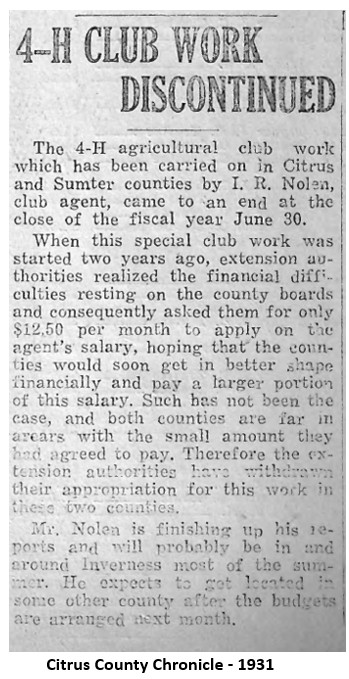
The Citrus County 4-H program was hit with bad news in 1931. The expenses of County Extension Agents were partially borne by the State and supplemented by the individual counties. Like many other small counties, Citrus County did not have the funds to underwrite their share of Extension activities, including the 4-H program. Members of the community recognized the value of the 4-H program and joined together to find the money necessary to resume 4-H operations the following year.
Camps and Short Courses
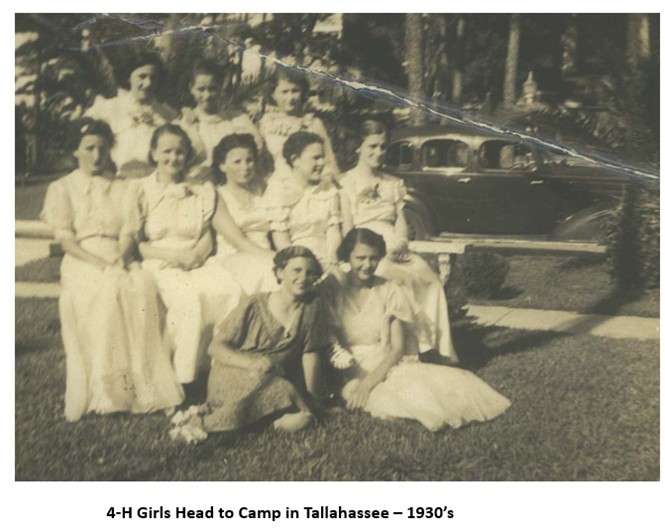
The Citrus County 4-H boys and girls were given the chance to attend summer gatherings at club camps and short courses in a variety of topics in Tallahassee and Gainesville. The camps included daily chores, lectures on practical life lessons and plenty of recreational activities. One of the more subtle objectives was to acclimate the campers to the university campuses in the hope that they would return someday as students.
Expanding Horizons
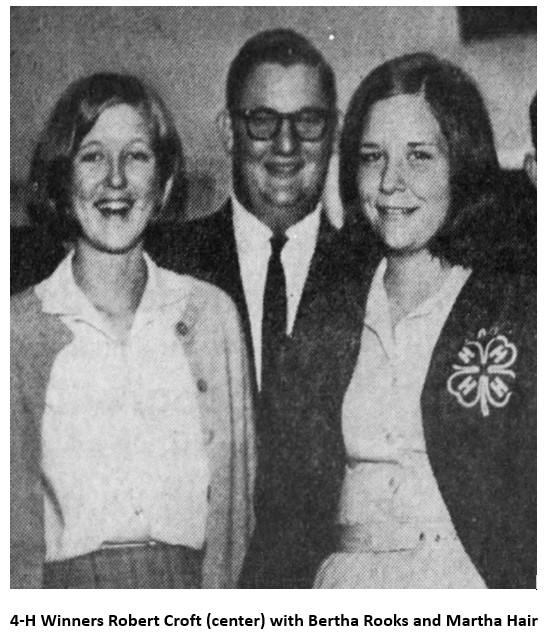
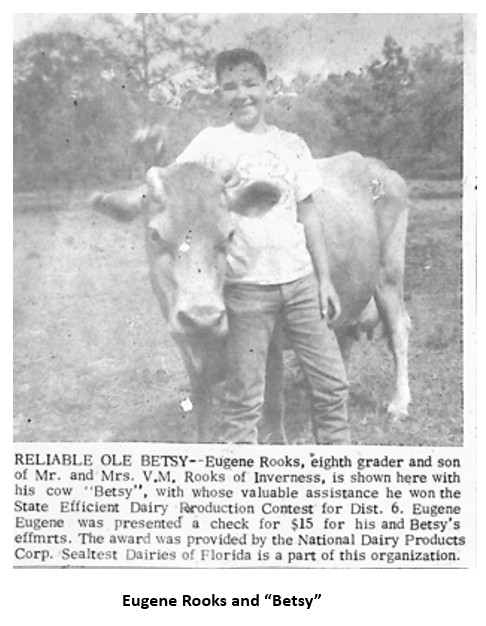
The national 4-H Congress offered the opportunity for small-town members to meet others from other regions in locations they had only read about in the newspapers. Hernando’s Robert Croft won an award in 1966 at the State level for his work in horticulture and was offered a chance to attend the national conference in Chicago. He recalled that this was to be his first trip on an airplane and was white as a ghost when he walked up the stairs to the plane. He was accompanied by 4-H Sponsor Royce Williams and fellow State winners Eugene Rooks and George Stokes. The boys had secured sponsorship from local and national contributors.
As a Florida native, this trip gave Croft his first chance to experience the legendary wind and snow of a Chicago winter. Club members received tickets to the Chicago Symphony featuring Pablo Casals.
Robert Croft later became Camp Manager at the 4-H camp at Cherry Lake FL so other boys and girls could enjoy the same experiences that he remembered as a youth.
Reflecting on his time with 4-H, Croft stated that the 4-H Motto “To Make the Best Better” and Slogan “Learn by Doing” became watchwords throughout his life and he continues to follow those maxims to this day.
The “Hustling Cloverettes”
Community service became an important mission for the 4-H clubs. The boys and girls served as hosts at the annual Citrus County Fair. They held bake sales and car washes so they could support worthy local causes.
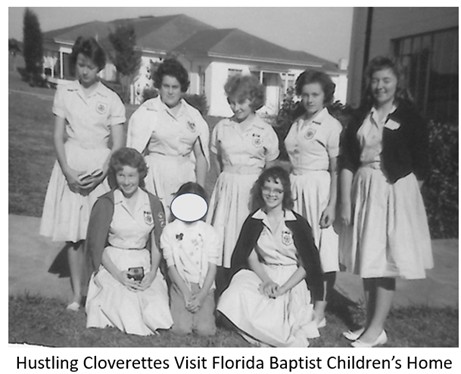
One group that typified the 4-H dedication to community service was a group of young 7th and 8th grade girls who always seemed to be the first to volunteer for special projects. Their “hustle” led to the group being dubbed the “Hustling Cloverettes” in 1959.
The team of nine girls embarked on a series of fund-raising efforts to support local families. Each girl made an article of clothing and donated to a needy family. They made a Christmas gift basket for the family so the children would receive presents (and food) under their tree. The girls filled over 700 bags with candy to support the Court House Christmas program.
All of those efforts paled in comparison to their sponsoring of an orphaned girl at the Florida Baptist Children’s Home in Lakeland. They sent her one dollar a month as well as presents at Christmas, Easter and on her birthday. The Cloverettes developed a strong relationship with the orphaned girl and arranged field trips to Lakeland so they could visit with their sponsored child.
Their efforts had lasting effects – the young lady later volunteered at her High School as a way of “paying it forward”.
4-H Today
The 4-H program has expanded to equip local youths to tackle the challenges of today’s world while still retaining emphasis on their rural, small-town roots. They have multiple active horse clubs and also offer leadership, community service, career and animal projects. Their animal and plant exhibits are prominently displayed at the annual Citrus County Fair.
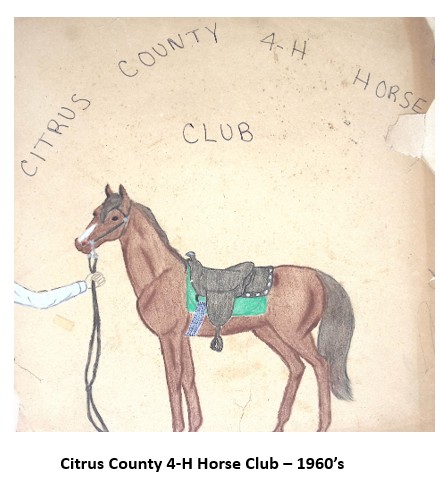

The Citrus Stampede Rodeo rolls into the Citrus County Fairgrounds on November 21 and 22. Enjoy the show and support your local 4-H Clubs! Visit https://citrusstampederodeo.com/ for ticket information
Ken Marotte writes for the Citrus County Historical Society. He can be reached via email at kenmarottejr@gmail.com if you have any comments, questions or suggestions. Contact him if you’d like to participate in the ongoing CCHS Oral History Project.