
Wild Citrus – More Than Manatees
By: Ken Marotte, Citrus County Historical Society
Citrus County has teemed with a surprising assortment of wildlife over the years. Some have disappeared due to growth encroaching into their habitat. Others have survived and learned to live in the shadows of our neighborhoods. Some were visitors that appeared unexpectedly and surprised the local inhabitants.
The Crystal River Monster
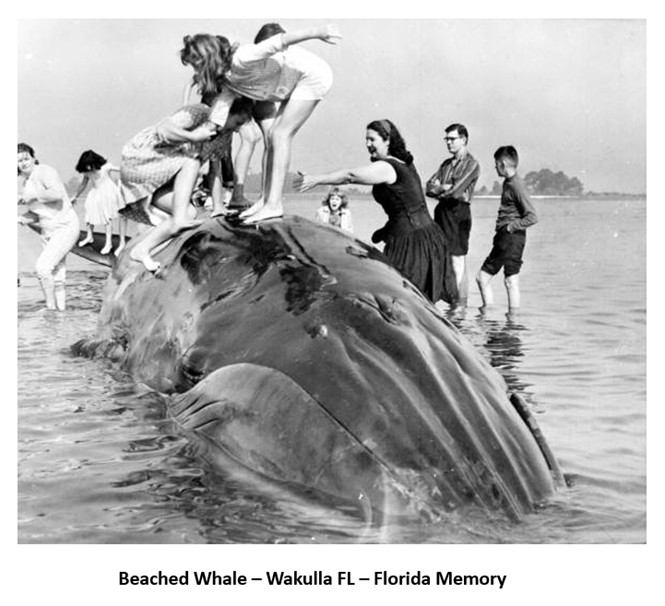
The waters of Citrus County are not usually associated with whale sightings. However, these giant creatures famously paid more than one visit to our shores in the 20th century.
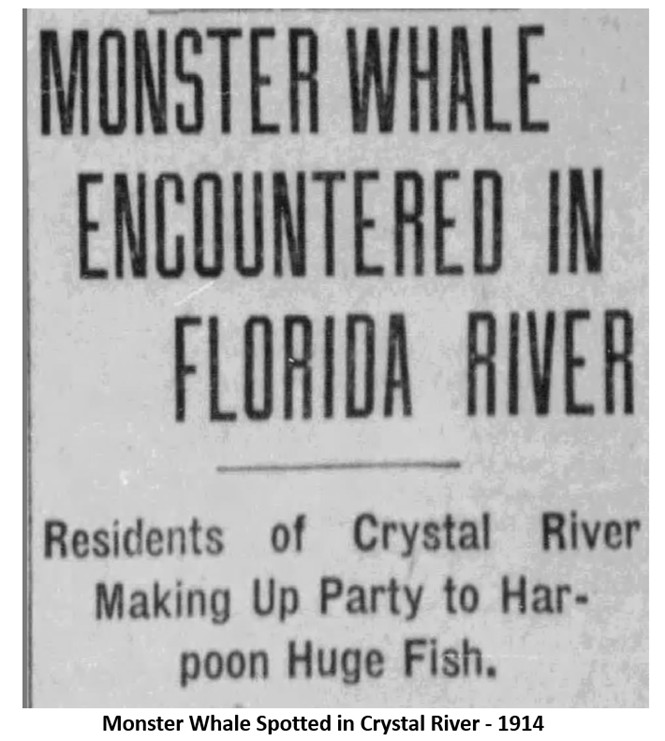
In the summer of 1914, J.W. Gilley and a party of three other fishermen were in a boat near Miller’s Point in Crystal River. Suddenly a huge fin broke the surface and created a wave that nearly capsized their boat. Nearby anglers reported seeing the same huge splash in the water. Mr. Gilley managed to peer into the water and saw a whale that he estimated was between 45 and 50 feet long. He had some previous experience with whales and declared that it was a grumpus whale. News spread throughout the town and a party of men launched boats into the bay to attempt harpooning the creature. There were no further whale sightings that year so the visitor must have escaped his fate.
A check of grumpus whale attributes reveals that they are typically no more than 13 feet long. I know that fishermen rarely exaggerate the size of their catches, so this “monster” must have been an exception to the rule for a typical grumpus whale’s size.
A more credible sighting occurred in 1920-1921. A huge whale, reportedly about 70 feet long, washed up on the shore in Crystal River. . There had been other whale remains cast upon Citrus County shores but had either drifted back to sea or disintegrated before an in-depth examination could be conducted. A group of local businessmen led by Frederick Van Roy engaged noted naturalist H.L. Ferguson to determine the length and species of the mystery whale.
Ferguson arranged to tow the carcass to the Tampa Bay area where he hoisted it onto dry land for further analysis. After conducting precise measurements, Ferguson determined that the whale was over 67 feet long and the head was 16 feet in diameter. It was estimated to weigh about 180,000 pounds. He enlisted the aid of the naturalists at the Smithsonian Institute in Washington, DC. They determined that it was a fin back whale – and there was no previous record of that species ever being reported in the Gulf.
There were several bullets embedded in the whale’s flesh which were probably due to an encounter with an exuberant fisherman.
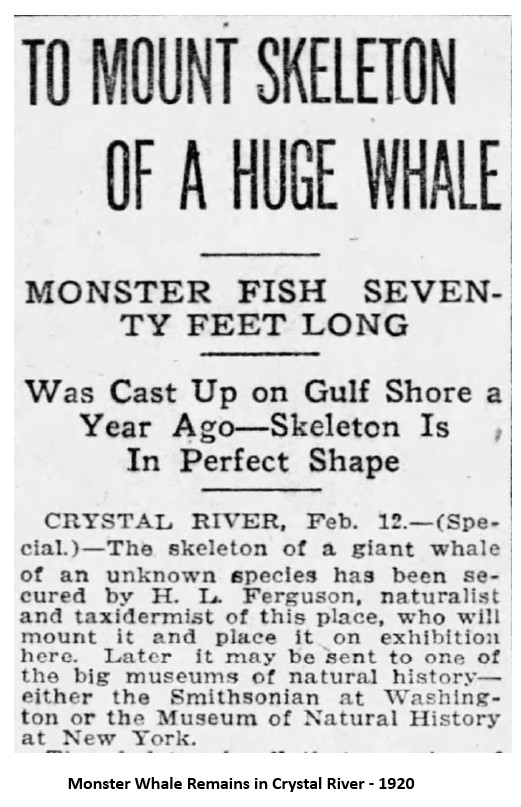
Ferguson reassembled the bones of the “Crystal River Monster” and the skeleton was displayed for many years at the Florida Museum of Natural History in Tampa. As is the case with many stories regarding marine animals and fish, the whale skeleton managed to grow to a length of 85 feet three years after its death (according to news reports).
Wildcats
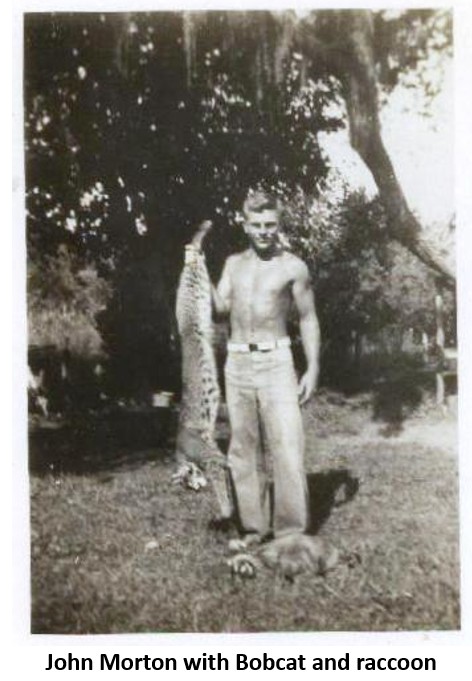
Early settlers found Citrus County to have a large population of “wild cats”, which was the generic term for panthers and bobcats. These animals posed a danger to cattle and other livestock for the ranchers and farmers. Accordingly, the Board of County Commissioners enacted a bounty of $1 (the equivalent of about $40 today) on the predators in 1905. BoCC minutes report that several men redeemed the scalps of the wildcats for cash in the next few years. Some hunters were bagging three or more every month and were processing the fur in addition to collecting the county bounty.
The panthers could pose of threat to humans as well. Mrs. Elizabeth Smith recalled a time when her family had joined with others to butcher their neighbor’s hogs. As a reward, they were given a portion of meat and were on their way back to their house. They heard a rustling in the woods and their mother saw a panther tracking them. As the animal drew closer, they threw all of their meat on the ground and ran to the safety of their house as fast as they could. She continued: “I’ve heard them….through the woods and back of us here from that line, a-yelling. They sound just like a woman screaming.” Her homestead was located on the territory of a mating pair of panthers and she frequently saw the stealthy black cats prowling in the woods.
In another interview, Richard E Rogers remembered that “…bobcats and wildcats. There used to be quite an abundance of those around here.” As late as 2005, Rogers recalled “Right at the intersection of 480 and 491, a great big old bobcat…biggest one I can recall ever seeing. He was out in the middle of the road and I drove up to him, and he didn’t even run or anything. He just sat there and kind of looked at me.”
It is not unusual to read reports of occasional bobcat sightings today. They have learned to cope with the growing human population by remaining in the shadows and outskirts of towns. Panthers were reported by residents of the Pine Ridge subdivision in 1997 but biologists determined that the sightings were probably related to a particularly large bobcat which had taken up residence in the area.
Deer Herds – Down but Not Out
Citrus County was known as a haven for hunters with plentiful deer herds to support that activity. The situation changed with the arrival of the Great Depression. Deer herds reportedly contained up to 75 members when they were on the run. Residents relied on the deer and other local resources to feed their families. Deer stocks declined precipitously and that forced state officials to take drastic action. Federal management areas were closed to hunting to allow the herds time to recover.
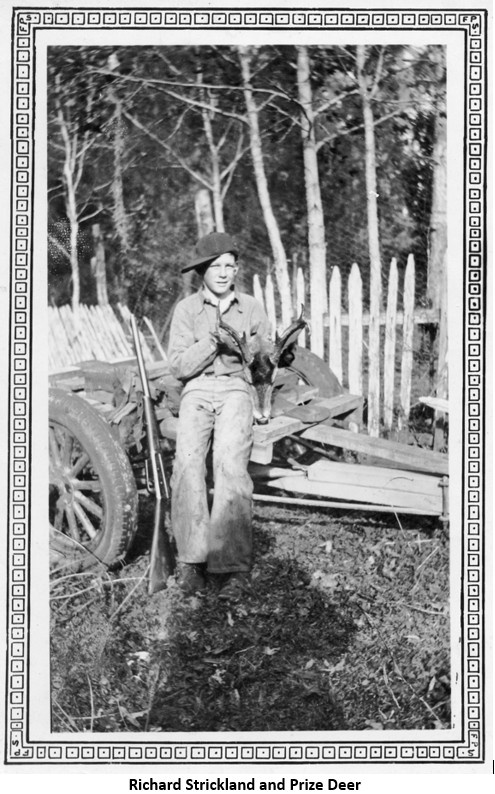
Richard Rogers recounted: “They brought 20 deer here to start stocking the place in 1935. They brought them down from Tallahassee, and then a couple of times…I’ve got newspaper articles from ’49, ’45 and then ’49, where they brought Wisconsin deer to try to increase the morphology of
the animals.”
The Wisconsin deer were larger and hardier than the native species and biologists hoped that the new arrivals would cross-breed and produce a healthier hybrid.
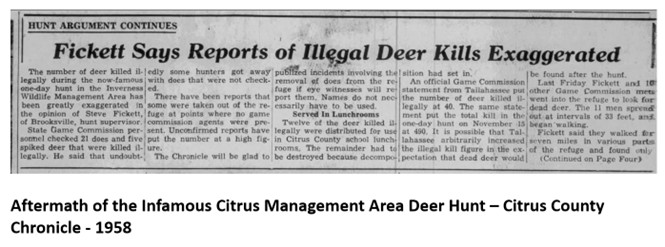
After a 20-year recovery period, sportsmen and hunting groups petitioned the government to open the management areas to controlled harvesting of the deer. The Fish and Wildlife staff relented in 1958 and announced the opening of the Citrus Management Area land to hunters. Over eager 3,200 hunters joined the hunt on the first day. Officials planned to stop the hunt once the limit of 250 deer was reached.
It took the hunters only a few hours to reach the 250 deer cap. By noontime on the first day, Fish and Wildlife agents called for reinforcements and were walking through the preserve to tell sportsmen that they needed to cease their hunting. There were reports that agents enlisted a helicopter with a bullhorn to find and deliver the message to the hunters spread over the 41,000 acre preserve.
Of course, there were some deer taken illegally that day, but the meat was donated to local school cafeterias after seizure.
The deer herds have never returned to their former numbers, but today they are often seen in the backyard gardens and woodlots of Citrus County residents. Deer are an example of a species that has learned to coexist with humans in spite of the reduction of their natural habitat.
Hoover Chickens
Deer were not the only wild resource that kept people alive during the Great Depression. Many people blamed President Herbert Hoover for the financial chaos. They found a natural meat source that was plentiful and tasted like chicken. Today we know them as “Gopher Tortoises”. During the Depression, residents collected the slow-moving reptiles and served as the main course for their meals.
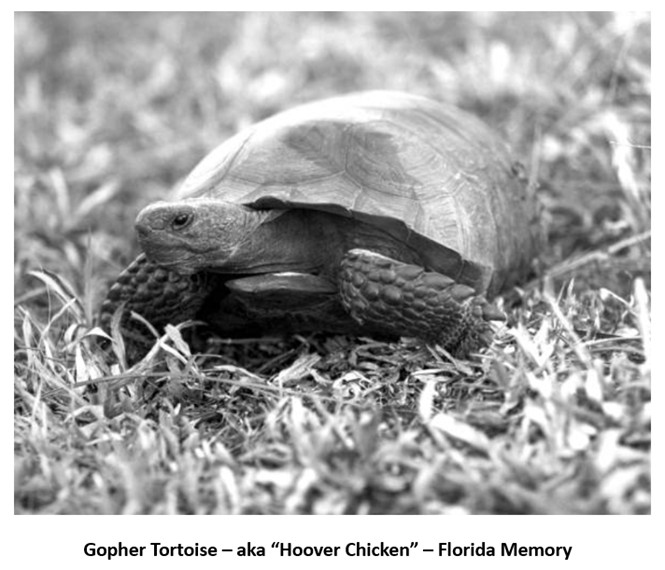
The tortoise’s sandy habitat has been threatened by explosive growth but today they have been protected from builder’s shovels – and chef’s caldrons – through expanded conservation efforts.
Ken Marotte writes for the Citrus County Historical Society. He can be reached via email at kenmarottejr@gmail.com if you have any comments, questions or suggestions.