
When Baseball was King in Citrus County
By: Ken Marotte, Citrus County Historical Society
“If there is any one thing which will help put a town on the map it is a ball team, preferably made up of home town boys…who play without any expectation of financial reward” – MLB Hall of Fame pitcher (and Homosassa Springs resident) Charles Arthur “Dazzy” Vance.
The National Pastime
The origins of baseball remain murky today. Many people think that it was derived from the British game of “rounders” and imported to America. Others argue that Abner Doubleday created the game near Cooperstown, NY. Regardless of which story you believe, interest in baseball swept the country by the mid-1800’s. The game became so popular that professional leagues arose, notably the National League in 1876 and the rival American League in 1901. Excitement reached a fever pitch when the champions of each league agreed to play a best-of-nine-game “World Series” in 1903. The Boston Americans (later “Red Stockings”) prevailed against the Pittsburg Pirates in the inaugural contest.
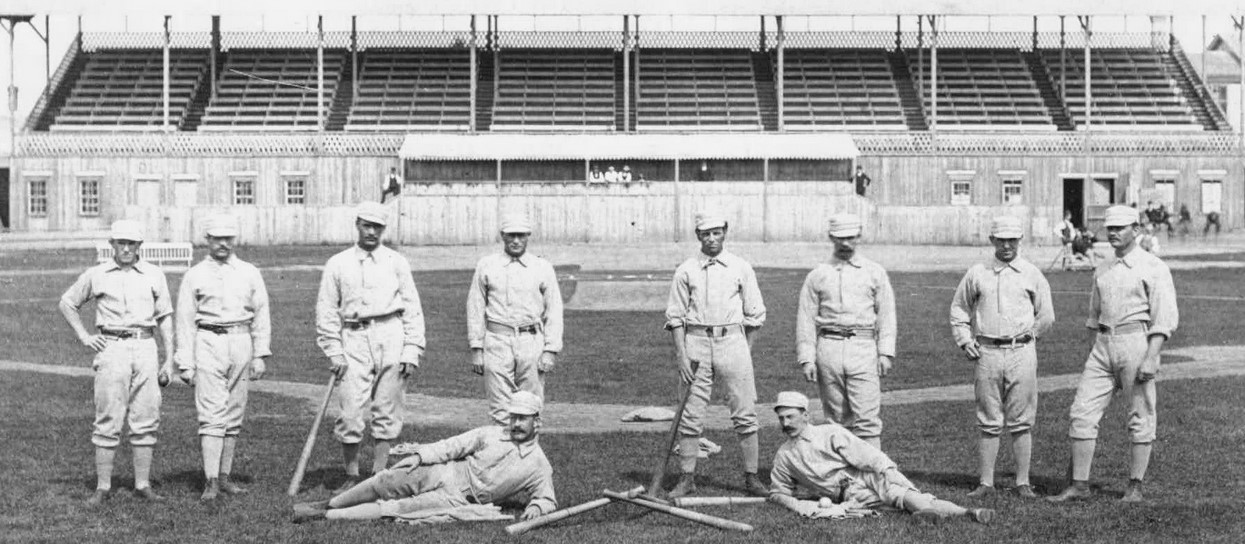
Early Baseball in Florida
Florida eventually became part of the baseball craze at the turn of the 20th century. However, there were no major league teams headquartered in the state. The Tampa Bay Rays would not be formed until a hundred years later. The Atlanta Braves were still playing in New England, known then as the Boston Bees/Braves. The closest major league team was the Washington Senators, and their record was so poor that they earned the accolade “Washington – First in War, First in Peace and Last in the American League” (to be fair, the Senators did have some winning teams in the 1920s before sinking into mediocrity).
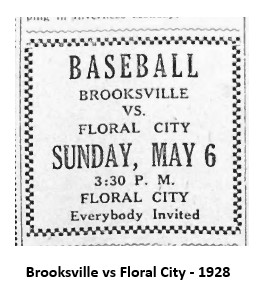
In the absence of a major league presence, larger Florida cities organized their own local teams. Since there was no league structure, each team’s manager arranged individual games with squads from other cities. Teams would solicit local patrons to provide baseball gloves and other equipment. The patrons might offer a prize purse for the winning team. Members would have bake sales and “pass the hat” at contests. Since Citrus County didn’t have any organized teams at the time, many of our citizens followed the Ocala team as they traveled throughout the state.
In contrast to the sometime hostile greeting given to today’s visiting baseball teams, visitors were usually welcomed like they were at a homecoming event. For example, the Ocala team traveled to Clearwater in 1901 for a game accompanied by several railroad cars loaded with local fans. Newspaper accounts cited a large number of “fair, feminine rooters who were there waving flags and inspiring huzzas”. When they arrived, the Clearwater fans did everything possible to welcome the visitors. The people of Clearwater organized boat rides, surf bathing, a dance and a visit to the huge Belleair hotel. Even though Ocala won the game, the host city wished them well as they left for the train station.
Citrus County Starts Playing Ball
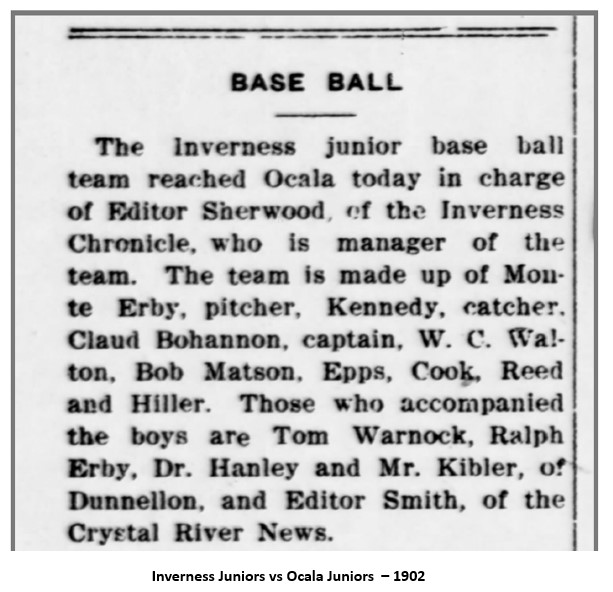
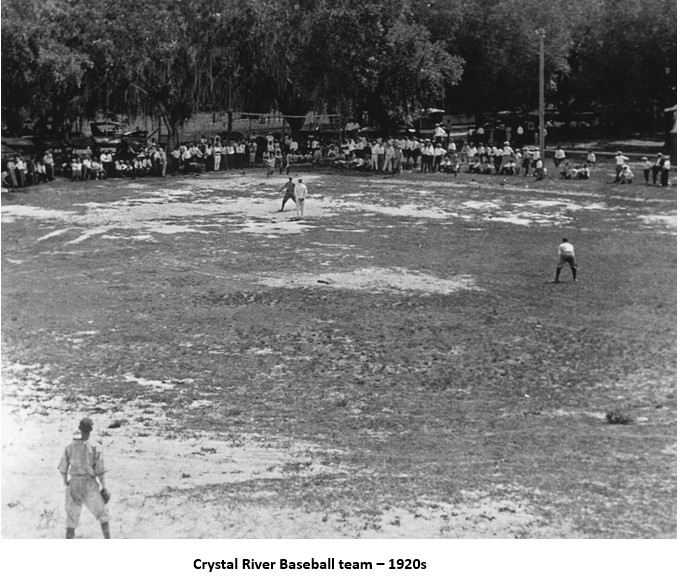
Citrus County began organizing junior traveling baseball teams by 1902. There were no high school teams at the time so the junior teams provided a chance to introduce young players to the game while representing their county. Crystal River formed their own adult team in 1909 and announced that they were ready to take on any squads from local communities. Soon Inverness, Hernando, Lecanto, Homosassa and Floral City had their own teams. These groups were all self-funded and relied on the generosity of the public to defray the cost of equipment and incidentals. The players didn’t make any money but rather put in long hours of practice after work for the love of the game.
Leagues of Their Own
Local baseball eventually outgrew the old model of single, unscheduled games. Leagues such as the “Florida Association” featured a formal schedule and team standings in the 1930s. The team with the most wins was declared to be the league champion, but league management soon discovered the allure of multiple playoff games (involving more paid fans) to determine which team had bragging rights for the rest of the year. In some cases, the season was divided into two parts and the leading team from the first “season” was matched against the team from the second “season” to declare a champion.
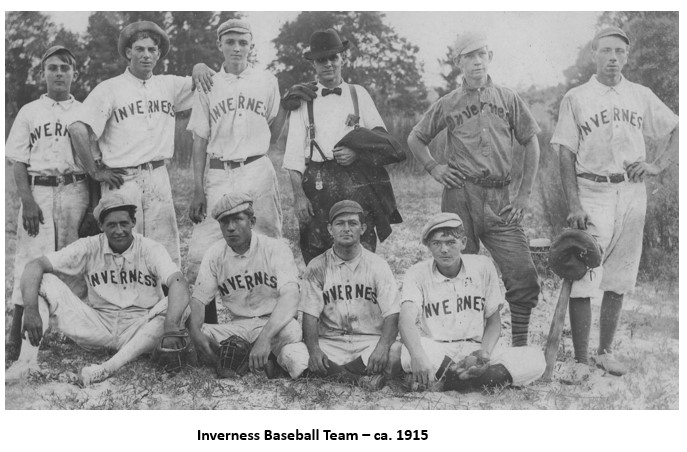
Early teams from Inverness played their home games on a field located in North Apopka Avenue. Lights were installed in 1934 to accommodate night games (more than 50 years earlier than the illumination of the Chicago Cubs Wrigley Field).
The Florida Association was followed by the Withlacoochee League, which later folded in 1940. The Gulf Coast League was organized to replace the Withlacoochee League after World War II. Inverness ceased to field a city team in the early 1960s.
Trouble in River City
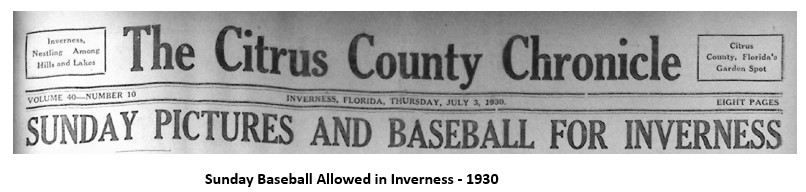
Along with “stimulating beverages” such as cola and movie theatres, baseball games were banned on Sundays. Church outings and family groups could play a friendly game, but organized games were forbidden (even if the games were strictly amateur in nature and no money changed hands). The game was so popular, however, that the Inverness City Council voted to exorcise the demons of Sunday baseball in 1930. However, as a concession to the local ministers, games could not be played between the hours of 10:00am and noon on Sundays.
The Inverness Powerhouse
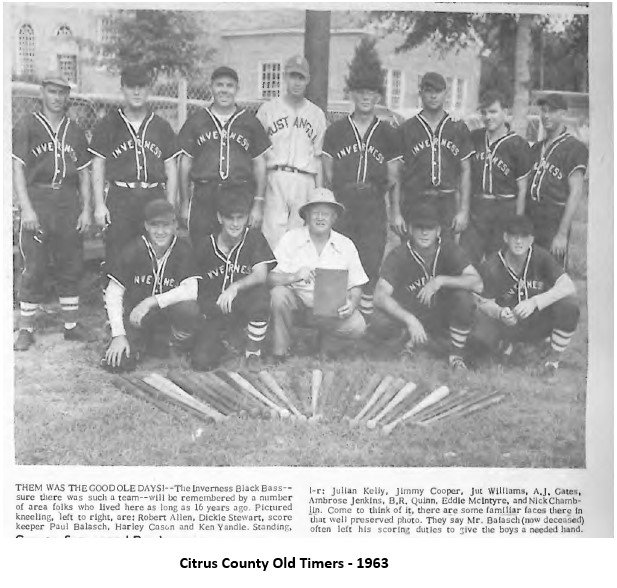
Jut Williams arrived in Citrus County and immediately began playing baseball on the Inverness team. He organized and managed the Inverness Black Bass team which enjoyed quite a bit of success in the late 40s and 50s. They were sparked by powerhouse hitter who worked as a lineman for the Florida Power company by day but spent his nights hitting electrifying home runs at the baseball diamond. His first name was Burton but most Citrus County residents better remember him as Sheriff B.R. Quinn.
Long time resident Ashton Hester remembers going to see his first Inverness game when he was five years old. By that time the games were being played on Sunday afternoons on the High School field off Line Street. A sign would be placed on Main Street announcing “Baseball Today – 3pm”. Fans would soon fill the bleachers but many people lined the streets and watched the game from the comfort of their cars. A flurry of automobile horns would roar approval whenever the Inverness team scored. Any time a player hit a home run, a hat would be passed through the bleachers and cars to show appreciation for the feat. Star pitcher and hitter B.R. Quinn, who was called “Big Un”, was the recipient of many accolades after hitting the ball over the fence. Hester recalls one time during a game with rival Crystal River, the opponent’s first baseman Marion Oliver hit three home runs during a double header. In spite of the rivalry, the hat was passed among the fans to recognize Oliver’s efforts. Hester later served as statistician for the Inverness team and transmitted game results to the Chronicle and Tampa newspapers.
It should be noted that the latest scores and standings of the local teams were prominently located on the front page of the Chronicle. Except for Spring training and the World Series, local newspapers didn’t carry coverage of the MLB teams at all.
Many of the team members had played baseball in High School and were not ready to hang up their spikes after graduation. For a while, the baseball program at Citrus High School was disbanded in the early 1960s but a determined petition drive by Doug Johnston resulted in reinstatement within a few years (but that’s a story for another time).
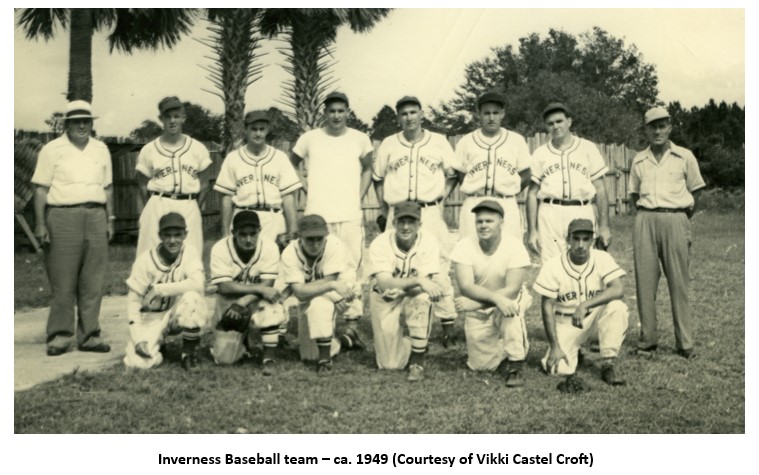
Vikki Castel Croft remembers that her father, Ebbert Castel, was a tremendous player and joined the Inverness team after he served in World War II. Ebbert Castel is pictured on the bottom row, immediate right in this picture from 1949. Many people from Citrus County remember Castel as the person you’d call when you came across a dangerous snake. He was a seasoned herpetologist who worked with snake experts in Silver Springs to extract venom for research and antidotes. Watch for the story of Ebbert Castel in an upcoming article.
Black Baseball Leagues
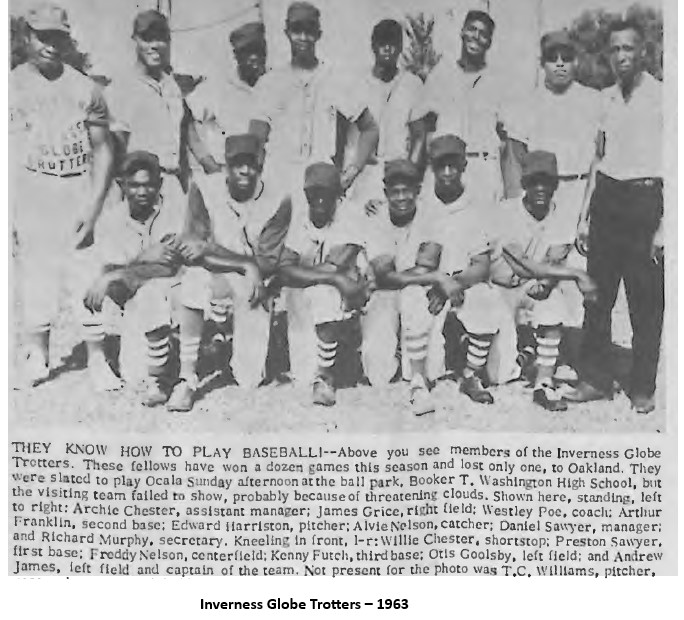
The experience of black baseball players in Citrus County paralleled the national “Negro Leagues”. Trainloads of excited fans traveled to away games to great fanfare. Marching bands paraded to announce their arrival. One game even featured a balloonist who exited his craft using a parachute. By all accounts, the brand of baseball played in those parks was first-rate. The Florida State Negro League was formed in 1952 and featured 10 teams. On a local level, Ashton Hester recalls that the team used to play on a field off Route 44 headed toward Westwood. He remembers that they had a player nicknamed “Snake” who hit monstrous home runs. Can anyone provide the identity of this star player?
Just Can’t Hang ‘Em Up
Even after their active playing days were over, many of the former city team players continued to compete in “Old Timers” games against much younger squads. Even if the results were lopsided in the newcomer’s favor, the men in their “mature” years got the chance to recall the days when they used to rush home after work so they play the game they loved. For those players, they will always remain “The Boys of Summer”.
I’d like to specially thank Doug Johnston, Ashton Hester and Vikki Castel Croft for their contributions to this article.
Ken Marotte writes for the Citrus County Historical Society. He can be reached via email at kenmarottejr@gmail.com if you have any comments, questions or suggestions Contact him if you’d like to participate in the ongoing CCHS Oral History Project.