
War Comes to Rock Crusher Ridge
By Ken Marotte. Citrus County Historical Society
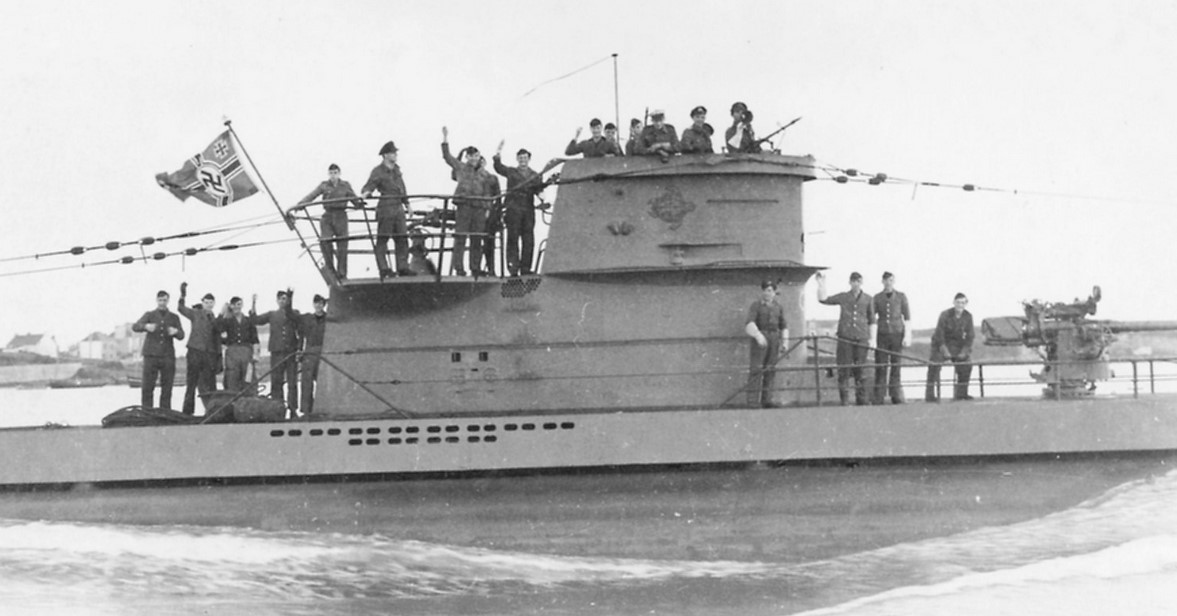
Rock Crusher Ridge may not have been valuable from a military perspective during the time of Robert E Lee’s 1849 evaluation, but the situation had changed dramatically almost a hundred years later. The unique location of Citrus County’s highest point made it the ideal place to help fight the Nazi U-Boat raiders who were plaguing Allied ships during World War II.
The U-Boat Menace
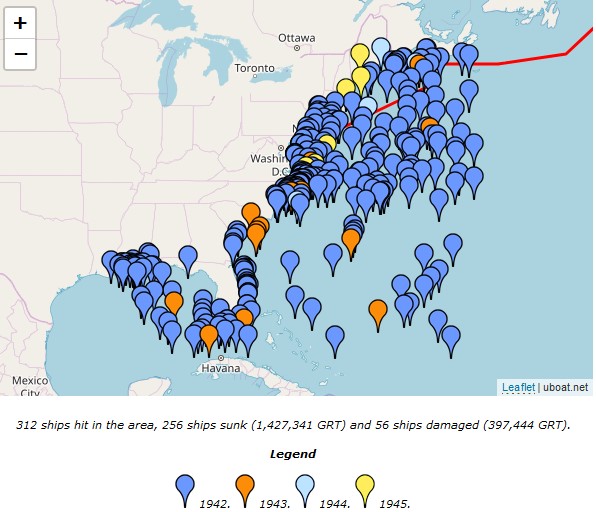
In the early years of American’s WWII involvement, U-Boats attacked the East Coast with impunity. Relying on archival records, the uboat.net website estimates that 312 Allied ships were hit by submarines on the East Coast during the conflict. Their map shows that a significant number of those attacks were in the Gulf of Mexico.
Stretched thin by limited resources and a long coastline, the US Navy called upon the assistance of the Civil Air Patrol and a rag-tag assembly of civilian yachts dubbed the “Hooligan Navy” to help track, and sometimes engage, enemy submarines. Noted author Ernest Hemingway was one of the “Hooligans” who patrolled for U-Boats in his 38-foot yacht. Not only were ships being lost at sea, but small groups of enemy saboteurs were being inserted into America under cover of darkness with the goal of disrupting our war effort.
America needed a better way to detect and track the Nazi boats so they could focus their limited fleet at specific locations. The use of new radar technology had significantly advanced in Great Britain since the beginning of the war. Radar had allowed the RAF to deploy their Spitfire and Hurricane airplanes at the exact time and location of Luftwaffe attacks. America’s military took heed and deployed radar installations along our coasts to spot warplanes and submarines.
Rock Crusher Ridge Radar
Rock Crusher Ridge in Citrus County was well-positioned to serve as a location for the new radar technology. The site’s elevation allowed soldiers to detect activity far out into the Gulf of Mexico. Communication and rail lines were already in place as part of an existing commercial quarry. The quarry had strategic importance since limestone from the pit was being shipped by rail to build airstrips across America. The shallow, shoal-filled coast would have made any attempt to attack the installation very difficult. Accordingly, the US Army Signal Corps built a new radar compound at the top of Rock Crusher Ridge in 1942. A group of 120 men were assigned to staff the radar in a 24-hour basis.
Life on The Rock
Daily life for the soldiers could be monotonous. Continually operating the radar was an important but tedious job. We’re fortunate that one of the past Presidents of the Citrus County Historical Society, the late Father James Hoge, was the chaplain for the of the Rock Crusher radar installation. He provided a first-hand account of his ministry and observations of the men stationed there. He ate with the men in their mess hall and stayed over in the guest quarters every Saturday night. Mass services were held in the PX building on Sunday. He noted that while the shoreline was beautiful to gaze upon, it was challenging to occupy the young soldier’s time while off duty. Attendance at Mass on Sunday was dependent on how many soldiers spent their Saturday night leave being entertained in Inverness or Crystal River.
Citrus County Adopts New Sons
Many people in Citrus County watched their sons and daughters go off to war. They wished them a safe return and hoped that people would treat their soldiers and sailors with kindness wherever they were stationed. When the citizens of Citrus County heard that a new detachment of young men were being billeted in our area, they opened their hearts and adopted them to make their stay as comfortable as possible.
In July, 1942 the soldiers had built a new PX (lounge) so they could have someplace to congregate during their off-duty hours. While the construction was being completed, the soldiers contacted the Citrus Chronicle staff and asked them to publish a request for used furniture and magazines to outfit their new building. There was a generous outpouring of support from the community. An Army truck was dispatched to downtown Inverness to pick up the donations by the grateful soldiers. A few months later, another request was posted in the Chronicle for games, phonograph records and more magazines. Once again, the people of our county came through and filled another Army truck with gifts. The Inverness Kiwanis Club became a local USO by outfitting a building in Inverness with entertainment for the soldiers when they were allowed to be off-base. Kiwanis spokesman stated: “This project is intended to provide a warm place for our servicemen during some of their leisure moments in town. The aim is to make it a local ‘Home for the Service Men’. The Club wants all of them to feel that this is their place in Inverness”.
Entertaining the Troops
While phonographs and magazines can occupy their time, young soldiers also look forward to more active entertainment. The post formed a baseball team and played against local high schools. Accounts of the games were published in the Chronicle. Local restaurant legend “Jut” Williams sponsored a dance for the radar installation servicemen that was open to the community. Williams said “there will be no admission charge for anybody. It’s free to all…bring not one penny. There is nothing to sell. Wear your old shoes and let’s dance.”
Invitations to another free dance were published in the Chronicle during Christmas time in 1943. Prizes were offered for jitterbugging, waltzing and hog-calling. It must have been entertaining to watch some of those “city boys” participate in the latter competition.
Former Brooklyn Dodger pitcher Dazzy Vance opened his Homosassa Springs resort to the soldiers in 1944. He invited 90 soldiers and 26 WACs to a dance on Saturday night and barbeque the next day. Will Bellamy provided 200 pounds of beef and had the feast cooked and ready for the group at noon on Sunday. Vance remarked “I think it was a noble and patriotic gesture on Mr. Bellamy’s part to break the monotony of the boys and girls in training…if you could have seen those boys and girls go at it there wouldn’t have been any doubt as to whether they were enjoying it or not”.
As you might expect, there was at least one marriage between a local girl and a soldier stationed at the radar site during this time.
Return to Normalcy
American soldiers and sailors went back home after the end of the War in 1945. The commander of the site, 1st LT Jesse K. Alexander, later served in Korea and Vietnam, retiring as a Lt COL. The Rock Crusher Ridge radar station was eventually closed and life returned to normal in Citrus County. However, memories of the support and friendship between the soldiers and the people of Citrus County lasted for many years. A note from the group published in the Chronicle signed “Your Soldier Friends” in 1943 expressed how much they appreciated all that was done for them.
“TO THE PEOPLE OF INVERNESS AND CRYSTAL RIVER
We wish to extend to you at this time our sincere and most grateful appreciation for everything you have done for us during the past year. We thank you one and all. Your hospitality has been most complete and we would like you all to know how much it has been appreciated. Please accept our humble thanks and rest assured we will do all in our power to hold this friendship at its present height.”