
Van Ness Takes on the Railroad and Big Phosphate
By: Ken Marotte, Citrus County Historical Society
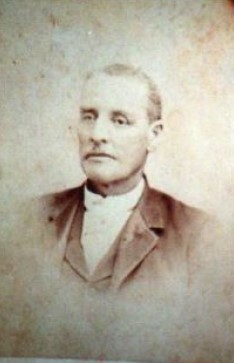
At a time when the railroad and phosphate industries ran Citrus County, a shrewd local rancher stood up to these Corporate Goliaths and outfoxed them both. This is the story of Martin Van Buren Van Ness, who is the patriarch of a pioneer family that thrives in our area today.
Dutch Origins
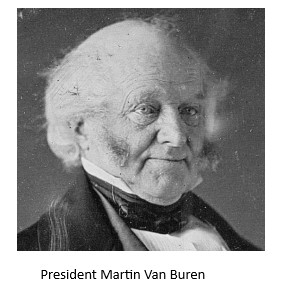
The Van Ness family were part of the Dutch occupation of the New York area in the 1600’s. They eventually moved away from New Amsterdam (now New York City) and settled near the Catskill Mountains to the north of the City. It was in Columbia County where they prospered as farmers and community leaders. They were patriots who fought against the British in the Revolutionary War. The Van Ness family lived in Kinderhook, which was also the home of President Martin Van Buren. The close-knit community retained its Dutch roots and family traditions. As a matter of fact, Van Buren spoke mainly Dutch and English was a second language for him. He entertained his friend Washington Irving in Kinderhook and some of the local citizens served as models for Irving’s stories featuring Rip Van Winkle and Ichabod Crane.
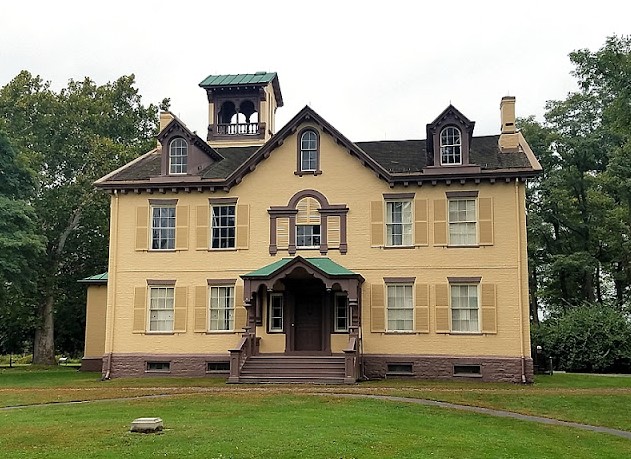
When the Van Ness family decided to sell their ancestral home, President Van Buren purchased the property from his old friends. He substantially remodeled the estate and christened it “Lindenwald”. Van Buren spent much of his retirement years there. The estate is now open to the public and is administered by the National Park Service.
The Mobile Van Ness Family
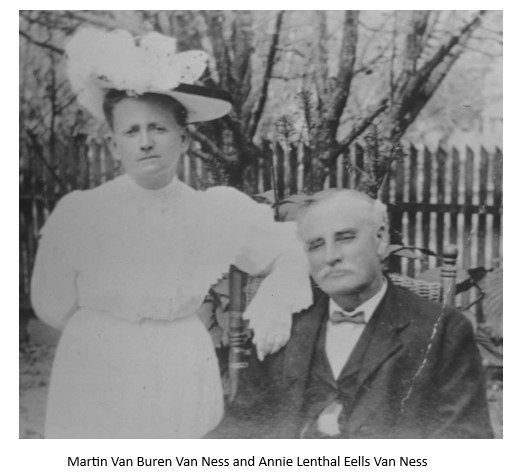
Since large families were customary at the time, estates grew smaller and smaller as a result of division among a number of descendants. Jesse Van Ness (father of Martin VB Van Ness) moved with his siblings to West Point WISC where young Martin grew into adulthood. He married Annie Lenthal Eells in 1855. Her family also included Revolutionary War veterans; moreover, she could trace her lineage to the original passengers on the Mayflower. They moved to Florida in 1881-82 and established their family in the Arlington/Hernando area of what was then Hernando County (later Citrus County). They moved to Missouri in the early 1900’s before returning to Citrus County in later life. They had nine children over the course of their marriage.
Community Service
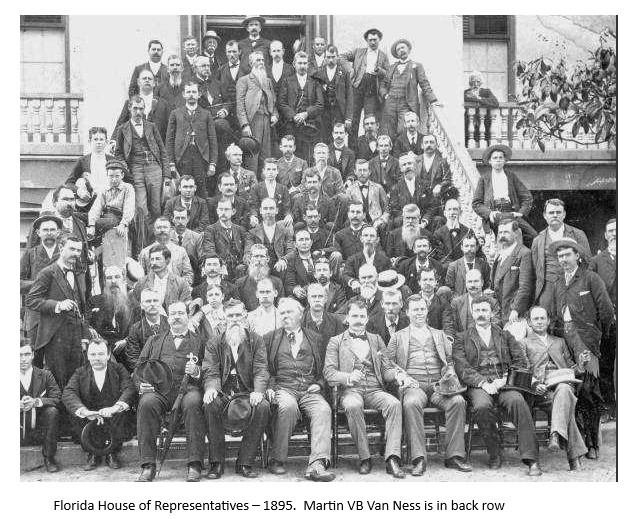
The Van Ness family established themselves as leaders in Citrus County. Martin Van Buren Van Ness was elected to the Florida Legislature for the 1895-1896 term. He was interested in immigration laws and so received an assignment to the Committee on Immigration. He was followed by Walter S. Turner in 1897.
Land Controversy – Atlantic Coast Line
The 1890’s were a time of rapid expansion and consolidation of railroad lines. The rail owners were focused on transporting freight to processing and shipping locations. There was a tremendous amount of competition among the diverse companies to be the first in line to tap the lucrative resources of Florida. The Silver Springs, Ocala & Gulf Railroad (SSO&G) was chartered in 1872 and was engaged in supporting the emerging lumber and phosphate industries. They gradually expanded their tracks to Ocala, Crystal River and Homosassa. The discovery of rich phosphate deposits to the south of Dunnellon led the company to make plans for an expanded line reaching Inverness and beyond. To achieve this goal, they needed to obtain right-of-way agreements with existing landowners along the planned path.
They approached Martin V.B. Van Ness and his wife Annie with a proposal for use of their property in Hernando/Arlington. The Van Ness family were astute business people and were aware that there may be important phosphate deports under the land sought by the railroad. The final agreement that the parties executed in 1891 gave the SSO&G right-of-way that they requested but there were some important provisions that would cause contention later. Specifically, if the Van Ness’ later determined that there was a significant amount of phosphate under the right-of-way, they would be able to require SSO&G to temporarily reroute their rail line to a side track so that the phosphate could be mined. After mining was complete, the Van Ness’ would restore the ground to a stable status and allow the railroad to move their tracks back to the original location.
SSO&G was also required to build a depot at Hernando as part of the 1891 agreement.
Geological tests were conducted on the property in 1894 and it was determined that there were three large phosphate deposits under the rail line. Test boring indicated that about an acre of land under the right-of-way contained over 20,000 tons of phosphate at a depth of between 12 and 80 feet. Based on this report, Van Ness gave the railroad the required 60-day notice to move their tracks. Naturally, the railroads felt that they had the upper hand over a small-town farmer and refused to comply with the terms of the contract. After losing the initial suit, the railroad submitted multiple legal appeals with the intention of wearing down the family.
The SSO&G was acquired by the giant Plant System in 1901. The Plant holdings were then assumed by the Atlantic Coast Line (ACL) in 1902. The amount of money available to conduct litigation grew with each consolidation. In spite of the conglomerate’s “deep pockets”, the case was finally settled in Van Ness’ favor after years of delaying tactics. The jury’s original award of over $500,000 (in 2024 dollars) had increased to over $785,000 after interest and expenses were added. While the tracks were not moved, Hernando’s depot remained, the Van Ness family continued to own the land while pocketing a hefty award. This “David versus Goliath” victory was celebrated in the press.
Land Controversy – Royal Phosphate
Royal Phosphate Company was one of the largest mining companies in Florida at the time. They began large scale operations in Alachua County at the advent of the boom times and had mined all of the commercially feasible minerals there by the early 1900’s. The company announced that they were shutting down their plants in 1902 and were planning to follow fresh deposits of phosphate in Citrus County. The Tampa Tribune remarked “When these mines have been closed down and removed, that part of the country will present a desolate appearance. It will be a country full of holes…and it is not thought that it will ever go back to a farming section but that it will remain for many years vacant. Even all of the timber has been removed, including the small tress, which have been utilized for wood operating the plants”.
Royal Phosphate approached landowners in Citrus County to obtain mineral rights and permission to conduct mining operations. Since the Van Ness family was aware that there were significant deposits on their land (including under the railroad right-of-way), Martin VB and Annie were willing to enter into an agreement with Royal Phosphate in 1900. A substantial amount of land was involved but the deed specifically reserved areas around the Van Ness Family Cemetery as off-limits.
When the ACL railroad refused to move their tracks and the Van Ness’ were compensated by the courts, Royal Phosphate filed suit claiming breach of contract since they had planned to mine the property but could not start operations based on the agreement between Van Ness and the ACL. Royal argued that they were entitled to about $350,000 (in 2024 dollars) from the Van Ness family’s recently acquired settlement. Once again, the court case dragged on for years while the large company tried to wear the defendants down. They actually won a jury award in a lower court but the case was escalated to the Florida Supreme Court based on a number of issues with the original trial.
Royal Phosphate was the second large company to underestimate the persistence of the Van Ness family. Royal made the argument that they were not aware of the ACL right-of-way situation and were hoodwinked by the Van Ness’ into purchasing property that they could not use for mining. The Supreme Court found this statement preposterous. They found that Royal Phosphate was a large company with an extensive legal staff and thus should have been aware of the controversy about the lands. It appeared to the court that Royal was waiting for the Van Ness family to receive their monetary settlement with ACL and then they entered a lawsuit to obtain a piece of the award. The Court was extremely critical of Royal Phosphate’s intentions and reiterated that the rail line was openly visible and anyone offering to buy the property should have taken that easement into account when negotiating an agreement with the seller.
In the end, David vanquished Goliath a second time in court and the Van Ness family was found to be blameless in the situation.
Final Chapter
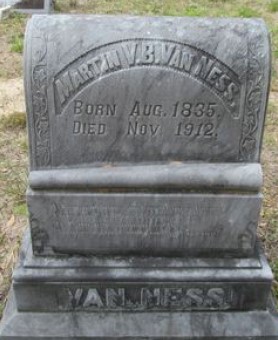
According to his descendent Robert Croft, Martin Van Buren Van Ness was working on a wall surrounding the family cemetery in Arlington in 1912. He had completed the wall and walked to the home of Annie Lenthal Van Ness Croft (his daughter) to visit and rest, stating that he felt dizzy. He passed away at the age of 77 while sitting in a chair at her house. He was buried and today rests in the Van Ness Cemetery.
Footnote
The annual Van Ness Family Reunion is being hosted by Robert Croft in Hernando FL this Saturday, June 15, 2024.