
The Personal Lives of the Men Who Built the Courthouse
By : Ken Marotte, Citrus County Historical Society
The cornerstone at the Old Courthouse Museum in Inverness commemorates the men who were influential in building the Citrus County courthouse in 1912. Hidden behind the names are tales of murder, embezzlement, larceny and the hunt for a fugitive that ranged from Canada to South America. In the days before reality television, the names of architect Willis Biggers and contractors Read-Parker would keep newspaper readers enthralled with the jaw-dropping drama of their personal stories.

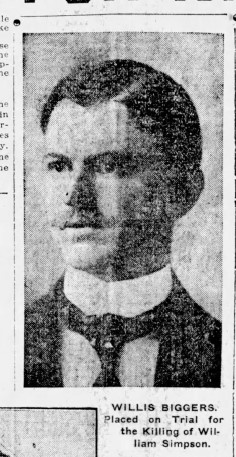
Willis R. Biggers
Biggers was the second architect for the new Citrus County Courthouse in 1911. That role was important – and lucrative – in the construction of large buildings. After drafting some preliminary plans, the architect was responsible for working with the contractor and superintendent to complete the job. The architect made sure that the construction work was being completed according to the plans. Any changes to the requirements had to be estimated and incorporated into a modified design document. He was required to provide a status report, often in person, at the regular Board of County Commissioner meetings. His compensation for these services was a percentage of the total project cost. In some cases, an architect could reuse their designs for other government buildings which allowed them to take less time to develop drawings for future proposals. Other Florida courthouses bear a striking resemblance to our Citrus court structure for this reason.
Arrested for Murder
Approximately ten years before designing the Citrus County courthouse, Willis R. Biggers was a rising architect in the Atlanta GA area. He lived in a modest house with his wife and her family in what was a respectable neighborhood at that time. One of his neighbors, William Simpson, was also the U.S. postal carrier for that area. For some reason, the two men had intense disagreements. Simpson questioned the morality of Mrs. Biggers, her mother and sisters. He passed a petition through the neighborhood with the goal of having the authorities deem the women as having questionable moral character and that Biggers house was being used for “disreputable purposes” and force the family to move.
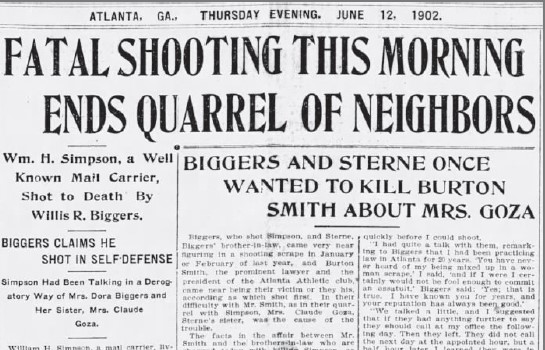
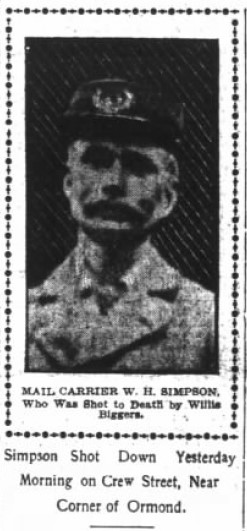
This situation occurred during a time when most women were thought to be “delicate flowers” and their honor must be protected by their men. Another neighbor attempted to work as an intermediary between Simpson and Biggers to reduce the growing tension. He advised Simpson to drop his petition and stop attacking the reputation of the Biggers women. That neighbor later visited Biggers who prophetically replied “…unless Simpson ceased his efforts to move the women, the undertaker would have some moving to do”.
Under the pretext of wanting to peacefully discuss the matter, Biggers and his terminally ill brother-in-law lied in wait at the intersection of Crew and Ormand Streets in Atlanta – along the route of postman Simpson. This location had depression in the ground and was obstructed by hedges. Both men were armed with a shotgun and pistols. Biggers account of the encounter would vary from the recollections of witnesses in court hearings. He claimed that he arose from his hiding spot and approached Simpson with the intention of asking him why he was persecuting the Biggers family. He claimed that Simpson drew his pistol first and shot at Biggers so he returned fire in self-defense. Biggers pointed to a wound that grazed his arm as proof of his assertions. Biggers said that Simpson fell from his carriage so Biggers attempted to catch him. However, witnesses later testified that while they did not see who fired the first shot, they agreed that Biggers deliberately pulled Simpson from his mail wagon and continued to shoot Simpson while his brother-in-law held the hapless mailman on the ground.
A sensational trial followed that was reported across the Southern states. Biggers and his accomplice certainly appeared to have the means, motive, and opportunity to commit murder. After long hours of deliberation, the jury acquitted Biggers of murder based on his self-defense argument. Historians reading through the court transcripts today might reach a different conclusion.
Designing the new Citrus County Courthouse
In June, 1911 the Board of County Commissioners (BoCC) decided that the Victorian wooden courthouse should be replaced. They invited architects to submit proposals and eventually chose the plans tendered by Willis Biggers. He claimed a track record other successful projects. His drawings for a new fireproof building with an estimated cost of $60,000 (almost $2MM in 2023 dollars) were accepted but were modified by the BoCC a few months later. The search for a construction company and local superintendent was conducted. Read-Parker Co. of Hillsborough County and Arcadia submitted the low bid of $50,000 and were contracted to build the courthouse. G.B. Stage was selected as Construction Superintendent with a salary of $100 per month. Stage was essentially the BoCC’s representative to ensure the quality of construction and adherence to target dates and cost estimates. Payments to Biggers and Read-Parker would be made after achieving agreed milestones.
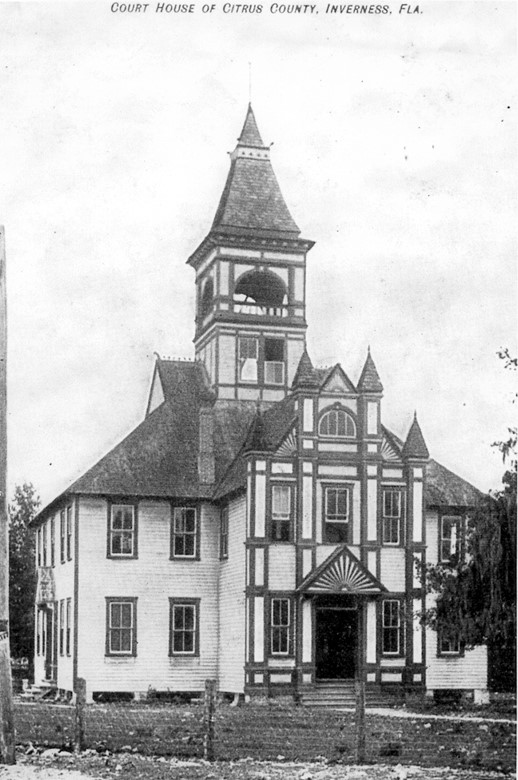

Read-Parker submitted invoices for flooring that the Superintendent found to be substandard and the BoCC declined to pay for it. Read-Parker also submitted an invoice for $5,000 to cover “xtras in the court house” that was rejected. The BoCC insisted on obtaining itemized invoices and receipts for all expenses. In June 1913, Read-Parker again approached the BoCC and declared that their work on the courthouse was complete. They also asked for $12,000 to cover extra work on the building. The BoCC reminded the company representatives once again that invoices for any extra work must approved in advance and itemized. Read-Parker replied that they could not provide detailed invoices at this time. Accordingly, the BoCC announced that they would not accept the new court house and make final payments. When company lawyers returned with an itemized list the next day, the BoCC found that most of the items had either not been done or had not been authorized by the BoCC. A compromise was reached and the county agreed to pay about $6,000 to cover some additional costs and the project was declared to be complete.
Troubles at Read-Parker
There was a good reason for the company’s attempt to extract more money from Citrus County. After a review of their financial accounts, it was alleged that President Hill P. Read had embezzled money from the company. In particular, a $1,500 payment by the Citrus BoCC was reportedly not entered on the official books and was converted to Read’s personal account. There were similar suspicions regarding the company’s project at the DeSoto County Courthouse and a schoolhouse in Fort Meade. Read was indicted and released on bond with a promise to attend the upcoming trial. When he failed to attend, Read was found to have forfeited his bond and a detective was assigned to find the missing company president. The detective traced Read to New Orleans and traveled there to arrest him. By that time, Read had left for Buenos Ares, Argentina in the company of a “mysterious woman”. The detective found documentation from Read in New Orleans directing that his remaining baggage should be shipped to the Grand Hotel in New York City.
The detective traveled to New York City and sat in the lobby of the hotel. When he spotted Read, the detective pounced and arrested him. According to New York law, any fugitive subject to valid warrant from another state was to be incarcerated for up to 30 days while the two states arranged for extradition. Read was sent to the infamous Tombs Prison in NYC awaiting disposition of his case. The detective noted that Read possessed $8,000 in stock certificates (about $250,000 in 2023 dollars) and several diamonds at the time of his arrest. When Florida did not finalize matters within the 30-day period, Read was released. He reportedly traveled across the border to Canada, where he wrote long rambling letters to the Tampa newspapers attesting to his innocence and justifying his decision to never return to Florida. He stated that he had married the “mysterious woman” in New York. Read eventually moved to Texas where he lived until his death in 1974.