
The Origin of Holder, Florida
By : Ken Marotte, Citrus County Historical Society
If you drive on Route 41 North past Hernando, you’ll see a sign for the village of Holder. There’s a quaint Post Office on the left before you encounter the village’s sole traffic light. It’s hard to imagine that this was once the largest population center in Citrus County at the dawn of the twentieth century. This is the story about the rise and demise of Holder, Florida as a phosphate boom town.

Hartshorn? Cordeal? Dunham? Anita?
The area where Holder is located today was originally supposed to be a railroad way station between Ocala and Mannfield. That situation changed in 1889 with the discovery of rich phosphate deposits in neighboring Dunnellon. As new entrepreneurs flooded the area, it was common for the same area to have different names over time. Map makers found it challenging keep up with the latest village name updates. The situation would be more confusing when the official Post Office name differed from the Station Name assigned by the railroad. The village that was eventually named “Holder” was crossed by three different railroads and the names assigned to their stations could be unique to that line.

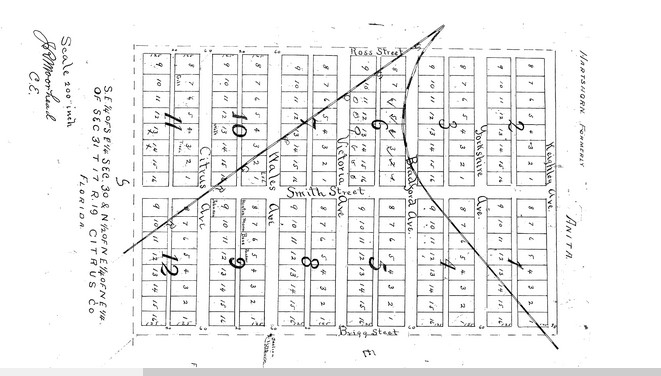
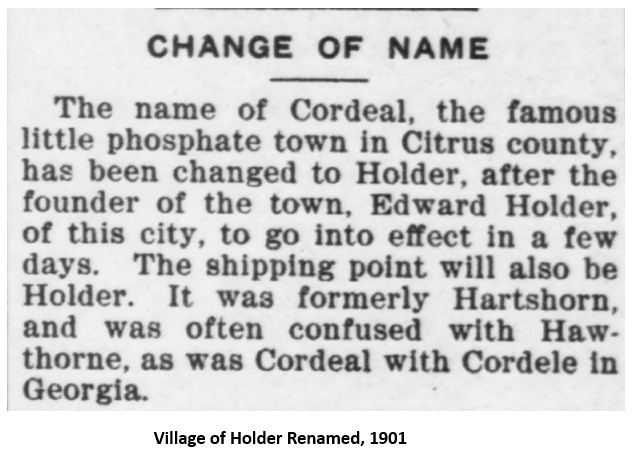
When Frank Dampier applied for a new Post Office in 1895, he originally submitted the name of the new village as “Dunham”. That name was rejected by the Post Office and so the area was designated as “Hartshorn”. Two years later, the name was changed to “Cordeal” (or “Ordeal” on some maps). Finally the Post Office name was changed to “Holder” in 1901, which remains in place to this day.

Edward Holder’s Ascent
Edward Holder was the son of German immigrants who had relocated to Cincinnati, OH. They ran a family tannery business and young Edward was employed as a bookkeeper. He married in 1884 but his wife perished during childbirth that year. Unfortunately, the infant died as well. He remarried a woman from Germany in 1888.
Looking to make his mark in the world, Holder read about the fantastic phosphate discoveries in Florida. With the assistance of financial backers in Cincinnati, Holder formed the “Hartshorn Phosphate Company” and set up operations in Citrus County. He proved to be a shrewd investor and purchased tracts of land that offered the possibility of making huge profits.
The process of mining and refining phosphate was back-breaking and required a large pool of laborers. At that time the State of Florida (as well as many counties) leased prisoners to private companies with the understanding that the business would provide room and board for the prisoners as well as employ guards to watch the convicts. Prisoners were used in the Hartshorn area for work in the phosphate mines as well as harvesting pine pitch in the turpentine forests and the building of the railroads.
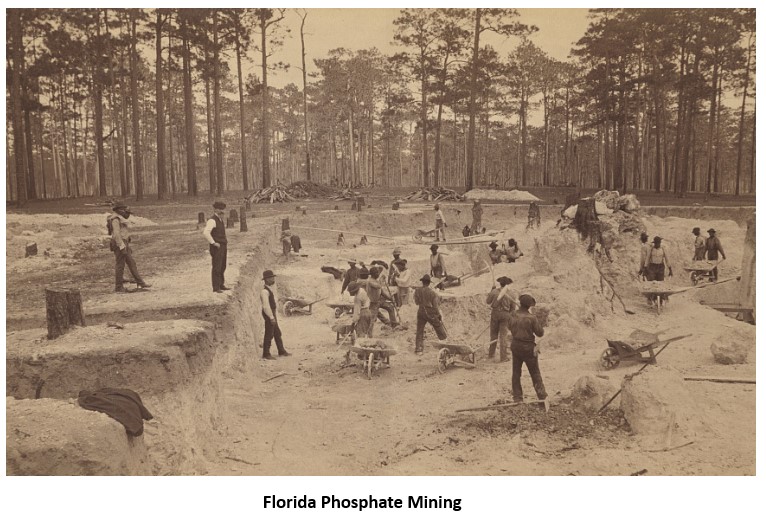
The market price of phosphate was volatile and shipping costs (by rail or ship) were expensive. Holder had emerged as a leader among the various phosphate companies and worked to assemble them into a cooperative conglomerate that would fix shipping prices for their product. He was one of the incorporators of the Associated Phosphate Company in 1894. According to the articles of incorporation, “The purpose of this company is the pooling and shipping of phosphate on the co-operative plan end prorating prices among the several stockholders who agree and contract to ship their total production though this association”. The organization positioned phosphate mine operators to charge a consistent price for their product and expand their market into Europe.
The world was in the grip of a financial panic during that time and phosphate prices hit rock bottom. Many of the largest mining companies shut down their Citrus County operations in 1895 because the prices were so low that they were losing money. The effect of these shutdowns rippled through the local economy. Hundreds of hourly workers lost their jobs. The leased prisoners were no longer needed and the government lost the revenue they had come to expect. Some banks that had loaned funds to the phosphate companies found themselves on precarious footing and had to close their doors. One of those failed banks had about $6,000 of Citrus County’s tax funds in their vaults. Much of that money was lost because the bank failed and there was no depositor insurance at that time. Businesses that relied on the phosphate industry were likewise impacted and forced to close.
Holder urged his fellow phosphate operatives to remain firm and keep their mines closed indefinitely. The mines would remain shuttered until “…the European buyers appreciating the merits of high-grade hard rock, will advance prices to a point that it will leave a margin for the miner, which is not the case now”. In the meanwhile, Holder used this interlude to purchase additional properties in Citrus County as well as investing in alternative ventures, such as the “Lightning Hoe Company” (which was devoted to the production of hoes and other farm implements).
Holder’s reduced production gambit proved successful within the next few years. By 1898 the phosphate market had markedly improved which prompted Holder to build two new phosphate plants in the Hartshorn area. He moved his residence to a more expansive home in Dunnellon. He leased more land in Citrus County in 1900 and planned to build two more plants in the Hartshorn area that year.
Hartshorn became a true boom town. In addition to the leased convicts, hourly workers flocked to the area to work in the mines and other associated businesses. At the turn of the century, the US Census reported that there were more people residing in Hartshorn than any other area in Citrus County – more than Inverness, Crystal River or Floral City. A full 25% of the reported residents listed their occupation as “Inmate”.
The village was renamed to “Holder” in 1901 to recognize his role in developing the area. In addition to honoring the founder, the name change was done to avoid confusion with other similarly-named places.
A Strategic Business Decision
Holder recognized that the phosphate mines in the Dunnellon/Hartshorn area had a finite amount of the precious material. Accordingly, he expanded his real estate holdings in other areas. He shocked the business world in 1902 when he sold the new Hartshorn phosphate plants and mining rights to the J. Buttgenbach Company for a reported $100,000 (about $3,700,000 in today’s dollars). The newspapers enthusiastically reported that the plants were some of the best constructed and modern in the area and the lands still held a plentiful amount of high-grade material. Holder had paid approximately $10,000 for the land originally and the deal provide him with a tidy profit. Negotiations also included the payment of a royalty based on the future profits of the Hartshorn / Holder operation.
Moving On Up
Ocala was recognized as one of the leading cities in central Florida for rising young businessmen. Holder and his wife purchased an opulent home on King Street and then made plans to practically gut the building and create a home worthy of their new status. They hired an architect from New York to design their revisions and filled the house with fine China plates and expensive furniture. Anna Holder had a highly publicized grand opening party for Ocala society and frequently entertained other socialites in her new residence.
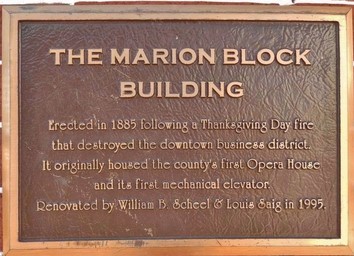
Holder purchased the former Marion Opera House and converted it into a successful commercial block. The Holders were one of the first couples to have “his and hers” automobiles. He joked that after his wife drove their new 42-horsepower Franklin touring car in 1908, she appropriated the vehicle for herself. Mr. Holder responded by immediately ordering another identical automobile for his use. The couple traveled to Europe, Canada and New England several times. They had hunting camps in Citrus County and also reportedly had access to a private island in the mouth of the Withlacoochee River where they could relax from the rigors of spending their money.
Holder Looks Southward
Flush with cash, Holder invested the proceeds in new mines in the Inverness area. He organized the “Holder Phosphate Company” in 1908. He enticed H.D. Bassett, who had been a key manager of the Bradley Mine in Floral City, to serve as general manager. Together they opened a number of profitable new mines in the Inverness area. One of those mines has been converted into a camping and recreational area. The Holder Mine campground has been established as part of the Withlacoochee State Forest and came be found off Pleasant Grove Road in Inverness today.
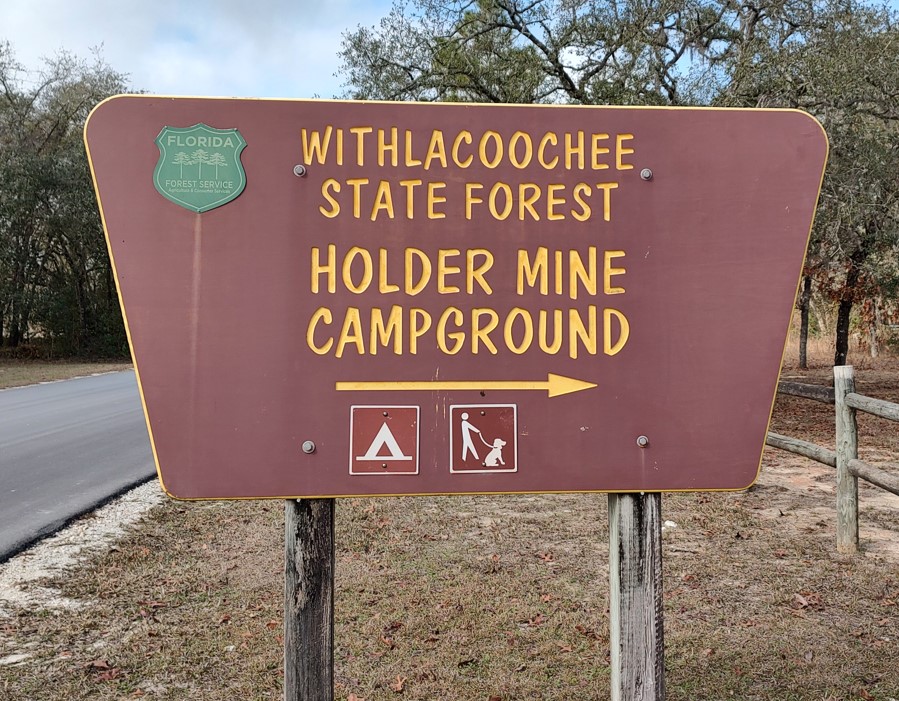
Eventually the profits from the Inverness mines were not as lucrative as expected. Phosphate deposits were discovered in the Polk County area that were higher-grade and easier to mine than the minerals in the Citrus County area. Holder concluded a deal for mining rights in the Bartow area and made preparations to move operations there in 1909. Two of the mines in Inverness were closed that year but were reopened briefly in 1910. He added large holdings in Lakeland in 1910 and was preparing to substantially expand operations there when tragedy struck.
Edward Holder’s Demise
Holder had suffered from physical maladies during this time. He had a chronic illness that began to affect his eyesight. He still pursued a vigorous life and tried to control his condition with careful dieting, exercise and fresh air; however, he awoke one morning and was almost completely blind. Holder traveled to Baltimore to consult with experts but they offered little hope. Edward Holder passed away on January 10, 1911 at the age of 48. News of his death was carried across Florida and Ocala mourned the demise of one of its leading citizens. Long-time Citrus County residents still remember the man who gave the village of Holder its name.
Phosphate operations slowed to minimal levels as the remaining minerals were not deemed financially feasible to extract. Commercial mining in Holder effectively ceased in the 1950’s.
Ken Marotte writes for the Citrus County Historical Society. He can be reached via email at kenmarottejr@gmail.com if you have any comments, questions or suggestions.