
The Marketing of Citrus County
By: Ken Marotte, Citrus County Historical Society
The marketing of Citrus County began immediately after creation in 1887. Land speculators and local officials alike developed plans for advertising the many benefits of Citrus County to our neighbors in the North. Aggressive marketing resulted in a cycle of boom-and-bust land values that continued through the 20th century.
President Cleveland Drops An Orange
Citrus and Pasco Counties were carved from a much larger Hernando County in 1887. There was quite a bit of disagreement among the leaders of the three locales regarding division of residual tax funds and existing contracts. Some residents of the new counties were not fully aware of the implications of the split and there were reports of Citrus County residents continuing to send their tax payments to Hernando County. The situation became so contentious that the Citrus County Board of County Commissioners (BoCC) voted to initiate a lawsuit against Hernando County “…to recover the rights of the citizens of Citrus County…” on September 8, 1887. Pasco County was requested to join the lawsuit as an additional plaintiff. The motion was really a move to prod Hernando County officials into entering negotiations about the many outstanding issues.
The BoCC met the following day to consider an opportunity to expose Citrus County’s potential to the entire nation. A giant fair for Southern States was planned for Jacksonville FL in January, 1888. The event was dubbed the “Sub-Tropical Exposition” and President and Mrs. Grover Cleveland were scheduled to attend. The BoCC designated a few leaders to approach Pasco and Hernando officials (who the BoCC had voted to sue the previous day) with a plan to collaborate on a joint display at the Exposition. Since the three counties saw benefits to sharing a booth and expenses, a consolidated exhibit was readied in time for the opening of the fair.
Most Florida counties sent representatives to the Exposition and Citrus County’s entry was drowned in a sea of booths competing for attention. The Citrus/Hernando/Pasco leaders had transplanted an actual orange tree in full bloom and laden with about a hundred pieces of fruit at their exhibit. When the President and his wife arrived in February, 1888, they toured all of the booths with the appropriate level of interest.
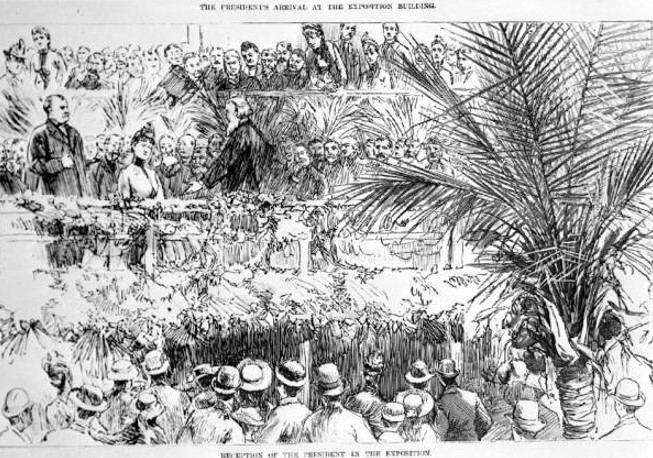
Grover Cleveland was an older “portly” gentleman and his wife Frances Folsom Cleveland was a vivacious younger woman. She was extremely popular and the country’s newspapers followed her every move. When the entourage approached the Citrus exhibit, Mrs. Cleveland plucked one of the oranges from the tree and unexpectedly tossed it at her husband. The President was more adept at catching fish than solid objects and the fruit bounced off his nose. The crowd erupted in laughter. She offered to gently toss another orange his way but the President made a joke and declined.
The newspaper writers who trailed the couple recounted the story for their readers across the country and Citrus County was the recipient of an avalanche of free national publicity. A county that did not exist less than a year prior was now “on the map” and a parade of land developers would soon follow.
The Homosassa Company
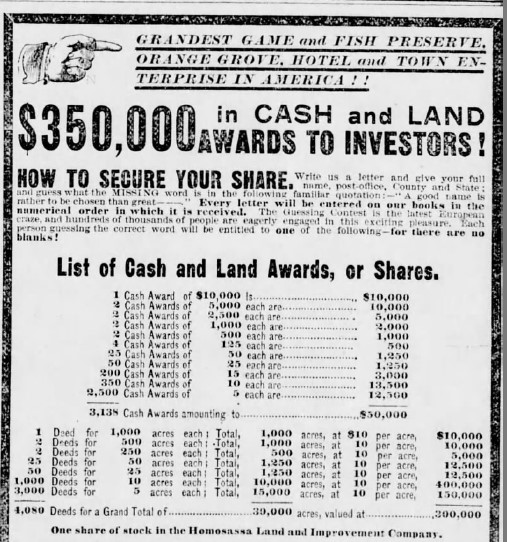
A group of investors had purchased a significant number of acres in the Homosassa area. Led by Civil War General and former Maine Governor Joshua L. Chamberlain, the “Homosassa Company” advertised in New York newspapers while the Sub-Tropical Exposition was underway. They offered house lots for as low as $10 and 5-acre lots starting at $100. Anyone purchasing land worth more than $300 would receive a free train ticket and admission to the Expo. Chamberlain worked tirelessly to create the new settlement and sales were brisk as a result of the fair publicity.

The enterprise was eventually taken over by the “Homosassa Land and Improvement Company”. Their eye-catching advertisements featured lottery-type awards for lucky entrants in a contest. It was later determined that their award promises was false and their leaders were charged with mail fraud. Government pressure combined with the economic calamity known as the Panic of 1893 led to its demise in 1894. Its assets were auctioned off that year.
A Series of Fortunate Events
Citrus County continued to be blessed by two unrelated (but fortunate) events. Phosphate had been used for many years as a medicinal aid and a key component in explosives. More importantly, phosphate was extensively used as a fertilizer for agricultural purposes. Bones and teeth of long-deceased animals provide a significant source of the compound.
William Bertine was walking along the Withlacoochee River in 1888 and found some leg bones and a giant tooth in the riverbed. The tooth was from an unknown animal and was ten inches long and fifteen inches in circumference. It weighed over ten pounds. Newspapers across the country reported this story as an oddity without realizing the implications of Bertine’s discovery. A year later, a well was being drilled in Dunnellon and a rich vein of phosphate was uncovered. These events led to the development of a mining industry that brought riches to the owners of Citrus County land.
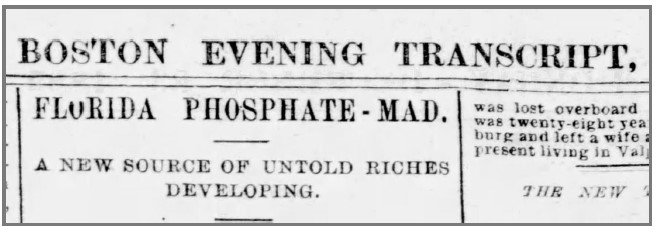
The publicity led to a period of wild land speculation. Large international companies, some from as far away as Germany, vied for properties that might contain the “White Gold”. Many unemployed men were lured to the mines with the promise of a steady job in exchange for hard work.
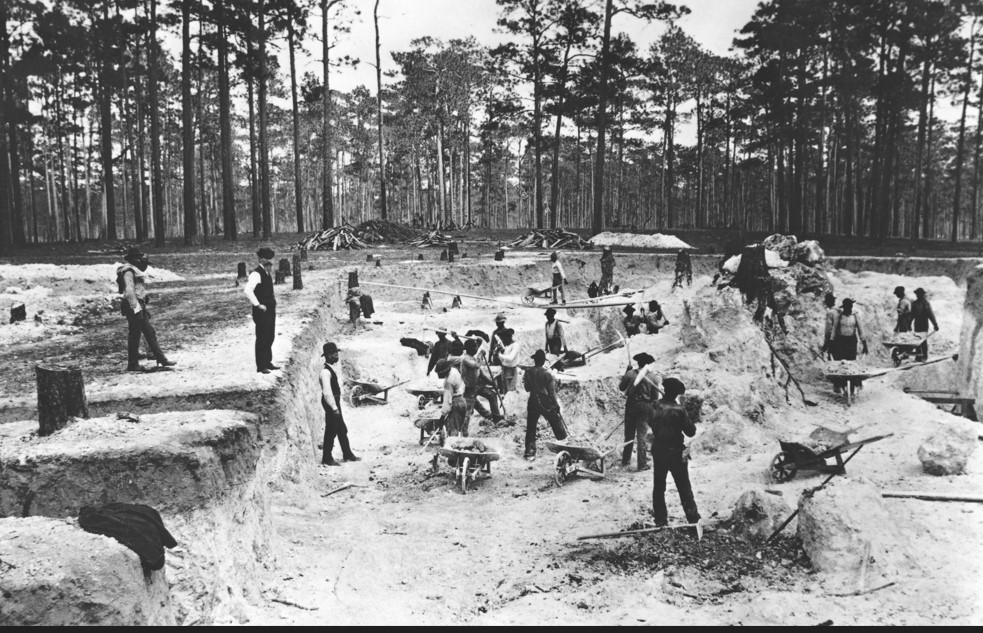
As phosphate resources were exhausted in an area, the mining companies continued to move southward in search of richer and more plentiful deposits. The center of phosphate mining activity gradually moved out of Citrus County. The start of World War I curtailed the sale of phosphate to European combatants. The market for this resource disappeared overnight and led to the demise of this industry in our county.
Another Land Boom
Homosassa became the target of another masterful marketing campaign in the 1920’s. The “Florida West Coast Development Company” was organized in Chicago and was led by Bruce Hoover. Hoover and his associates developed an extensive marketing campaign aimed at winter-weary Northerners. He promised that a new metropolis was being build on Florida’s West Coast that would rival every other resort city in the State. The company entered into an agreement with the Brooklyn Dodgers to base their Spring Training camp in Homosassa. Busloads of potential buyers were shepherded through the area and asked to imagine their lives in Sunny Florida. Company leaders started the “Grover Cleveland fished and built his Winter White here” myth to encourage sales. As explored in past articles, I could find no evidence that Grover Cleveland ever visited (or dipped a fishing line) in Citrus County.
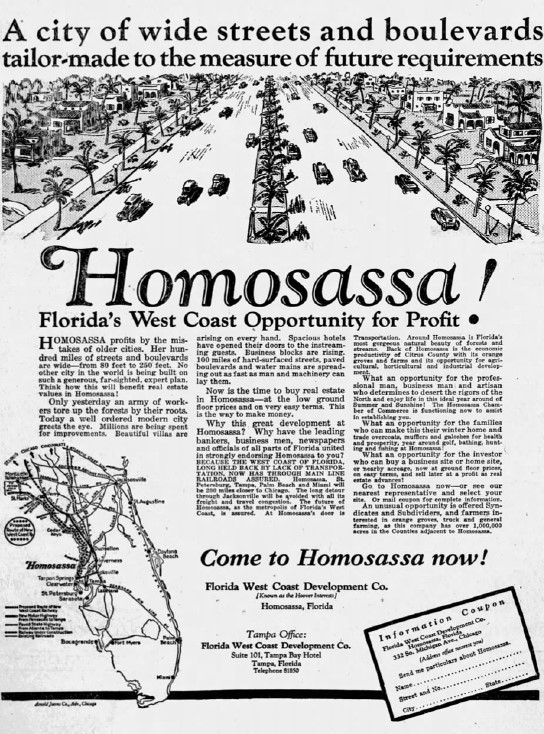
There were so many buyers that the Citrus County Clerk had to engage more staff to record all of the deeds that flooded their office. Unfortunately, the developers ran into financial difficulties and were not able to deliver their promised amenities. The company declared bankruptcy a few years later and its assets were auctioned.
Civic Leaders and Marketing
Leading citizens and politicians recognized the need to advertise the County from the beginning. The BoCC authorized County Clerk W.C. Zimmerman to create a Citrus County advertising pamphlet in 1893. In the wake of the 1914 phosphate crash, a local Board of Trade was organized that advertised in the Tampa Newspapers. The Citrus County Chamber of Commerce produced a glossy booklet in 1927 that highlighted all of the benefits of living in the county. They realized that the future of the area depended on good hard roads and made road construction a priority.
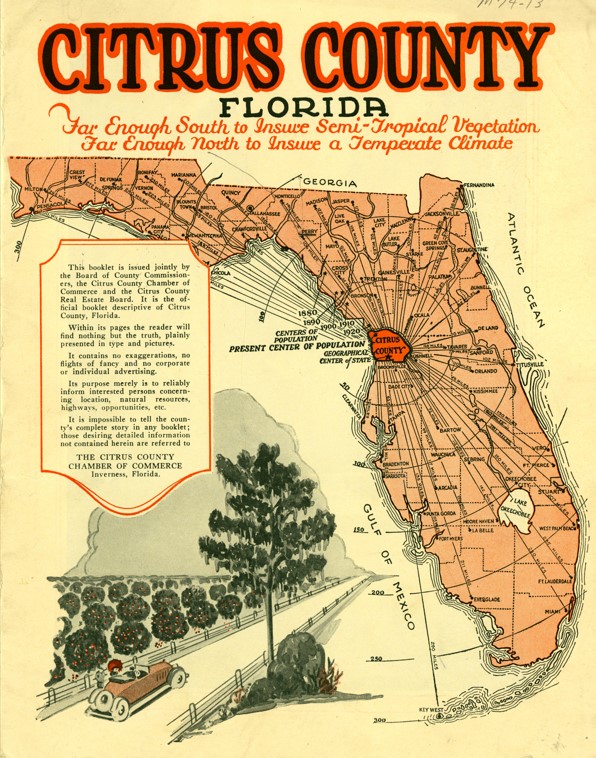
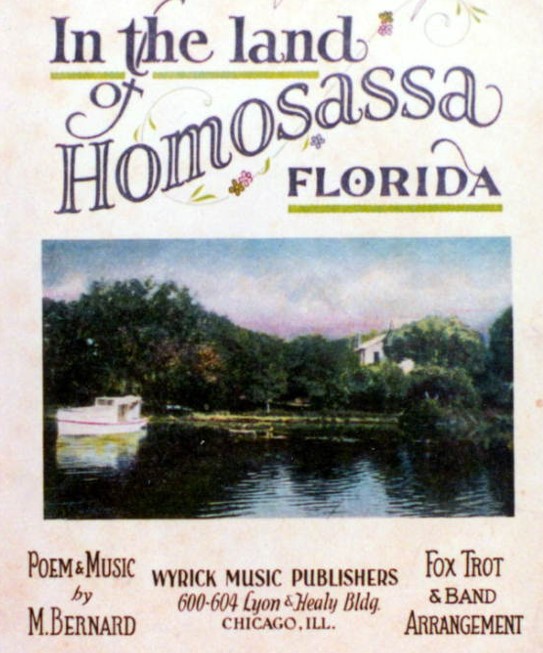
New developers learned from the mistakes of their predecessors and successfully convinced Northern visitors to settle in our area. All of the new developments, such as Citrus Springs, Inverness Highlands, Citrus Hills and Lake Tsala Gardens used the same marketing strategy and brought thousands of new citizens into Citrus County. Some enterprising developers even commissioned a theme song for their new community.
The county has grown from a handful of scattered settlements in 1887 to a population of almost 160,000 in 2020 according to the US Census. The marketing plans of our predecessors have worked well. Some would argue that the plans have worked too well.