
The Legend of Robert E Lee in Citrus County
By Ken Marotte, Citrus County Historical Society
Stories from Old Maps
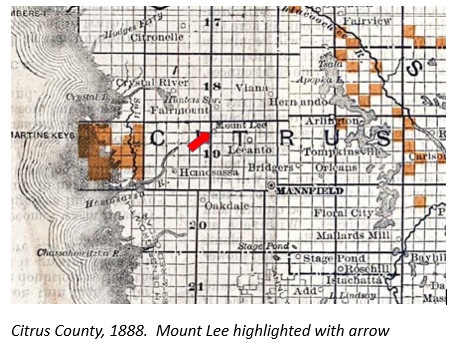
There are a number of old maps in the archives of the Old Courthouse Heritage Museum. It’s always interesting to see the names of villages and towns that no longer exist or have been renamed to something else. Who remembers “Mallards Mills” or “Viana” today? One of those forgotten places is today known as “Rock Crusher Canyon” but over a hundred years ago was called “Mount Lee”. The story was told that Robert E. Lee set up camp there during a trip to West Florida and the remains of his visit could still be seen 50 years later. Does this story ring true?
An Engineer at Heart
While most people recognize Lee’s name from his Civil War campaigns, he was not inclined by nature to be a cavalry officer. As one of the top cadets in his West Point class, he was able to pick his first assignment in the US Army after graduating in 1829. He won an assignment to the Army Corps of Engineers, where he remained for the next 26 years. Lee did not accept a billet in the Cavalry until 1855 when he realized that he had a better chance for advancement to flag officer in that role. While employed as an engineer, he successfully undertook a number of projects that changed the course of rivers and strengthened defensive fortifications.

Mexican War
When war with Mexico was declared in 1846, Lee was called upon to assess Mexican defenses and identify weak points that could be attacked. His engineering advice was instrumental in securing victory. Commander General Winfield Scott specifically recognized Lee’s contributions to the development of a winning strategy. While he still held the official rank of Captain, he was promoted to the Brevet rank of Colonel for his service during that campaign. [The use of a temporary, or Brevet, rank was common during that time to recognize exemplary service or assignment to a role normally held by a higher-ranking officer. The brevet officer typically did not receive the higher pay scale associated with the temporary rank.]
Official Concerns about Florida
After the conclusion of the Mexican War, the US Congress and the President were concerned about the possible need to defend Florida. They were worried that Spain may try to regain her former territory in the future. The government was also uneasy about the future availability of land that might be needed for fortifications given the number of new landowning settlers that started to migrate into the State. The Engineering Corps was directed by Congress to send some of their top engineers on a tour of the entire coast of Florida and make recommendations regarding reserving lands for immediate and future military use. A team of four engineers was tasked with completing their trip and providing a report to Congress within a 6-week timeframe. As a member of the “Board of Examining Engineers” and official recorder for this assignment, Robert E Lee made his first and only trip to the West Coast of Florida.


No Pleasure Cruise
The group would not be able to meander along the coast – sunbathing, fishing and exploring this strange land along the way. Their official orders charged them with assessing specific coastal locations for possible land acquisition by the military. The US Army did not have ships for this purpose and the Navy was not going to lend one of their vessels for such a journey. The US Coastal Survey loaned one of their schooners and crew – the USCS Phenix (also spelled Phoenix) for the survey party. The Phenix was a 70 foot two-masted schooner that usually had a compliment of five officers and almost two dozen petty officers and seamen. It was also filled to the brim with sails, drafting tables, anchors and chains used to determine depths and create navigation charts. The addition of four Army officers for the six-week duration resulted in crowded conditions. Karl A Bickel, past president of the Florida Historical Society, noted in his 1949 study that the engineering officers took advantage of any opportunity to get off the ship and to sleep in a village or on shore for the night.
The engineers were impatient to complete their assignment. They departed from Mobile AL on January 30, 1849 as soon as the Phenix arrived from Boston. They started work in Apalachicola on February 2. They were in Cedar Key by February 13 and finished with West coast visits to Tampa Bay and Charlotte Harbor by February 22. Then the party traveled up Florida’s East coast, arriving in Savannah GA on March 13. The report was delivered to the Department of War on the following day. The report contained entries for the 17 sites that they had visited and evaluated. Recommendations and ranking for government purchase of land for future defenses were included. All of locations recommended for purchase were located in close proximity to valuable harbors or neighboring islands.
We are fortunate that the original “Report of the Board of Engineers Upon Their Examination of the West and East Coast of Florida, from Pensacola Harbor to Amelia Island” still exists today. I would like to express deep gratitude and appreciation to South Florida / Ontario historian Graham Segger, who graciously provided me with an e-copy of this elusive report. Due to Mr. Segger’s kindness, we have Lee’s direct perspective on all of the harbors that they visited from February to March 1849 – especially his comments about the coastline of what was to become Citrus County. Please take a few minutes to review Segger’s interesting story of the Board of Engineer’s visit to Charlotte Harbor that he wrote for the Punta Gorda History Center (http://puntagordahistorycenterblog.blogspot.com/2019/03/170th-anniversary-of-robert-e-lees.html)
It is noteworthy that the future Citrus County area was not included in that list as having been visited or recommended for further review. The only references to our area are: “The country East and South of Cedar Cays is as yet uncultivated. It is represented to be rich and adapted to the growth of sugar and cotton as far as the Cheesowitcha river…the coast South of Cedar Keys, as far as Anclote Cay, is so low that the land is not visible to the naked eye until you get into less than 2 fathoms water”. The use of the word “represented” is important because it implies that Lee did not see the soil for himself but rather was informed by someone else.
Mount Lee in 1849
It’s helpful to describe Mount Lee (Rock Crusher) during that period. At 212 feet above sea level, it was one of the highest points in the area and offered a good view of the Gulf. Located eleven miles from the Gulf shore, however, it would have been an unlikely place for a shore defense battery since the coastal defense cannons of the period had a maximum range of three miles. There were shortcomings in the site’s use as an observation post due to the fact there were no telegraph lines in the area (even Atlanta did not have telegraph lines at that time) and train tracks would not extend into that area for another 40 years. Soldiers stationed there might conceivably see an oncoming invasion, but there was no way for them to report the impending attack to the outside world. In short, in spite of its elevation, Mount Lee would have been of dubious military value.
After the Civil War
The story of Lee’s supposed visit to “Mount Lee” lay fallow until the 1880’s. The owner of the property, Colonel C.P. Jenkins, offered a portion of the land as a home for elderly Confederate soldiers in 1890. It was during this time the story of visitors being able to see the remains of Lee’s years-old camp was published. Coincidentally, Jenkins placed advertisements in Southern newspapers offering to sell acreage on “Mount Lee” for a good price at the same time.
The Final Analysis
Is it possible that the Board of Engineers, including Robert E. Lee, ever set up camp on the top of Rock Crusher Canyon? The probability that these engineers – under a tight six-week deadline mandated by Congress – would take a side trip to a location not listed on their orders, ask the ship’s Captain moor the USCS Phenix off shore, row to the Citrus County coast, march 11 miles through the wilderness to climb a 212-foot hill with dubious military significance loaded with camping gear so they could spend the night in a tent is extremely low.
There were probably two factors involved in the creation of this legend. First, at that time there was a rise of Southern Lost Cause historical revisionism regarding the Civil War and Robert E Lee’s reputation was at its zenith. Any association with his name was revered in the South at that time. Secondly, the value of C.T. Jenkins “Mount Lee” land holdings would be enhanced by mentioning the name of the former Confederate General.
Ironically, the area now known as Rock Crusher Canyon did play an important role in coastal defense during a conflict over a hundred years later. But that’s a story for another time.