
The Legacy of Ralph “Elmer” Van Ness
By: Ken Marotte, Citrus County Historical Society
“He was a wizard with plants and the land. I think Elmer was the best farmer this county ever saw”. – Judge E.C. May
The Van Ness family is recognized as pioneer settlers of Citrus County. There are roads and other landmarks that memorialize their impact on our area. This article tells the remarkable story of one enterprising member of the clan – R.E. “Elmer” Van Ness.
Van Ness Family Background
The Van Ness family originated in Holland and settled in New Netherland – now upstate New York. The clan owned property that was eventually purchased by President Martin Van Buren. Genealogy research indicates that the family can claim US Senators, judges and mayors of major cities in their history.
Elmer Van Ness’ father was Martin Van Buren Van Ness, who served in the Florida State legislature. His mother was Annie Lenthal Eells. She was a direct descendant of John and Priscilla Alden of Mayflower fame.
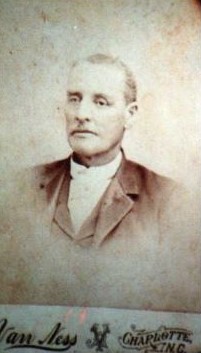
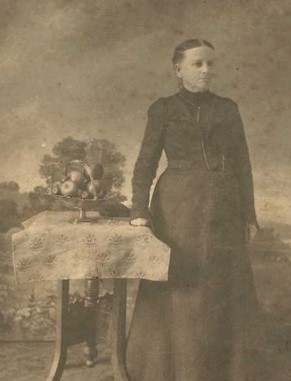
Martin Van Buren Van Ness (father) and Annie Lenthal Eells Van Ness (mother) – courtesy Robert Croft
Ralph Elmer Van Ness was born April 1, 1879 in Wisconsin. His parents migrated to the village of Hernando in what is now Citrus County in the 1880’s. He learned farming and husbandry practices from his father and eventually became an innovator in agricultural techniques and marketing.
Reporting for Military Duty
When the nation issued a call for soldiers to fight in the Spanish-American War, Elmer Van Ness stepped forward and enlisted in the US Army. He served as a Private in Company “A” of the 1st Florida Infantry for the duration of the conflict. After establishing himself back in Hernando, he married Jane Mary Guthery in 1901.
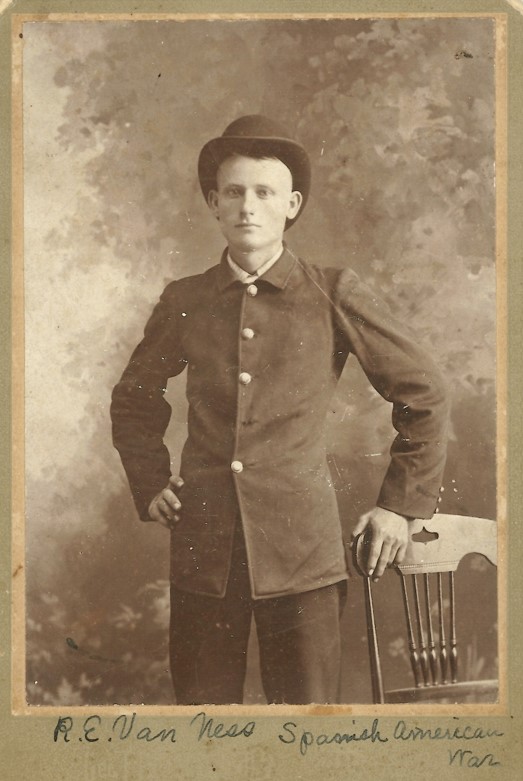
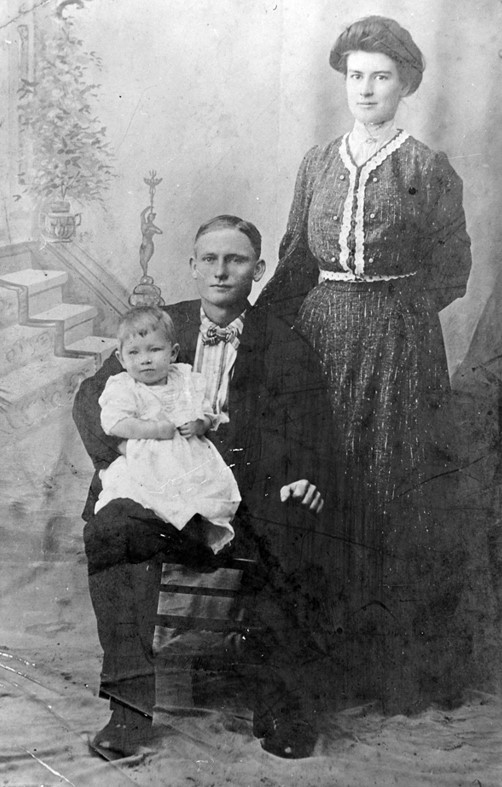
Ralph Elmer Van Ness, Spanish-American War, 1898 ; Ralph Elmer, Jane Mary and Walter Hassan Van Ness, ca. 1904 – courtesy Robert Croft
Wounded in the Line of Duty
A youthful Elmer Van Ness was appointed Constable in Citrus County. While trying to arrest a suspect for carrying a concealed weapon, the perpetrator shot Van Ness in the face during an escape. Van Ness survived but carried the bullet in his face for over a year before having it removed in 1903. It was reported that the projectile had dropped from his face into his neck which complicated the surgery. Family members were relieved when they received news of the successful operation.
A Shrewd Businessman and Farmer
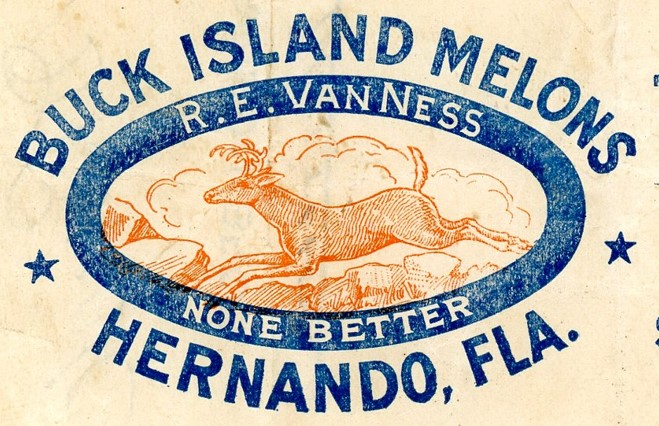
He started out growing watermelons in Hernando and would sell them to the men working in the phosphate mines. He was able to pay off the mortgage on his farm through the profits on his melon business. In addition, he later developed a new type of orange – the “Van Sweet” – that matured a week before other varieties.
Citrus County Booster
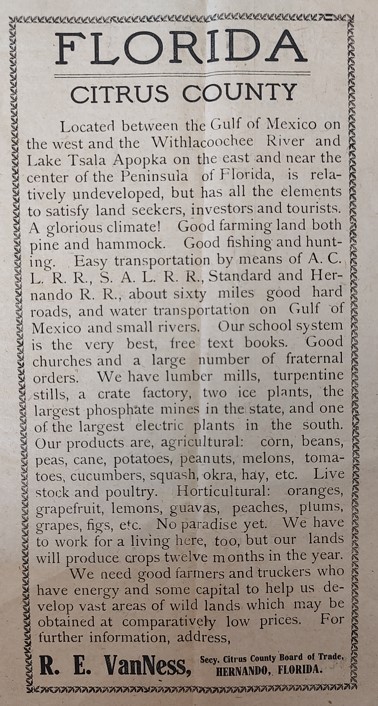
Van Ness turned his attention to marketing the benefits of Citrus County. As Secretary of the Citrus County Board of Trade in 1913, he authored an advertisement to encourage farmers and truckers to relocate in our area.
When the Citrus County phosphate market crashed during World War I, Van Ness took the lead in seeking alternative sources of income for the local farmers. He noticed that the prices for tomatoes were rising, so he urged his neighbors to plant that crop. Encountering their skepticism, he told the farmers to just grow the tomatoes and he would personally handle the marketing and shipping of the crop. E.C. May and Elmer Van Ness rented the former Seaboard train depot and established a packing house for the harvest. The venture was marginally profitable, but served as a model for his success with other crops such as watermelons and oranges.
Mr. Van Ness Goes to Washington
Van Ness recognized that farmers could realize greater profits by eliminating the middleman in the supply chain. He loaded his truck with some of his prize watermelons and set off to Washington DC to directly connect with customers. The quality of his products and lower prices undercut the middlemen and negatively affected their business. According to Judge E.C. May, Van Ness was threatened with jail and heavy fines by the well-connected middlemen but he stubbornly persisted and expanded his involvement in the Washington market.
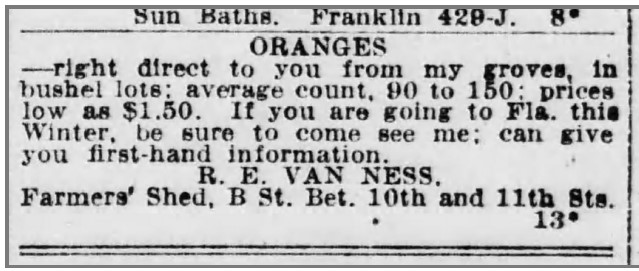
Elmer Van Ness headed a new organization – Citrus County Fruit Growers Association – and opened a packing house in Inverness to wash, dry and load fruit into railroad cars. In addition to the wholesale operation, the group opened two new retail stores in Washington DC to sell their products directly to customers. Large signs were posted in the stores reminding shoppers that the produce was from Citrus County, Florida.
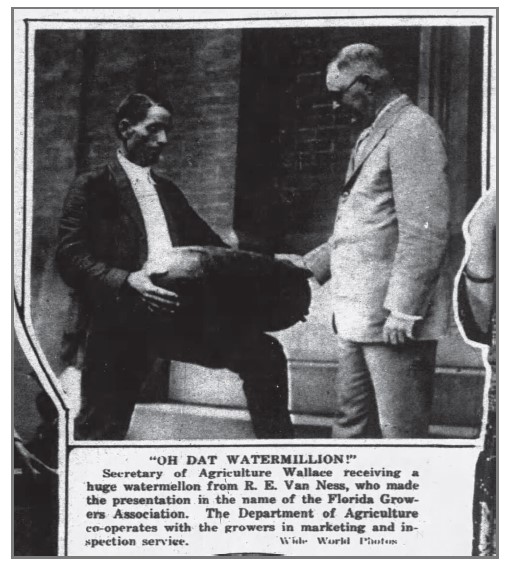
His marketing skills soon attracted national attention. Newspapers carried pictures of Van Ness with the US Secretary of Agriculture (and fellow farmer) Henry A. Wallace displaying a huge watermelon that was grown in Citrus County.
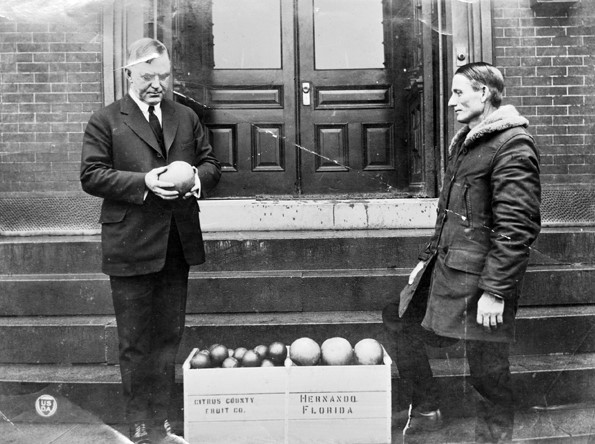
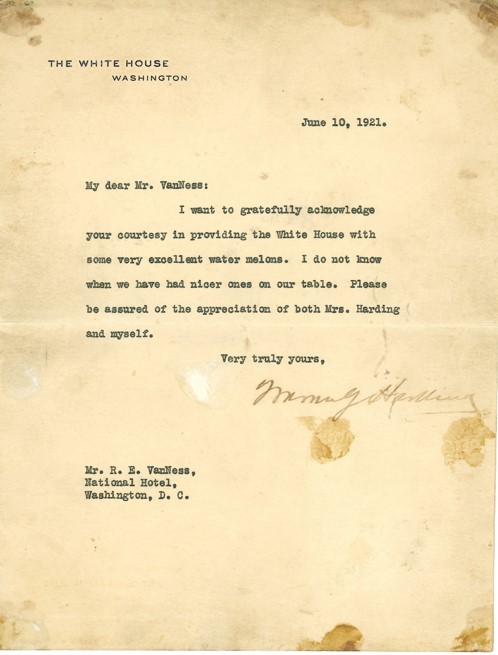
Elmer Van Ness scored a greater publicity coup when he was pictured presenting watermelons and oranges to President Warren G. Harding. The fruit was served at the White House and the President sent a complimentary thank-you note to Van Ness exclaiming “I do not know when we have had nicer ones on our table”.
The Inventor
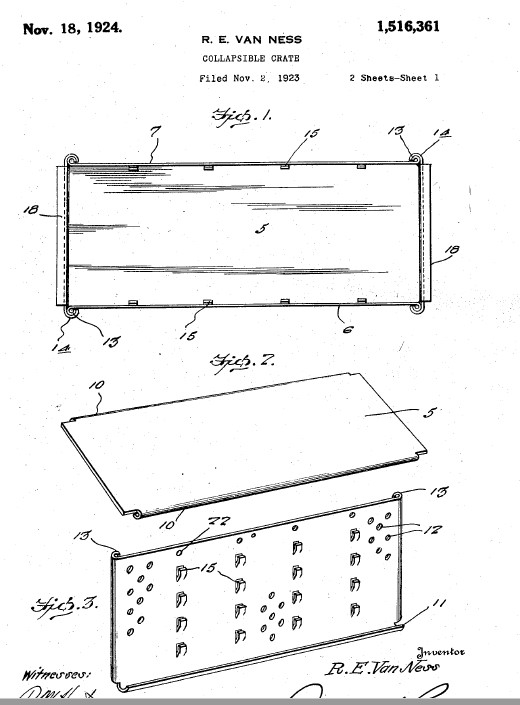
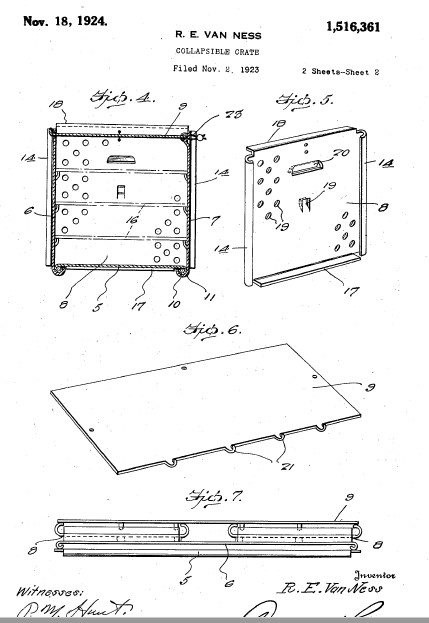
The Van Ness shipping caravan had outgrown the overloaded truck used during the early Washington trips. Crates of fruit were being loaded onto trains and multiple trucks. Some of the fragile products were being damaged in transit or needed to be repacked once they reached their destination. Van Ness saw that a shipping crate was needed that would be lightweight yet strong enough to protect the precious fruits. Unable to find an existing container that met his needs, the “marketeer” turned “inventor”. Van Ness developed a new container that he registered with the US Patent Office.
Patent 1,516,361 Description: This invention relates to an improvement in crates primarily adapted for use in the shipments of fruits and vegetables…that may be knocked down or set up and when once set up and filled with fruits or vegetables, there is no liability in the same accidentally collapsing. One of the main objects of the invention resides in the provision of collapsible crates wherein the different walls thereof may be rigidly joined together without the necessity of providing pin or hinged connections, the different walls of the crate being formed with cooperative interlocking elements.
Supporting the “Bonus Army”
In the grip of the Great Depression, a number of World War I veterans petitioned Washington to give them an advance on the future bonus that had been promised to them. When President Hoover refused to act, the veterans marched on Washington and vowed to remain until their pleas were met. One of the main encampments was located close to the grower’s market where Elmer Van Ness had established his business. As a veteran and farmer, he sympathized with the desperate plight of these men.
By that time Van Ness was employing many of his nephews to assist with the Washington operation. He generously instructed his staff to give the veterans apples and oranges so they would have something to eat during their stay.
Agricultural Innovation
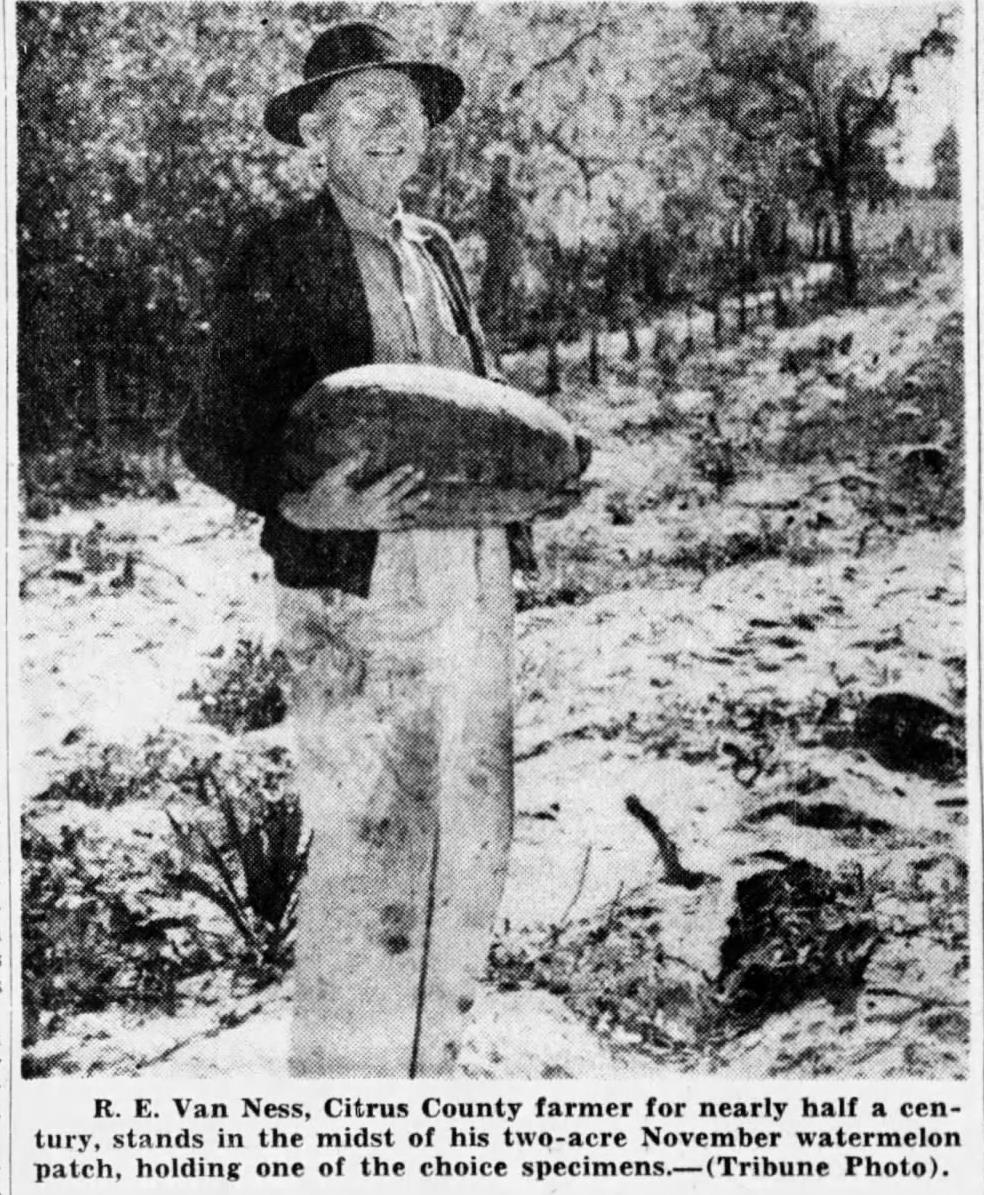
By the mid-1930’s, Elmer was growing tired of the long trip to Washington. He decided to refocus his efforts on creating produce variants that would improve yields in our area. Newspaper reports indicate that he developed a new type of melon that yielded 3,400 melons on a two-acre patch in 1935. The melons were not small, averaging 33 pounds each with some exceeding 60 pounds. This crop was grown on “sand hill” land and required intensive cultivation and fertilization.
Watermelon is a crop that’s harvested during the Summertime. Van Ness performed some extensive experimentation in 1949 that allowed for the production of large melons during the Fall. Since the value of “out of season” fruit is much higher, he was able to sell a 60-pound “Fall watermelon” for the equivalent of $36 in 2023 dollars. He noted that when he first started growing melons in 1902 a typical Summertime melon would bring only the equivalent of $3.50.
Legacy
Elmer Van Ness passed away in 1956. His admirer and friend Judge E.C. May offered this eulogy: “He was one of my best and closest friends, and I have seen him do the impossible with placid nonchalance. Elmer laid no claim to greatness, but his work and his example have left their mark on this county and will live and bear fruit long after he is forgotten”
