
The Legacy of Dixon Pencil Manufacturing in Crystal River
BY: Ken Marotte, Citrus County Historical Society
If you go into a cold sweat remembering Dixon Ticonderoga Number 2 pencils used for standardized school tests, you can thank the people of Crystal River for their historical role in development of this iconic writing instrument.
A Born Inventor
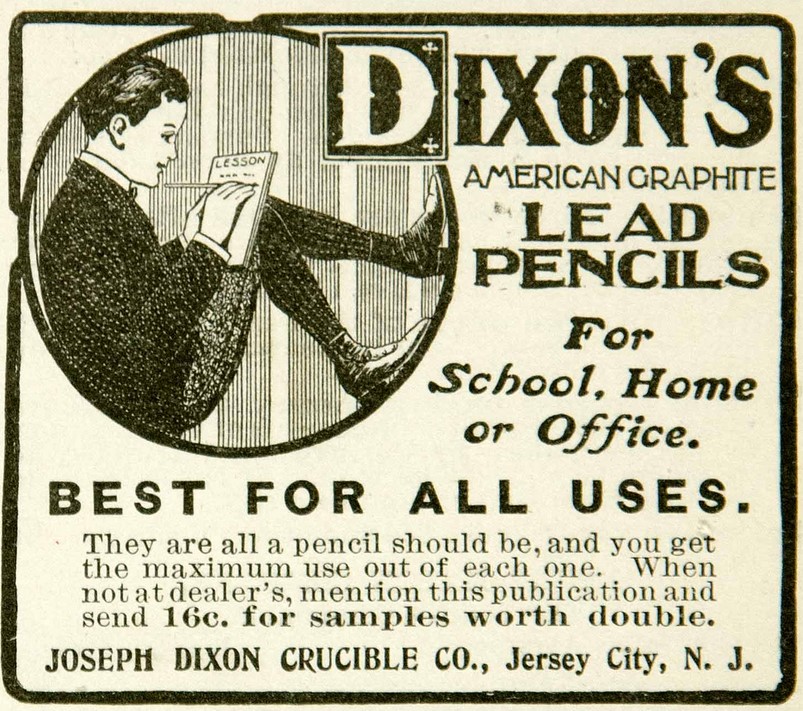
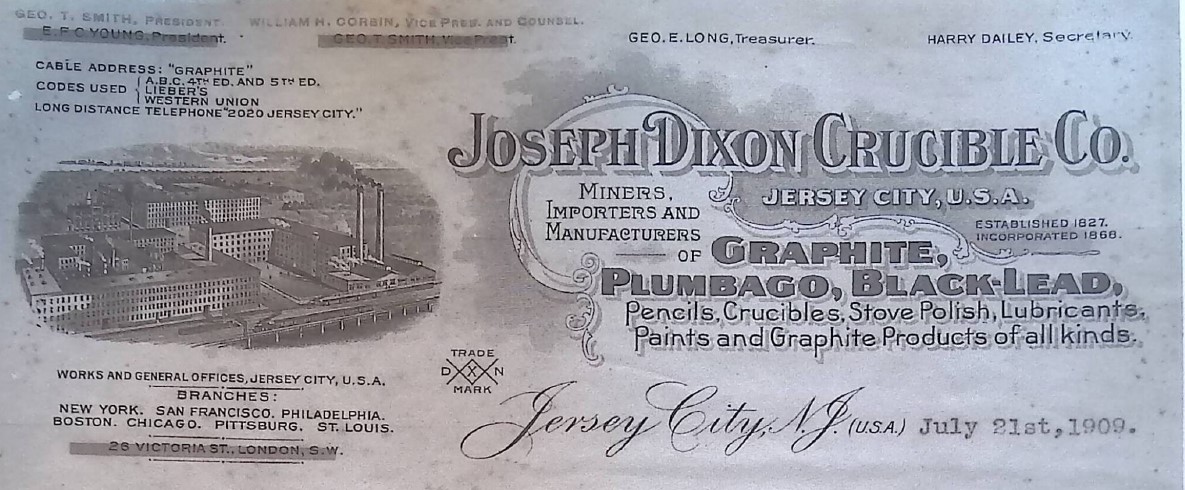
Joseph Dixon was born the son of a sailor in Marblehead, Mass in 1799. He was a natural inventor and demonstrated his talents from an early age. His father acquainted him with a material – graphite – that was typically used in sailing ships of the time. It was usually discarded after serving as ballast. Dixon obtained a small sample and found that it could be used to make a writing instrument when wrapped inside a tube made of wood. He made a small quantity of handmade pencils and tried to sell them in his city. They were too expensive for most people, but along the way Dixon discovered that graphite could be used to clean cast iron stoves and also produce superior crucibles for foundry operations. He established the Joseph Dixon Crucible Company and became a very rich man as a result of his inventive use of graphite. He never forgot his boyhood experience with the material for pencil production, however, and his early interest eventually had a massive impact on Crystal river.
When Dixon passed away in 1869, his company was the largest graphite concern in the world. It is estimated that his company was making over 85,000 pencils annually a few years after his death.
Dixon Looks Southward
The Dixon company needed immense quantities of red cedar trees for their increasing pencil-making operation. They determined that the best trees for the purpose could be found in the forests of central Florida. They originally constructed a cedar mill in Tampa and later relocated to Cedar Key. When the supply of available cedar trees was exhausted in that area, mill operations were once again moved to Crystal River. Land records and newspaper reports indicate that the Dixon Crucible Company was processing cedar lumber at Crystal River since the mid 1880’s.
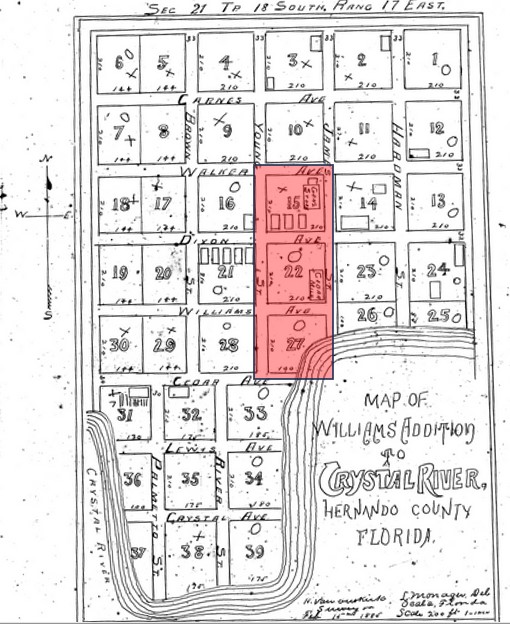
The map above shows the location of Dixon Cedar Mill properties on Kings Bay, Crystal River FL. The mill was located in lots 22 and 27. Lot 15 was dedicated to their offices. They also owned lots 1, 2, 5, 6, 7, 12, 13, 17, 19, 20, 21, 23, 24, 25, 26, 28, – 39, which were used for storage and accommodations for workers.
The area was platted when Crystal River was part of Hernando County, prior to the establishment of Citrus County in 1887. Most of the original street names do not exist today. Most of the Dixon properties comprised what is today the heart of Crystal River. (Township 18S, Range 17E, Section 21)
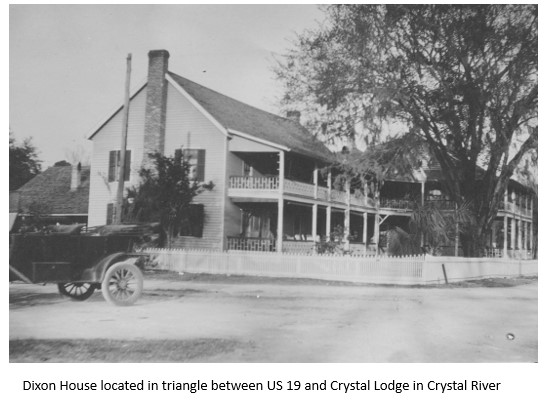
A hotel (appropriately named the “Dixon House”) served as a place for visitors from the head office and other travelers. A number of small shanties were built on property for some of the workers. These buildings were one or two room structures with pine walls and corrugated metal roofs.
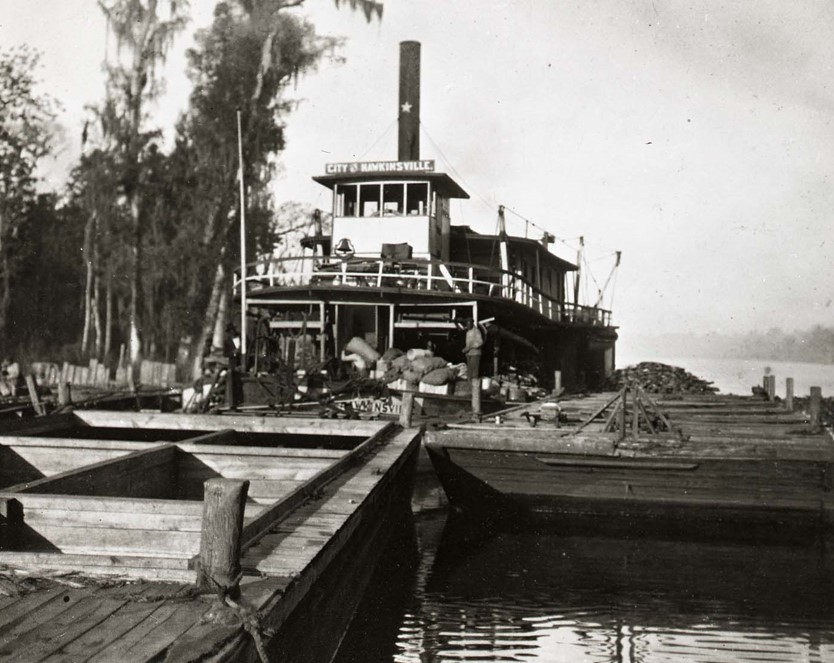
They relied on subcontractors and other smaller lumber companies to provide cedar for the mill. Their operations were far-flung across the region, with some woodcutters clearing forests as far North as Otter Creek and Rosewood in Levy County and Sumter County in the East. Trees would be felled, graded by size and rafted to the mill in Crystal River. In some cases, lumber was transported by boats and barges to be processed.
Correspondence from the period 1909-1914 has been uncovered between newly-appointed President George T. Smith of Dixon Crucibles headquarters in New Jersey and C.E. Herrick, who was in charge of the daily operations of the mill. It is clear from the contents of the main office’s instructions that there was tight central control of the finances and processes. The President issued detailed directions regarding plant employees, production levels and handling payment to the various subcontractors.
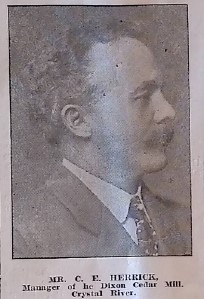
The communications took an interesting turn in 1909. Smith instructed Herrick to tell practically all subcontractors that they were to limit their current production and cease sending cedar to the mill as of December 1, 1909. A plant-wide shutdown for the month of August was scheduled. Over Herrick’s objections, Smith ordered that two employees who had been with the firm for over twenty-five years, were to be told that their services would no longer be needed. Herrick managed to keep them on the payroll as watchmen, but Smith asked pointed questions about Herrick’s decision and the amount of pay that they were receiving. Smith advised Herrick that he would be receiving further orders on August 15, 1909. He held steadfast on the separation of long-term employees and subcontractors by the end of 1909. As it turned out, the mill was shuttered for six weeks and reopened in September 1909.
A Devastating Fire
A fire broke out in the Crystal River mill on Christmas Eve, 1909. Given the timing of the conflagration, all employees were home with their families to celebrate the upcoming holiday. The volunteer fire team and local citizens attempted to halt the spread of the flames but the wood and sawdust materials served as ready fuel for the fire. A frantic call was placed to the Ocala Fire Department, since they had equipment to better fight the fire. The equipment was loaded onto a special train and rushed to Crystal River. The firemen were greeted by a scene of utter destruction when they arrived. The fire had consumed much of the stock and milling machinery by the time they arrived. There was little that the Ocala firefighters could do than prevent the spread of the flames into other parts of the town.
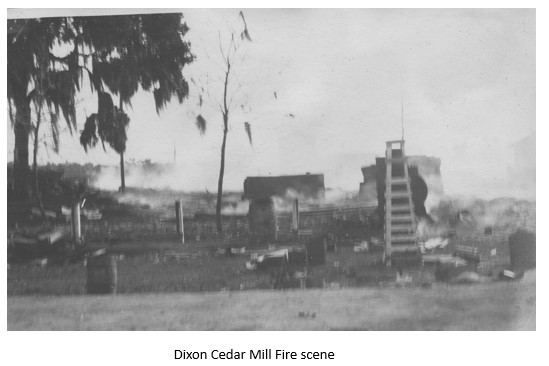
Estimates of the damage varied at the time. Contemporary newspaper reports pegged the loss at $800,000 (over $27 million in 2024 dollars). The fire was so intense that “hot spots” continued to ignite sawdust for months after the event.
Thankfully, there was no loss of life since the mill was empty at the time. Dixon management had the foresight to protect some of their key machinery behind thick fireproof walls, so some milling equipment could be refurbished and put back into operation. The Dixon House was also unaffected by the blaze.
Rebirth of the Mill
Dixon management made a decision to rebuild the mill. They traveled across the country to view other wood milling factories. They also evaluated equipment manufacturers to determine if the revived plant could be better automated using new technology. Reports of their assessments are on file with the Citrus County Historical Society and reveal their frank assessments of the mill operators and their equipment. As is usually the case, management was interested in reducing their labor force by reliance on the latest technological advances.
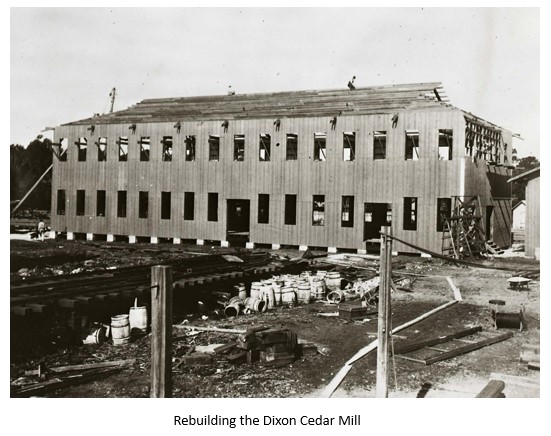
The reborn Crystal River mill was opened in May, 1911. They reported that they were able to increase productivity beyond previous levels while employing only half of the prior staff. Local stocks of cedar trees were becoming scare, however. The company had to rely on more distant forests to satisfy their needs. This situation led to increased transportation costs. Dixon management could calculate the exact cost (down to the penny) to process a tree into a finished product. They could see the handwriting on the wall and looked for a partner to assume the business.
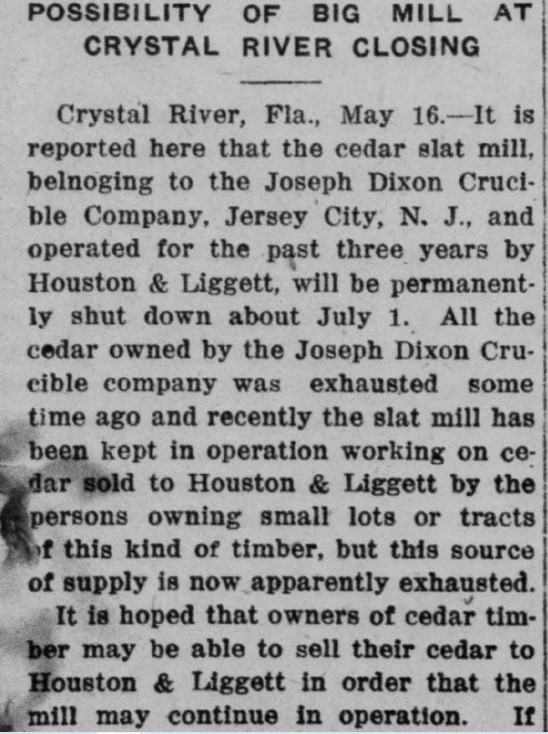
The Dixon company leased the business operations to the Houston & Liggett company from Tennessee in 1913. The amount of lumber processed continued to decrease during the decade. The situation became so uncomfortable that the company told the Citrus Chronicle that the mill was in danger of closing in 1917 due to dwindling cedar forests in the area. A plea was issued to local landholders to allow forestry operations on their property so the mill could be kept in operation. Enough additional lumber was placed under contract so the mill was able to continue limited operations. Dixon Crucible sold all of their Crystal River holdings to Houston & Liggett in 1919, thus closing the book on the story of the Dixon Cedar Mill in Crystal River.
Epilogue
Much of the land formerly occupied by the Dixon Cedar Mill is owned for recreational purposes by the City of Crystal River. Green spaces and upscale homes now occupy the area where a mighty complex grew, was destroyed by fire, and then arose from the ashes. In some cases, Dixon workers met, got married and raised families in the City. The Dixon House hotel continued to operate for many years after the heyday of the cedar mill.
The Dixon company was purchased by a conglomerate from Italy and most of their pencils are produced overseas now. The company maintains a small presence in Georgia so they can still be considered a “domestic producer”.
Thanks to Citrus Chronicle readers Rick and Debbie Reynolds for suggesting the topic of this article.