
The Largest Duck Farm in the South
By: Ken Marotte, Citrus County Historical Society
The Sunnyland Duck Farm was one of Citrus County’s most prestigious businesses in the late 1920’s. Many people drive past the site of the former farm every day on Route 41 but have no idea about the history of the farm and the man who risked everything to make his dream a reality.
Morgan Rundel
Morgan Rundel is practically unknown In our county today, but his name regularly appeared in the Citrus County Chronicle almost a hundred years ago. He was born about 20 miles from Detroit, Michigan and lived in Los Angles and Brooklyn before moving to Tampa about 1918. He found there was money to be made in the growing real estate market and became involved as a broker and trader in the 1920’s. He had several rental houses in Tampa that provided a comfortable income. However, the Florida Real estate Boom ended in 1926-27 so Rundel decided to try something completely different. Rundel had a friend in the North who had made a very profitable living by raising ducks.

A New Industry in Citrus County
His plan was to create a duck farming operation that would rival anything seen in the North. Rundel found the perfect property for his endeavor in Citrus County. He purchased almost 300 acres about four miles south of Inverness on Rt 5 (now Rt. 41) . He had a crew construct build a series of large buildings and bought all new equipment to outfit his new plant.
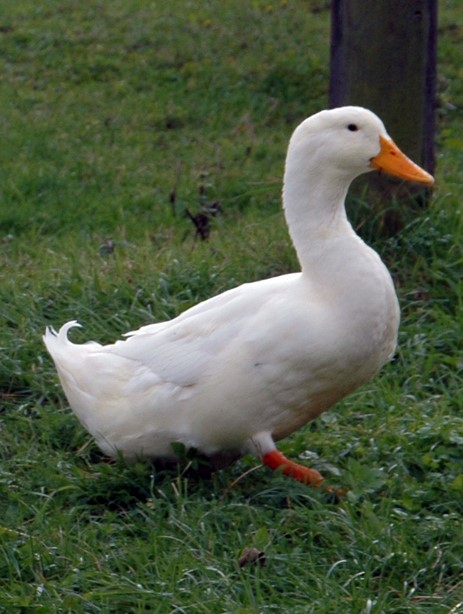
In September, 1927 Rundel bought 50 White Pekin ducks from a friend in Long Island. He added another 35 laying ducks from local stock. Widely known as the “Long Island Duck”, the White Pekin was imported from China in the late 1870’s. The four chicks that were originally hatched in Peking (now Beijing) are the ancestors for most of the Pekin ducks in America today. The chicks are yellow but those feathers are white after molting. They are a sturdy breed and are used mainly for meat.
Rundel started his operation in earnest during March 1928. There was quite a bit of skepticism by locals who thought Rundel was just another city boy who would eventually become a laughing stock. They didn’t know that he had spent months at various Long Island duck farms learning as much as he could about their operations before making his move into the business. He reported that he planned to have more than 1,200 ducks ready for market by May 10. He installed a massive incubator that could handle 1,600 eggs at once.
He started with a Breeder House which was heated with long steam pipes for young ducklings from one day to a month old. Ducks were then moved to a larger “cold breeder” room that was 20×100 ft with no artificial heat. They would remain there until they have reached 10 to 12 weeks old. At that point, they were about 5 ½ to 6 pounds and ready for market.
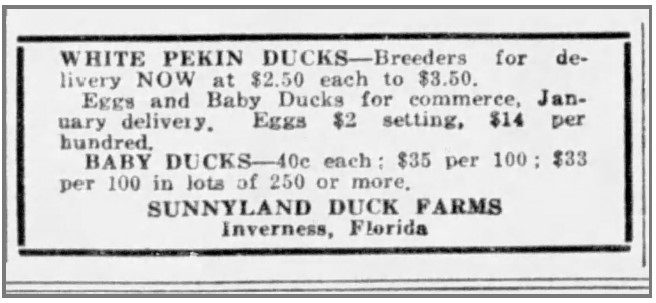
Rundel planned selling to markets, hotels, railroads and luxury liners. He registered “Sunnyland Farms Ducklings” as a trademark for his product to make sure customers know they are fresh and not imported from the North.
By April 1928 he added a new building, new water lines, and more electrical lines for increased capacity. There were 2,400 ducks in process at that point, not including the breeders. He also added small houses for people working on the farm.
He openly invited people to come and see his processing plant. Visitors came from as far as away as Missouri to view his operation. Since the egg production was now outstripping the ability to process into mature adults, locals were offered the chance to buy some eggs for breeding purposes. He would later sell breeding ducks to other farmers.

Earnest Silcox was appointed Superintendent. His day started at 5:30am when plant components were inspected and eggs were turned using a hand crank. The process was repeated at least four times per day to ensure that the eggs were kept at the proper temperature. Breakfast for the ducks started at 6:30am which was first of four feedings that day. There were different food mixes for ducks based on their age so attention had to be paid to the correct formula for each. Purina grains were used exclusively rather than trying to grow their feed on site. Silcox told reporters that the more expensive feed yielded better ducks. The day ended with a final inspection of the plant at 10:00pm. Having the proper temperature was critical, so the thermostat was checked before closing. The eggs were turned one more time before shutting the doors for the night.
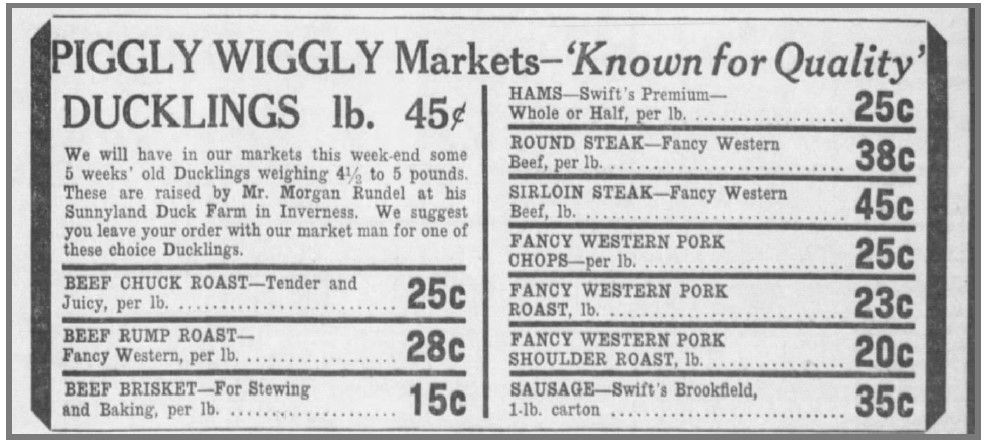
The first batch of ducklings was sent to market on May 12, per plan. The popular Piggly Wiggly supermarket chain featured ducklings from Rundel’s Sunnyland Duck Farms at the same price as their best sirloin steak. Management reported that their entire inventory was sold out by noon, so they increased the order from Sunnyland by 50%. Several restaurants and hotels placed orders for as many ducklings as could be supplied.
In a very short time, industry writers and other prospective farmers came to regard Rundel as an expert on duck rearing and solicited his advice. Rundel was open with advice to potential competitors. When asked why he selected the Pekin duck, he provided a comparative analysis of various breeds and the best conditions for ducks to thrive. He was of the opinion that the flightless White Pekin duck was well suited to thriving in a confined environment, as opposed to the Muscovy duck which was predisposed to flying away and could not easily be confined. His ducks could be hatched in 28 days while the Muscovy took 35 days to hatch. The White Pekin could be brought to market in 12 weeks as opposed to 14 weeks for the Muscovy. It was evident to everyone that Rundel was focused on the commercial viability of the breed and that the purpose of his business was to quickly deliver the best quality fresh duck to his customers – which led to making money for future expansion.
Rundel also stated that the best conditions for ducks involved access to water, such as a pond, as a prerequisite for optimal growth. While others might engage in dry duck farming, he felt that having access to one of the many lakes in Citrus County was a key component in his success. The location he had selected for his farm was on the shore of a lake and well shaded by oak trees. The ground sloped toward the lake which resulted in better drainage of waste, although that may have impacted water quality. The water was ten feet deep off his shore and contained high quality natural grasses. One of employees used a rowboat and ordinary rake to pull some of the grass for use as a green feed for the ducks. This process saved money for Rundel because he didn’t need to purchase green feed from others.

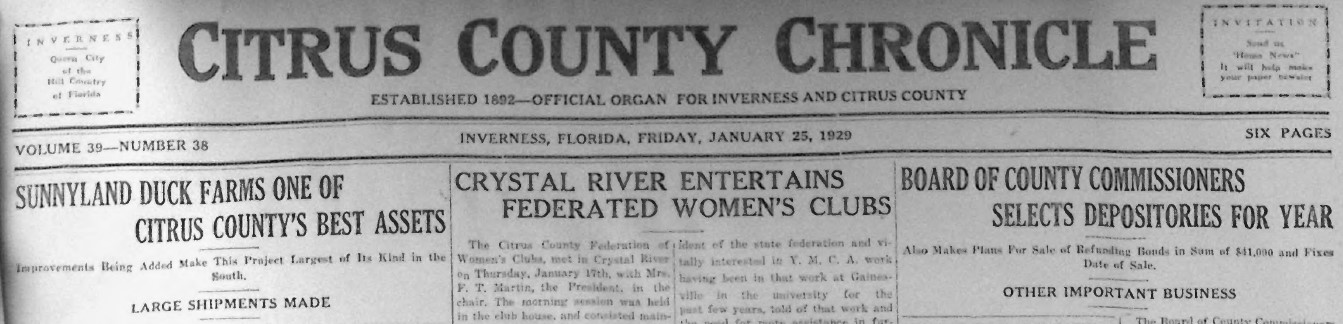
The Citrus County Chronicle deemed Sunnyland one of Citrus County’s best assets and largest of its kind in the South. Rundel was shipping ducks to New York, Chicago, New Orleans and Jacksonville. The expanded plant could accommodate 8,000 ducks at any given time. Expansion plans were in process to double that capacity. Rundel asserted that he would eventually ship 1,000 ducks per week after plant improvements and construction. Sunnyland was employing a large number of employees from as far away as Tampa in addition to local talent.
Loss of the Founder
On March 24, 1930, Morgan Rundel died unexpectedly after a short illness. He passed away at his duck farm and was 62 at the time. Dr. George Dame was in attendance and specialists from Tampa were consulted but no treatment could save Rundel’s life. He left a widow and two sons. He was an example of how someone could educate themselves in a brand-new field late in life and succeed. His widow, Mrs. Alice Rundel, vowed to continue the business. She had been deeply involved with the planning and development of the operation. She reported that sales were increasing and the future looked bright for her family business. That summer Sunnyland was overstocked with ducks and gave 60 birds to the local Citrus County cannery. Mrs. Rundel offered more ducks to local residents at an attractive price to alleviate the growing inventory.
By December 1930, Mrs. Rundel was faced with the overwhelming task of single-handedly running the farm operation that she built with her husband. One of the Rundel sons was in the U.S. Army, while the other was away at military college so she had no family to help her. She was also dealing with some residual losses from her deceased husband’s real estate business. She decided to sell the farm in December, 1930, closing the book on the story of Citrus County’s world-famous duck farm.
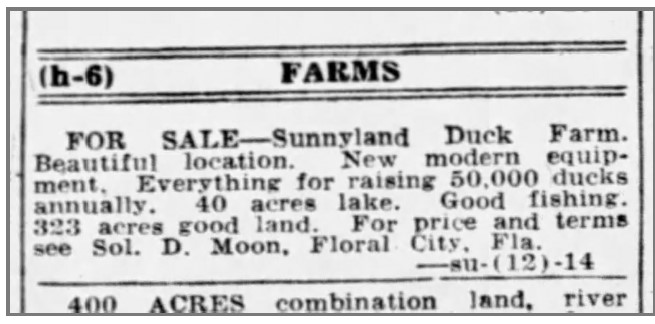
Where was the Sunnyland Duck Farm Located?
All property in Florida is laid out in grid format that roughly mimics the cartographer’s practice of longitude and latitude. A review of old deeds in the county archives indicates that the Rundel/Sunnyland property in was in Township 20S, Range 20E, Section 3. A 1957 land ownership map shows the owners of properties in Section 3. Walter R. Kabrick was the owner of the land where part of the old Sunnyland Duckling Farm was located. For reference, the farm was located near the Wishing Stone on Route 41.
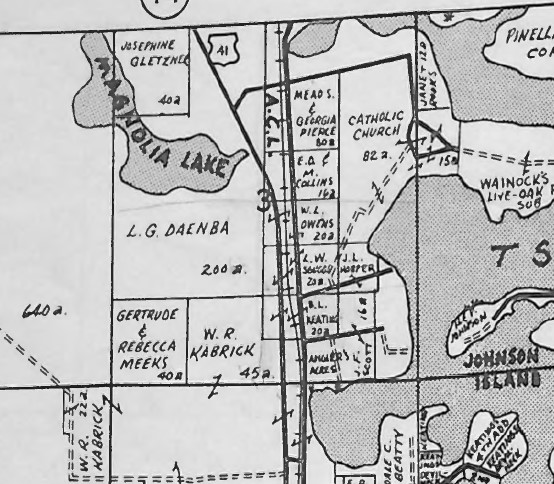
Walter Kabrich was interviewed as part of the Citrus County Historical Society’s Oral History project shortly before his death in 2006.
Now, the Duck Farm is that place back in there behind where you go past the Wishing Stone, go down that little road and the road goes down to the end of that farm. Well, there was, I don’t know how many acres in there, but quite a bit. It run from about where the miniature golf course is, let’s see that was the north 40 along there and just on north of that, was the line started for the Duck Farm. And, we had it all fenced in and there was an old house down there. The house is still there, today. It was the superintendent’s house for the Duck Farm. And they had pens there. They had a hatchery there where they hatched out the duck eggs. And at the end of it they fixed them a pen so they could go down the water. And they’d feed them and then, as they grew, they’d move them to another pen. They had their own slaughter house there, where they slaughtered them and my understanding was, that they’d crate them up in boxes about, oh, I guess about 2’ by 3’ and maybe 18 inches deep, something like that. And, they used to ice them down and the Southland would stop here and they’d load them for New York. This was during the boom days. And, they had chilling houses back in there. There was still one old house in 1940 we had. And, we had a family live there, with a bunch of children. And they sort of took care of the place.