
The Exploding Fish of Citrus County
By: Ken Marotte, Citrus County Historical Society
We’ve all heard legends about the backwater fisherman who filled his creel by lighting an explosive charge and tossing it in the water. This dream once came true for some Citrus County residents – and the local government paid for the dynamite. This is the story of the time when local fish (and sometimes residents) came under attack from TNT.
A Love/Hate Relationship
Fish known as gar have inhabited Citrus County’s rivers and lakes for thousands of years. They are long and slender with mouths filled with razor-sharp teeth. They have a voracious appetite and have a reputation for attacking the local game fish that drive Citrus County’s economy. They’re near the top of the food chain in the water but are hunted by alligators and some snakes. While they are sought by fishermen as a challenging fighter, there is relatively little meat on their bones once caught. They have a strong external armor that sometimes requires tinsnips to break through during food preparation. Moreover, the roe (eggs) are poisonous to humans if eaten.
Gar were put in a class of “rough fish” that specifically hunt young fish and the food that game fish need to survive. This group also included mudfish, catfish, suckers and gizzard shad.

The population decline of predators such as alligators in the 1950’s allowed the number of gar to increase substantially during that time. Game fish and crustaceans became the target of these ravenous hunters. Fishing guides and resort owners noticed that their guests were returning empty-handed from their trips on the rivers. This situation was starting to hurt their business. Meetings were held in the county demanding that something be done to limit the gar population.
A seine was used to remove rough fish in Lake Tsala Apopka during 1951. Twenty-one sweeps of the lake were completed and approximately 13,000 pounds of those “trash” fish were removed. The State Game and Fresh Water Fish Commission, sponsors of that effort, concluded that the number of fish trapped was too small considering the costs in equipment and labor. In addition, use of a seine swept all fish into the net regardless of species.
An Explosive Experiment
Under the auspices of the Homosassa Civic Club, local fishermen proposed an experimental plan to reduce the number of gar in the rivers. The guides noticed that the gar tended to congregate in deep holes during late Spring. Other species of game fish avoided these areas, so an attack on those holes would impact the gar without affecting any desirable fish. A collaborative group of State, County and private citizens would assemble to reduce the schools of gar by dropping explosives in the areas where they congregated. The Board of County Commissioners agreed to contribute 1,000 sticks of dynamite to the team. Special permission was obtained from the United States Army Corps of Engineers.
Local residents who participated included State Officer Karl Halteman from Crystal River; and State Representative Harry Gleaton from Homosassa. Gleaton was a sportsman who would later build a fish camp opposite Miss Maggie Smith’s in Chassahowitzka. Homosassa’s Jimmy Reed, who worked for the State Game and Fresh Water Fish Commission, took pictures that would be included in a future “Florida Wildlife” magazine article. Fletcher Barnes from Lecanto managed the explosives.
The crews boarded small boats in the Chassahowitzka, Homosassa, Crystal and Withlacoochee rivers during the week of June 14, 1954. Once they located a school of gar in a deep hole, they would drop a charge with between thirty and fifty sticks of dynamite. After clearing the area, the explosives would be triggered and thousands of gar would be thrown into the air and onto nearby shores. Each charge resulted in the elimination of between 10,000 and 15,000 gar fish.
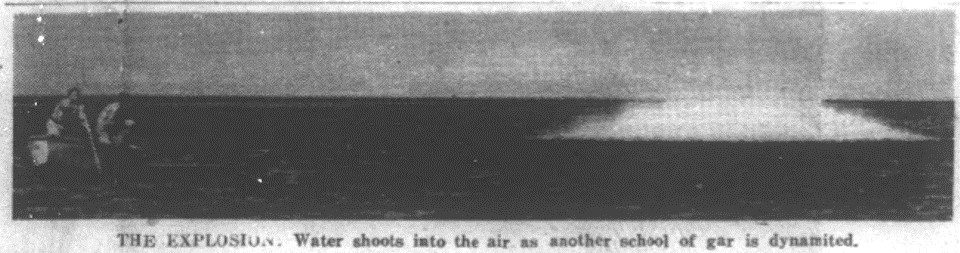
The process was repeated throughout the week until thousands of gar with an estimated total weight of 200,000 pounds were killed. Most of the fish were between twelve and fifteen pounds, although some were much larger. A strong wind from the East pushed most of the deceased fish out to sea, but there were some spots where they were piled as high as cordwood and needed to be removed. There was an initial concern that this activity would indiscriminately affect game fish, but a survey of the results indicated that the “precision bombing” had impacted only a few of the desirable fish.
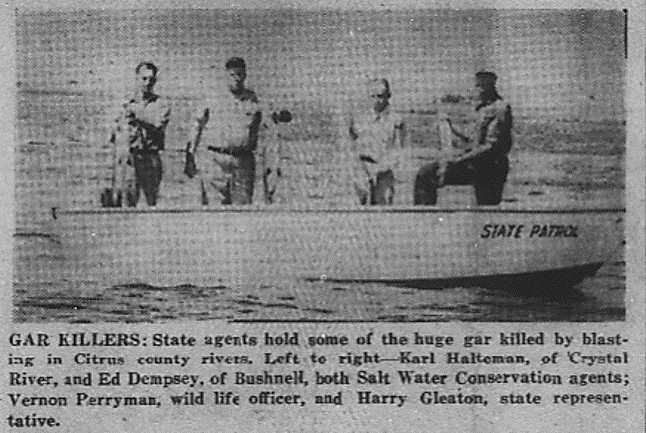
A subsequent “mopping up” campaign was conducted over two days in July, 1954. The explosion of about 400 more sticks of dynamite resulted in the eradication of another 30,000 pounds of gar.
The number of gar dropped dramatically that year. Encouraged by the preliminary results, an expanded group returned to the rivers in May, 1955. Headed by the State Wildlife officers, another 500 sticks of dynamite were used to kill approximately 10,000 more gar during their spawning season. Local Conservation Officer Marion Oliver from Crystal River was part of the State team. Local volunteers were John Brown (Ozello), Knox Purcell (Crystal River) and Duncan MacRae, Sr. (Homosassa). Raymond Hart (Crystal River) was in charge of the explosives.
The overall results were impressive. With the reduction of predatory gar, the county’s prized game fish levels rose dramatically. The unorthodox proposal from the coastal fishermen of Citrus County was a success.
Bombs Away!
Salt water fish were not exempt from mankind’s explosive assaults. The buildup of military airpower prior to World War II required expansive bombing ranges for pilot practice runs. Most people are aware of the Avon Park Air Force Range in Highlands County. Portions of the Ocala National Forest are also designated for bombing exercises. Newcomers to Citrus County might be surprised to learn that a vast swath of Gulf waters, from Chassahowitzka to Crystal River, were used as an Air Force bombing range from 1941 – 1955. The impact of live bombs would be felt by resident fish and occasional fishermen who wandered into the prohibited area.
Practice bombing began off the Citrus coast in October 1941. Only daylight operations were to be held and the exact dates and times would be published in advance in the Chronicle. Vessels were not supposed to be in the target area during bombing. Coast Guard boats patrolled the area to enforce that rule. In addition, an Army Air Force plane would fly over the zone to scout for any wayward boaters immediately before the event. If any fishermen were found, the plane would engage in “buzzing” – flying low while opening and closing the plane’s throttle – to make sure that the offending boat was aware that they needed to evacuate immediately. A further restriction was imposed in 1942 that restricted night operation of any boat after sunset.
While this was an inconvenience, Citrus County citizens were happy to do their part by observing the published notifications and avoiding the area. Once a sponger boat violated the rules and was escorted back to port by the Coast Guard and subjected to a severe “tongue lashing”.
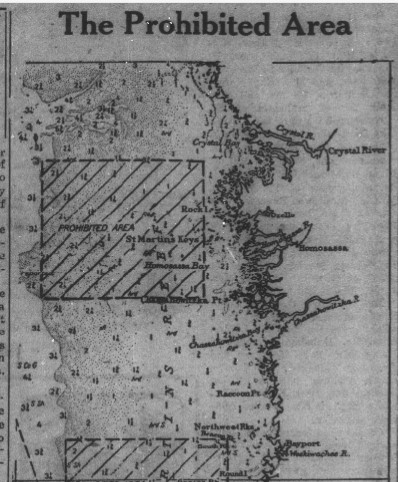
1945 brought an end to World War II but did not halt the Gulf Coast bombing. High-altitude bombing had become a military doctrine and fishermen were not always warned when a practice run was to take place. Two Wildwood fishermen found out the hard way when they took a small rowboat inside the Restricted Zone. A B-29 Superfortress dropped a practice bomb that splashed the water within 50 yards of the hapless anglers. Needless to say, they beat a hasty retreat from that area.
Armistice in Citrus County’s Waters
By 1955, Citrus fishermen had grown weary of the restrictions imposed by the Air Force. They contacted the Florida Congressional delegation to complain about the damage being done to the fishing industry by the continued use of the bombing range. Local leaders told our federal lawmakers that “…the Homosassa River channel is completely cut off by the target range in the prohibited area. In fact, two of the channel markers and one marker buoy are within the prohibited area. This means that no one can go from Homosassa or Homosassa Springs without violating the ‘no trespass’ orders of the Air Force”
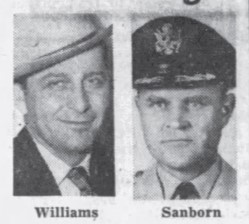
Senator Spessard Holland convinced the commander of MacDill’s 6th Air Division, Brig. Gen. Kenneth Sanborn, to meet with Citrus County leaders to discuss the issue and arrive at possible solutions. Francis “Cowboy” Williams presented the Citrus government’s side of the problem. He wryly noted that he had once been fishing in the restricted area when bombers appeared overhead. He remembered his past experience on a B-24 bomber in World War II and quipped that he headed directly for the target – since that’s the safest place to be when the Air Force started dropping bombs. Poking fun at his old compatriots lightened the mood in the meeting. Gen. Sanborn agreed to recommend that the restricted zone be moved four miles to the West.
Shortly after that meeting, the Air Force agreed to abandon the Citrus County bombing range entirely. Before the area could be opened to the public, Navy divers from Charleston SC had to first remove the hundreds of unexploded bombs that rested on the bottom – some as close as five feet from the surface. Their work was completed by the end of 1958. Finally the fishermen of Citrus County, and the fish swimming below, were freed from worrying about another explosive attack from the US Air Force.