
The Early History of the Citrus County Chronicle
By: Ken Marotte, Citrus County Historical Society
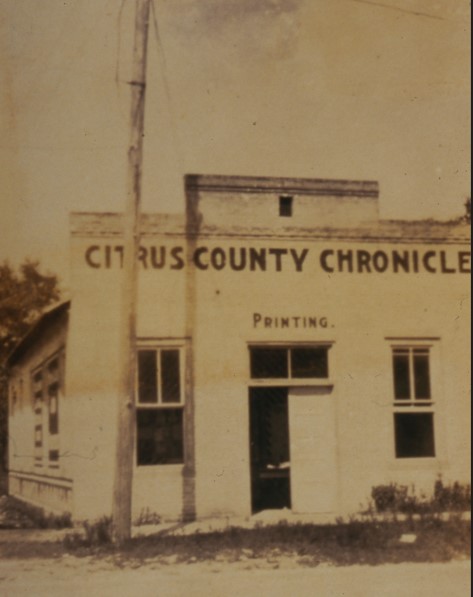
The Citrus County Chronicle was fourth, and most successful, newspaper in Citrus County. Floral City’s A.M. Williamson started Phosphate Field in 1890. A rival newspaper, the Citrus Star was published by E.A. Niles in Mannfield. Niles later sold to G.E. Fearing who moved the Citrus Star to Inverness in 1891 . In the meanwhile, Williamson later merged the Phosphate Field and Citrus Star to form the South Floridian in 1892 and continued to publish that newspaper until it became clear that a new upstart was in town that would eventually dominate the news industry in Citrus County.
The Citrus County Chronicle was incorporated in 1894. Rather than utilize a sole proprietorship, a group of the most prominent citizens formed a corporation to support the new publication. W.C. Zimmerman, County Clerk, and Nick Barco, County Treasurer, led the roster of dignitaries who formed the Chronicle owners.
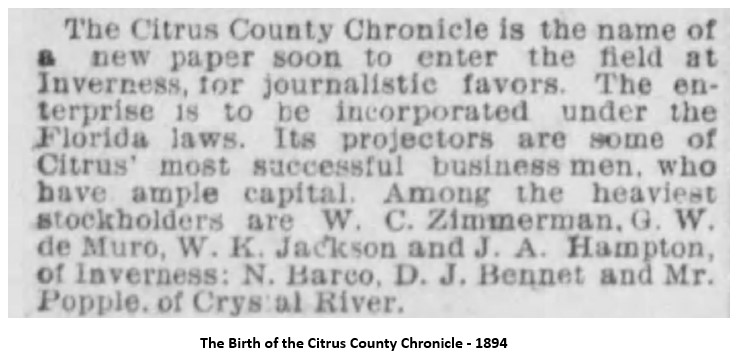
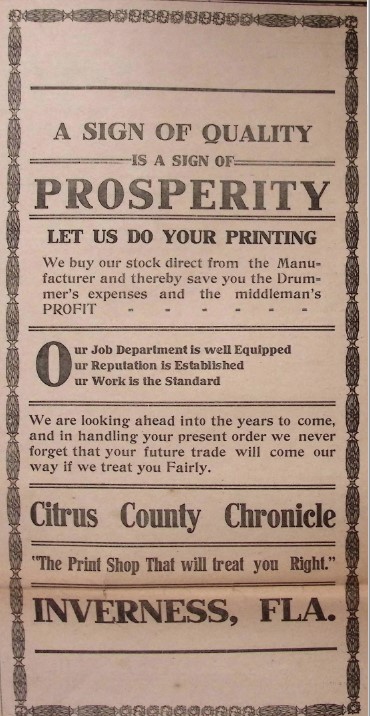
The newspaper business at that time was dependent and four revenue sources: publication of official notices; advertisements; commercial printing; and subscriptions by readers. Williamson’s newspaper originally had the contract to publish official county notices and meeting minutes. However, since the formation of the Chronicle by Citrus County officials, Williamson eventually conceded Citrus County official notice business to the Chronicle and ceased business operations as few years later.
Political Influence
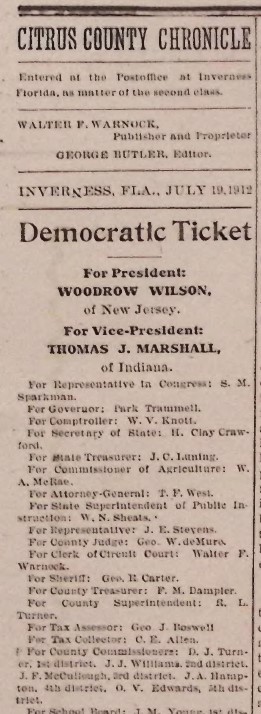
The early Citrus County newspapers never claimed to be impartial. A.M. Williamson became a Florida Senator by 1894 and used the South Floridian to amplify his message. As noted above, the list of original owners included the political elite of the county. When (County Clerk) Walter Warnock took over in 1907, he made it clear that the Chronicle supported the Democratic Party and listed the chosen officials in the editorial page. Later owners included Scofield Publishing, which included prominent members of a Citrus County political family.
The practice of overt newspaper ownership by politicians was not that unusual at the time. Warren G. Harding had continued to own his newspaper in Ohio even after he was elected President of the United States.
The Early Years
The Citrus County Chronicle began as a four-page weekly paper. It contained mostly local news and advertisements. The columns contained detailed personal information that might be considered intrusive by today’s standards. Readers would submit updates about their neighbors such as who was on vacation, who attended birthday parties for example. The newspaper would collect visitor information from local hotels and publish a list of travelers from the previous week.
The articles in the newspaper remained focused on local events. National and world stories were usually included only if they were of interest to the local community. For example, when former President Grover Cleveland passed away in 1908, the story about his death was not on the front page but was printed in a small article on page 2.
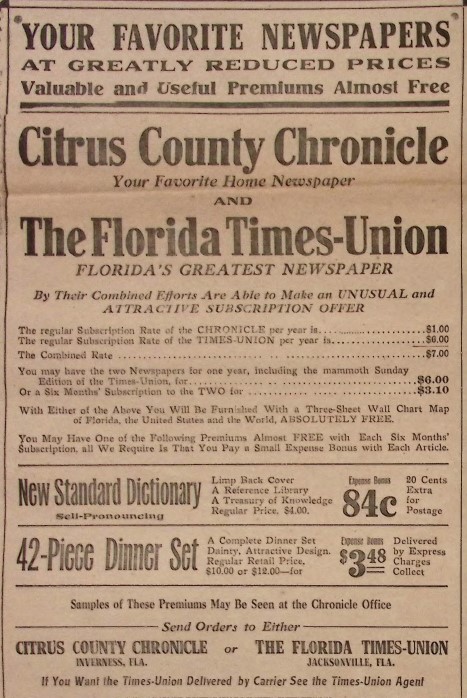
The editors soon discovered that boosting subscriptions was the key to survival. They offered special deals – subscriptions were available for only $1 per year. Knowing that many of the people from Citrus County had moved from Georgia and Jacksonville, the publishers offered combination packages for newspapers such the Jacksonville Times-Courier and the Chronicle for a reduced price. They even offered a set of dinnerware at a discounted rate if a reader signed up for a long-term subscription.
The Great Inverness Fire of 1916
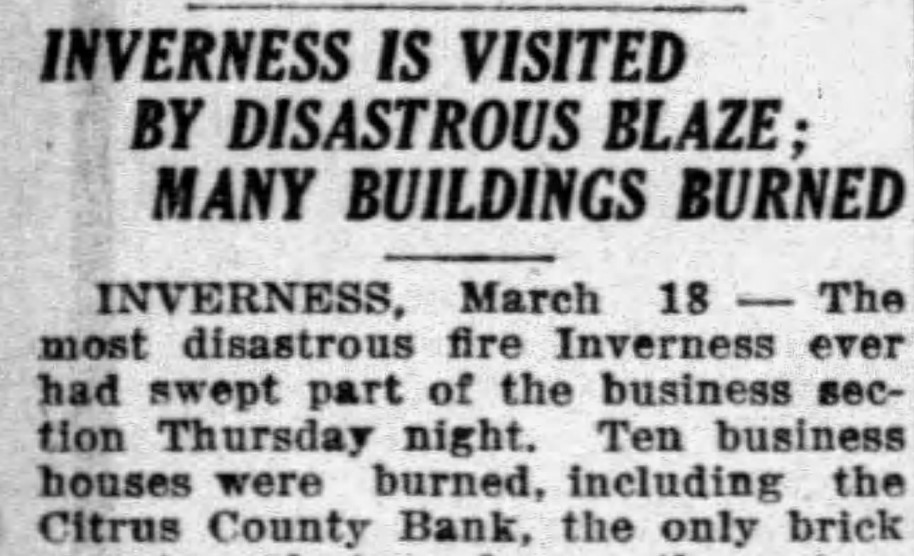
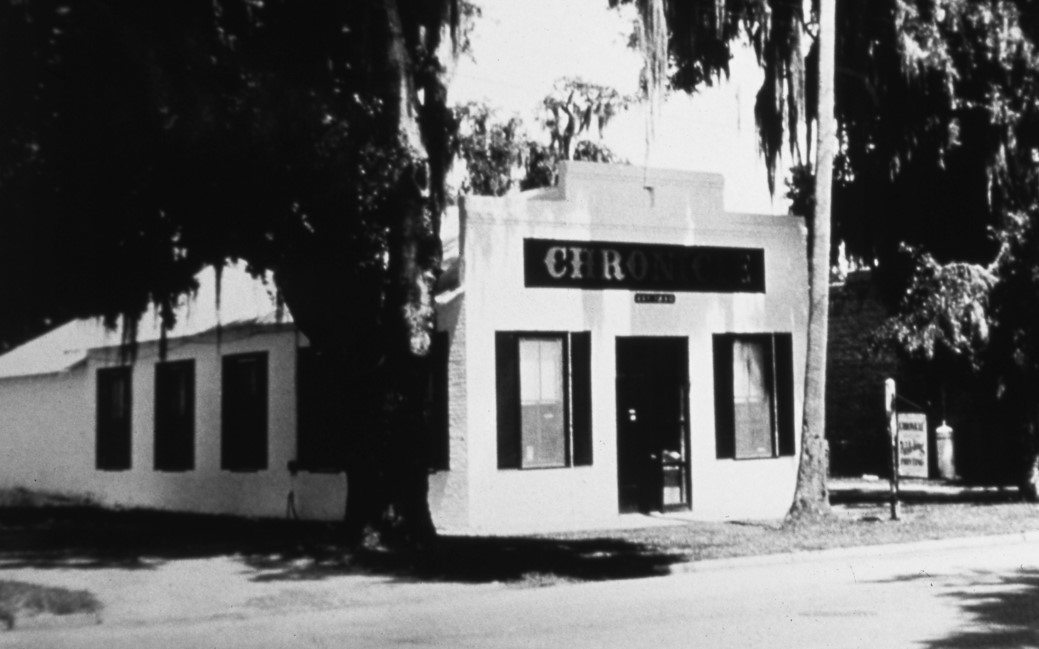
The Chronicle had an office directly across the street from the old County Jail (now the site of the Citrus County courthouse). During the night of March 16, 1916 a fire broke out in downtown Inverness. By the time that the flames were extinguished, many of the buildings in the downtown area were destroyed. The total loss was estimated at $500,000 but only the Citrus County Bank was fully insured. The Chronicle building was a total loss but publisher B.O. Bowden had the foresight to partially insure the building. However, all of the operational equipment (including printing presses) were beyond salvage.
Publisher Bowden quickly responded to the disaster. He made arrangements with the Ocala Star to continue production of the Chronicle within a few days. He used the disaster as an opportunity to completely modernize the Chronicle’s equipment. The newspaper had completely recovered in a couple of months and had completely resumed business by May, 1916.
Stories Told on the Front Page
A sampling of the front pages from the Citrus County Chronicle provides an interesting look into daily life in the county
During the early years, the latest phosphate discoveries and turpentine lands were featured. They continued to print glowing reports about the agricultural progress by our farmers. There was a slowdown in phosphate production in 1908 followed by a recovery and then a complete crash in 1914.
The front page included random stories designed to pique the reader’s interest, such as the “Hen Battles Snake” headline from 1913.
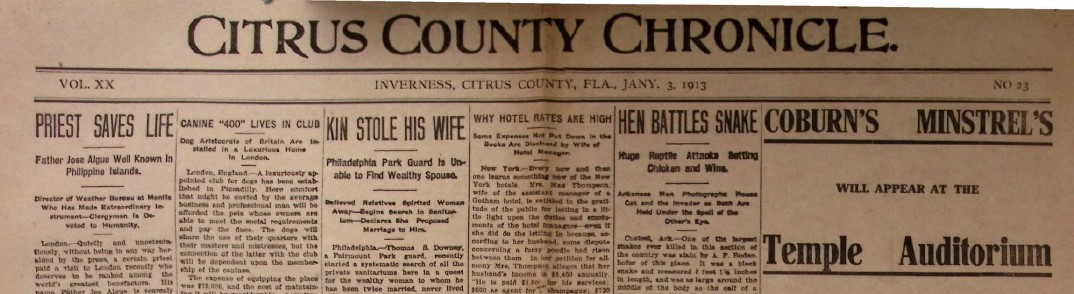
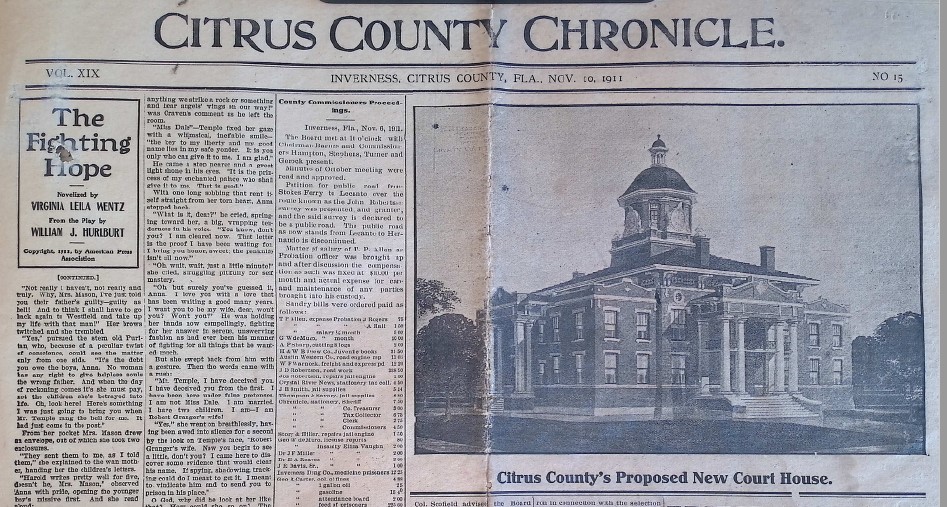
Citrus County residents were given their first look at the proposed County Courthouse in 1911. When World War I erupted in Europe, there were stories about local soldiers and sailors but relatively little information about the strategies of the War.
Stories in 1920s were focused on prosperity and real estate boom, especially in the coastal communities. Homosassa seemed destined to become a great city.
The optimism of the previous decade was replaced by the gloom of the Great Depression in 1930s. Stories featured predictions of when the “Hard Times” would come to an end and tips regarding how local citizens could stretch their dollars to survive in uncertain times.
The 1940s highlighted the local response to World War II and life on the homefront. Citizens were urged to do their part by manning spotting towers, growing victory gardens and scrap material drives. There were weekly updates about the boys (and eventually “girls”) in the service. The front page included information about Armed Forces recruiting drives and also need for civilian workers in the factories and farms. Citizens were even asked to lease their typewriters for the war effort. There were increasing War Bond drives that involved savings by regular adult citizens but also children in schools.
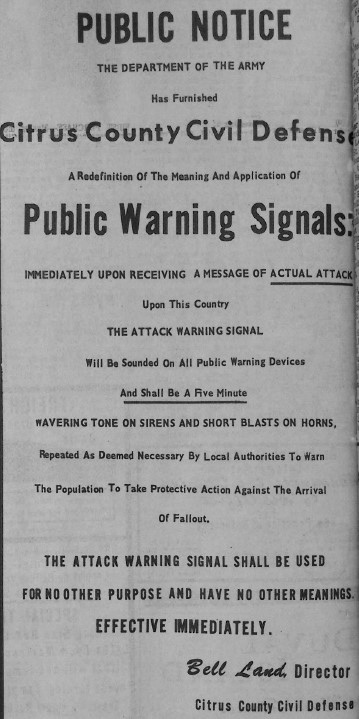
The headlines from the 1950s and 1960s contained worries about nuclear war and communism. The Chronicle carried information about the designation of bomb shelters around the county and plans for tests of the civil defense system.
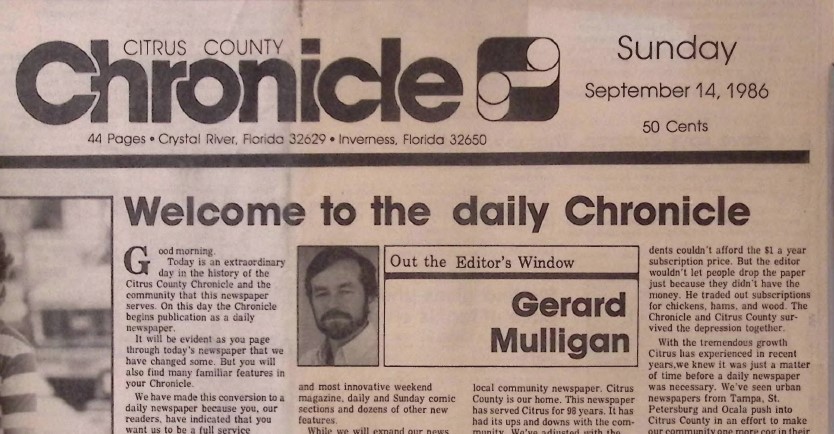
Finally, in the 1980s, the Chronicle expanded coverage to include weekday editions
Chronicle Today
The Citrus County Chronicle has been synonymous with local news since the 1890’s. It has grown with the community and now celebrates a new chapter by returning home to Inverness. There will always be times of triumph, tragedy and controversy, but the Chronicle will be there to keep our local citizens informed and up-to-date.
Ken Marotte writes for the Citrus County Historical Society. He can be reached via email at kenmarottejr@gmail.com if you have any comments, questions or suggestions Contact him if you’d like to participate in the ongoing CCHS Oral History Project.