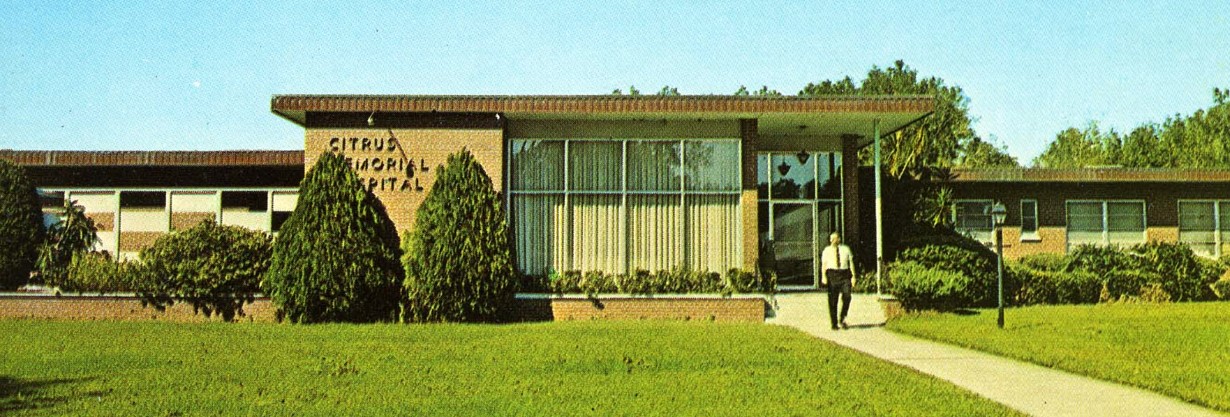
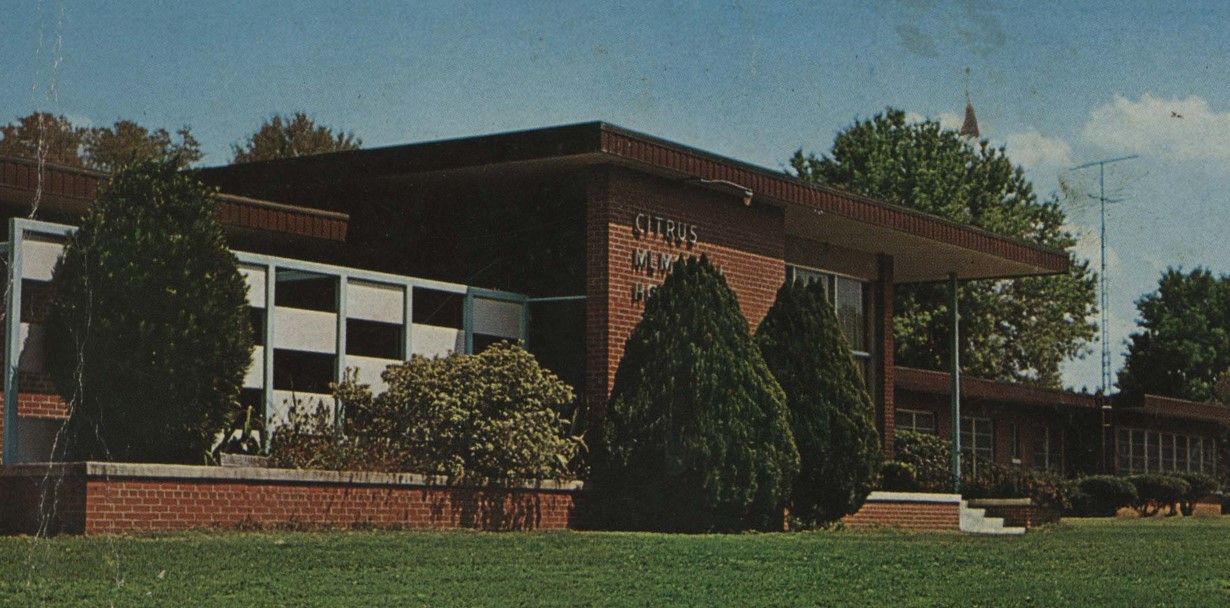
The Birth of Citrus Memorial Hospital
By: Ken Marotte, Citrus County Historical Society
Reliance on Hospitals in Other Counties
Early settlers in Citrus County were primarily served by a local doctor. Seriously sick or injured patients had to be transported to a facility in Ocala or Hernando County if they needed hospitalization. Travel could be slow in those days and that may have affected outcomes of patients. While a “Poor Farm and Hospital” was constructed off Route 41 in 1927 near the Inverness Airport, this facility was more akin to an infirmary for the farm residents than a community hospital. Dr. Porter J. Hudson was engaged by the BoCC later to provide medical services at the small poor farm hospital. Dr. Hudson was the father of famed Citrus County educator and historian James F. “Doc” Hudson.
The Citrus Board of County Commissioners (BoCC) would routinely approve payment of hospital invoices for citizens and included provisions for future payments in their annual budget. For example, they voted to send a letter to Munroe Hospital in Ocala authorizing payment of medical bills for any Citrus County citizen that had been approved by one of the Commissioners.
Kiwanis Members Lead the Charge
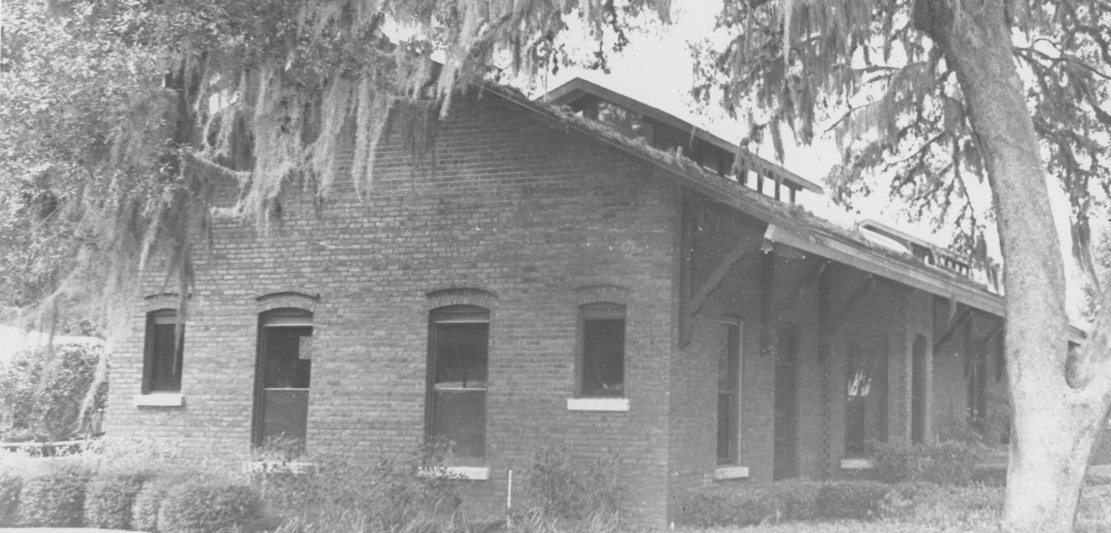
The influx of more people into Citrus County emphasized the need for a dedicated hospital facility in our area. According to reports, the county was having difficulty in retaining physicians due to the lack of an advanced medical facility. George Brannen was head of the local Kiwanis club and led an effort to resolve this issue. A subset of club members purchased the old Seaboard Railroad depot and planned to convert the building into a small hospital. The railroad agreed to sell the building to the men at a discount. After some exploratory work, it was determined that the old brick building was not an acceptable solution. The group sold the building and promised to apply any profits to the construction of a new hospital in Inverness.
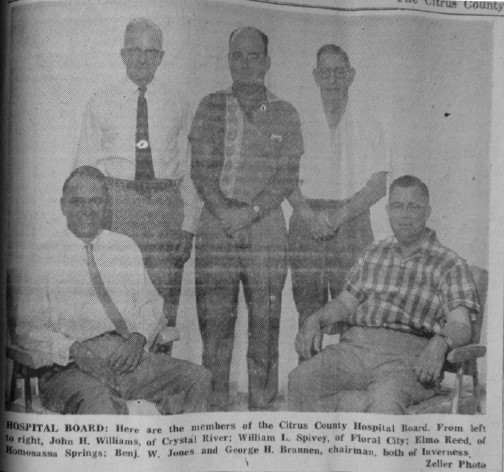
The creation of a Citrus County Hospital Board was authorized by Florida Statute in 1949. George Brannen was appointed Chairman and John H. Williams was designated as Secretary. Elmo Read, Benjamin W. Jones and William L. Spivey rounded out the roster of board members. The BoCC approved an initial annual allocation of $25K (equivalent of $285K) in 1953-1954 to engage an architect and perform preliminary evaluation of construction of a hospital.
Citrus Citizens Approve a New Community Hospital
The Hospital Board determined that it was “…necessary for the public health and welfare of the citizens” to erect, build and equip a new hospital in Citrus County. They approached the BoCC on March 28, 1954 and requested a public vote on formal approval of a 20-year bond in the amount of $150K (equivalent of $1.7 MM today). The BoCC set the election for 5/4/1954 and the appropriate notices were published in the Citrus County Chronicle.
Citrus County voters overwhelmingly approved the creation of construction bonds. There were 1,408 votes for the proposal and only 355 against. Every precinct, with the exemption of Pleasant Grove, approved the measure. It was anticipated that the Federal government would award a matching $175,000.
Slow Planning – Fast Construction
Architect Bryan Duncan was contracted to prepare plans and obtain government approval in July, 1954. The project was beset by delays and Duncan reportedly ignored repeated requests from the Hospital Board for status updates. The matter came to a head in 1956. The Board summoned Duncan to appear before the group by March 20, 1956 with written plans for the endeavor. Duncan managed to attend the meeting but showed up an hour late. He was told that the Hospital Board expected that he would have fully developed plans by the next meeting on April 20 or that his contract would be cancelled. Duncan managed to meet that deadline and submitted four sets of plans to the appropriate Federal and State authorities. By way of explanation, Duncan claimed that he had submitted plans to the regulatory bodies earlier but the preliminary submissions had been rejected. He was confident that the final versions would obtain quick approval and construction could be put to bid by June 1, 1956.
The authorities requested some minor changes to the submitted plans. They noted that they had not received the original submission until several days after it was promised by the architect. If the architect quickly responded, they would expedite their approval. A “Request for Bids” was announced and response due from construction companies by July, 1956. There were seven bids in response to the request for proposals. No bids were submitted by local contractors. Miami contractor Edward J. Gerritts had the lowest bid of $327,886 (which was somewhat higher than the Hospital Board had anticipated). He estimated that he could complete the 25-bed hospital project in 10 months. Gerritts had local ties since he raised Hereford cattle at the Shamrock Farms in Lecanto.
Bids for equipment and furnishings were also higher than expected. The total cost was revised to 385,000. Work commenced at the end of August, 1956 and was projected to be completed by the end of June, 1957.
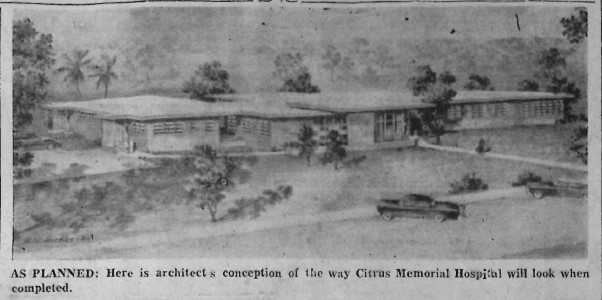
Even after considering matching government funds, the Hospital Board realized that there would be a funding shortfall. They reviewed and revised several of the amenities originally planned for the facility. For example, air conditioning was reduced to include only the nursery, labor room and operating rooms.
The community started to raise money for donations in earnest. The Inverness Kiwanis club, for example, held Chicken Pilau suppers and all proceeds would be earmarked for the upcoming construction project. The Floral City Church of Christ volunteered to furnish the main waiting room. Individuals such as Mrs. Joe Savary, Benjamin Jones and Dr. W.D. Hopkins stepped up and offered to each furnish a room. The ladies of the Citrus Home Demonstration clubs held a bake sale for the purchase of a wheelchair. They would later be joined by a flood of local organizations and residents who donated cash or offered to fund specific equipment.
By January 1957 work was progressing on schedule. The site had been graded, concrete slab poured and concrete blocks were rising into their final construction. Construction was expected to be completed by June (on schedule) but the total budget had grown to $400K.
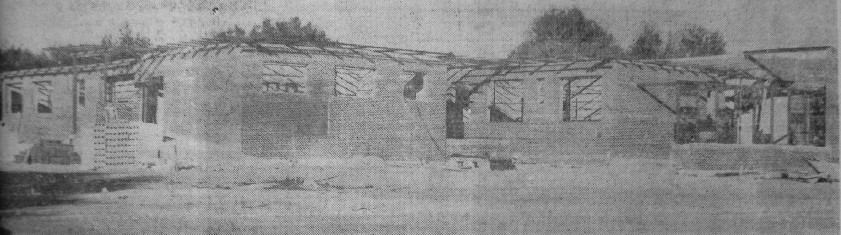
Curious “sidewalk superintendents” stopped by the construction site to monitor progress. Hospital administrators were grateful for community support, but asked people to wait until the formal Open House to be held on Dedication Day. The City and County government paved the roads leading to the hospital and finished grading and paving of the surrounding parking lots. Prospective staff were interviewed and hired to ensure that patients received the highest standard of care. New testing and monitoring equipment was purchased. Finally, July 11, 1957 was set as the formal opening day. The facility would be open to patients the next day.

Experienced Staff and Advanced Amenities
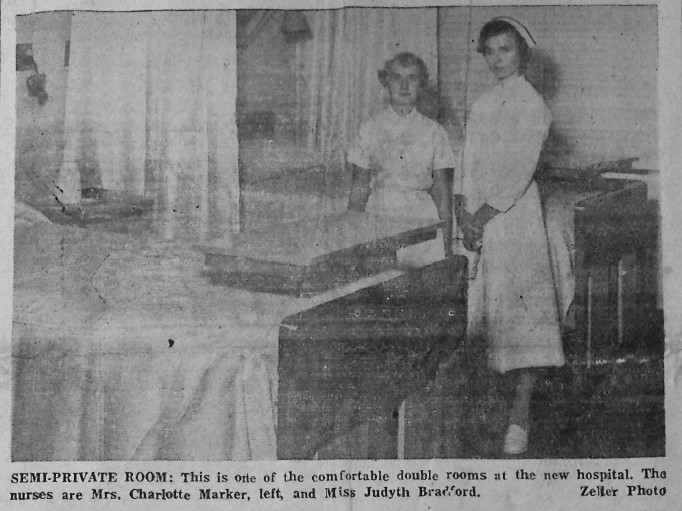
The hospital included a number of amenities that were considered advanced for that time. For example, an intercom system linked every room with the nurses station so a patient could speak directly with a nurse to request assistance. The air conditioning system did not use recirculated air to avoid cross-contamination. Each room had separate thermostats to accommodate individual patient comfort. Covering 17,000 square feet, the hospital featured 4 private rooms and 12 semi-private rooms. There were 16 other patient rooms that could be arranged in either private or semi-private configuration. There was an emergency generator for continuous power in the event of disruption.
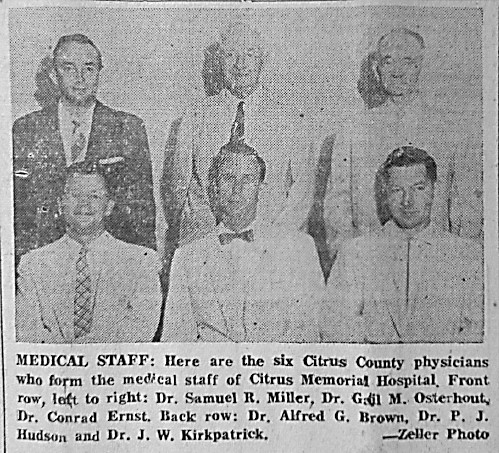
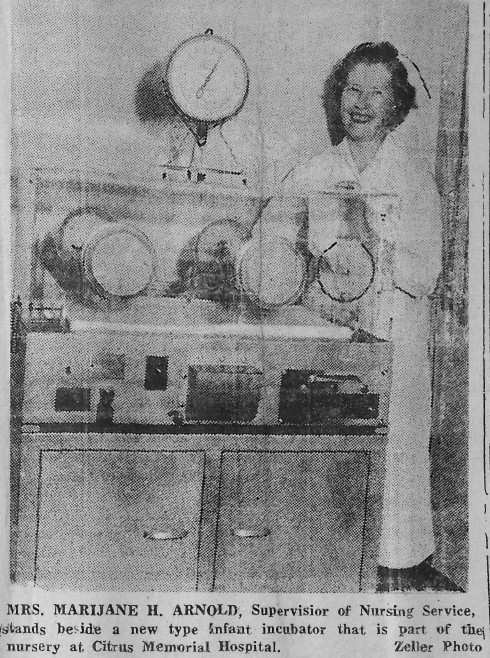
Six doctors agreed to serve as attending physicians: Dr. Alfred G. Brown; Dr. Conrad Ernst; Dr. P.J. Hudson; Dr. J.W. Kirkpatrick; Dr. Samuel Miller; and Dr. Gail M. Osterhout. Three other doctors from other facilities were tapped as consulting physicians in the fields of radiology, pathology and anesthesia. James D. Arnold, the former chief technician at Ocala’s Munroe Hospital, was designated as hospital administrator as well as the laboratory technician and X-Ray technician. Mrs. Marijane H. Arnold acted as Supervisor of Nursing Service.
The hospital did not wait long for the new patients to arrive. The first patient was a two-year old girl from Floral City who had fallen out of chair at home and hit her head on the concrete floor. She was admitted to the hospital with a concussion. Staff found that she was also suffering from tonsilitis. After a few days stay, she was successfully treated and released. That same day, an Inverness man became the first ER patient when he was transported to the hospital with injuries to his hand resulting from a tussle with a power saw. Doctors pointed him in the right direction and he was also treated and released.
A True Community Hospital
The real story of Citrus Memorial Hospital was how the community banded together to make the dream a reality. As noted previously, organizations held numerous fund-raising events to help with the cost of the facility. Individuals and other small groups stepped up and made generous donations to the facility. The children of the late Mr. and Mrs. Howard Tuttle donated the surgical suite. The Eden family donated the solarium in memory of John H. Eden, Sr. Mrs. L.C. Yeomans dedicated the treatment room in memory of her late husband. There were separate facilities for black and white patients and the black community donated funds to equip their waiting room, patient rooms and nursery. Many other community leaders and ordinary citizens alike donated funds for rooms, equipment and infrastructure to make the Citrus Memorial the pride of the county.
The editor of the Citrus County Chronicle summed up the effort on the hospital’s opening day:
“This is a great day to be remembered in Citrus County – the day we dedicated our new hospital. There was more unanimity among us in the undertaking and accomplishment of this project than any heretofore. Today we have a fine building, filled with new and gleaming equipment. New lives will begin here, the sick will be made well and a haven will be waiting for the victims of sudden accidents. Yes, this is certainly a day to be remembered.”