
Taking Care of Our Own
By: Ken Marotte, Citrus County Historical Society
Long before federal assistance programs, elderly, destitute and sickly citizens could count on their neighbors to carry them through. During a time when some children attended school barefooted and the county sometimes faced financial challengers, people opened their hearts – and wallets – to help their neighbors.
Confederate Pensions
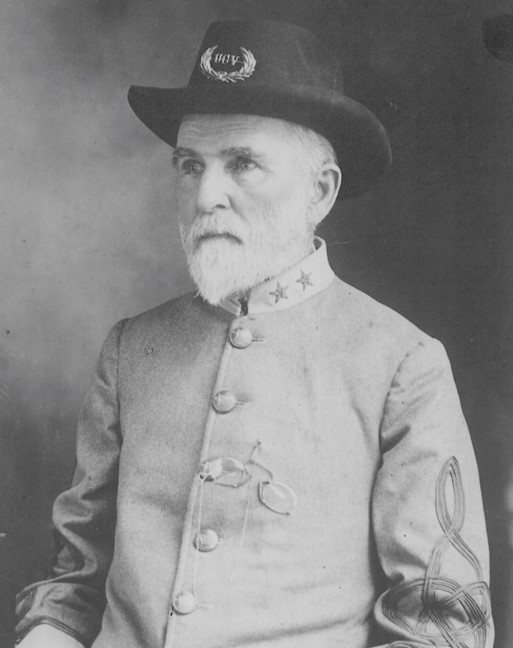
While Union soldiers qualified for military pensions based on their service during the Civil War, former Confederate soldiers were not eligible for any federal pensions. The State of Florida authorized modest payments for former Confederate soldiers and sailors in 1885. The initial stipend was about $160 per month in today’s dollars. The amount was adjusted over time in consideration of rising prices. As the soldiers died, they left behind widows and dependent families, so the program was expanded to include monthly pensions for their dependents.
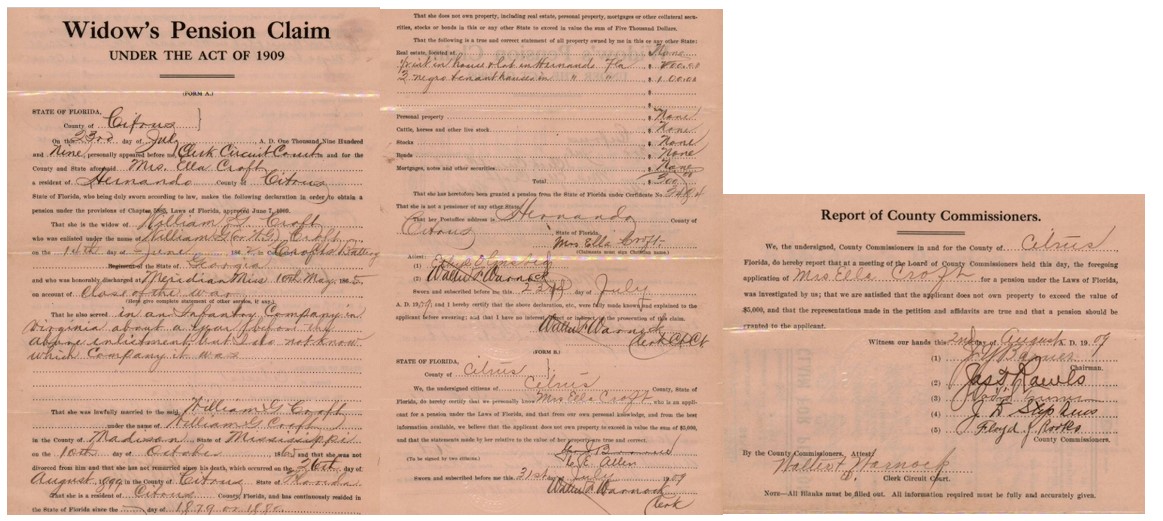
The applicant was required to complete paperwork containing information related to enlistment, dates and place of service and date of mustering out. In addition, a detailed list of assets, income and expenses was required to demonstrate that the applicant didn’t have the financial means to live comfortably. While the pension was administered by the State of Florida, the Board of County Commissioners (BoCC) was responsible for reviewing the application and attesting that the submission was accurate.
After review by Florida officials, the US War Department was asked to verify the information about the soldier. If all of the information was complete and verified, the soldier (or widow) would be granted a pension.
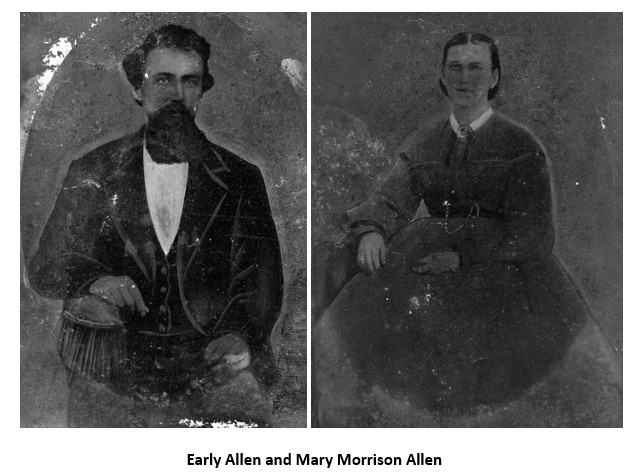
There were over 80 former Confederate soldiers or widows who requested pensions in Citrus County. Some pensioners included Ella Croft, widow of W.G. Croft and former County Clerk W.C. Zimmerman. Some veterans may not have shared the details of their service with their families. Applicants such as Mary Morrison Allen (widow of Early Allen) were refused a pension because she didn’t have the details regarding her husband’s enlistment and service records and could not adequately substantiate her claim. The BoCC stepped in and provided support for her at the county level.
The Confederate pensions were an invaluable source of support for veterans during their retirement years. Most of them were farmers or ranchers and had difficulty maintaining those professions during their sunset years.
Board of County Commissioners
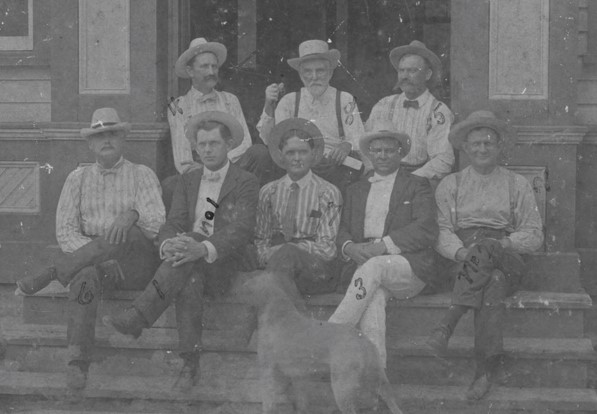
The citizens of Citrus County, through their county commissioners, allocated funds on a regular basis to assist the needy and unfortunate in our area. For example, indigent persons could either apply directly for a pauper’s allowance or could be nominated by petition from their neighbors. Each case would be discussed individually and the BoCC would issue a decision whether or not they felt the applicant was qualified. The amount of funds allocated to each for pauper varied by circumstance (including number of dependent children). The allowances were adjusted and paupers were added or stricken on a monthly basis. In 1908, the average pauper’s allowance was about $170 per month in today’s dollars.
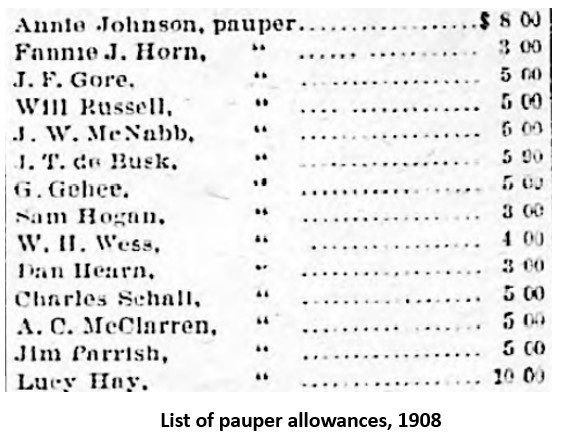
Widows who did not qualify for Confederate veteran pensions were able to apply for a county Widow’s Pension through the BoCC. The amount of money allowed considered the number of dependents that the widow had to support. As the dependent children became adults, the amount of money given to the widow would be reduced accordingly.
In some cases, the BoCC would approve special requests from its citizens. Since Citrus County did not have a hospital at that time, it was commonplace for the BoCC to compensate residents who required hospitalization outside the county. They would also help with the cost of medicine and medical supplies.
Humanitarian aid would sometimes be rendered by the BoCC on a case-by-case basis. For example, a widow named Mrs. Cross approached the BoCC in 1912. She needed to return home to Lafayette, GA and did not have the funds for transportation. After some discussion, the commissioners agreed to purchase a train ticket for Mrs. Cross’ return home. They allocated the equivalent of $555 in a show of compassion.
Finally, the BoCC would pay for a pauper’s funerals expenses. They contracted with local carpenters and undertakers for a basic casket suitable for burial.
Local community groups
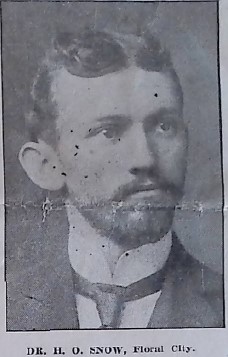
While the government pensions were a good start, local merchants, charitable organizations and ordinary citizens stepped up to fill the gap. Students at the local High Schools collected funds to provide gifts for disadvantaged children. Citrus County’s churches offered free meals and groceries to anyone who needed assistance. This was especially welcomed during the Great Depression. Professionals such as Floral City doctor H.O. Snow donated his services to the poor of his community. People said “the doctor has got a heart as big as a meeting house for he always stands ready and willing to help the poor”
Poor Farm and Hospital
Some counties had instituted poor farms. The farms were viewed as a way to make sure that at-risk residents were taken care of and worked to earn their keep at the same time. While some of the poor farms were advertised as producing a net profit from sales of produce, the reality is that they usually did not break even and required the counties to provide some financial support for operations. Some counties adopted a poor farm approach and later dropped them as being too costly. As early as 1901, Citrus County officials had visited neighboring Marion County’s poor farm as a potential model for our own facility. Their citizens were admitted to the poor farm with the understanding that they would work a sufficient time to pay for their housing, food and health care.
The Citrus Chronicle printed an editorial in 1908 stating “a great many tax payers are planning to do away with our present unsatisfactory pauper system and urge the commissioners to provide a poor farms and send every pauper who applies for aid to it. Other counties have tried this idea and it is shown to be a big improvement over handing out money every month to this class of unfortunates”. The Commissioners discussed the idea but did not agree that this was not the best approach at that time.
A basic poorhouse was constructed around that time. However, most paupers continued to reside outside the poorhouse and received separate allowances. In 1917, the cost of the poorhouse in Citrus County was $600 while allowances for paupers outside the poorhouse were $1,500.
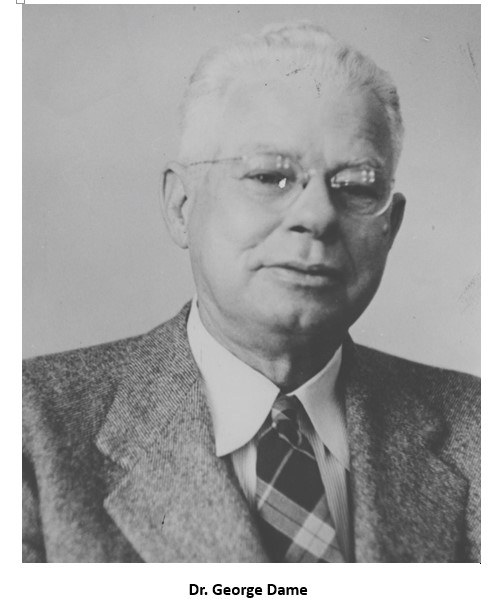
After studying Marion county’s successful setup, The Citrus BoCC petitioned the Florida legislature to allow the county to establish a Poor Farm and Hospital. Chapter 792 of the Florida State laws of 1927 authorized the county to purchase lands for a poor farm and hospital. After conducting an extensive search, the BoCC decided to purchase land to the south of Inverness near the airport. They negotiated with the South Florida Lumber Mills for a 200-acre property on Route 5 (now Route 41). The cost was $10,000, to be paid in four annual installments. A basic hospital building for the residents was erected and Dr. George Dame was contracted to serve as physician and Sara deMuro was assigned to nursing duties. As was the case with pauper allowances, the BoCC reviewed each request for admission to the Farm and age, health and income qualifications were considered.
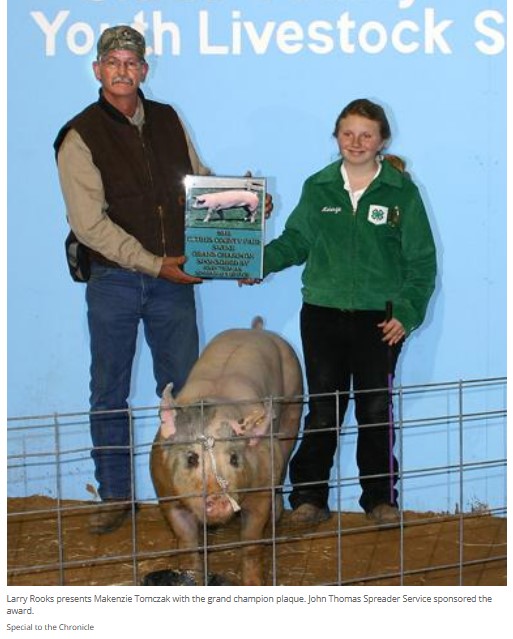
After Roosevelt’s New Deal was instituted, the need for the County Poor Farm and Hospital diminished. In 1947 the BoCC authorized the Citrus County Fairgrounds Association to hold their annual fair on the old Poor Farm site. A stock car race track was added later. This location has served as home for Citrus County Fair since that time. (There was a brief hiatus in the 1990’s when the County Jail ran out of space and minimum-security prisoners were housed at the Fairgrounds. The locals dubbed the temporary prisoner housing as the “jailatorium”.)
Conclusion
Citrus County’s residents have always stepped up to help their neighbors in time of need. Rather than rely on grants from a distant government, anyone requiring assistance could rely on their friends, family and community to make sure that no one was left behind or forgotten.