
Remembering Berry Cannon – Citrus County’s Aquanaut
By: Ken Marotte, Citrus County Historical Society
A man born in Citrus County risked his life to expand America’s deep-sea programs in the 1960’s. He paid the ultimate price when equipment failure ended the brief career of this dedicated aquanaut. His local family and county leaders were shocked and saddened by the loss of this brave adventurer. This is the story of Berry Cannon, veteran of the US Navy’s Sealab program.
Early Years
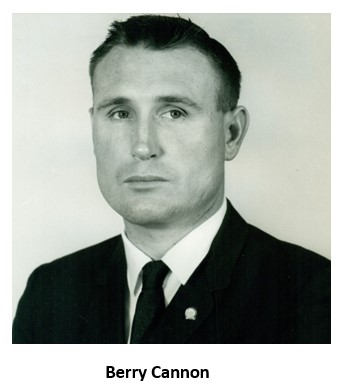
Berry L. Cannon was born in Red Level on March 22, 1935. His parents were very young and divorced soon after Berry was born. He moved to Williston FL with his mother but still had close ties with relatives in Citrus County. He enlisted in the US Navy in 1951 and gravitated to undersea mine removal. He achieved the rating of Mineman 2nd class and served in the USN for four years; however, Cannon continued to pursue commercial underwater diving after leaving the service. He graduated from the University of Florida in 1962 with a degree in Electrical Engineering. When plans were announced for an expanded Navy “Man-In-The Sea” program, Cannon enthusiastically submitted his candidacy to become one of the members of the new Sealab experiment.
Sealab I – Could Mankind Survive at Great Depths?
The Navy wanted to determine whether or not humans could live and work at great depths in the world’s oceans. They were motivated by a rivalry with the Soviet Union for dominance of the ocean floor. While there were bathyscaphes that could descend to great depths, they were sealed environments that were intended for research and exploration (and didn’t have provisions for human divers to exit and perform work outside).
The USN initiated the Sealab program in 1964. The stated goal of the project was to construct an environment where divers could descend to almost 200 feet in a hardened shelter, exit the shelter and determine the effect of depth on human physiology. The divers would experiment with expanded use of saturation diving, which provided for the replacement of surface air with a mixture of helium and oxygen. Use of this mixture allows the human body remain for extended times in a pressurized environment and reduces depressurization time when returning to the surface. Sealab I was a somewhat crude, but effective, undersea environment. The Navy decided to expand on the Sealab success with a more sophisticated version.
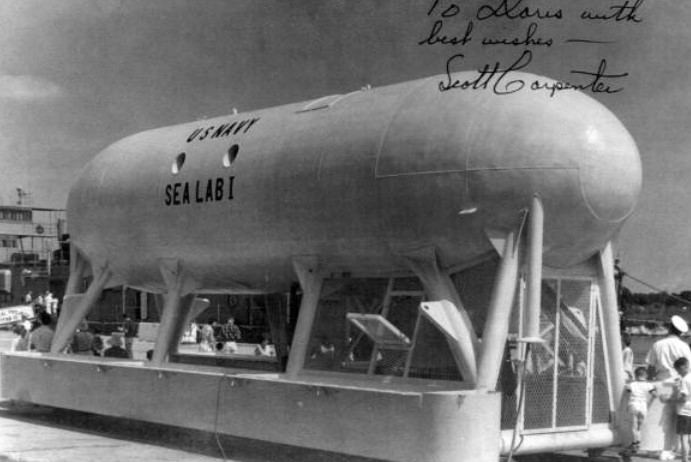
Sealab II – Could Mankind Live and Work on the Bottom of the Sea for extended periods?
The Navy announced that they were recruiting team members for the next Sealab iteration – Sealab II – in 1965. Since Berry Cannon was an experienced diver and former Navy sailor, he submitted an application for selection to the team. Cannon possessed a set of skills and attributes that the Navy needed: as an electronics specialist, he could help link and repair the electrical devices (heaters, cameras, etc.) to the laboratory; as an experienced diver, he could work outside the capsule at great depths to address any electrical problems that arose; he was familiar with the Navy’s structure and procedural standards; and he had kept himself in tremendous physical condition which would enable him to survive the rigors of the cold, dark seas that awaited the team.
The commander of the mission was someone that Americans recognized. M. Scott Carpenter was famous astronaut who was the second American to orbit the Earth in May 1962. He happened to have a chat with renowned ocean explorer Jacques Cousteau the following year. Based on Cousteau’s advice, Carpenter joined the innovative Sealab II mission. Carpenter was anxious to face new challenges and was welcomed by the Sealab leadership team. The “Astronaut turned Aquanaut” story captured the nation’s attention and created positive publicity for the project.
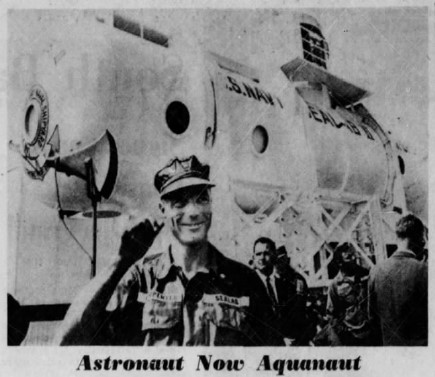
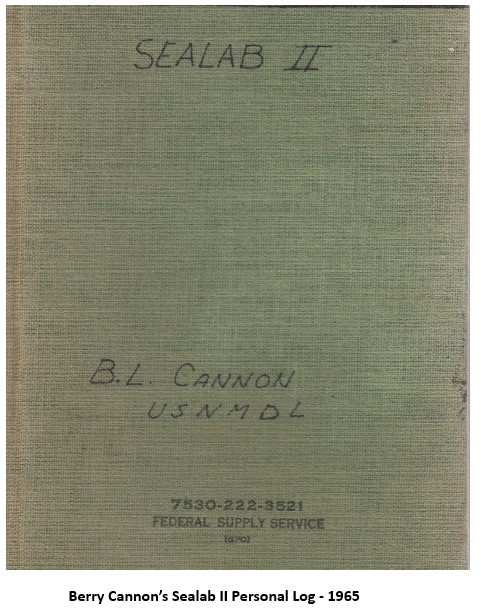
Carpenter recognized Berry Cannon’s extensive experience and selected Cannon to dive on “Team One” alongside the mission commander. Cannon constructed a detailed log of his activities that fortunately still exists today. His journal provides insight into the preparation for the endeavor and the many daily tasks that consumed his time under the sea.
All of the team members had to undergo rigorous psychological and physical testing. During the physical test portion, the Navy found Cannon was in excellent shape except that he had an impacted wisdom tooth. Since he technically a civilian at that time, the Navy told him that he had to have the issue resolved (and pay the bill himself) or he would not be able to participate. Cannon could not let this opportunity pass him by.
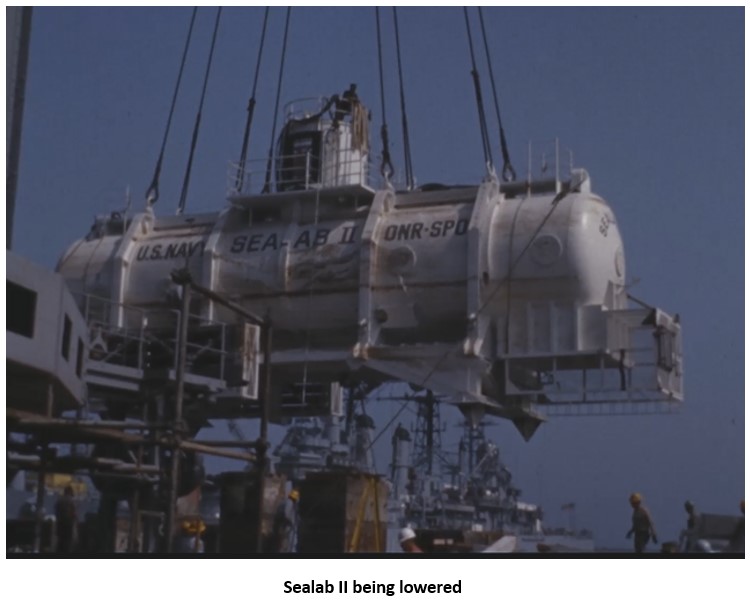
Sealab II was ready for unveiling for the public and press in August 1965. Cannon recounted that the program managers had ordered that Sealab II the capsule must be mocked up to look like it’s ready to be lived in for the photo opportunity, but reality was a much different situation. After the press left, he and the rest of the crew scrambled to make many repairs, especially to the electrical and pumping components.
The Tiltin’ Hilton
On August 28, 1965 the Sealab II vessel was ready to be lowered to the waters off San Clemente Island in California. In spite of their planning, the capsule was lowered onto a steep slope on the ocean floor only 150 feet away from a deep trench. This caused lab to have a substantial pitch that Cannon noted made him feel uncomfortable. The team members jokingly dubbed Sealab II to be “The Tiltin’ Hilton” due to the pronounced slant.
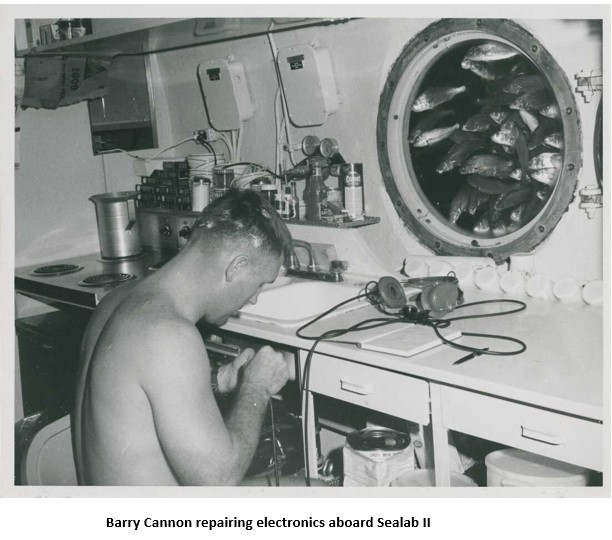
As part of “Team One”, Cannon was required to complete repairs on the capsule to maintain power and keep it from flooding. Many of the repairs involved working outside the living environment in a pitch-black sea. Cannon’s daily log shows that he was constantly busy fixing one item or another. While the crew’s daily schedule originally included an afternoon siesta and early bedtime, Cannon and his teammates found themselves taxed solving continual problems. An audience of curious fishes watched through the portholes while the divers completed their tasks. Cannon remarked that the food was adequate but the ravenous sailors appreciated treats from topside delivered by a special mail carrier. After President Lyndon B. Johnson placed a phone call to Commander Carpenter while stationed in Sealab, Cannon and team members wondered how LBJ reacted to Carpenter’s helium-filled squeaky voice.
Tuffy the Dolphin
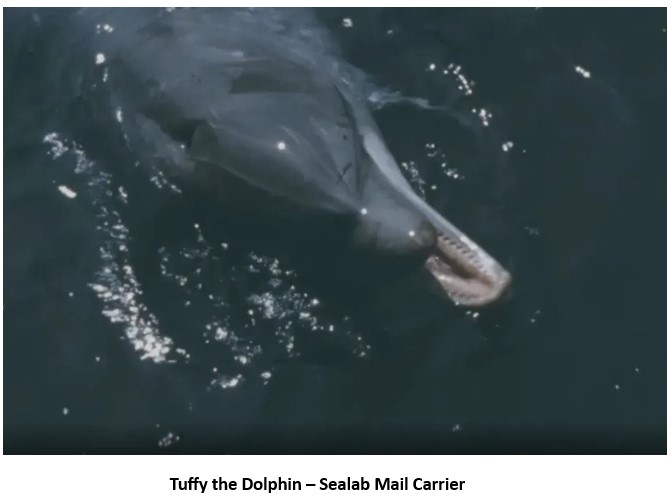
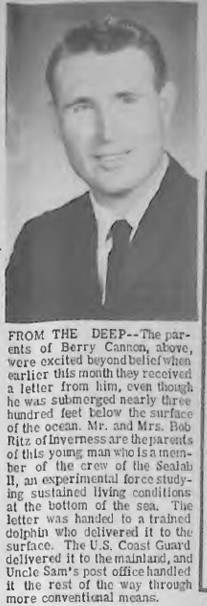
Since the crew remained submerged for over two weeks per shift, they relied on an ingenious way to transport packages and mail between the support staff anchored above and Sealab. The Navy was experimenting with training marine animals and “Tuffy the Dolphin” was enlisted to deliver supplies and mail from the topside vessel and Sealab. Tuffy’s mail delivery exploits captured the nation’s attention and the Post Office created a special cancellation impression on all letters leaving the Sealab for later local delivery. Local 343 of the National Association of Letter Carrier’s Union designated Tuffy as an “honorary member”.
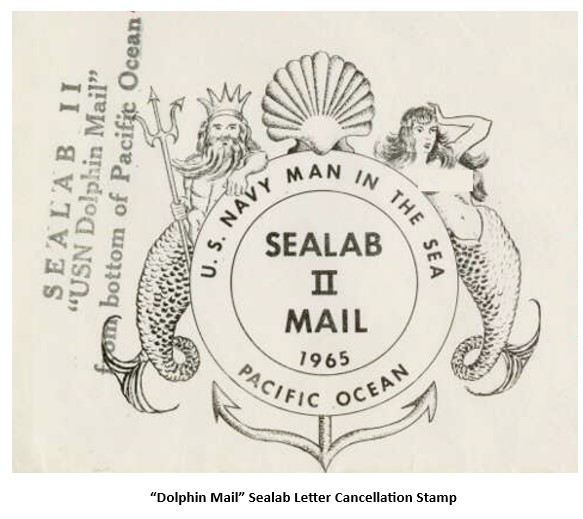
Some of the letters handled by Tuffy were delivered to Cannon’s parents – Mr. and Mrs. Bob Ritz of Inverness. According to the Citrus County Chronicle story, the Ritz’ were thrilled to receive several letters from their hometown aquanaut even though he was residing 300 feet beneath the waves of the Pacific Ocean.
Sealab III – Equipment Failure Leads to Disaster
The USN was anxious to expand on the success of previous Sealab expeditions. A more complex and technologically advanced Sealab III was constructed in 1969. The use of saturation diving practices and a habitable work pod would be put to the test at over 1,000 feet below the surface. The complexity of the project led to substantial delays and cost overruns. Program managers were wary of losing funding and pressured the team members to find risky work-arounds to the many problems that arose. One of the issues involved a helium leak in Sealab III that needed to be repaired after it was lowered to 600 feet. Rather than return Sealab to the surface, a decision was made to send divers to the sea floor to repair the leak.
Cannon was one of the four divers who volunteered for this risky mission. While working on the other side of the capsule, Cannon’s dive buddy heard what sounded like a scream. He swam to the other side of Sealab and saw Cannon’s body floating in the water with the breathing apparatus dislodged from his mouth. He tried to put his own breathing tube into Cannon’s mouth, but his mouth was locked shut. He dragged Cannon’s body into the nearby rescue pod and tried to administer life-saving measures. He knew that his friend, Berry Cannon, had passed away on that dive.
The Navy initially speculated that Cannon had suffered a heart attack. However, the subsequent Board of Inquiry found that a canister containing a material that removed toxic CO2 from Cannon’s breathing tanks was improperly filled. As a result of the tragedy, the Sealab program lost public support and government funding. The Sealab project was quietly cancelled.
Citrus Remembers Berry Cannon
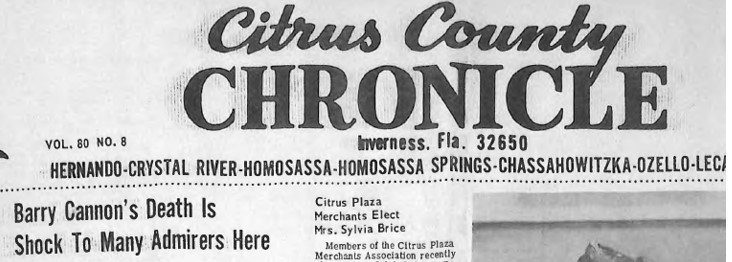
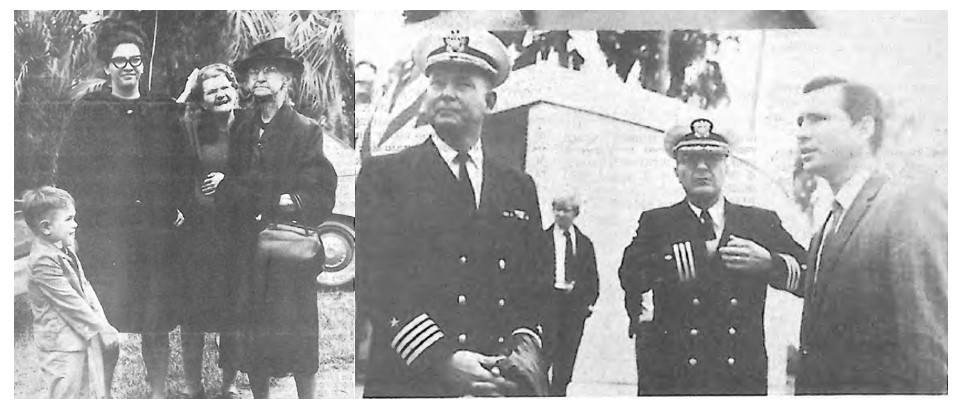
Citrus County residents decided to honor his memory by establishing the “Berry L. Cannon Memorial Marine Museum” at the Marine Science Station in Crystal River. The dedication ceremony was held on January 16, 1970 and included representatives of the US Navy, Sealab Program Management and local politicians. Members of the Cannon and Ritz family, including his wife and son, were guests of honor.
Nearby counties renamed some of their roadways in memory of the fallen aquanaut.
Epilogue : Sealab’s Dark Ops
While Sealab was publicly portrayed as a scientific exploration program, the military had other covert intentions for the project. President Kennedy had become aware of a similar Soviet deep-sea program and took steps to initiate a “Sea Race” in addition to the more famous “Space Race”. Officials wanted to send divers to the area of sunken Soviet ships and planes to harvest secrets about their technology. American divers used some of the techniques developed during the Sealab program to place a phone tap on the main telephone cable between Soviet naval bases (a cable that the Russians felt was so secure that they did not bother to encrypt messages).
Tuffy the Dolphin was only one of the marine animals that the Navy tested for undersea demolition and communication work. “Gimpy the Sea Lion” was also engaged in the Sealab program to exploit the deep-sea diving capabilities of that species.
The members of the Sealab program team held periodic reunions into the 21st century and some of them remarked that they were privy to secrets of the Sealab mission that they could not disclose during their lifetimes.
Barry Cannon was involved in more than a simple experiment to test human’s endurance. His sacrifice resonates today in the Navy’s mission to protect America from our adversaries.
Ken Marotte writes for the Citrus County Historical Society. He can be reached via email at kenmarottejr@gmail.com if you have any comments, questions or suggestions Contact him if you’d like to participate in the ongoing CCHS Oral History Project.