
“Number Please?” – Early Telephones in Citrus County
By : Ken Marotte, Citrus County Historical Society
Smart phones that can immediately connect people across the globe are everywhere. Younger people who have grown up with this technology would be amazed at how far we’ve come since the first telephones were installed in Citrus County. If you asked them about station-to-station calls, collect calls, nighttime calling discounts, pay phones, party lines, paper phone books, or strange phone numbers that begin with two letters, they would shake their heads in disbelief. Here’s the story of how we evolved from telegrams to cell phones in Citrus County.
The Invention of the Telephone
The telegraph was the only method for fast, long-distance communication in the 1800’s. A giant corporation – Western Union – held a virtual monopoly on telegraph services. As a monopoly, Western Union was free to raise prices and change message delivery times until an upstart technology called the “telephone” would threaten their dominance. Conventional wisdom holds that Alexander Graham Bell invented the telephone in 1876. The truth is that many people had incrementally developed the technology that led to Bell’s device. As a matter of fact, Bell had beaten one of his competitors, Elisha Gray, to the US Patent Office by only a few hours. Litigation dragged on for years among various inventors and was settled in Bell’s favor by the US Supreme Court in 1888. However, the foundational patent essentially expired in January, 1894 which opened the market to a number of independent telephone companies.

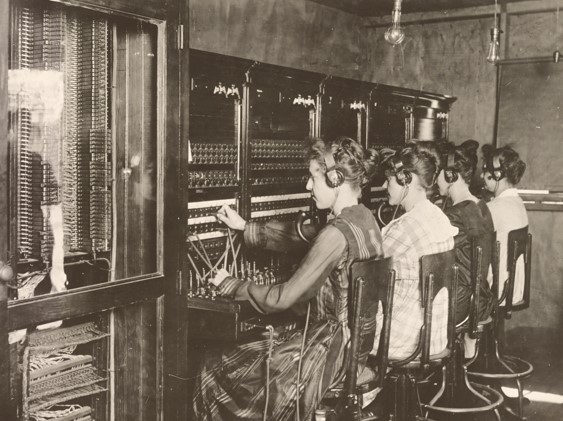
The telephone instruments and systems seem crude by today’s standards. Early telephones consisted of a separate headset and microphone. Users would pick up the receiver from its cradle and crank a handle to signify to the operator that they wanted to make a call. The operator would reply “Number Please” to determine the name or number of the party being called. The operator would physically complete the connection by plugging a cable into the slot for the recipient at her exchange board and cause their phone to ring. After briefly listening to make sure the parties were properly connected, the operator was supposed to disconnect her headset from the call. It was common knowledge that phone operators always seemed to have the latest gossip and know everything that was going on in town. Perhaps they continued to listen in to the private calls, for “quality and training purposes” of course.
Direct dial phones were not invented until the mid-1920’s and not available in Citrus County until more than 20 years later.
Citrus County’s First Telephone
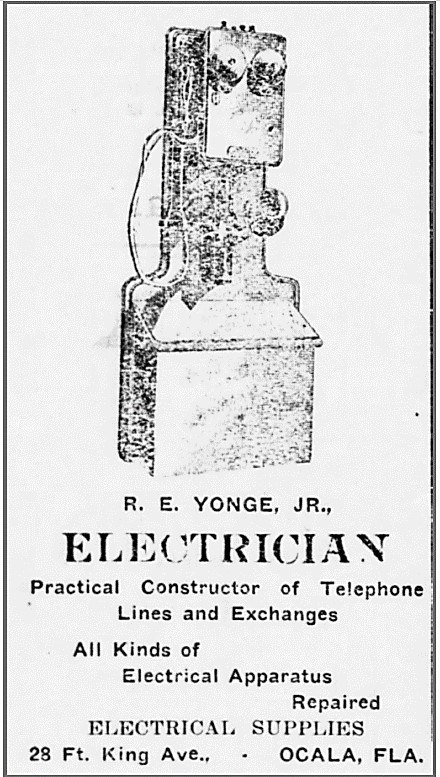
Once Bell’s patent had expired, start-up telephone companies blossomed across the country. There were few exchanges or connected networks during the early installations. Connections among customers would eventually follow, but initially private lines between customers were offered. The Ocala Telephone Company was established in 1895 and a local electrician/plumber/bicycle repairman, R.E. “Rossie” Yonge Jr., served as the Superintendent and Head Installer of the company. He set up all of the equipment and then climbed the 27-foot telephone poles (sometimes falling off the ladder) to string lines through the city. He eventually set up a switching device that provided rudimentary connection among his customers.
Yonge’s work attracted the attention of the J. Buttgenbach Phosphate company in 1898. They had phosphate mines in Citrus County that stretched from Dunnellon to Floral City. If management wanted to convey a message to one of their mines or obtain a status report, then a rider had to be dispatched to carry the paper message to the destination. Buttgenbach contracted with Yonge and the Ocala Telephone Company to install twenty miles of private lines from Dunnellon through Hartshorn, Hernando, Inverness, Floral City and Istachatta. While the Buttgenbach lines did not initially connect with the Ocala exchange, this opened the door to future expansion beyond the limits of Citrus County.
Competition and Consolidation
The typical lifecycle for new inventions includes a number of inventors forming innovative start-up companies followed by industry consolidation into a few larger businesses. The growth of telephone providers in Citrus County continued that pattern. The Florida Telegraph and Telephone Association (FT&TA) was organized in Inverness in 1901. The ambitious goal of this company was to erect lines in Citrus and Hernando counties and eventually construct direct lines to Ocala, Tampa and Jacksonville. They were soon joined by the Lecanto Telephone Company, the Citrus Telephone Company, the East Florida Telephone Company, Bell Telephone, and the Ocala Telephone company. Each of these companies were initially independent and strung their own lines across the right-of-way on the roads of Citrus County. This situation led to a landscape that was filled with power and telephone lines on the streets of Inverness and Crystal River. None of these companies had more than a few dozen Citrus County customers in the early decades of the 20th century.
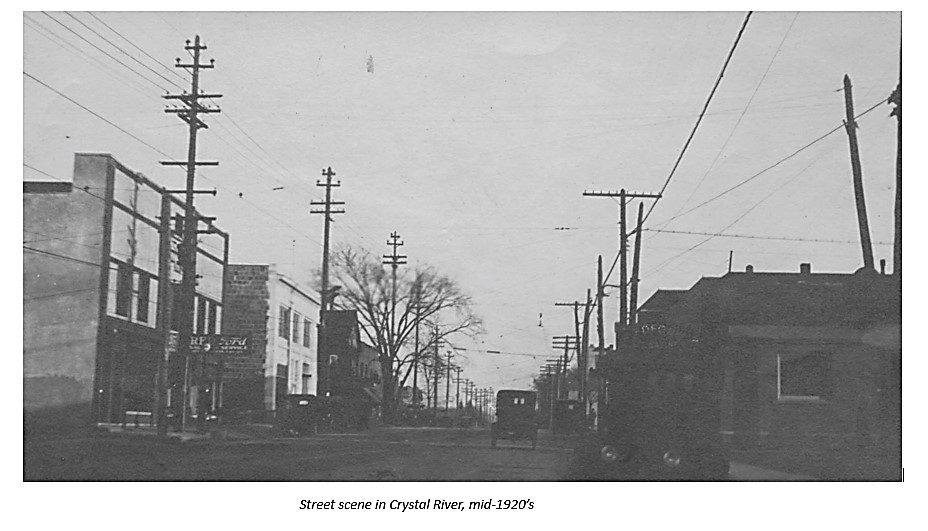
Every phone pole that was placed on county right-of-way had to be approved by the Board of County Commissioners (BoCC). If any line did not conform to location or safety standards, then the BoCC would order that particular telephone company to remedy the defect by relocating or replacing the poles. For example, the Commissioners ordered the FT&TA to remove their poles from the main road in Inverness “…as they are rotting and a menace” in 1906. None of the local companies were very profitable and were ripe for consolidation with larger entities.
In addition to the myriad telephone companies, private citizens and businesses were erecting their own lines between their neighbors. As late as 1941, Miss Gertrude Weaver was granted permission to erect poles for a private telephone between her house and Col. W.R. Taylor’s house in Floral City.
Florida Telephone Corporation
The telephone business was ripe for consolidation. A transplant from Iowa, Otto Wettstein Jr, was the man who engineered the company what would later become known as the Florida Telephone Corporation. His original intent when moving to Florida was to make his fortune in real estate. When the land he purchased turned out to be swampland (a common occurrence in those days), he had to find another way to support his family. He took a job in Pasco County with E.E. Edge who owned the tiny Dade City Telephone Exchange. Mr. Edge eventually offered the company to Wettstein. Wettstein found other small Exchanges in Central Florida and offered stock in his new company in lieu of cash. Some of these systems were little more than wires strung through trees in a farmers field to connect neighbors, but they offered the potential to grow in that area. By 1925, Wettstein had purchased the small independent telephone companies in Citrus County and merged them into the new Florida Telephone Corporation.
Slow Growth in Citrus County
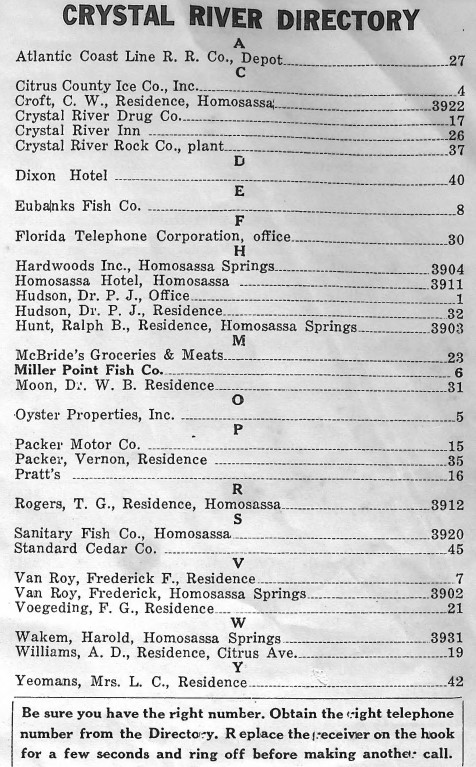
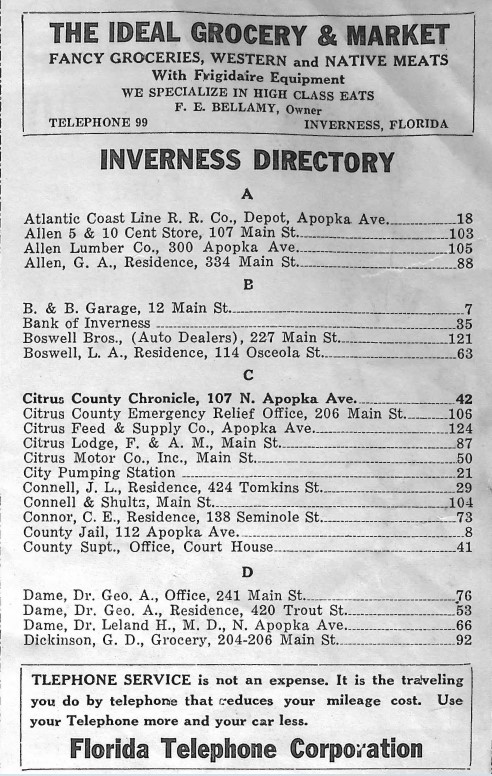
While some businesses took advantage of the new telephone, installations by Citrus County residents lagged. There were pay stations in Inverness and Crystal River for the people who only needed to make an occasional phone call. Neighbors who had residential phones would help others in times of need. Prices were perceived to be too high for common people at that time. The Florida Telephone Corporation directory for 1935 shows only about 60 phones in operation in Inverness and 30 installations in Crystal River.


An Interesting Marketing Campaign
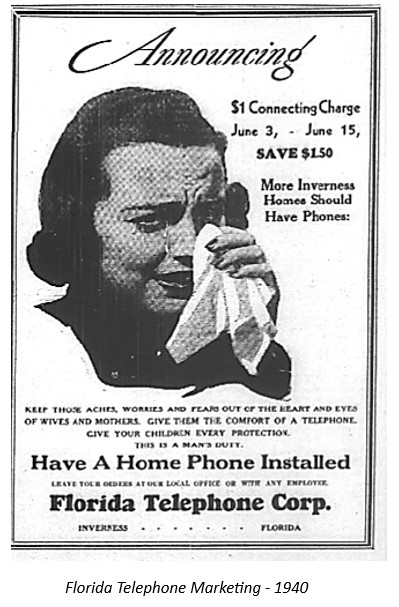
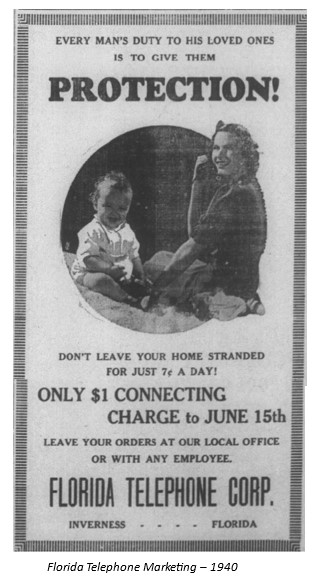
Florida Telephone decided to embark on a bold marketing strategy 1940. They would embarrass any man who did not “do his duty” to protect his wife and family by having a telephone at home. The local Inverness telephone exchange ran advertisements in the Citrus Chronicle showing a crying wife who was scared apparently because she didn’t have a home telephone. Another ad proclaimed “Every man’s duty to his loved ones is to give them protection” featuring a contented baby and wife (now smiling because she has a phone). The company offered a limited-time connection discount and a low charge of just 7 cents per day. The campaign must have been successful because Inverness residents soon reported that the equipment that Florida Power allocated to Inverness could not keep up with customer usage.
Dial Telephone Service Arrives in Citrus County
Florida Telephone announced that they intended to raise rates for all customers in 1946. The Inverness Council expressed opposition to the increase during the State Utilities meetings. Company executives came to an agreement with local leaders that they would improve service in Citrus County through automated dial switching equipment within one year if county government would withdraw their opposition to the rate hikes. Accordingly, local opposition to rate hikes was revoked in February 1947 in anticipation of the upgraded service. Automated dialing would eliminate the need for operator intervention on most calls.
The year 1948 passed without the promised updates. Florida Telephone did not install the new switches until October 1949 citing one problem after another. While the switches were indeed updated, the required trunk lines were delayed until the following year.
Florida Power was eventually merged with United Telephone and became part of the Sprint network.
Confessions of a Florida Telephone Operator
Even though most calls were handled automatically through direct dialing, some people still felt more comfortable dialing “O” and having the Operator handle the call for them. Some of the operators were temporary or part-time students, especially on the night, weekend and holiday shifts. One writer reminisced about the four summers she spent as an operator for the company: “I’ll tell you a secret known to operators all over America – but rarely revealed publicly. It affects you only when you go thru the operator rather than dialing direct…. Operators listen in. The juicier the call, the more likely it’s being giggled over at the phone company. Now you know to keep it clean or at least go through the automated equipment if you’re in the mood to be intimate”
It’s no wonder why telephone operators always had the best gossip.