
Letters to the Homefront
By: Ken Marotte, Citrus County Historical Society
Soldiers and sailors relied on mail to retain their ties to the loved ones they left behind. While the uniforms, weapons and adversaries may have changed over the years, the challenges faced by our military have common themes. This is a look back at their experiences, hopes and fears expressed in letters that they sent back to the homefront.
Hurry Up and Wait
Veterans are familiar with the term “hurry up and wait”. Citrus County soldiers who enlisted during the Spanish American War were deployed to Tampa while the Army tried to decide how they should be deployed. They were told to be on high alert and be ready for action but were then transported to training camps in the forests while being held in reserve. Many of them contracted malaria and never saw military action.
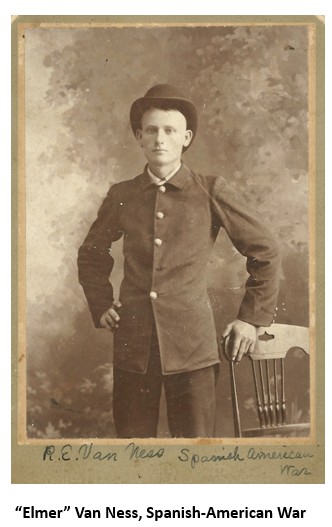
This was a familiar scenario in future conflicts. For example, J.A. Hester enlisted in the Sea Bees during World War II. He wrote to the homefolks that his status was “just sticking around which all too frequently is the plight of those being held in readiness for duty overseas.”
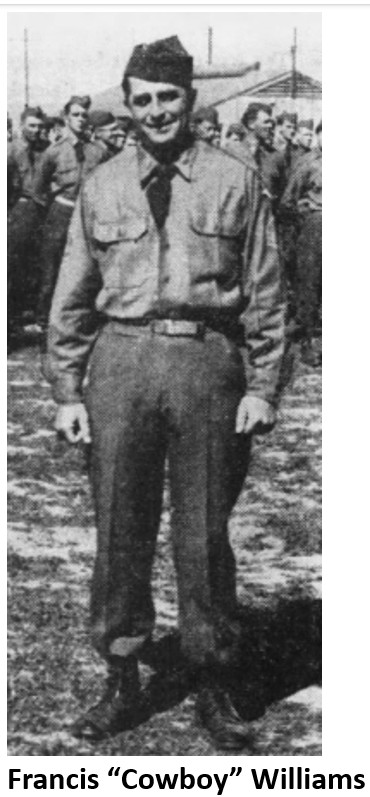
Private F.W. Williams related that his initial experience after enlistment in 1944 was like being on an assembly line where you are told to “move it” and collect your new uniform, get medical shots, learn how to salute and then shunted from one barracks to another while waiting for your first assignment. Long-time residents may remember the new recruit as the future Citrus County Clerk “Cowboy” Williams.
Williams re-enlisted during the Korean War and repeated the process again as a member of the 747th Tank Battalion.
Months of Boredom…Interrupted by Moments of Sheer Terror
WWI Veteran Charles O. Ames chronicled his training in America and trip to the battlefields of France. Orientation and training seemed to drag on for weeks until they were rousted for a quick train ride to New York. They were hustled aboard a captured German liner and brought to a port in France.
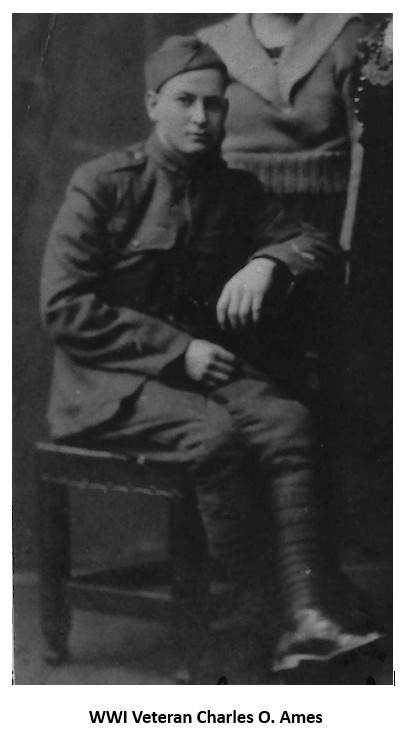
Life in France took on a leisurely atmosphere. There were long hikes across the countryside that eventually ended back at their starting point. At one point, their guide became disoriented and Ames’ group became lost in the darkness. As daylight broke, the group was surprised to see that they had blundered their way near the intended destination.
At one point their Lieutenant brought their squad to a small café where they were encouraged to try the various flavors of wine. The young farm boys wasted no time following the officer’s suggestions.
All of that relaxation came to an abrupt end after six weeks. They were loaded onto small boxcars and transported to the battlefields of Verdun. The group could hear the large artillery pieces locked in a duel as they exited the railcar. Before they could think about the strange treeless environment, they were sent to relieve exhausted soldiers in the trenches. An officer ordered them to “go over the top” and Ames’ group charged German positions. After some initial success, Ames felt the sting of a machine gun bullet rip through his arm.
Ames slapped a field dressing on his arm and reported his injury to his Lieutenant. An ambulance was called to bring him to field hospital. Not waiting for the ambulance, Ames changed the dressing and hiked alone for five miles until he reached the hospital. His wounds were not life threatening, but required transfer back to the United States for repeated surgeries. After waiting months in relative safety, Ames’s time on the battlefield was reduced to a few days watching death and injury for his squad.
Navy Ensign H. “Rabbit” Hancock wrote to his mother about his part in the invasion of Tarawa in WWII. He recounted how he was loaded into a landing craft that stopped on a coral reef off the coast of the island. He followed Marine Lt. Col. Herbert Amey into the choppy water once the door opened. Amey was cut down in front of Hancock’s eyes but the group had to keep moving toward their objective. Once the island was secure, Hancock had time to write home about his experiences and remember those comrades who fell during that assault in 1943.
Floral City’s Lt. Thalmann wrote to his parents about his role in the recapture of Luzon (Philippines). He was severely wounded during the invasion and “was a bloody mess” but felt lucky because he saw his men lose their lives during the assault. He was bed ridden at the time and realized that he would need more operations before he could walk again. He wrote that he felt sad that he couldn’t help his men who were carrying on the fight.
Mail Call
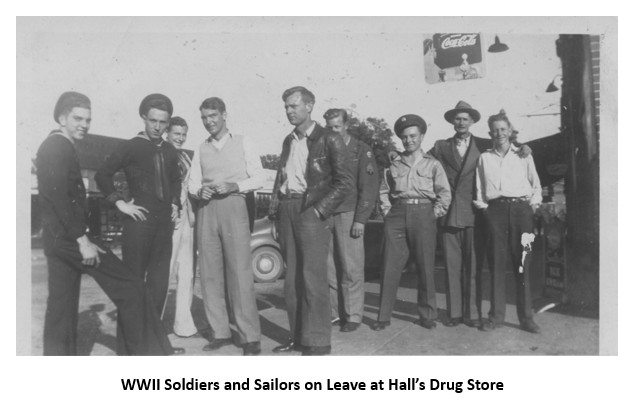
Letters and packages from home became a lifeline for all soldiers and sailors regardless of the conflict where they fought. Marine Gunner Edward Anderson, who grew up in Crystal River, received a bag full of birthday cards from his friends in Citrus County in 1943. He remarked “It makes a fellow feel good to know that he is remembered by friends back home when he is on the other side of the world”.
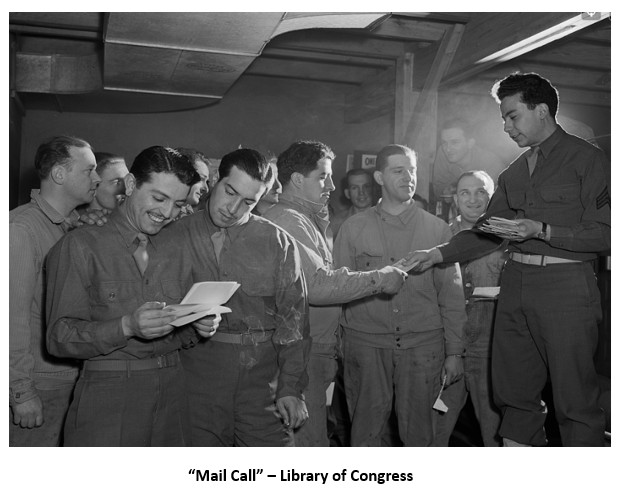
Soldiers in Seoul Korea noted that they advanced so quickly that it sometimes took weeks for the mail to catch up with his company in 1950.
The Citrus County Chronicle regularly carried the military post office address of our native sons. The mail may have taken a while to reach the recipient but instantly boosted the morale of soldiers and sailors to read a message from home.
Care packages from home were particularly prized. Cpl. Jeffre Turner wrote in 1945 that he received a package from his brother containing “…a jar of something, I don’t know what, but I ate it and it was delicious.”
Pfc. Donald Whitacre from Floral City wrote to his mother and thanked her for all of the “sweets and good eats” during the Korean War. After fighting on the front near Inchon and Seoul, Whitacre was elated to see all of the mail that awaited him when he was sent to the rear for some well-deserved R&R.
The Chronicle’s office manager, Gladys Melzner, received a letter from her son Woody who was stationed in Viet Nam. He joked that “The cookies were good. The brownies were excellent…but the salami is the best thing that’s happened around here in a long time. Everybody wanted a slice and I could have sold a whiff for 25 cents each”
Expanding Horizons
Young men from small-town Citrus County were exposed to cultures and places that they only read about in magazines. Some soldiers stationed in France joked that they could eventually learn to communicate in French, they could not understand the dialects of the British soldiers.
Others wrote about the hospitality of the English families who invited lonely soldiers into their homes at Christmastime.
During a lull in the fighting, T/Sgt. John T. Cook regaled his parents about his success hunting deer in Burma. Other soldiers provided detailed descriptions of the lives of the people and landscape in Europe and Pacific Islands. New perspectives on other lands and cultures opened soldiers and sailors minds and changed their lives forever.
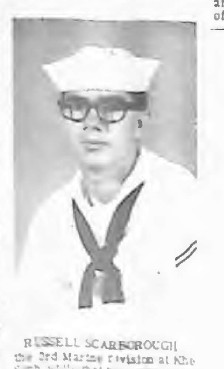
Russell Scarborough grew up in nearby Dunnellon. He was an aspiring architect but enlisted in the Navy while deciding on his career. He became a Navy Corpsman and was assigned to a Marine unit in Khe Sahn Vietnam. He sent letters to his relatives back home detailing his interactions with the residents in the area. Since they were aware he was a medical professional (“Bac Si”), the local Vietnamese – especially the children – would approach him to address various cuts and bruises. They would also crowd around him selling bottles of coke or home-made bread in exchange for C-Rations,
He wrote to his aunt in Inverness about a ten-year old girl who approached him one day. He had just finished a can of meatballs and was ready to open a can of pears. She asked for a few bites because she hadn’t eaten in a while. Scarborough knew that his rations wouldn’t be replenished for another day but wrote “…who could resist such open-eyed charm?” so he opened the can and gave her all of his pears. The two sat for a while discussing her family life before she went on her way.
Russell W. Scarborough was killed a few days later during a mortar attack on Khe Sahn in April 1968. His family received the letter detailing his impressions of the countryside and his compassionate meeting with the young girl after they learned of his death. He is buried in Inverness.
Today’s soldiers, sailors, airmen and “coasties” would welcome mail and packages from home, especially during the holiday season. There are many different organizations that provide gifts for military personnel stationed far from home. Personally, I have used https://troopster.com/.
Consider brightening their day with a package from home to let them know we appreciate their sacrifice.
Ken Marotte writes for the Citrus County Historical Society. He can be reached via email at kenmarottejr@gmail.com if you have any comments, questions or suggestions.