
Jack Carter – Floral City’s Naval Hero
By: Ken Marotte, Citrus County Historical Society
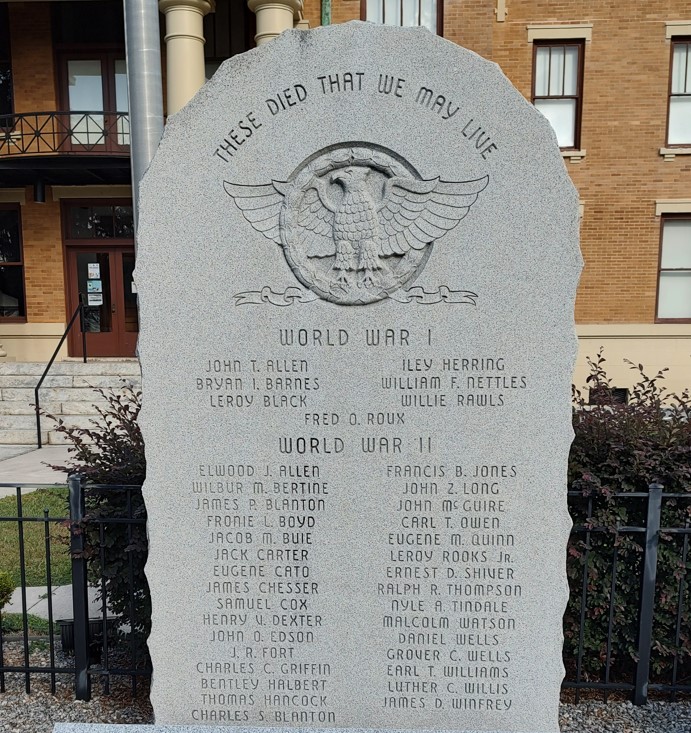
There are a number of granite memorials in front of the Old Courthouse Heritage Museum in downtown Inverness. Many visitors take a few minutes to view the names of local citizens who have given their lives in defense of this country. Every one of those names has a unique story of their life and times. This article is about one of those heroes – Navy AOM3 Jack Carter from Floral City, who was tragically killed during the Invasion of North Africa – World War II’s Operation Torch.
Early Life
Jack Carter was born in Floral City to Edward and Sadie Carter in 1923. Due to his mother’s health problems, the family relocated to Texas in the 1930’s but moved back to Floral City when Sadie Carter passed away in 1934. Carter was an excellent student and distinguished himself at Citrus High School. He was regularly placed on the Honor Roll (which required all “A’s” for that month across every subject). He was nominated by the faculty to represent the school in a nationwide contest for a 4-year scholarship to an Ivy League university.
Patriotic Duty
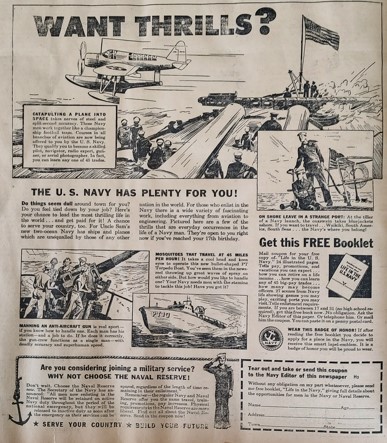
Many months before the attack on Pearl Harbor, Jack decided that he wanted to enlist in the US Navy. He took the oath in February, 1941 at the age of 19. By October 1941 he had been promoted to Seaman Second Class (Sea2C) – however due to medical issues he was aboard the Naval Hospital Ship U.S.S. Relief that month. He rebounded and decided to pursue an aviation rating and started training to become an ordnance specialist.
Desperate Times, Desperate Measures
The United States Navy was deficient in practically all types of resources when the conflict began. German U-Boats were inflicting terrible losses on merchant convoys. There were so few warships to protect the convoys that any available vessel – from converted yachts to trawlers to obsolete battleships – was pressed into guardian service. In addition, all large fleet aircraft carriers (except USS Ranger, CV-4) were assigned to the Pacific theater so naval airpower was hamstrung for Atlantic operations.
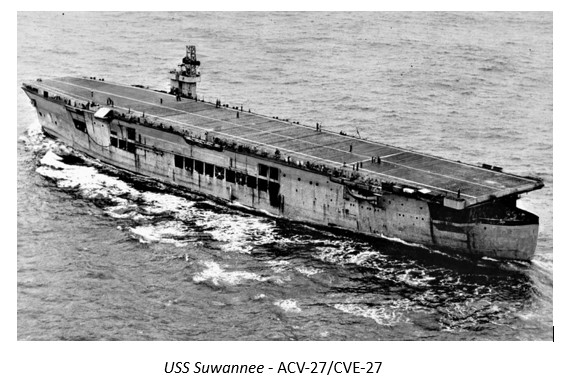
Naval strategists arrived at a solution that they hoped would fill the gap until new carriers could be built. The Navy obtained four large oil tankers and converted them into makeshift aircraft carriers. Reinforced flight decks were welded onto the tops of the former oilers. Provisions were made for elevators to move airplanes from storage below to the flight deck. Anti-aircraft guns were added to the fore and aft of the ships.
One of the new “escort carriers” was named USS Suwannee after a river in Florida. After conversion was completed, she was re-commissioned as an Auxiliary Aircraft Carrier (ACV-27, later CVE-27) on August 20, 1942. There was no time for extensive sea trials or crew training. The Allies were planning an invasion of North Africa in a few months, code named Operation Torch, and desperately needed Suwannee and her three sisters to provide air support. Less than a month after commissioning, Suwannee was headed out to sea and on her way to the African coast. Her guns had only been tested from a structural perspective and some of the civilian yard workers were still aboard. The fighter airplanes assigned to the new carrier didn’t even have time to adjust their gun sights and completed their preparations on the high seas while bolted to the deck of the Suwannee.
Jack Carter – Ready to Attack
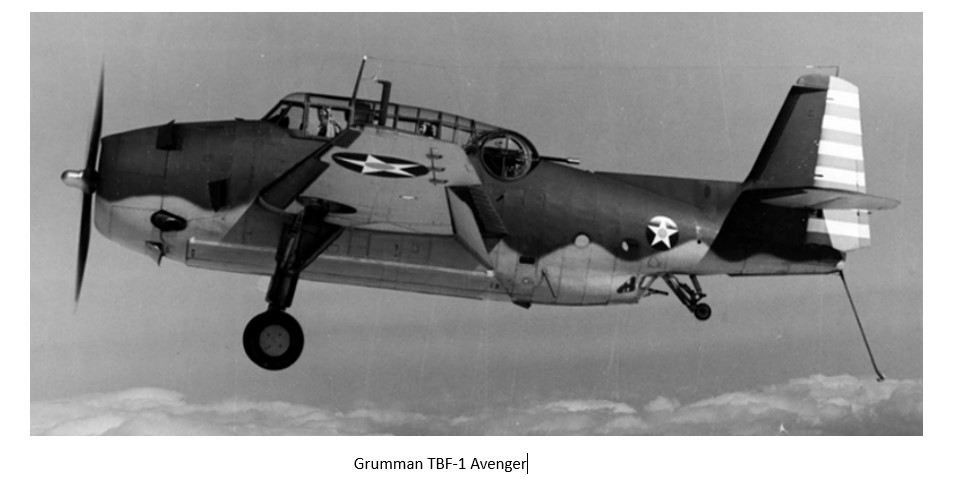
Jack Carter completed his expedited aviation training and was promoted to Aviation Ordnanceman 3c (AOM3) in 1942. He was assigned to serve as a bomber/gunner on a new Grumman TBF-1 Avenger 3-seat plane as part of USS Suwannee’s VGS-27. He was paired with pilot ENS Robert O’Neil and fellow AOM3 Walter S. Gorka. This airplane fulfilled a dual role as a torpedo / mine bomber for naval warfare as well as having the capability of dropping conventional ordnance to support ground action.
The Battle is Joined
France had surrendered to Germany before America joined the conflict. The German-allied French government was termed the “Vichy French” by the Allies. The well-trained and well-equipped Vichy French military was entrenched in North Africa and stood between the Allies and their objective of liberating that area. As the massive task force approached the coast, Allied leaders were in communication with the Vichy French commanders and urged them to forsake their German overlords and join the Allies. After internal discussions (and casting a wary eye on the German U-Boats in the area), the French decided that they would remain in league with the Germans. They refused to surrender their naval weapons, including the incomplete but potent battleship Jean Bart. Accordingly, Allied leaders decided to attack the Vichy French forces on November 8, 1942.
Jack Carter and his crew launched their TBF-1 Avenger from the USS Suwannee that day. French opposition was stiff. However, his group managed to score a number of direct hits on the Jean Bart. The new battleship USS Massachusetts (BB-59) was able to complete the work that the naval aviators had started. Carter’s plane received some damage from anti-aircraft artillery but managed to fly back to the Suwannee. Ship crew patched and refueled their Avenger. Carter’s plane set off on more bombing runs that day and continued through the day on November 9.
Disaster Strikes
There was a report of a German U-Boat in the area on November 10. Carter and the rest of the Avenger group scrambled to their planes and rose to meet the enemy. As it turns out, there was indeed a submarine in the area but it was part of the Vichy French navy. The anti-aircraft gunners on the French submarine were exceptionally accurate and Carter’s plane suffered significant damage. The Avenger was loaded with naval mines but they decided to immediately attempt a return to the Suwannee. According to reports, as they approached the carrier the plane was not able to properly hook the arrestor cables. The plane plunged over the side of the ship. The impact with the water triggered the mines and the Avenger exploded on contact. Carter, O’Neil and Gorka were killed on impact. Their remains were never recovered.
Their shipmates exacted revenge the following day and sank the French submarine that had been prowling in the area. On November 11, the Vichy French in North Africa decided they had suffered enough. They agreed to halt hostilities and join the Allies.
Carter and his crewmates received posthumous citations and medal for their actions during Operation Torch; however, that’s not where this story ends.
A New Ship – A New Honor
As World War II progressed, the US Navy determined that a new ship class – smaller and more agile than traditional Destroyers – would better protect the convoys that were destined for England and Russia. The new ships were designated as “Destroyer Escorts” (DE) to distinguish their role and attributes from the Destroyer class. While Destroyers often served multiple roles, the Destroyer Escorts were designed specifically for convoy escort and anti-submarine warfare roles. They were half the weight of a standard Destroyer, carried smaller deck guns, had a slower top speed but had a greater range. Loaded with depth charges, the DE’s became the bane of the German submarines.
The Navy decided to name the new ships after naval heroes, especially those who were killed in action. To recognize his service and honor his memory, the Navy named the next Cannon-class Destroyer Escort after AOM3 Jack Carter from Floral City FL.
USS Carter (DE-112)
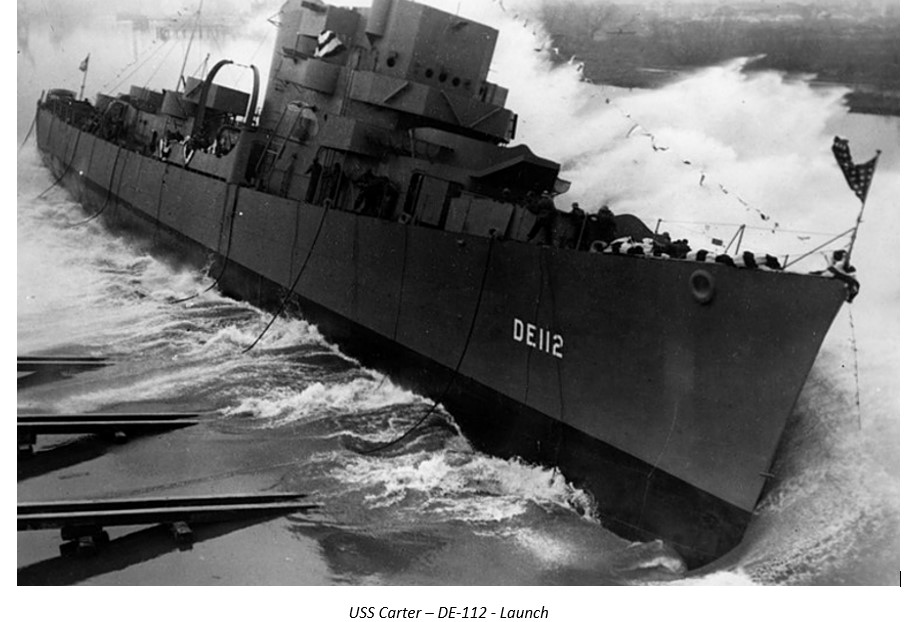
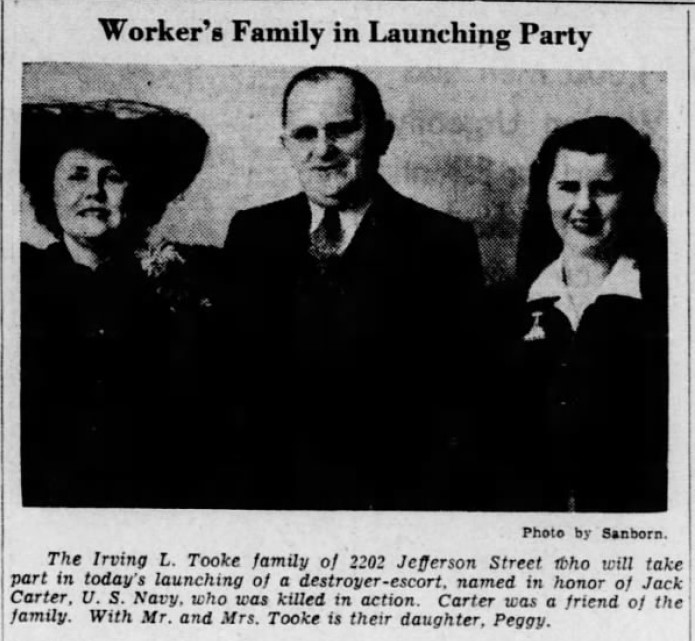
The ship that was destined to become USS Carter was laid down in November, 1943 and launched in February, 1944. Jack’s father, Edward Carter, could not attend the commissioning ceremony so Jack’s aunt (Mrs. Evelyn Carter Patterson) served as sponsor for the new ship. Edward Carter also asked his former Floral City neighbors, Irvin, Wilma, and Peggy Tooke, to represent the Carter family at the ceremony. Coincidentally, Mr. Tooke worked at the Delaware plant where the USS Carter was built.
After commissioning, the USS Carter provided protection for several convoys in the Atlantic. Her most noteworthy action occurred on April 22, 1945. The Carter detected a submerged submarine and moved in to attack the boat in concert with USS Neal E Scott (DE-769). As a result of their determined hedgehog attacks, German submarine U-518 was sunk with all hands. The submarine had been responsible for sinking nine Allied ships and damaging three ships during the War.
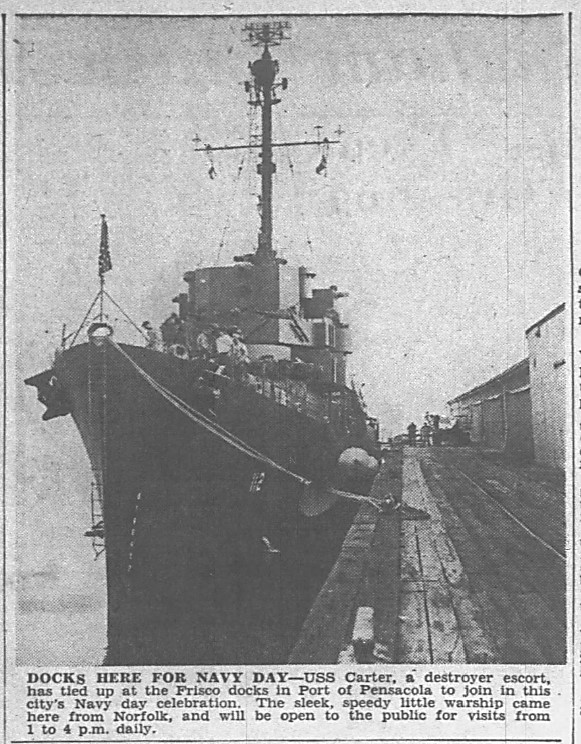
As the war was winding down, the USS Carter served as flagship of a group of Destroyer Escorts and made a port call to Pensacola FL to celebrate Navy Day in 1945. The warship was assigned to the reserve fleet at Green Springs FL at the end of the war and finally decommissioned in 1946.
Jack Carter was one of thousands of patriotic Americans who devoted themselves to securing our freedom today. We owe every soldier, sailor, marine and airman who served a debt of gratitude that can never be fully repaid.
Epilogue
USS Carter (DE-112) was decommissioned after the war but remained in reserve at Green Springs FL until 1948. She was transferred to the Republic of China (Taiwan) in 1948 and served in their Navy until 1973.
USS Suwanee (ACV-27/CVE-27) earned 13 battle stars during WWII. She was relocated to the reserve fleet in Boston after the war and decommissioned in 1959. Suwannee was sold for scrap in 1962.
USS Ranger (CV-4) served in the Atlantic theatre through most of the war. Erroneous reports of her sinking embarrassed Adolf Hitler when he found that she was still afloat after a nation-wide bulletin about her demise. After serving in a training and transit role, she was sold for scrap in 1947.
USS Massachusetts (BB-59) was decommissioned in 1947 and can be visited at Battleship Cove, Fall River MA
USS Slater (DE-766) is the only remaining Destroyer Escort moored in the USA and can be visited on the Hudson River, Albany NY
Jean Bart was repaired by the Free French Navy and served as a training ship. She was scrapped in 1970.