
By Ken Marotte
Citrus County Historical Society
What is today considered downtown Inverness was actually three distinct and separate historical villages: Tompkinsville, LaBelle and Inverness [see Plat map from 1887, below]
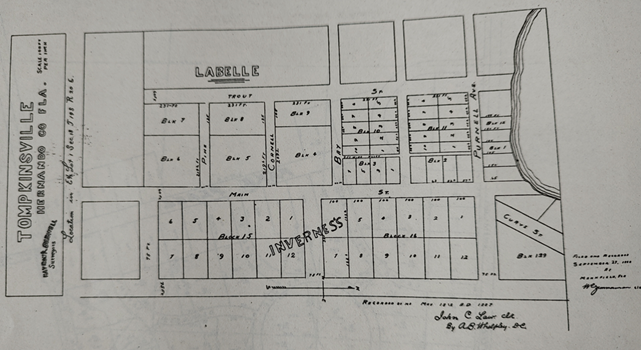
While Tompkinsville and Labelle are specifically mentioned in deeds and newspaper articles prior to 1887, there are no references to a village by the name of Inverness prior to 1886.
These three villages were considered separate entities both before and after the designation of Inverness as the county seat in 1891. They did not automatically merge into Inverness at that time. The “Town of Labelle” was taxed by Citrus County as a separate entity into the 1920’s. Tompkinsville continued to be listed as the voting district that encompassed Inverness and roads continued to be referred to that town as a destination point.
There are many stories, myths and legends regarding how Inverness received its name. This ambiguity is fueled by an absence of surviving records from any person or group claiming responsibility. Let’s examine the stories that have been published over the years to see if we can unmask the most likely source of our county seat’s name. We’ll evaluate each claim based on:
- Is the story related to a specific identifiable person or group?
- Did the person live or own property in the Inverness area during the 1880’s?
- Was the person respected in the community?
- Was the person politically connected or economically powerful?
- Did the person have some affiliation with Scotland in general, and Inverness in particular?
The Lonely Scotsman
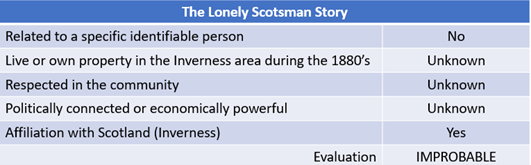
The most common legend is that a lonely Scotsman, gazing upon Lake Tsala Apopka, lamented that it reminded him of a Loch near his homeland in Inverness. Based on that man’s offhand comment, everyone in the area decided to name that section of Hernando [later Citrus] County “Inverness”.
Who was the mystery Scotsman? Was he passing through the area or did he own property near the Lake? When did he make his remark? Was he somehow connected with the political leaders of the town? The scarcity of evidence leads to substantial doubts about this story. There is not enough information to either prove or disprove this story.
The Scottish Blacksmith
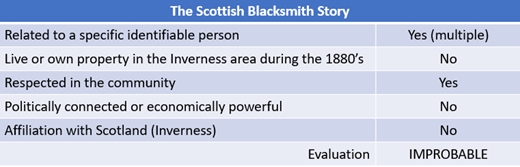
An article published in the Tampa Bay Times (November 1, 1959) quoted a former State Attorney for Citrus County asserting that “…an old blacksmith, born in Inverness Scotland, gave the town its name.”
There was a Florida census conducted in 1885. The results of the Federal Census of 1880 and 1900 are also available. Reviewing the population entries for Hernando/Citrus County, there were a number of people who were blacksmiths. I could not find any blacksmith who met the criteria for probable candidates.
In addition, I checked those census records for any resident of the Inverness area who was either born in Scotland or had parents born in Scotland. While there were several citizens of Scottish heritage, their family trees indicate that they were from the southern section of Scotland (far from Inverness) or did not meet the other criteria.
Mattie Baker

Another possible candidate has been mentioned in past histories of Citrus County. A school teacher named Mattie Baker, of Scottish origin, supposedly remarked that Lake Tsala Apopka reminded her of Inverness and, of course, the town in Hernando/Citrus county should be similarly named.
Martha H “Mattie” Baker was born in Georgia about 1841. She lived with her father, Early Baker, and extended family in Troup County GA. On December 30, 1884, the entire Baker clan (father Early, mother Martha, Mattie, her brothers Marcus and Edward Baker) relocated to the Tompkinsville FL area. Their relocation was prompted by Early Baker’s health and the chance for the younger Baker’s to take advantage of the new business opportunities our area offered.
When the establishment of “Tompkinsville Academy” was approved on April 6, 1885, Mattie Baker was hired to be the sole teacher. In keeping with the requirements of the period, she was not married and her wage requirements were minimal since she continued to live with her parents. By July 1886, Early, Martha and Mattie Baker had purchased a home in Labelle.
Her brother, Edward H. Baker, quickly found his way into the Citrus County elite. He was designated as Justice of the Peace in 1887 and assigned by the Board of County Commissioners to oversee the construction of the first Inverness Courthouse in 1891. He was appointed Sanitary Inspector in 1894. Most importantly, he was elected as a Director of the Florida Orange Canal and Transit Company – the de facto leaders of the county – after the designation of Inverness as the county seat. His property was located in the new village of Inverness (across the street from the site of today’s Old Courthouse Heritage Museum).
Mattie Baker moved back to Troup County and by 1899 was living in LaGrange GA.
While it is certainly clear that the Baker family was well positioned to influence the naming of Inverness, there is no evidence that Mattie Baker, or any of the Baker family, had any ties to Scotland. Their family trees indicate that they had no relatives that were either born or lived in Scotland as far back as the 1750’s. There is no evidence that any of the Baker family ever visited Scotland. None of the available traveler’s manifests show Mattie Baker traveling to Scotland, although that assessment may change as more historical resources (diaries, newspapers, manifests) become available.
Alexander Bronson Campbell

Most Citrus County historians are probably surprised to see an unfamiliar name such as A.B. Campbell’s name associated with the naming of Inverness. Who was Campbell and how was he connected to the new village of Inverness?
A clue can be found in the aforementioned article published in the Tampa Bay Times (November 1, 1959). One of Citrus County’s oldest residents, Jim Priest, was related to one-time Florida Orange Canal and Transit Company (FOC&T) president Jacob “Jake” Landrum. His father, James Priest, was the Sheriff that was also involved with the FOC&T. These connections enabled the younger Priest to have unique insights into the backroom stories regarding Citrus County.
When asked about the origins of Inverness, Priest claimed “there was a Scotsman, President of the Florida Orange Transit Canal Company…he named it for the town in Scotland”. However, it appeared that FOC&T President “Jake” Landrum had no ties to Scotland.
Further research shows that the leadership of the FOC&T had changed several times since it was formed in 1884. While organized by local politician Austin Mann, most of the original officers and investors were from Jacksonville FL. They made substantial purchases of land in the area of Tompkinsville, Labelle and what is now Inverness. The President of the FOC&T at the time of Citrus County’s birth was former Governor George F Drew of Jacksonville. However, his family tree did not include any Scottish connections.
The Secretary of the FOC&T was Jacksonville investor Alexander Bronson Campbell. While he came to Florida by way of Canada, both of his parents were from Scotland. His maternal line came from the Inverness Scotland area and he had visited his relatives in that country.
In addition, leaders in Citrus County were promoting the area as “The Highland County” which fit in well with the naming of village of Inverness – reminiscent of Scotland’s Highlands.
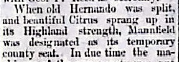
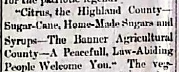
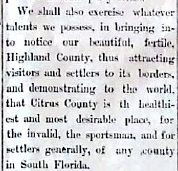
During the many elections to determine the location of Citrus County’s seat, the FOC&T offered $5,000 (over $160,000 in 2023 dollars) to the voters for courthouse construction if they would name Inverness as the new capitol.
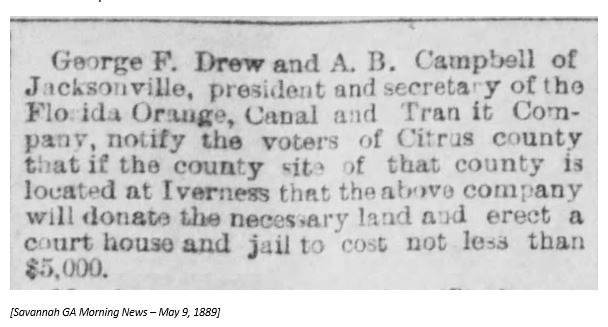
This offer resulted in hundreds of votes being cast for Inverness. However, a majority of Citrus County voters could not agree on the courthouse location until 1891. By that time, outsider investors such as Drew and Campbell had been replaced on the FOC&T board by local leaders such as Landrum, Priest and E.H. Baker.
While there are no records that positively identify the person who bestowed Inverness with its name, the preponderance of evidence points to the Florida Orange Canal & Transit Company – specifically Director/Secretary Alexander B. Campbell, as the most likely source.