
Homosassa’s Riverside Lodge
By Ken Marotte, Citrus County Historical Society
Riverside Lodge – Background
The story of Homosassa’s Riverside Lodge began with mercantile guru Benjamin F Dutton. His company, Houghton and Dutton, was a Boston landmark for years. The store was housed in a multi-floor building prominently located in the center of the city. They carried just about anything that the consumer wanted and heavily advertised their discounted sales in the regional newspapers. The store was a destination in snowy Massachusetts where families could bring their families and spend an entire day while purchasing the latest finery and everything else the shoppers needed. There’s a good reason why this building and business blueprint might resemble Macy’s in New York City – S.S. Houghton formerly managed the Macy’s store in the past and replicated that setup in Boston.
This formula made Benjamin Dutton a very wealthy man. In addition to a palatial family estate in Malden MA, he had a large summer “camp” in New Hampshire that would cost millions today. The Dutton and Houghton families cast their eyes southward to Florida to escape the harsh New England winters. Both B.F. Dutton and S.S. Houghton are listed as guests at A.E. Willard’s Homosassa Inn in 1887. Dutton eventually built a luxurious winter retreat in Homosassa containing 14 rooms on several acres of waterfront land.
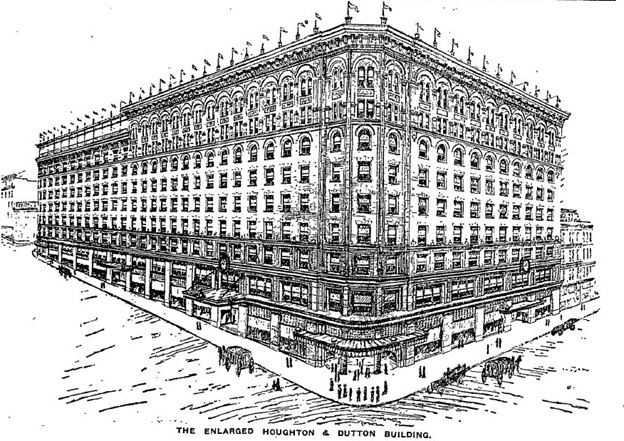
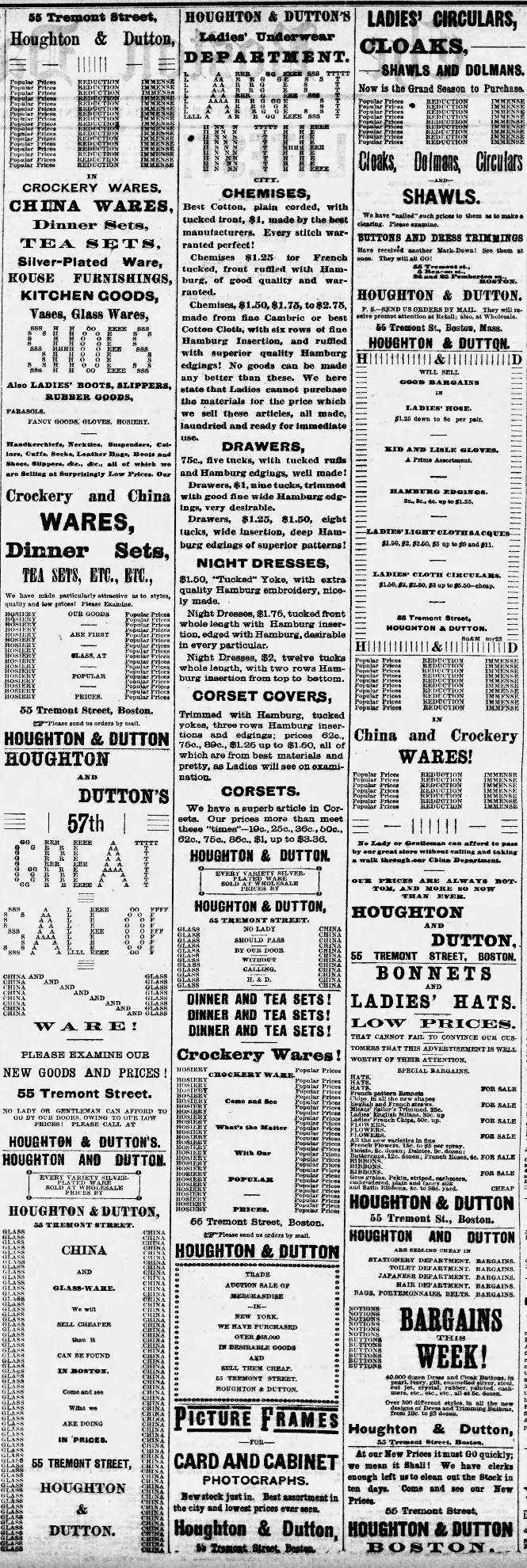
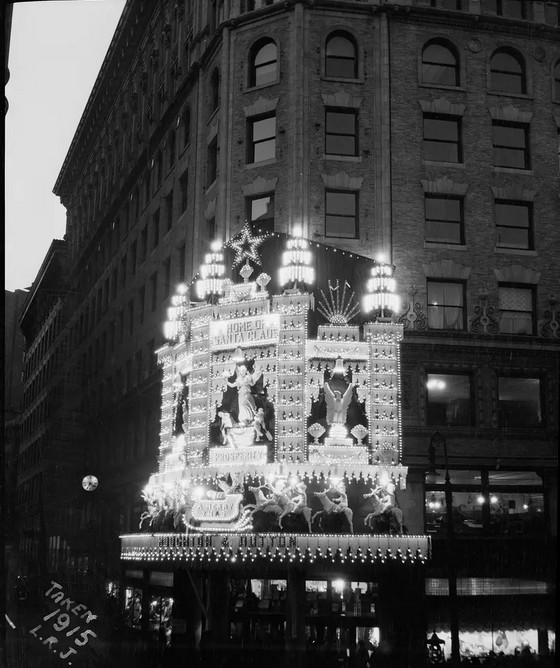
A Victorian Gentleman and Master Marketer
B.F. Dutton took advantage of the recent Homosassa railroad extensions to transport his entire family (and many friends) to Homosassa for the winter season. A special Pullman car took them from New England to the warm shores of Homosassa. They enjoyed the exceptional fishing that the area offered, as well as bountiful hunting. Mr. Dutton once shot a huge alligator during an expedition. The gator was brought back to Boston, preserved by a taxidermist and displayed in the window of Dutton’s store. Up until that time, these reptiles only existed in the imagination of the crowds that traveled to Tremont Street to see the 12-foot-plus beast. This proved to be another bit of masterful marketing on Dutton’s part.
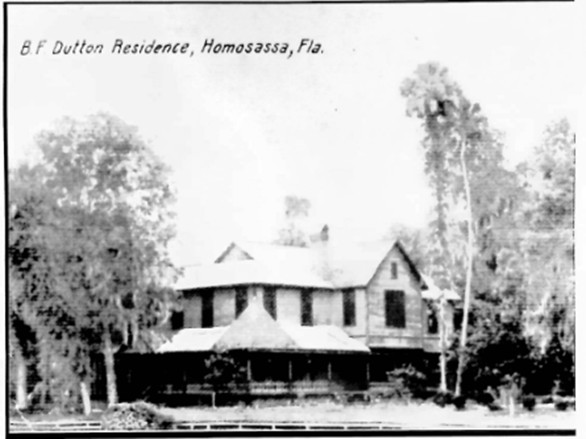
fish into the boat. That fish was mounted and received a similar treatment as the alligator.
The family brought their cooks, maids and servants along to make their time more enjoyable in their winter home. Staff members would prepare the house prior to their arrival. They brought their hunting dogs to help track quail. The Dutton’s employed local guides to maximize their experience on the river and fields near their home.
B.F. Dutton continued to make the trip to Homosassa every year until his death in 1915. The family decided to sell the house and property in 1916 to settle his estate. A Real Estate advertisement from that year provides a detailed view of the comfort features that the family enjoyed during their time in Citrus County.
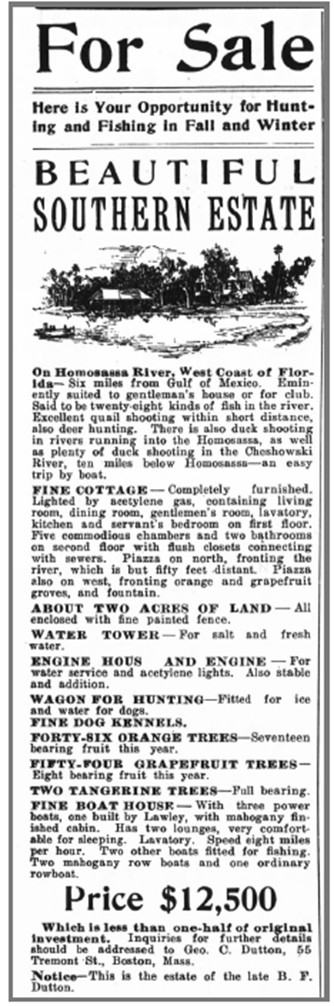
[The_Pinehurst_Outlook_Sat__Dec_2__1916, via Newspapers.com]
There are inconsistencies in some of the recent historical accounts for B.F. Dutton and this property. Some articles indicate that he built his Homosassa winter home in 1885. Some indicated that he was a member of the Homosassa Company which fostered the first wave of development in that town. Land records indicate that Dutton did purchase a single Homosassa lot in 1884, but the bulk of his extensive land purchases occurred in the 1891-1894 timeframe. This would seem to indicate that his expansive home and docks were built in the mid-1890’s. Also note that he was listed as a visitor at the Homosassa Inn in 1887 and 1892. He would not have needed to stay at the Inn if he had completed his home in 1885.
There is an original entry for the Homosassa Company on the official State of Florida / Department of Corporations site. An 1888 newspaper advertisement by the Homosassa Company also listed their entire Board of Directors. B.F. Dutton’s name does not appear on either resource.
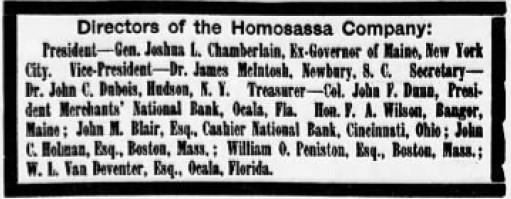
[New York Sun, February 18, 1888, via newspapers.com]
One newspaper report from the 1960’s referred to Dutton as “an old sea captain”, which probably would have amused him considerably.
Kansas City Magnate Purchases Property
The next owner of the Dutton house was Walter S Dickey of Kansas City MO. He was owner of the largest clay drainage pipe company in the world. His enterprise was established at the perfect time in American history – coinciding with the explosive growth of paved highways and the drainage systems that would be needed to make them passable in rainy seasons. He parlayed his millions in profits into other ventures, such as real estate and purchase of the influential Kansas City Journal-Post newspaper
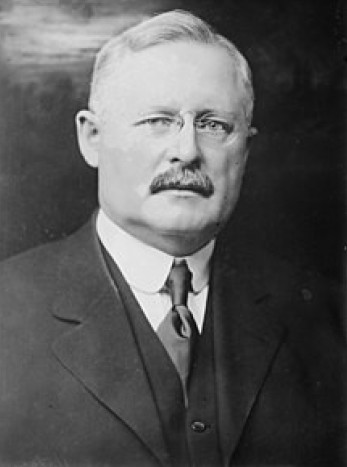
[Wikipedia – Walter Simpson Dickey]
During his tenure as owner of the newspaper, he won a landmark decision in the Unites States Supreme Court – United States v. Dickey 268 U.S. 378 (1925) – that confirmed the right of newspapers to publish the public tax records of influential people, such as politicians. The impact of this decision continues to be felt to the current day.
It appears that Dickey visited his Homosassa lodge on an infrequent basis. His Florida trips usually involved the state’s East Coast resorts. He passed away in 1931, but the property stayed in the Dickey / Sharp families for several years after his death. When the next generation of the family retired in 1938, they sold their newspaper holdings as well as the former Dutton residence in Homosassa.
Transformation to a Fishing Lodge
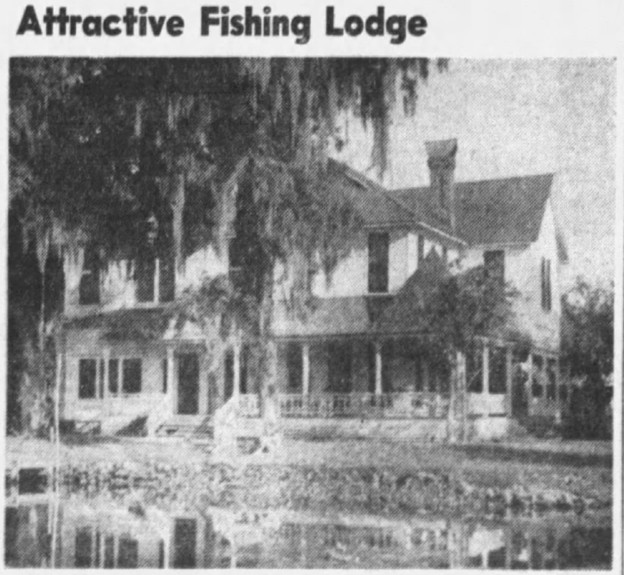
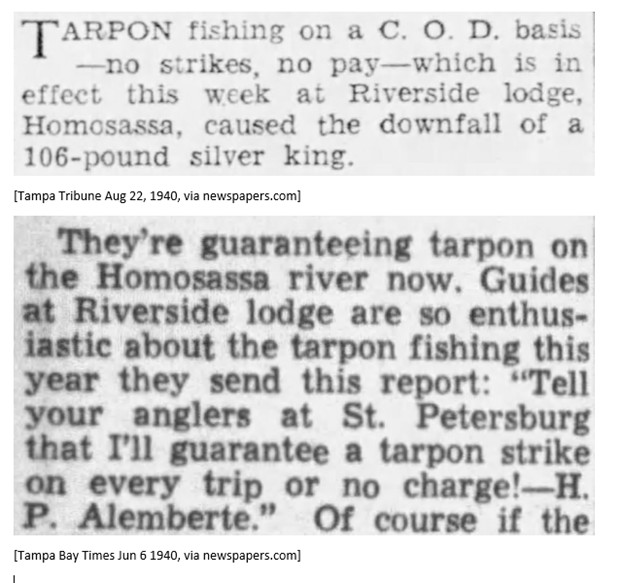
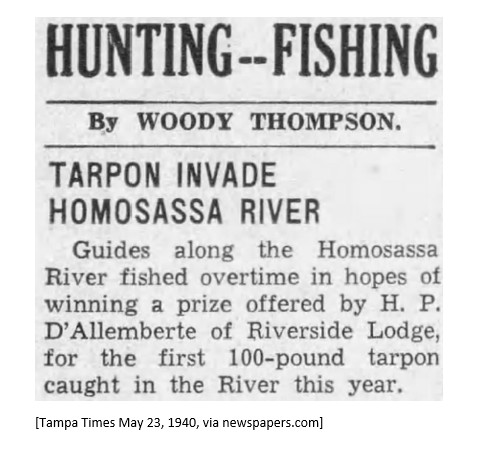
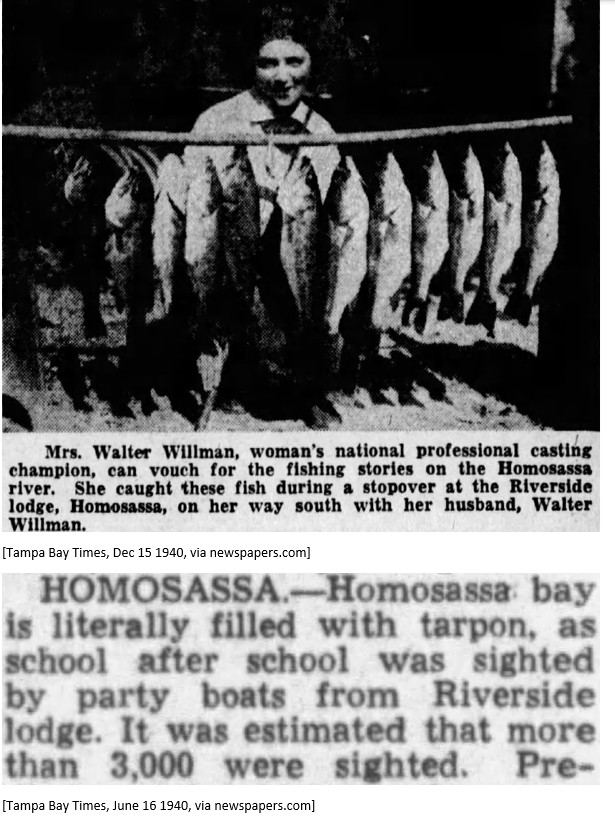
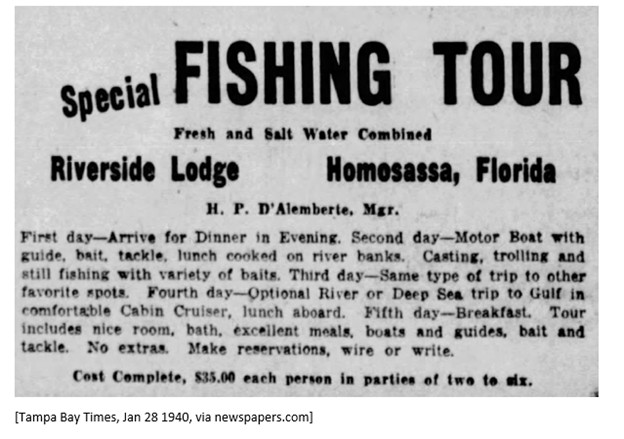
H.P. D’Alemberte managed the renamed Riverside Lodge in the late 1930’s. He understood the challenges of marketing in a competitive environment and had a number of innovative ideas to bring in customers. D’Alemberte featured a weeklong “guaranteed catch or you don’t pay” event that was touted in the Tampa newspapers. He offered a cash prize for the first 100-pound tarpon caught at his lodge. He heavily promoted a visit to the Riverside Lodge by the national men’s and women’s casting champions and made sure that their catches were featured in local newspapers. He created a popular all-inclusive five-day fishing package that included a room at the Lodge, all meals, guides, boats, bait and tackle for $35.
D’Alemberte decided to sell the Riverside Lodge in 1941 to L. Chaney. He was concerned that a new law allowing expanded net fishing on the river would negatively affect limit the catches for his hook-and-line clientele.
The Rise of Chaney’s Riverside Lodge
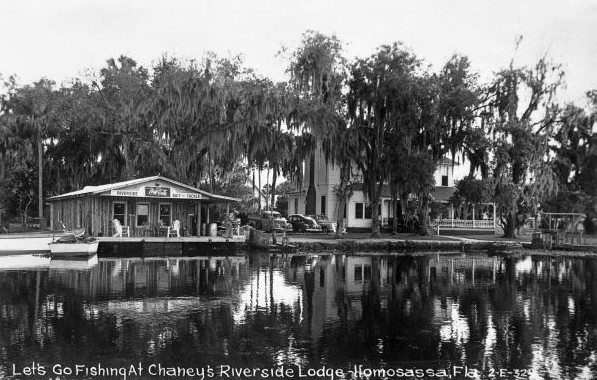
L Chaney was the next owner of the Lodge. He proved to be a popular resort owner. He always used his first initial and people speculated about his first name. Coincidentally, a famous movie star named “Lon” Cheney starred in blockbuster “The Phantom of the Opera” and “Hunchback of Notre Dame” movies a few years earlier – so “Lon” became the Homosassa Lodge owner’s nickname. His given name was actually “Lafilse” Cheney.
[Florida Memory, ca 1940’s]
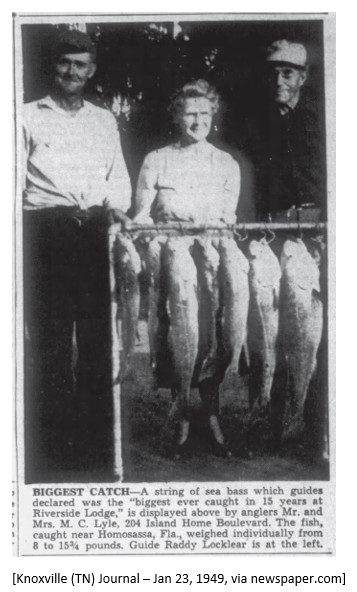
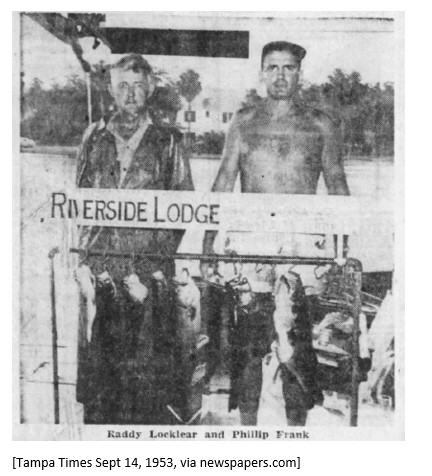
Chaney expanded the public profile of the lodge during his tenure. He marketed the property by making sure that pictures of his visitors catch appeared in their local newspapers, which generated more interest and potential customers.
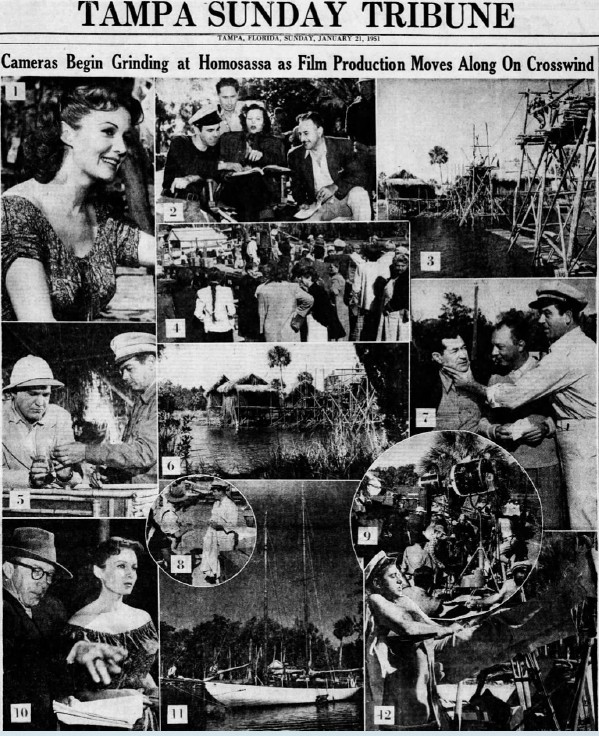
Perhaps the greatest “claim to fame” for the Riverside Lodge during L Chaney’s time was the resort being selected as a central site for activities during the shooting of the 1951 “Crosswinds” movie. Local citizens crowded Homosassa to watch the proceedings and some were hired for bit parts. One local boat captain managed to insert his craft in the background of every scene. The exasperated Director hailed him to come ashore and asked how much money the boater usually made in a day. Upon hearing the amount, the Director promptly paid the captain twice his daily earnings – and told him to sit in a chair at the Riverside Lodge and not move all day!
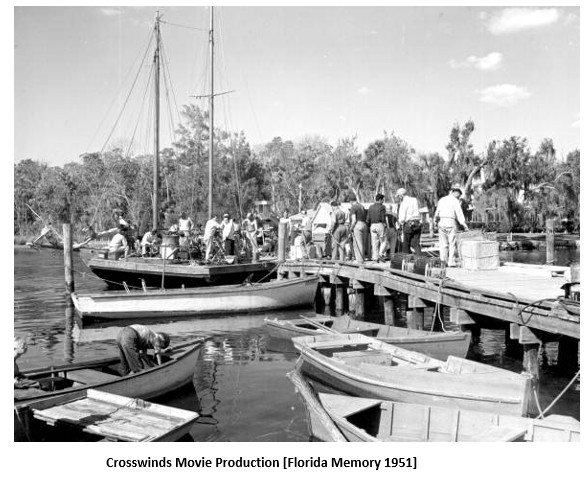
Homosassa was asked to provide accommodations for 115 movie actors and technicians. The stars of the film – Rhonda Fleming, John Payne and Forrest Tucker – stayed at Cheney’s for the duration of the shoot. According to reports, L Cheney actually had an unplanned bit acting part. During a break in the shooting, Cheney overheard actor Forrest Tucker ask for some water. Cheney went to the back of the lodge to get a glass of ice water for Tucker, unaware that the break was over and shooting had resumed when he returned. Cheney walked over to Tucker’s table, placed the glass of water on the table, and walked away. The Director liked Cheney’s unexpected acting chops and left the scene in the finished film. (Those of us who watched TV in the 1960’s will recognize Forrest Tucker as Sgt. Morgan O’Rourke in the “F Troop” show.)

Riverside Lodge’s Famous Guides
Visitors selected fishing lodges based on their guide staff and much as the accommodations. Guides provided an important role because they know where the fish are biting, what bait works best, and what time of day is optimal for each type of fish. The guides at the Riverside Lodge were well-known and had a reputation for making sure their customers left full and happy. It was common for a guide show where to catch the fish, pull up to an island in the river and prepare a meal for the fishermen using their catch. They would add fresh hush-puppies, beans and salad for an al fresco dining experience visitors would not soon forget.
Some of the guides listed in local newspapers included: Eustis (Raddy) Locklear; Capt. Wiley Locklear; Capt. Clyde Locklear; Harley Williams; Riley D Head; Capt. Leon Head aboard the boat “Sheila-Ann”; Bill Trotter; Elmo Cash; and Pete Richards.
The Fate of the Riverside Lodge
A string of different owners managed the Riverside Lodge in the 1950’s and 60’s. Roy Stallings and Ray Randall bought the property in the early 50’s and renamed to “Randall’s Riverside Lodge”. The Winchesters purchased the lodge from Roy Randall in 1956 and listed it for sale the following year. Ron Shillings and Jack Deters assumed operations after that time.
The Norris Development Company (a subsidiary of Norris Cattle Co) purchased the property in 1963. They changed the name from Riverside Lodge to Riverside Villa in February 1964. The company subsequently announced plans for a larger and modern Riverside Villa Recreation Complex. Their plan included a 150-seat conference center, hunting facilities, fishing boats, restaurant and new tackle shop. A separate Riverside Villas Hunting Preserve, where people could pay to hunt on a daily basis, would complement the complex.
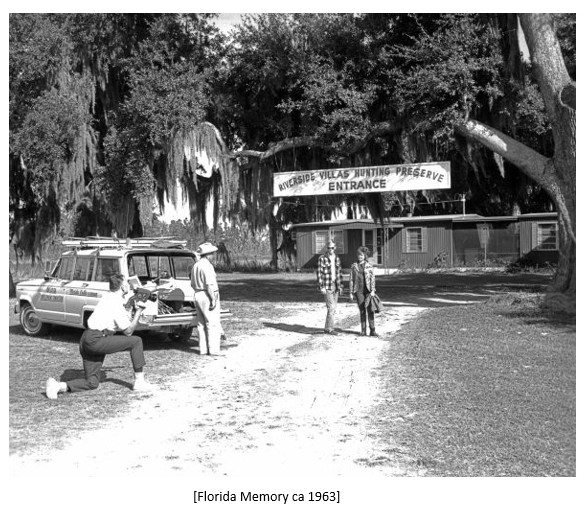
B.F. Dutton’s architectural gem was showing its age by the mid-1960’s. The large Victorian mansion didn’t fit in with the expansion plans of the Norris Development Company. It was only a matter of time until the company announced their plans to demolish the old Riverside Lodge in December 1965. Unfortunately, this relic of the nineteenth century is now gone, but not forgotten by long-time Homosassa residents. The spirit of the old Riverside Lodge lives on today at the Florida Cracker Riverside Resort in Homosassa.
Ken Marotte writes for the Citrus County Historical Society. He can be reached via email at kenmarottejr@gmail.com if you have any comments, questions or suggestions. Contact him if you’d like to participate in the ongoing CCHS Oral History Project.