
Hi-Tech Citrus County – 1950’s style
By: Ken Marotte, Citrus County Historical Society
It’s hard to imagine a world without smart phones and the internet. It’s fun to take a step back and remember some of the “high-tech” devices that captured the imagination of Citrus County residents in the 1950’s. While they may seem quaint, the advances made during that time paved the way for the technology used today.
Radio Was Still King – For the Time Being
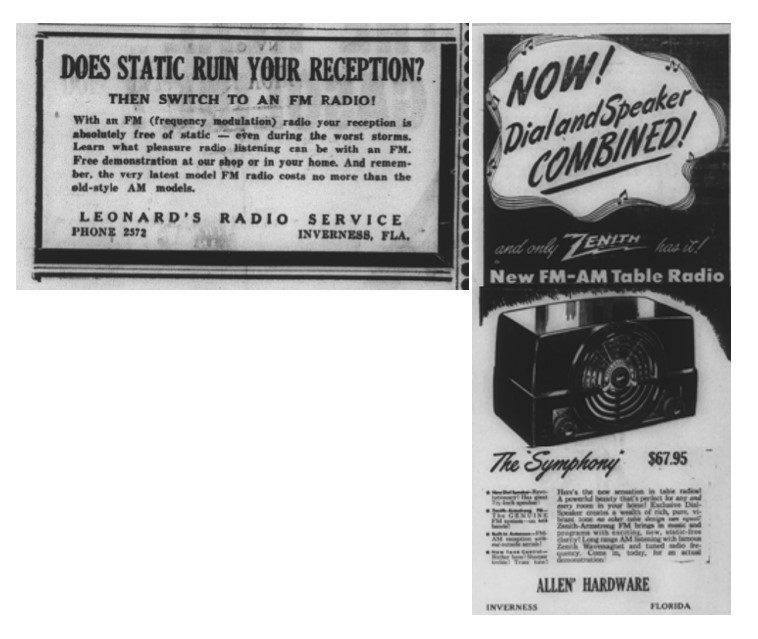
Radio remained the main source of entertainment at the dawn of the decade. While there were some small portable radios, many families had a large radio console that was as large as a piece of furniture. Most of those devices used the popular AM radio band which was frequently subject to interference during storms as well as static when someone near the radio used an electronic device such as a mixer. An alternative FM radio band was made available in the 1940’s. FM radio had a shorter range but offered clearer transmissions. By 1950, merchants such as Leonard’s Radio Service in Inverness were touting the benefits of the new FM radio. Even in those days, a small AM/FM portable radio could cost the equivalent of $400 – $850. AM remained the predominant medium for radios until the 1970’s when it was surpassed by FM’s superior quality.
The Birth of Television
No other device had a significant impact on America in the 1950’s than television. There were relatively few owners of this experimental gadget in the late 1940’s but by the next decade everyone could see that this would change the country’s entertainment habits forever. There was little interest in Citrus County at the time because the television sets were very expensive and there were no stations available in our county. That situation changed when Jacksonville’s WMBR started broadcasting in late 1949. The signal was relatively weak and even the eastern parts of the county were over 110 miles from the station. Given the right circumstances, however, a well-equipped viewer might pick up a signal in Inverness. On some nights, a small number of Tampa users picked up the WMBR’s signal. Surprisingly, there were no stations in Tampa at that time.
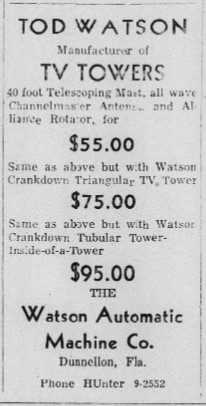
Since television signals were directional and could be impacted by landscape, a substantial antenna was required. Most antennae of that era were between 30 to 60 feet tall and were pointed in the direction of the television station. That meant if a pioneer user wanted to reach stations located in different directions, then multiple antennae would be required. This problem was solved later by the creation of the rotary antenna. A small motor would be used to manually move the antenna into the exact spot required for each station. A basic model would cost the equivalent of $600 today.
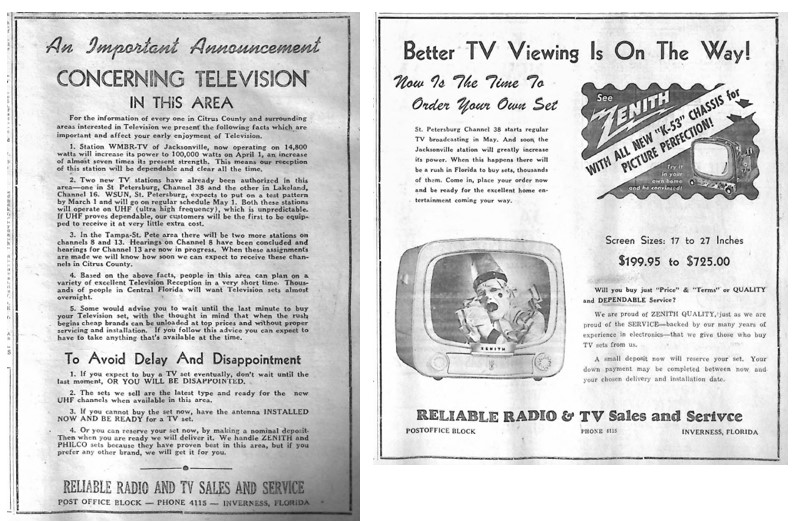
The expansion of television stations into new areas was delayed by the Federal Communications Commission (FCC). They implemented a freeze on approvals for new licenses in 1948. Stations that were in the process of being brought online before the freeze date could continue. Accordingly, a weak UHF Tampa station (WSUN) was allowed to start operations in 1953. Jacksonville’s WMBR was granted a substantial increase in power. This meant that television viewers in Citrus County might be able to access two stations now, assuming that the weather cooperated.
Citrus County’s television sales and repair shops sprang up in 1953. Reliable Radio and Television Repair, located on the Post Office block in Inverness, informed residents about the impending growth of programming options and urged people to purchase their TV sets soon to avoid the rush that would certainly follow. Most sets at that time were 17” and could be purchased for the equivalent of $2,300. They also offered a gargantuan 27” model for the equivalent of $8,400.
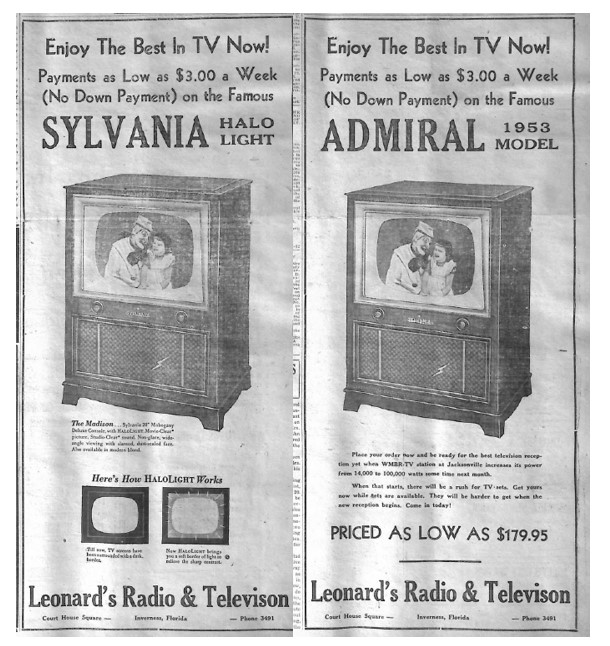
Not to be outdone, Leonard’s Radio and Television, located on Courthouse Sq in Inverness, offered Sylvania and Admiral console sets for the equivalent of $2,100. Since the cost might be prohibitive for most people, payment plans of $3 per week were offered as an inducement.
Limited Program Options
A review of the Television Program listings for 1954 report a very limited number of choices. Sports programs dominated when available but defaulted to local programming and network drama shows on most days. Soap operas such as “Love of Life”, “Search for Tomorrow” and “Guiding Light” became a staple in the afternoons. NBC’s “Today” show had debuted on January 15, 1952 and was offered to Citrus County viewers on Jacksonville’s WMBR.
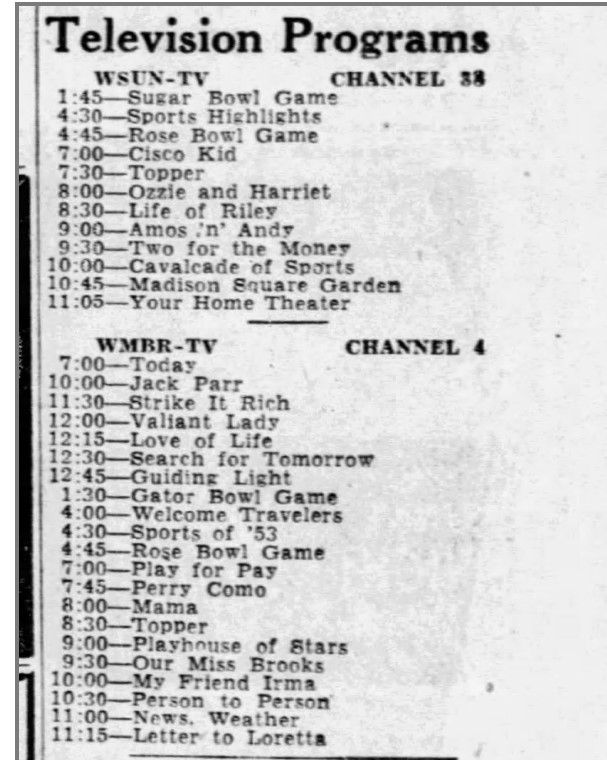
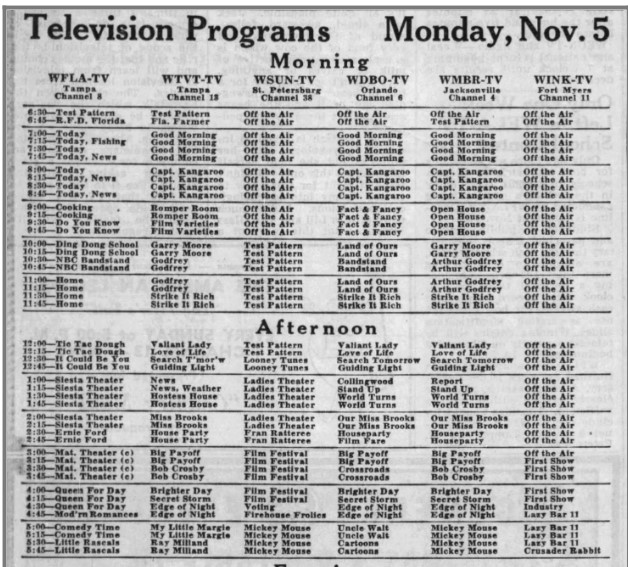
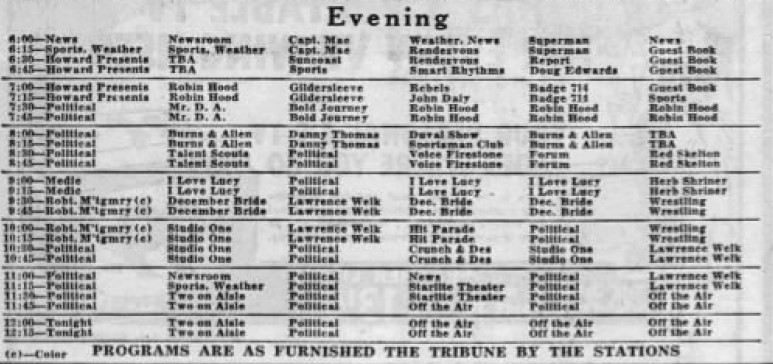
The number of choices increased significantly once Channel 8 – WFLA became operational in February, 1955, followed by Channel 13 – WTVT two months later. By 1956, Citrus County viewers had five programming options with a wide range of children’s shows and news in the morning, dramas and game shows in the afternoon, followed by network comedies and dramas at night. Children were entertained by “Captain Kangaroo”, “Ding Dong School” and “Romper Room”. (I was a proud Romper Room graduate during that period and still have my “Good Do-Bee” certificate to prove it). Game shows such as “Queen for a Day”, where three women would tearfully relate their life’s hard-luck story and the audience would vote for the saddest tale using a “Clap-o-Meter”, showed how desperate television management could be to fill airtime slots. Networks utilized coaxial cables and microwaves to simultaneously distribute shows across the nation during this time.
Installation and Service
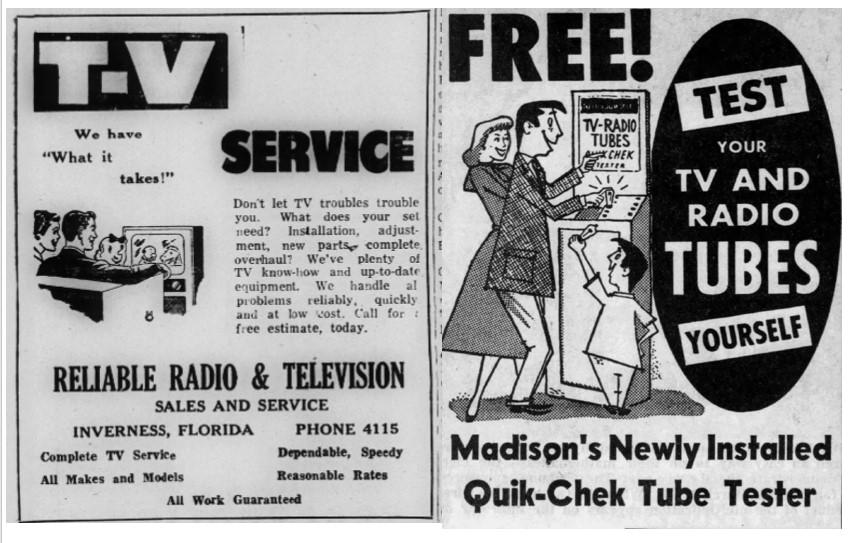
Today we’re used to purchasing a TV, opening the box, attaching to the appropriate network and start enjoying our shows. By the time the television starts to fail, it’s cheaper to discard the TV and purchase an updated version. Given the complexity and expense of televisions in the 1950’s, the setup and fine tuning of home television installations was usually handled by a professional. A cottage industry – the TV Service Person– employed technically-minded individuals to construct the required aerial towers / antennae to ensure that the television experience was maximized for each individual customer. Since the television set was controlled by over twenty separate vacuum tubes, a failure of any single tube would result in an inoperable device. The Service Person would make house visits to identify and resolve the issue. More often than not, they would test each tube and replace any tubes that had worn out. Some television owners adopted a “do it yourself” approach. Tube testing machines were set up in drug stores, soda shops and grocery stores. The television owner would carefully remove all the tubes from their set at home and bring them to the Tube Tester. After identifying the offending tube(s) by a process of trial and error, they would carefully repack all of the tubes and return home to reinstall everything. This was time-consuming, but popular, process because it usually saved the customer money in repair bills.
Appliances
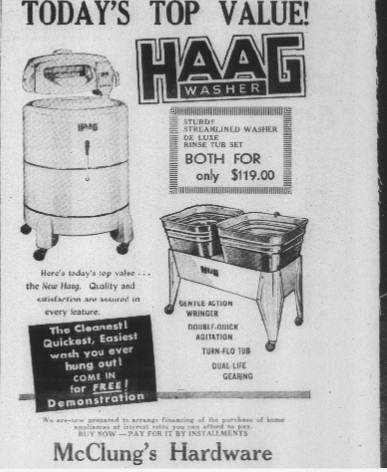
An explosion of labor-saving appliances found their way into Citrus County homes during the 1950’s. Some of them would be unrecognizable to younger people today. For example, a Haag washing machine could be purchased in Floral City that had a powered wringer on top of the device to perform today’s “spin” cycle. A separate set of pans handled the “rinse” cycle in the process. This was a marked improvement from the days of washboards and hand-cranked wringers.
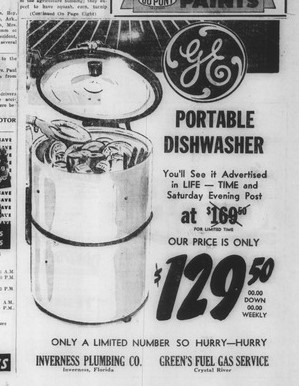
Inverness Plumbing and Green’s Fuel Gas of Crystal River offered a new GE portable dishwasher for the equivalent of $1,700 in 1950. Shaped like a large trash bin, the device would be wheeled over to the sink once filled. The advertisement seemed to indicate that dirty dishes and glasses could be piled haphazardly into the barrel prior to washing. A special attachment on the kitchen faucet would bring hot and cold water to the dishwasher and the grimy water would be drained into the sink.
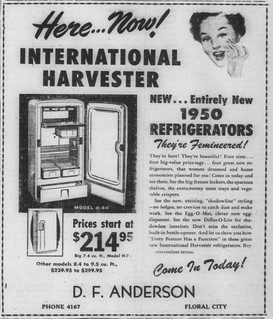
International Harvester offered “femineered” refrigerators in 1950. IH engineers stepped down from their trucks and tractors and consulted a team of women during the design process for their new appliance. They boasted that the layout of the appliance had been optimized based on the needs of the lady of the house. The refrigerator could be purchased from D.F. Anderson in Floral City for the equivalent of $2,700.
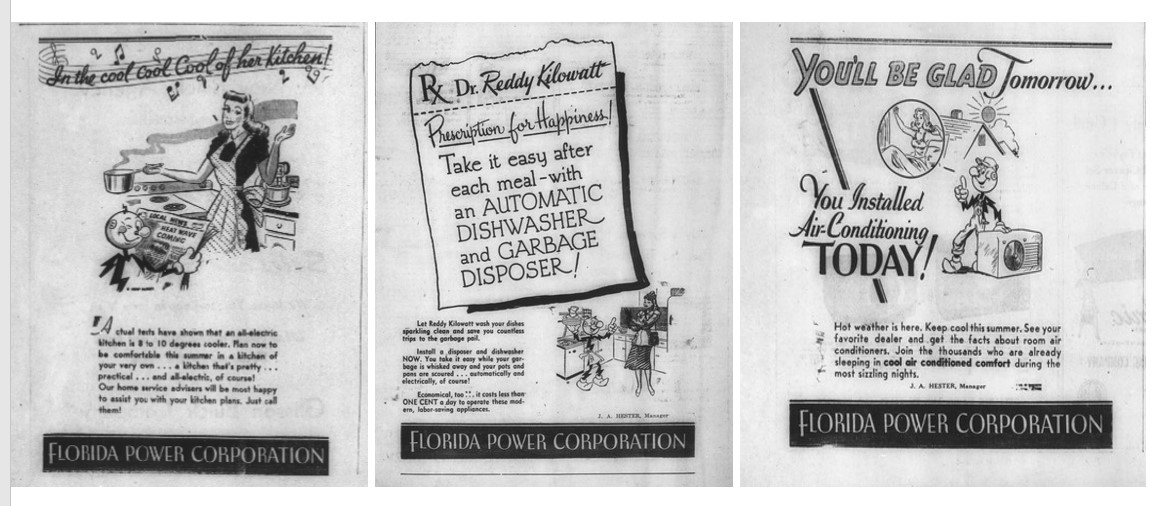
Florida Power Corporation, through their mascot “Reddy Kilowatt”, had been marketing use of their services since the 1920’s. The 1950’s saw the company urging Citrus County citizens to install dishwashers, garbage disposals, electric ranges and ovens and (of course) air conditioning to make the kitchen experience more enjoyable for housewives of the era. At the same time, increased usage of those kilowatts helped pad the company’s profits.
The decade of the 1950’s saw the rapid growth of new entertainment and lifestyle options in Citrus County and the rest of the country. While some of those ground-breaking devices may seem hopelessly outdated to us, they represent the building blocks of the daily lifestyle that we enjoy today. This also causes us to pause and think – what will future residents think about technology that we use in the 2020’s?