
Everything You Wanted to Know About the Florida State Seal
by Kenneth Marotte
Florida State Seal Mosaic at the Old Courthouse
One of the stops on the Old Citrus County Courthouse Museum tour focuses on the Florida State Seal mosaic in the center of the first floor. While this is an impressive piece of art, our docents correctly point out a number of inaccuracies in the depiction of the Florida State Seal. Firstly, there are mountains in the background and Florida’s terrain does not possess such high peaks. Two, the tree depicted is a cocoa tree, which is not typically grown in the state. Finally, the Seal is supposed to portray a female Seminole, but the picture contains a Plains Native American (obviously a male – females did not wear headdresses or feathers in their hair).

How were the inaccuracies allowed to occur in the 1912 Citrus Courthouse?
There are at least two local legends regarding why the Citrus Courthouse’s version of the Florida Seal contains these inaccuracies: 1) Either a Bricklayer / Mason from outside Florida delivered the mosaic but they were not familiar with the correct Florida Seal or 2) an unknown local Bricklayer / Mason used an 1868 version of the old Florida State Seal which contained the inaccuracies.
Are either of these explanations plausible? Let’s examine the history of the Florida State Seal, contemporary use of imagery, and details surrounding the design and construction of the Citrus Courthouse in 1912.
History of the Florida State Seal
The first Legislative Session after adoption of new Florida Constitution was convened in 1868. The Legislators were charged with rebuilding the state government after the Civil War. Among many other tasks, the Legislature was required to design a new Seal for the state of Florida.
A Joint Committee consisting of two Senators and three Representatives was established to develop the new State Seal. After almost two months, the Committee proposed instructions for new Seal: “The size of an American silver dollar, having in the center thereof a view of the sun’s rays, over a highland, in the distance a cocoa tree, a steamboat on water, and an Indian female scattering flowers in the foreground.”
Their proposal was adopted by both legislative houses on August 6, 1868 and sent to Governor Harrison Reed for approval. The instructions for the state Seal (but not a sample graphic) were ratified by Reed on August 11, 1868. The Seal attached to Governor Reed’s official proclamation foreshadowed over 100 years of controversy regarding the official state Seal.

The Seal appeared in different incarnations on official documents and flags over time. Examples below illustrate the differing designs that observed the “spirit” of the 1868 instructions.

A 1903 version of the state seal. Note the steam ship that appears to be sinking! Courtesy of Florida Memory.

Another version from 1903 of the design as a state shield instead of a flag. Courtesy of Florida Memory.
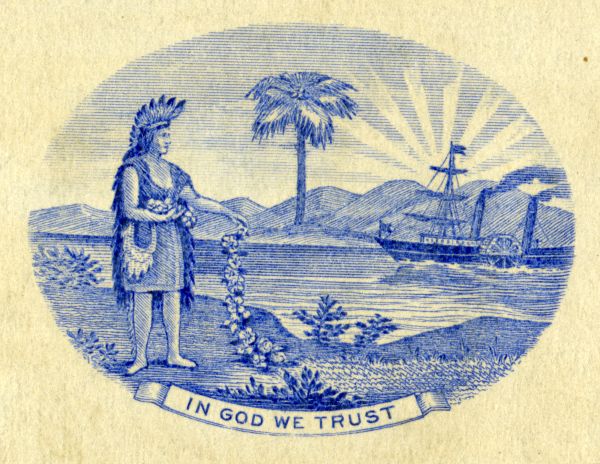
Version of the state seal from 1907. Courtesy of Florida Memory.

Simple Seal Design from 1911. Courtesy FCIT.
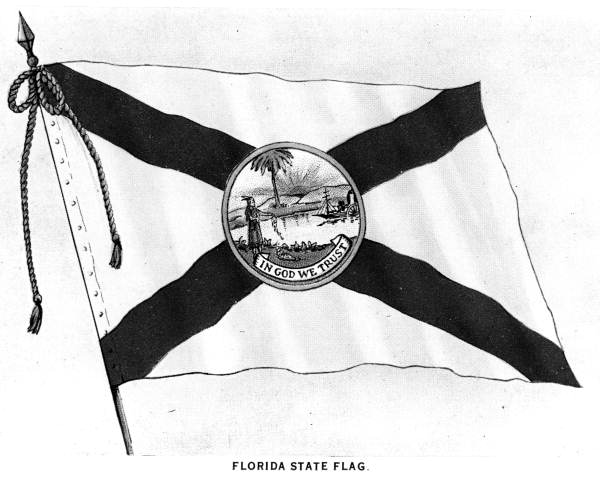
A version of the State Seal and State Flag from 1903. Courtesy of Florida Memory.
There were “tweaks” over the years to correct some glaring errors – such as ensuring that the steamship doesn’t appear to be sinking – but the Seal continued to vary from user to user. The Florida State House (1903) is a good example – featuring a mosaic of a more accurate state Seal on the rotunda floor, but the portico and Senate hearing rooms depict the mountains, inaccurate Seminole, and other errors. When the same government building doesn’t agree on a single version of the Florida state Seal, it’s understandable why some of these inaccuracies crept into the Citrus County Courthouse mosaic in 1912.

Mosaic at Florida State House (1903). Courtesy of Florida Memory.
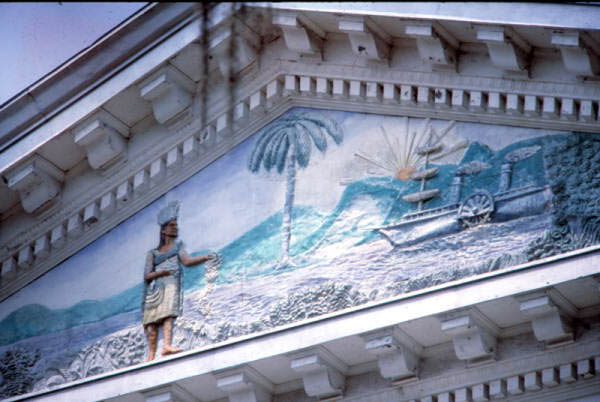
Florida State Seal Imagery on the entrance to the Florida State House. Courtesy of Florida Memory.

A wooden carving of the Florida State Seal from the Senate Chamber at the State House. Courtesy of FCIT.
Plains Indian Representation
The Florida Historical Society published a detailed review of the state Seal ’s inaccuracies in 1924 (twelve years after the construction of the Citrus courthouse). They offered this scathing analysis of the representation of a Seminole maiden: “The Seminole Indians did not wear the head-dress illustrated in our Seal . It was characteristic of tribes farther north and those of the West, and it was an insignia of distinction for the head-men and warriors exclusively. Their women did not wear it. When the 1868 artist put the crown of eagles’ feathers on his Indian female he presented Florida with an unclassified savage having the head of a warrior and the body of a squaw”. They attributed the state Seal inaccuracies to the Legislature consisting of non-elected politicians from the North who were appointed during Reconstruction and were not familiar with the history or geography of Florida.
The disregard for accurate representation of Native Americans was rampant throughout the USA during that period. The most glaring examples were the ubiquitous US “Indian Head Cent” and Golden Eagle $10 piece, which both depicted female Native Americans in full plains tribal headdress.
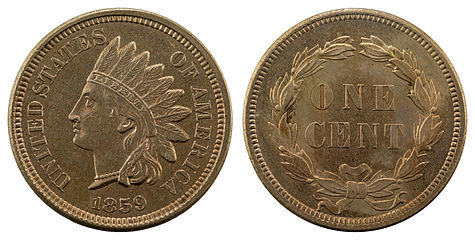
US “Indian Head” Penny
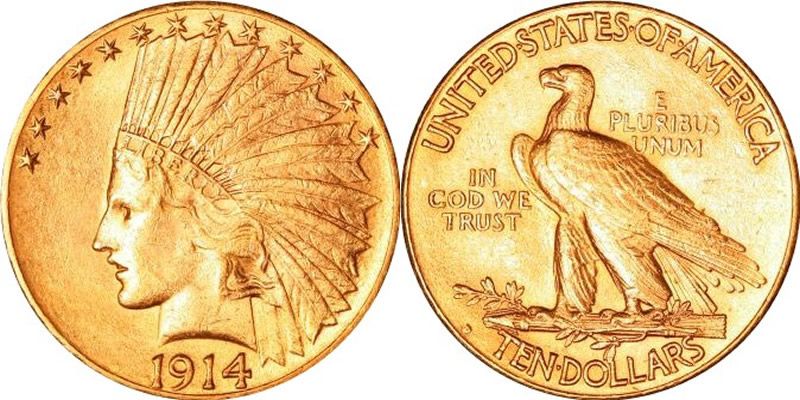
US “Indian Head” Gold Eagle $10 Coin
(Right) An 1892 postage stamp commemorating Columbus discovery of America shows him encountering a group of Natives wearing plains Indian attire in the Caribbean.
In the view of many Americans, a prototypical Native American wore Plains attire and females wore full headdress – regardless of varying styles and customs for different tribes in different regions.

Citrus County Courthouse and Florida State Seal Mosaic
Construction of the new Citrus County Courthouse commenced in 1911 and the building was accepted as completed in 1913. Willis Biggers was engaged as Architect and Read-Parker Construction Co was hired to build the Courthouse. Unfortunately, the detailed architectural design blueprints and Read-Parker construction records are not available today. We simply do not know what instructions were provided to the bricklayer / mason who finished the mosaic nor do we know the identity of the person who worked on this task. We do know that there was extensive oversight of all facets of construction and it is improbable that an independent workman’s inaccurate depiction of the Florida State Seal would have been allowed to proceed without correction.
The building contract between Citrus County and Read-Parker Construction specified a defined process that involved periodic payments for approved work performed. The construction company was given access to the Architect to address any questions. The Board of County Commissioners (BOCC) retained their own Construction Superintendent, Charles B. Stage, to monitor progress and ensure that the quality of materials and workmanship met the design specifications. Mr. Stage served as the “eyes and ears” for the BOCC and was a trusted advisor to the Board.
The Board minutes during 1911-1913 reveal that the BOCC was extremely involved in the details related to Courthouse construction. They debated furnishings, quality of the wood flooring and window shades. They selected the colors for the brickwork. They debated wood fireplaces vs. steam heat and changed course a few times. They explored multiple options for the clocktower and vault locks. When the time arose to select a janitor to maintain the building, they considered several candidates and selected one of them – and also reviewed and approved the cost of his broom!
The deliverables approval/payment process specified in the contract required Read-Parker to periodically submit formal requests for payment and attest that the agreed upon work deliverables were complete. The Architect was required to formally attest that he agreed that the work was in concert with the design specifications. Mr. Stage, the BOCC’s Construction Superintendent, was obliged to attest that the work was completed according to specifications and reflected the expected quality and workmanship.
After all of these attestations were formally submitted, the BOCC would review, debate and authorize payment. In cases when the BOCC disagreed with the any charge they felt was inappropriate, they could delay or refuse payment. Such a situation arose when Read-Parker tried to add $15,000 for “extras” at the end of the project. The BOCC refused to pay for any unauthorized work and steadfastly refused to accept the completed building until Read-Parker provided a detailed list of extra work performed. The two parties were able to arrive at an agreement and the Courthouse was formally accepted on June 13, 1913.