
Four Survivor Stories
By: Ken Marotte, Citrus County Historical Society
Citrus County residents have survived wars, financial panics, droughts, floods, and other calamities. Their lives serve as an inspiration for future generations. Here are the stories of four local people who survived events that were front and center on the world stage.
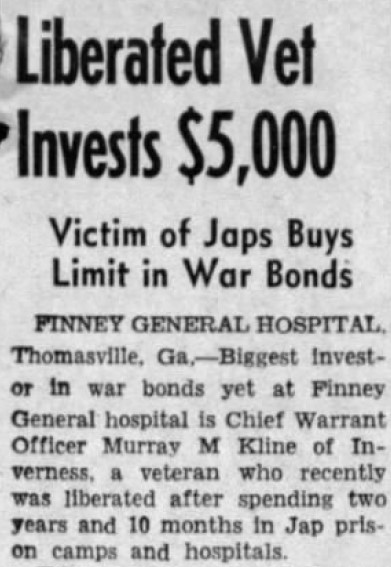
Bataan Death March – Murray Kline (Inverness)
Murray Kline grew up in Michigan and lived with his sister and her husband since his teen years. He had enlisted in the Army as a young man and returned to his home in between assignments. When his sister’s family moved to Inverness, Kline used that city as his new home base. The military assigned him to duty in China and Hawaii during his many deployments. He began his career as a Private and was progressively promoted to Chief Warrant Officer by the time World War II started. He arrived in Manila, Philippine Islands in October 1941 and started work as Personnel Officer in the US Signal Corps.
Japanese forces attacked the Philippine Islands less than two months later. Even though his duties primarily involved office tasks, Kline noted that every soldier was first and foremost an infantryman. He shouldered his rifle and joined his company in an attempt to repel the enemy. When it became apparent their position was being overrun, the remaining American soldiers surrendered to the Japanese victors. The Japanese were faced with a logistical problem. They had not anticipated the large number of soldiers and civilians that had ultimately capitulated. Their plan was to relocate the survivors to Camp O’Donnell in the Northern part of the island. Since the Japanese didn’t have enough vehicles to transport their captives, everyone would have to make the journey on foot, including exhausted and wounded soldiers.
The heat from the Sun was brutal in the Islands. Captives were not given water or food during their march. Anyone who dropped to the ground during the march was immediately shot or bayoneted. By the time they reached their destination (sixty-five miles from their initial capture), an estimated 10,000 Americans and Filipinos had been brutally murdered during the atrocity.
Kline languished in the Japanese military prison until he was freed by advancing American troops in February 1945. He was forced to perform hard work for the Japanese during his internment and suffered from extreme malnutrition at the end of his captivity. It was reported that he was so affected by lack of food and water that he couldn’t open his eyes when freed by his countrymen.
After returning to the United States, Kline was brought to a hospital in Georgia to recuperate. One of his first acts was to purchase $5,000 in US War Bonds (equivalent of $85,000) to help end the war against Japan. He stated that he would have bought even more but the government limited the amount a person could purchase annually. Kline eventually retired from the military and passed away in 1973 and is buried in the Barrancas National Cemetery in Pensacola.
The Holocaust – David Bergman (Hernando)
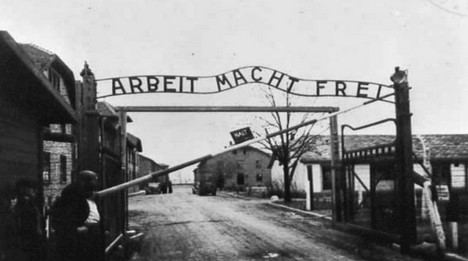
David Bergman was born to a Jewish family in a small town in Czechoslovakia in 1931. His placid world was shaken when Hungarian soldiers, who were aligned with the Nazis, came to his town and started to oppress the Jewish citizenry. In 1944, his family was notified they were going to be deported to another city in Hungary. Little did he know that this was the start of a journey that would lead to the gates of Hell.
At first the family was allowed to travel together. Then they were put on a cattle car and brought to one of the Nazi selection camps. An officer was waiting as the door opened and the group disgorged. Fathers, mothers, grandparents and children were separated from each other and sent into different lines. Bergman, who was only 12 years old at the time, was quick to note that all children were being ripped from their parents and forced into another line. He slipped into the line where his father was stationed and lied to the Nazi guard by claiming to be older. He later found out that this lie saved his life, because the Germans were exterminating anyone who couldn’t work and young children were deemed to be of little use in their fields and factories. He never saw his grandparents, mother or siblings again.
Bergman claimed to be a bricklayer and was put to work building bomb shelters for the Germans. When the Allied bombers appeared overhead, the Jewish prisoners had to remain outside the shelters and bear the impacts of the bombs. As the war progressed, Bergman was shuffled to all of the Nazi death camps, including Auschwitz, Dachau, Plaszow, Gross Rosen, and Reichenbach. He saw trainloads of unfortunate Jewish and Gypsie people arrive and then disappear into the camps. The stench of the crematoriums remained burned into his memory until the day he died. He narrowly avoided death many times through quick thinking, luck and the help of fellow prisoners. He recalled “…one of the things that I was told is survival means the ability to work. If you could work, there was hope for survival. If you couldn’t work, you were done.”
As the end of the war approached, the Nazi guards abandoned their posts to avoid the advancing Allied soldiers. Before they departed, they marched Bergman and the other surviving prisoners into the woods and used their machine guns to kill most of group. Bergan hid under a pile of dead bodies until he hear the shooting stop and the guards drove away. When the danger passed local citizens brought him to a group of American soldiers who gradually nursed him back to health.
Bergman eventually migrated to Michigan after war and started making appearances on TV shows to describe the horrors he saw and experienced. He later moved to Hernando FL and lived the rest his life in Citrus County. Determined to make sure the memory of the Holocaust did not fade, he led discussions and presentations throughout the region including several at the Beverly Hills Community Center and the Old Courthouse Heritage Museum in Inverness. His book “My Testimony and Legacy” details his survival in the face of Nazi cruelty. He passed away in 2018 at the age of 86.
Sinking of the Lusitania – John I Lewis (Inverness)
The massive conflict now known as World War I erupted in 1914. The American government saw this fight as a European matter and tried to remain isolated and neutral in the War. This resolution was severely tested in 1915 when German U-Boats torpedoed and sunk a passenger liner resulting in the loss of many lives, including a number of Americans.
John I Lewis was born in North Wales and went to sea at the young age of 15. His diligence and persistence led to progressive promotions within the Cunard Lines company. By 1914 he was a Navigation Officer aboard one of Cunard’s premiere ships, the Lusitania. The vessel was one of the fastest liners in the world, able to achieve speeds of over 25 knots. It was employed on the profitable New York – Liverpool route and ferried passengers across the ocean in record time. Once the War broke out, the Lusitania continued to operate as a luxury liner since there was a general agreement among the combatants that passenger ships would not be molested as long as they did not carry military troops or cargo.
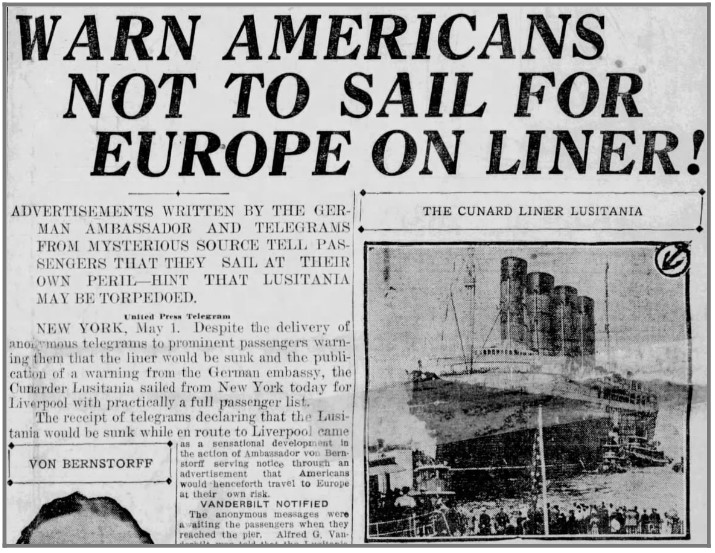
The Germans had information that the Lusitania was carrying ammunition and other munitions that had been purchased by the British from American factories. They issued a warning that they intended to sink the Lusitania as a combatant ship since it was being used for military transport.

John Lewis was the last officer to board the ship in New York City on May 1, 1915. He had read about the warnings from the German embassy but the Cunard officers felt that the ship was so fast that she could easily outrun any primitive German submarine. The ship’s Captain ignored the British Navy’s advice to follow a zig-zag course to avoid any lurking submarines. Modifying the ship’s track would have increased the duration of the trip and he was under pressure by Cunard management to make the trip as quickly as possible.

Tragedy struck on May 7, 1915. A German submarine hit the Lusitania with a torpedo and the stricken liner sank 20 minutes later. Lewis and the rest of the crew frantically attempted to lead guests from their rooms and onto lifeboats. Many passengers could not escape from their cabins. Some lifeboats either failed to launch or were capsized before they reached the water. In spite of the crew’s heroic efforts, almost 1,200 passengers, including 129 Americans, perished in waters off the Irish coast that day. Lewis was on one of the last lifeboats to leave the ship and lived to tell his story.
As expected, there was an uproar for vengeance by the American public. President Wilson, however, retained his isolationist stance and managed to keep America out of the conflict until 1917. The memory of the Lusitania remained in the American consciousness and was one of the factors that eventually led to our involvement.
John Lewis later became an American citizen and continued working at Cunard’s New York City facility. After retiring, the Lewis’ purchased a house on Talmage Street in Inverness. The national “This is Your Life” TV show featured Lewis and several other Lusitania survivors in 1956 while he was living in Citrus County. They recounted their stories of escape and remembered the other passengers who not as fortunate.
Military historians have confirmed that the Lusitania was indeed carrying almost 200 tons of munitions at the time of her sinking.
Custer’s Last Stand – Albert Richards (Crystal River)
On September 3, 1940, an elderly man wandered into the chambers of Judge E.C. May in Inverness. He began to spin a yarn that captured the attention of the jurist. Richards told the judge that he was 91 years old and had just been released from a hospital in Tampa. He used to live and work in Crystal River as a ship captain bringing lumber from Citrus County across the Atlantic to places such as Italy. He later spent years in Crystal River working as a fisherman. His biggest claim to fame, however, was that he was one of the only white survivors of Custer’s Last Stand.
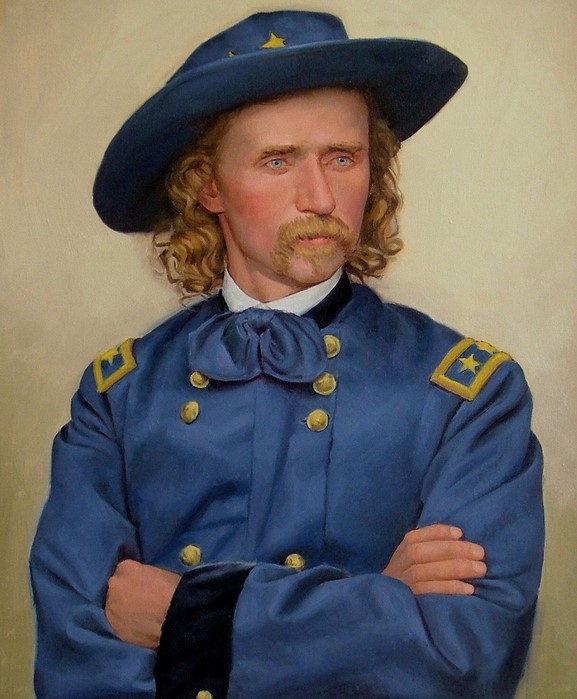
Lt. Col. George Armstrong Custer was charged with leading the US Army 7th Cavalry against a coalition of Native Americans in 1876. His ill-advised and arrogant military tactics led to the slaughter of his entire troop at the Battle of Little Big Horn. According to Richards, he was one of a group of civilian “packers” that carried supplies for Custer’s group on mules. When he saw the battle commence, Richards and two other packers quickly took their mules and escaped to the top of some hills several miles away. He was able to watch the battle through a telescope that he had in his pack. He swore that the other packers could confirm his story, but unfortunately all of them had passed away.
He told Judge May that he was a destitute former resident and was respectfully asking for some type of a pension or other monetary compensation for his services. While no official contribution would be forthcoming, E.C. May promised to relay Richards’ story to the people of Citrus County. Judge May told the Chronicle: “Anybody interested in adventure stories will find Richards a vast source of hair-raising yarns, and he is a fluent and entertaining talker, seeming to enjoy his subject as much as the person listening to him”
As an aside, there is no record of Albert Richards on the roster of civilian “packers” for the 7th Cavalry nor are there any records of Albert Richards living in Citrus County.