
Floral City’s College
By: Ken Marotte, Citrus County Historical Society
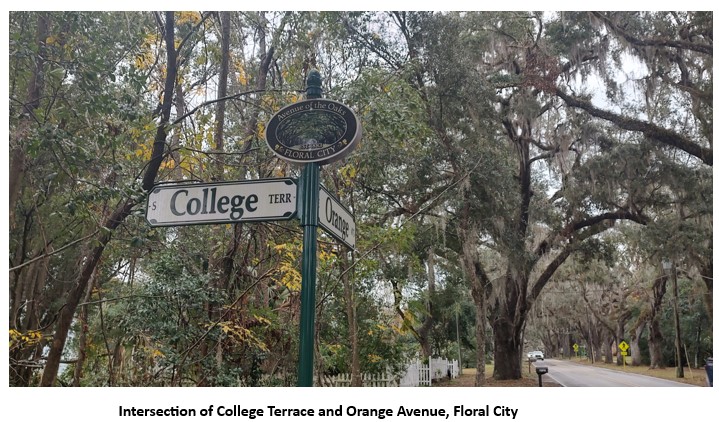
While driving down Floral City’s beautiful Avenue of the Oaks, you’ll notice a nondescript road named “College Terrace” on the North side of Orange Avenue. Many people are unaware that it was once the planned site of the South Florida College – a school that began with the best of intentions but failed to generate public interest and eventually faded into history.
A Tennessean Looks Southward
William H. Havron was a “Renaissance Man” by any measure of the term. Residing in Chattanooga, TN, he was instrumental in organizing a popular debating club that would explore the issues of the day. In an age before radio, television and the internet, lectures and debates were well-attended events in the community. Havron decided to parlay his argumentative skills into a legal career and was admitted to the Tennessee Bar in 1879. His first love, however, was engineering and surveying and he later earned certification in those fields.
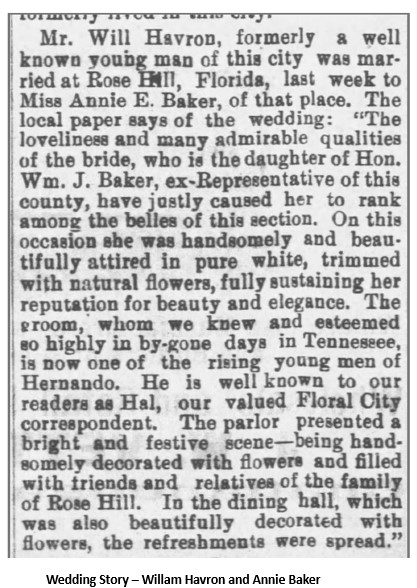
He traveled to the area that would eventually become Floral City while on business in 1881. The abundant resources and beauty of the countryside won his heart. The pretty young sister of a prominent landowner caught his eye and he soon informed his friends in Tennessee that he wouldn’t be returning. Annie Baker and William Havron were married in 1884 and settled down in Floral City.
Floral City’s Biggest Booster
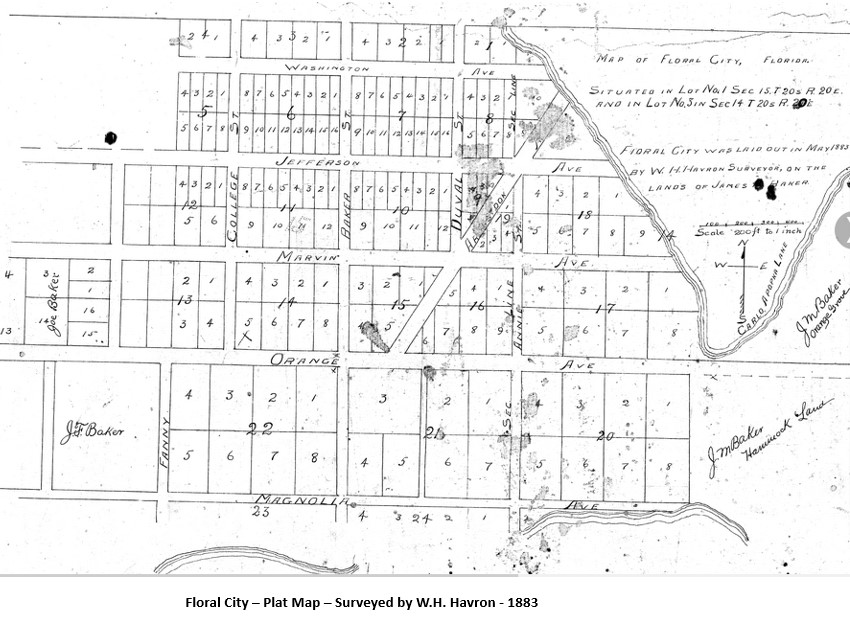
The Baker’s were one of original pioneer families in Floral City. James M. Baker needed to have his extensive landholdings formally surveyed and designated as a village in the county clerk’s office. He struck up a friendship with Havron (his eventual brother-in-law) and discovered that the Tennessean possessed the surveying expertise that Baker needed. Together with Senator A.S. Mann, Baker prevailed on Havron to lay out the new village of “Floral City” in 1883. Havron’s original map is on file in the Citrus County Clerk’s office and can be located in Plat Book One. Of course, one of the roads was named “Baker Street”. As you may have guessed by now, “Annie Street” runs through the heart of the new village. He had married “Nettie” Duval in 1878 so the new area featured a “Duval Street”. The Baker’s first son was named “Marvin” and one of the avenues bears his name. College Street (now “Terrace”) intersects with Marvin Avenue and was selected as the site of a new school for higher education.
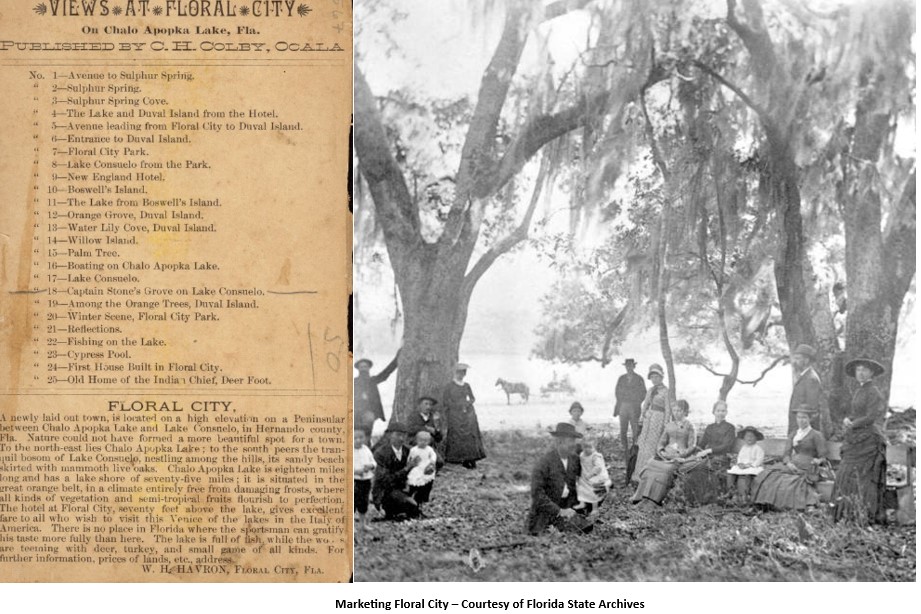
Havron continued to publicize the benefits of Floral City to other potential citizens. He waxed poetic in describing a paradise on earth He hired noted Ocala photographer C.H. Colby to create a series of views that could be used for marketing purposes. Havron described the areas as the “Venice of the Lakes” and the “Italy of America”. Some of the original photographs are on file in the Florida State Archives.
South Florida College
Havron was able to convince Floral City leaders that establishing a college there would attract national interest and would increase the influx of settlers. Accordingly, plans were announced for the creation of a new institute of higher learning on College Street. He envisioned a large main building covering 50×80 feet and a 40×60 foot long wing. The buildings would be two stories high.
The college organizers took an approach to education that was novel for the times. No instructors would be hired who had not achieved at least a Masters degree. The institution would be open to both men and women. The administration would confer the Bachelor of Arts or Master of Arts degrees on male graduates. Women would receive either the “Mistress of Arts” or “Mistress of English Literature” degree upon graduation.
Since this was to be a private non-sectarian college, the board of directors appealed to the public to support the new school. They offered membership stock subscriptions for ten dollars each (a little over $300 in today’s dollars). News articles indicated that one gentleman from New York heard about the new college while in vacation. He reportedly purchased $100 worth of stocks. Patrons from other Southern states likewise purchased stocks. Members would be asked to provide one-half of their stock purchase funds once two thousand dollars had been raised and the remaining half was due six months later. The proceeds from the stock sales would be used to purchase lumber and supplies to begin construction. A building of this size was expected to cost upwards of $5,000 (about $160,000 in today’s dollars), which seems like a modest investment.
Newspaper readers in Georgia and Tennessee were encouraged to purchase subscriptions as well. Havron told a Tennessee audience “Able talent will be employed and the school will be first-class in every respect. Persons desiring winter houses in Florida can spend the winters at Floral City and at the same time be educating their children at an excellent institution in a healthy locality”.
The cornerstone for South Florida College was laid down with great ceremony in July 1883. The community was invited to a huge barbeque and local dignitaries were asked to deliver speeches. Senator A.S. Mann, Rev. Dr. Shands, Colonel Russell (publisher of the Brooksville Crescent) joined W.H. Havron at the podium. Newspapers in Tallahassee spread news of the dedication event across the state.
The timing for establishment of a new private college could not have been worse. The country was in an economic downturn that has been designated “The Depression of 1882-1885”. In particular, the Panic of 1884 led to a tightening of credit and the creation of hardships for most Americans. Subscriptions for the college slowed to a halt as people struggled to survive. The college’s board of directors were left with no choice but to end their fund-raising efforts and abandon their plans to create South Florida College in Floral City.
Havron Moves On
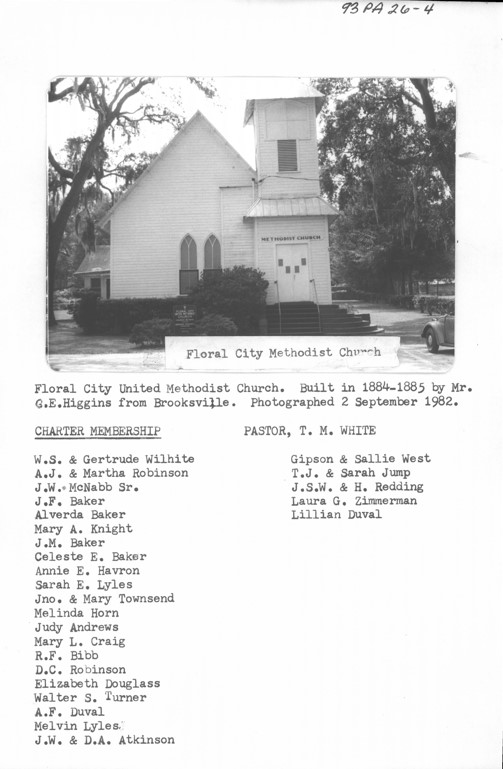
The Havron family remained in the area during the 1880’s. Annie Baker Havron (along with other members of the Baker and Duval families) is listed as one of the charter members of the Floral City Methodist Church. William Havron continued his work as an engineer and was appointed the official Surveyor of the reconstituted Hernando County in 1889.
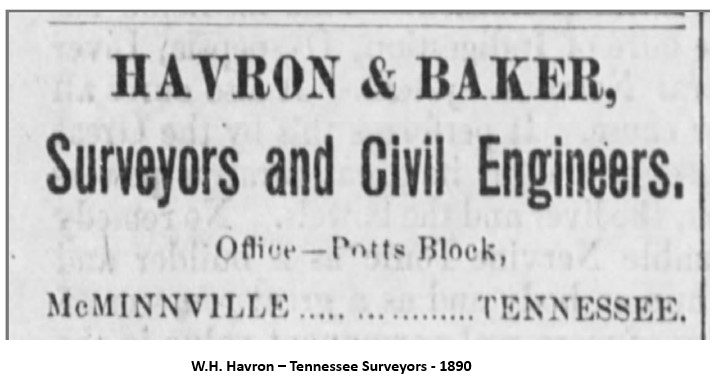
The Havron’s relocated several times over the next few years but still retained properties in Floral City. William opened a Surveying business in Tennessee during the 1890’s. He was also editor of the first “Confederate Veteran” magazine. He was a frequent contributor to that periodical and offered historical analysis of various battles and Confederate leaders.
William Henry Havron passed away in Madison County, Florida in September 1928. In his final year, the Havron’s sold the First Baptist Church of Floral City a lot for one dollar which serves as the current location for that congregation.
Citrus County should recognize his significant contributions to the establishment and marketing of Floral City during his time in our area.
Ken Marotte writes for the Citrus County Historical Society. He can be reached via email at kenmarottejr@gmail.com if you have any comments, questions or suggestions.