
Fill ‘Er Up? Service Stations in Citrus County
By: Ken Marotte, Citrus County Historical Society
The diverse early automobiles used by Citrus County citizens was explored in a previous Chronicle article. Except for the pioneering electric cars such as the Pope or Columbia, all of those classic cars required gasoline to fuel their engines. Even the legendary Stanley Steamer used gasoline or kerosene to heat the boilers that propelled the vehicle. Where did drivers purchase the fuel needed to run those new “horseless carriages” during the twentieth century?
Limited Fueling Options
Travel by automobile in the early days was relatively limited by today’s standards. The absence of hard roads, except near larger cities, meant that drivers faced a teeth-rattling experience on Citrus County’s washboard roads. Given the short driving distances, demand for gas was relatively low.
The revolutionary Ford Model T was a low-cost automobile that put driving within the reach of the ordinary person. The Ford Model T had a small 10-gallon gas tank and averaged an estimated 25 miles to the gallon. The versatile Model T’s could also be used to power small saw mills. Conversion kits were available to convert the Model T into farm implements such as a tractor or reaper. Most drivers kept some reserve in their tanks for these unusual purposes, so a fuel fill-up of 5 to 6 gallons was typical.
Most people bought their fuel at the local dealer where they purchased the car. There were only a couple of independent options scattered in the County.
1920’s
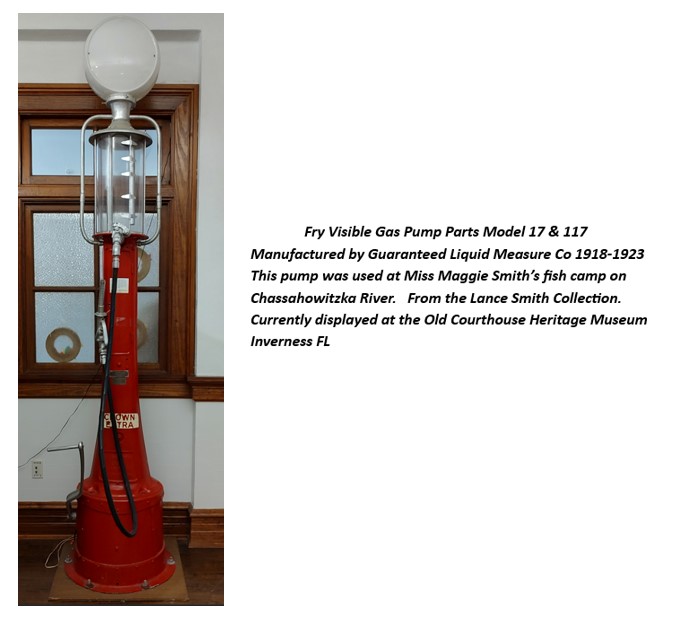
At first, a simple bucket and funnel approach was used to fill automobile fuel tanks. A new type of device was perfected during the decade that used a hand crank to pump gas from an underground tank. Fuel was transported to a globe on top of the unit that had gradations indicating how many gallons had been pumped into the globe. Once the agreed upon number of gallons was visible, a simple hose and nozzle would use gravity to fill the customer’s tank from the contents of the globe. These gas pumps did not require electricity and could be located in more remote spots. The Old Courthouse Heritage Museum has an authentic gas pump on display from 1923 that was used at “Miss Maggie” Smiths fish camp and store in Chassahowitzka.
The men who pumped the gas were more likely than not to have been identified as “mechanics” according to the 1920 census. They tended to wear ordinary work clothes and usually had a grease filled rag hanging from their belt. Most stations had an attached garage that was used for mechanical repairs.
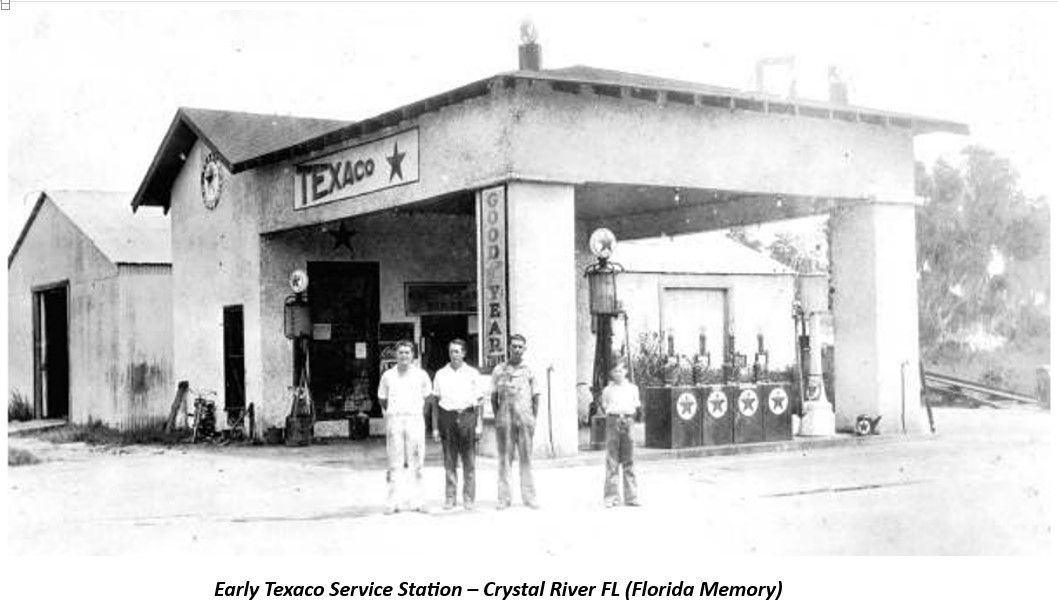
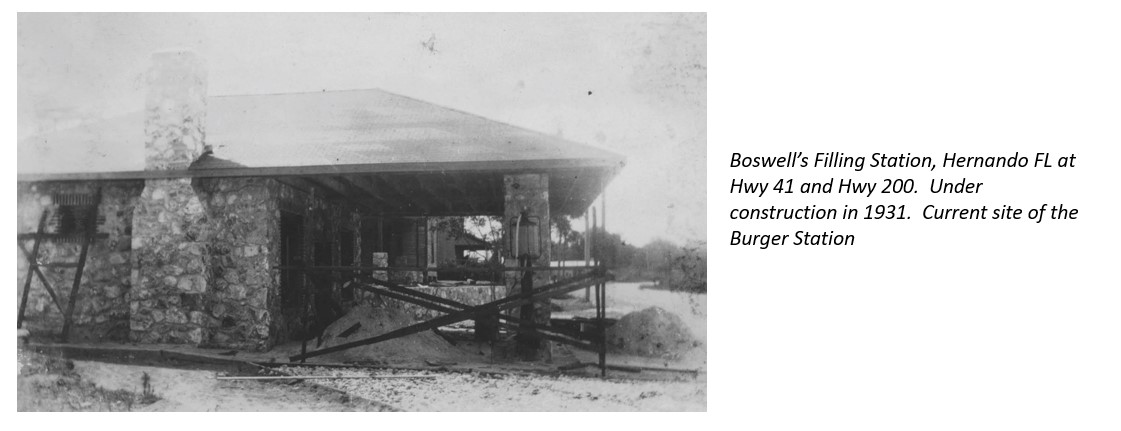
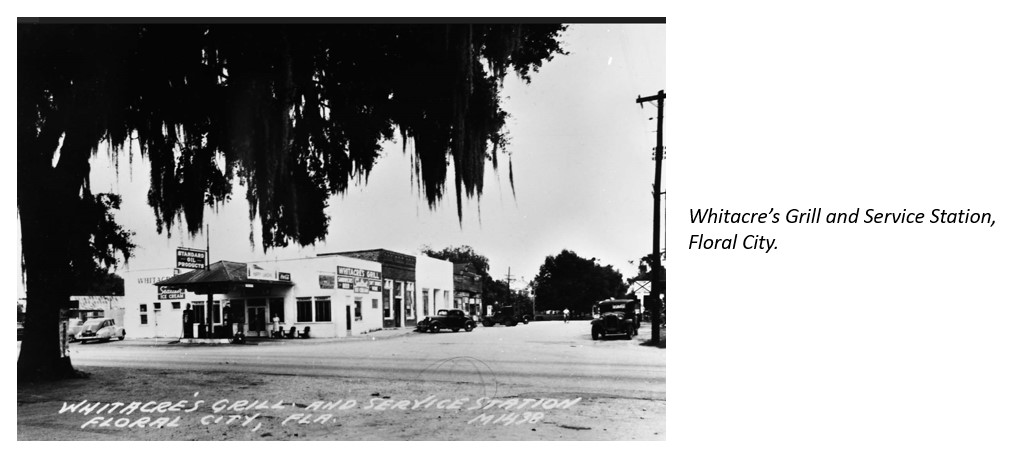
While some of the original buildings have since been demolished, some have been repurposed as gift shops and restaurants.
1930’s
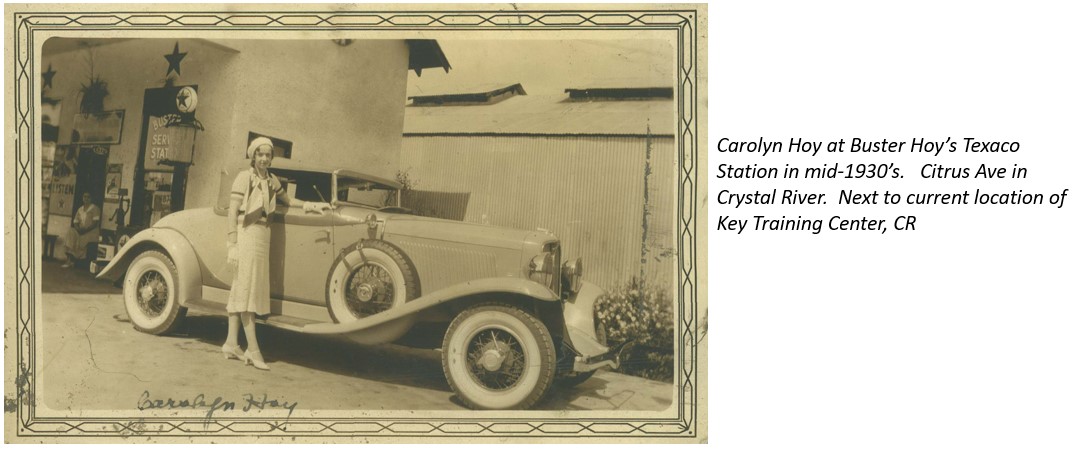
The 1930’s ushered in a period of larger cars and better hard roads. This led to a greater demand for gas when customers filled their tanks. Electrification reached more areas so more advanced pumps could increase output using electricity rather than hand pumping. Driving clubs took advantage of better roads and plentiful fuel stops to explore different parts of the State. Some of the road rallies would include Inverness, Homosassa and Crystal River.
1940’s
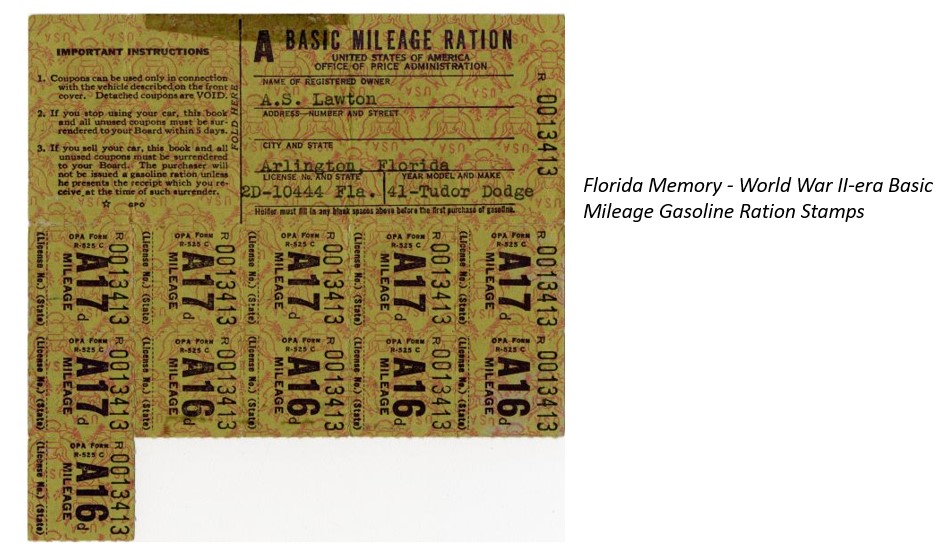
The advent of World War II necessitated strict rationing of gasoline. Ration stamps were issued on a monthly basis had to be redeemed at local service stations for gas. Tires were also important for the war effort so each family was only allowed to possess a limited number of tires and were required to turn any excess into authorities for use in the conflict.
1950’s
Freed from the restrictions of wartime rationing, Americans “hit the road” in record numbers. Service station attendants changed their image. They started to dress in uniforms similar to police officers. Their workplace was no longer a “filling station” but was rather a “full-service station”. Station owners were trained to use expanded services to sell more ancillary (and profitable) goods. For example, offering to vacuum the front seats gave the attendant an opportunity to check the “last serviced” sticker on the inside of the door to determine if the auto was due for an oil change or periodic “tune-up”. Complementary washing of the windshield sometimes led to a suggestion that the wiper blades needed to be replaced. While checking the pressure of the tires, the attendant could check for signs of wear or nails that could be addressed by new tires that they just happened to have in stock. Offering to “check under the hood” frequently resulted in the sales of oil, anti-freeze and other fluids as well as new belts if any were found to be fraying. Oil chains produced training videos that quantified how much money a typical operator could gain by offering full services.
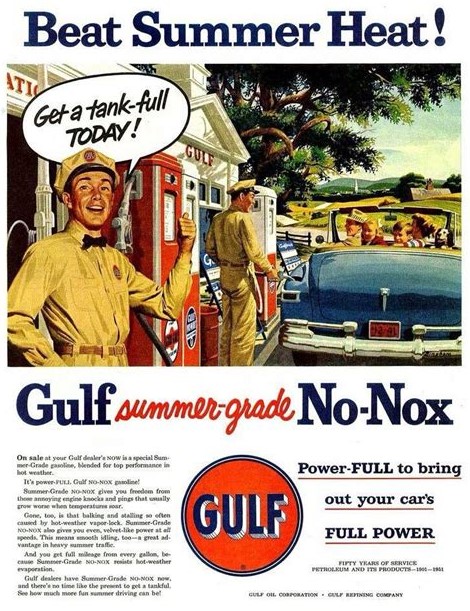
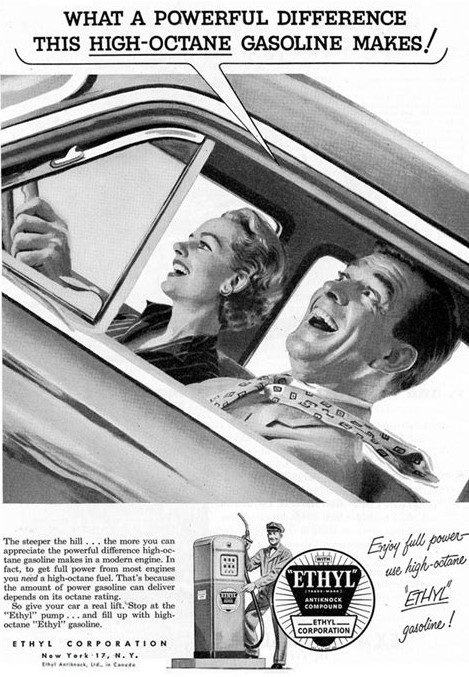
As cars grew larger and heavier, engine power grew as well. Marketing in the 1950’s and 1960’s emphasized how a particular gas brand delivered more power for the larger engines of that decade. Customers felt that they were almost “flying” when they used Ethyl gasoline!
1960’s
In the 1960’s the price of gas was still at historically low levels. The usual cost of regular gas in Citrus County was 28 cents per gallon while premium cost only 32 cents. This was the era of the big-block “muscle cars” that required premium gas to speed along the county’s roads. Service station attendants still provided personalized attention to drivers as the number of gas stations grew in the county.
1970’s
There were two significant events that affected service stations in the 1970’s.
Researchers at General Motors determined that adding a lead compound to gasoline improved performance in the 1920’s. In spite of industry assurances that the amount of lead used was not harmful, subsequent studies revealed that the additive could result in significant health issues, especially for younger children. The Federal government began an effort to gradually phase out lead-based gasoline in 1973. New cars would be outfitted with systems that could only use unleaded gas. Since most older cars required leaded gas for acceptable performance, service stations needed to either maintain both leaded and unleaded pumps or offer lead additives to their customers. Conversion to unleaded gas was generally completed by the mid-1980’s.
Secondly, the Organization of Petroleum Exporting Countries (OPEC) decided to limit production in the early 70’s. The resulting oil shortage led to “skyrocketing prices” approaching one dollar per gallon. A new fad – self-service pumps at stations that offered a discount – swept the country as a way for consumers to reduce the impact of the shocking high prices.
Prompted by gas station owners, Florida had implemented rules prohibiting self-service gas stations. The State Fire Marshals organization was on record as being against self—service stations. One Manatee oil dealer claimed “…they aren’t safe in the hands of the general public…the average citizen coming up to get his own gas could unwarily smoke a cigarette or spill gasoline, thereby creating a serious fire hazard”.
However, the economic pressure was too great and the Florida legislature and Governor signed a law in June 11, 1974 that allowed self-service gas stations to be installed in the State and superseded local ordinances outlawing such devices.
Self-service stations were slow to be adopted in Citrus County. The “Shop & Go” convenience stores received approval in May 1975 from the Citrus County Zoning officials to install self-service pumps at 5 locations in the county (Inverness, Homosassa, near Floral City, Green Acres, and State Road 488 west of Dunnellon). The Shop & Go chain was eventually purchased by Circle K stores.
Today, full-service stations are something of an anachronism – only New Jersey stubbornly clings to a ban on self-service stations throughout the state.
Needless to say, the early drivers of Citrus County would be unpleasantly surprised by the price of gasoline since the Model T days.