
Evolution of the Inverness Airport
By Ken Marotte, Citrus County Historical Society
The Inverness Airport was first established as a grass landing strip in the 1920’s. It grew incrementally over the years into a commercial airport that can handle larger planes and small corporate jets today. It has become an integral part of the future economic development plan for Citrus County.
From Landing Strip to Airport
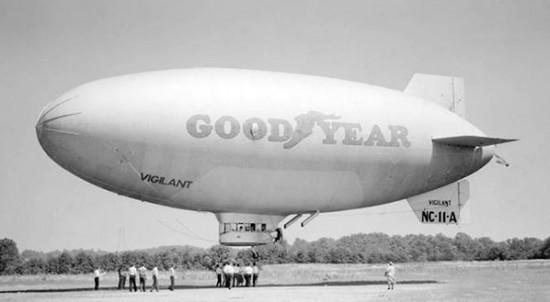
One of the first reports about the Inverness Landing Strip didn’t involve an airplane at all. The Goodyear blimp “Vigilant” made a stop at Inverness on December 10, 1929. Santa Claus was making a trip from Valdosta GA to Key West and had scheduled a stop in Inverness. A large contingent of children were waiting for him at the appointed noontime hour. After distributing candy to all of the good boys and girls of Citrus County, the 128-foot blimp lifted off at a 45-degree angle powered by two 82hp engines. It bucked a bit in the wind and sailed off to the South.
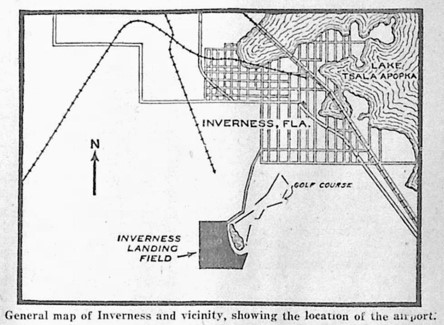
By 1930 the “Inverness Landing Field” was recognized by the US Government in their official US Airway Bulletin. Long before the days of computerized navigation aids, the Department of Commerce produced a book with annual updates that was offered to pilots who might be flying through the area. Many of the bulletins included landmark notations and maps of local roads since sophisticated location tools were not available. Pilots joked that in those days “IFR” meant “I Follow Roads”.
The description of the airport in 1931 demonstrates how much have changed since that time. Today’s Inverness Airport has a single paved 5,000-foot runway with a parallel taxiway. The 1931 bulletin notes that there were two intersecting sod/grass strips of 2,600 and 2,400 foot respectively. There was an abandoned road that crossed the North/South landing strip at the North end. There were high trees bordering the landing strips. Aviation fuel was available, but only during daylight hours.

Inverness Air Shows
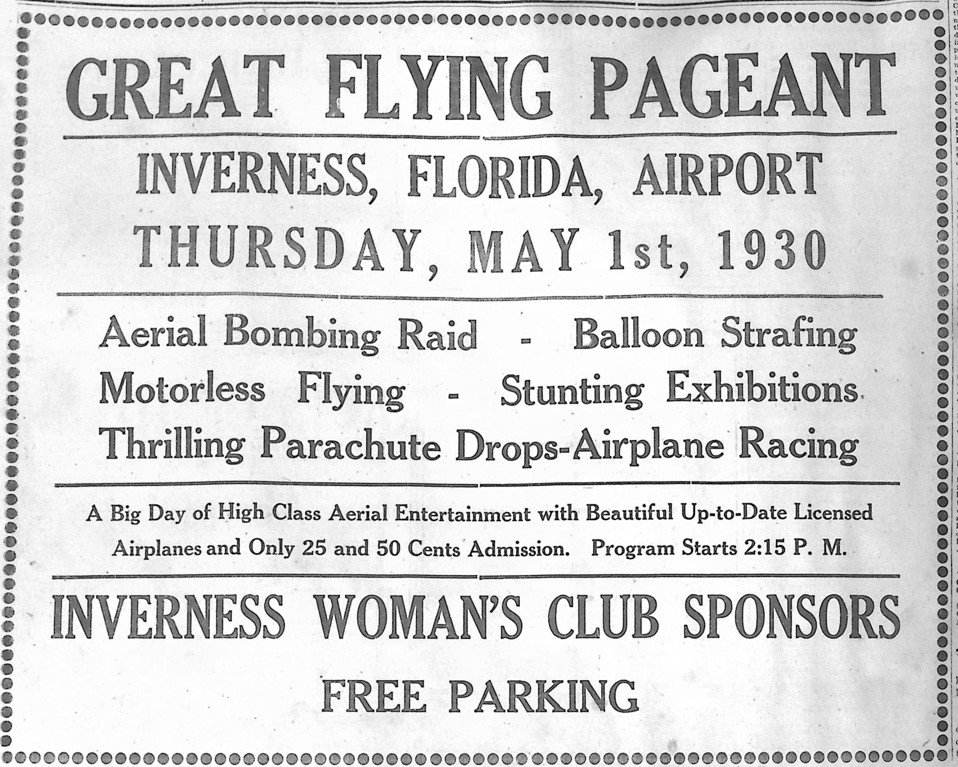
The public was fascinated with flying and airplanes and would flock to local air shows. The Inverness Women’s Club hosted a successful air show in 1930. There were demonstrations of bombing, balloon strafing, airplane racing and stunt-performing aeronauts. The planes and pilots were available for public viewing when not performing. The show “…is not to be confused with the ordinary barn-storming air circus, but will be a dignified presentation of modern development in aircraft of all kinds.” They later advertised that Thunderbolt Knight of Cleveland, the premier parachute artist in the world, will give the crowds a real thriller.
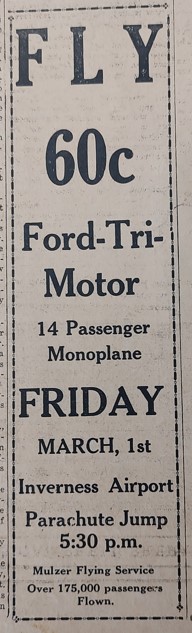
It was also common to give the public a chance to actually fly in one of the planes. As an example, Major Leslie Mulzer (USAAF Reserve) brought his 14 seat Ford metal tri-motor monoplane to the Inverness Airport in 1935. Passengers could ride his plane for sixty cents and fly over their home town. As an added bonus, Dick Hunter (world record holder for parachute jumping) bailed out over the Inverness crowd. When the show was over, Maj. Mulzer offered to take passengers to his next stop in Ocala for two dollars.
Expansion
As Citrus County grew, so did interest in expanding the airports in Inverness and Crystal River. Some of the modifications were based on future business projections, while other changes were mandated by the government. For example, the Inverness Airport lost its FAA license for an 18-month period because the height of the surrounding trees limited the effective length of the runway. Until the trees were removed, Inverness Airport’s usable runway space was 200 feet below the acceptable minimum.
There were debates over the years regarding the value of the airports to the county and whether or not the area really needed two airports. The existing airports were hemmed in by commercial and residential development and local opposition to expansion rose to a fever pitch. Replacement of the existing two airports with a new central airport in Beverly Hills was met with stiff criticism and the plan was dropped. Developer Sam Tamposi was inconvenienced because he had to fly his corporate jet into Ocala when he visited his Citrus developments so he wanted to construct a 10,000-foot jetport near his Meadowcrest developments. That plan was thwarted by a stubborn rancher who would not sell Tamposi the needed land.
The Board of County Commissioners eventually agreed to expand the Inverness Airport and realign the runways to their existing configuration. Additional land was purchased contiguous to the airport for a future industrial park. Tom Davis and the Crystal Aero Group won the contract to manage both the Inverness and Crystal River airports.
Airport Neighbors
The land surrounding the airport has been used for a diverse group of other tenants. As noted above, there was a golf course on the site in the 1920’s. We are familiar with the existing Citrus County Fairgrounds, Citrus County Speedway, Mosquito Control and Animal Shelter complexes. There is also a sewage effluent plant located on site. Most people are not aware that a section of the airport is built on top of the old Inverness City Dump. The Sheriff’s Office built a shooting range near the property that was used for law enforcement and civilian purposes. Archery competitions were frequently held there. Controversy arose when some of the Airport’s landing lights were shot out by errant rounds from the nearby shooting range.
The site was almost chosen for the new Citrus County Jail in the 1990’s before the current Lecanto Jail location was finalized. When a judge mandated that the county immediately address overcrowding in 1989, the nearby County Fairgrounds Auditorium was quickly turned into a makeshift jail that provided housing for over 100 prisoners. Locals dubbed the gutted building “The Jailatorium” where prisoners were separated by chicken wire dividers. The building was restored to the Fairgrounds Association in 1994.
Always Use Chock Blocks
A pilot who shall remain nameless was having trouble with the starter on his Beechcraft Sundowner in 1982. He hopped out of the cockpit and tried to move the propeller to advance past the “dead spot” on his starter. The good news was that he fixed the starter. The bad news is that the plane started to taxi before he could get back into the cockpit. The pilotless plane headed toward hangar area. While the nose of the craft made it between two hangars, its wings did not. Both wings were ripped off the plane and the two hangers sustained significant damage. The plane was a total loss.
Natural Misfortunes
Part of the expanded runway was located over the old Inverness dump. Some of the buried refuse had not fully settled when the airport was paved with asphalt. Over time, the buried waste caused the new runway to dip in spots. The temporary solution was to simply add asphalt to smooth over the buckled sections, but eventually more permanent remediation was needed.
Three sinkholes opened in the complex in 1993. They were centered in the adjacent effluent treatment plant and drained the six-million-gallon ponds used during the process. The sinkholes were plugged and the ponds eventually refilled.
Finally, what was described as a “meteorite” crashed to earth in a cloud of smoke near the airport in 1983. The County’s Office of Disaster Preparedness was called and determined that the blueish-white chunk was neither metallic nor radioactive. No one was hurt during the incident.
Smuggling Rings and Inverness Airport
Drug cartels used small planes and remote airports to smuggle contraband into the United States in the 1980’s. Citrus County became a target because it is remote yet close to a major Interstate highway. Since there was no permanent staff working at the Inverness Airport at that time, pilots could land without being noticed during off-hours. Planes moored at the airport could easily targeted by smugglers and there was low risk of being caught by the occasional deputy on their regular rounds.
Twin-engine planes with increased range were particularly popular with smugglers. A Piper Apache was reported missing from Inverness Airport in 1983. It was found near Lake Okeechobee with one fuel tank empty and the other tank full. Witnesses said that two men landed at Pahokee Airport and walked away stating that they had engine problems. There is speculation that they did not know how to switch tanks to maximize fuel usage.
A deputy on routine patrol at the Inverness Airport one night in November 1984 noticed two men in army fatigues working on an airplane at 2am. When questioned, they handled the deputy official-looking papers and told him they were on a secret mission. They said that they would call their superior officer to clear things up but quickly absconded and were eventually captured. As it turned out, they were part of an international plane theft ring and were probably responsible for other recent thefts in neighboring counties.
A much more serious operation was broken up by law enforcement in 1988. Eighteen people were charged with planning to import 3,300 pounds of cocaine from South America to Inverness. The report stated that “…the plan was to transport the cocaine in two shipments to the Inverness Airport and then take it to Miami for street sales. Inverness was selected as the planned drop-off site because the its rural nature, proximity to the Gulf of Mexico and location 18 miles from Interstate 75”.
Crashes
Flying in small airplanes carries some inherent risks. It’s inevitable that there were to be some crashes – some deadly – at Inverness Airport over the years. Local citizens were shocked and saddened to hear the news about a crash involving Inverness Police Lt. John Heffron and another couple in 1978. Their plane took off from Inverness Airport and veered sharply into some trees. The woman was killed on impact. Heffron and the other man survived but were burned over 90% of their bodies. They eventually succumbed to their injuries.
Some accidents resulted in danger to neighboring houses. A crash in April 1979 landed on property located at Dartmouth St in Inverness. A more serious calamity involved the 1987 crash on Gurley St. that resulted in the deaths of four people. The plane came down in an unoccupied lot and no one on the ground was injured.