
Duck and Cover – Civil Defense in Citrus County
By: Ken Marotte, Citrus County Historical Society
On the morning of Friday October 26, 1962, most of my classmates were intently watching the Southern skies during recess. Some of the older students had told us that nuclear war may be starting that day because the Russians were bringing missiles to Cuba and the US Navy was going to stop them. We all scanned the horizon that day and saw missile contrails in every cloud. Occasionally someone would report that they saw a flash of light that must be a nuclear bomb. We weren’t especially worried, though, because we had been instructed by the government’s Civil Defense (CD) program to save ourselves by ducking under our school desks and covering our heads with our hands. This “Duck and Cover” maneuver would protect us from whatever damage the Soviet warheads could dish out.
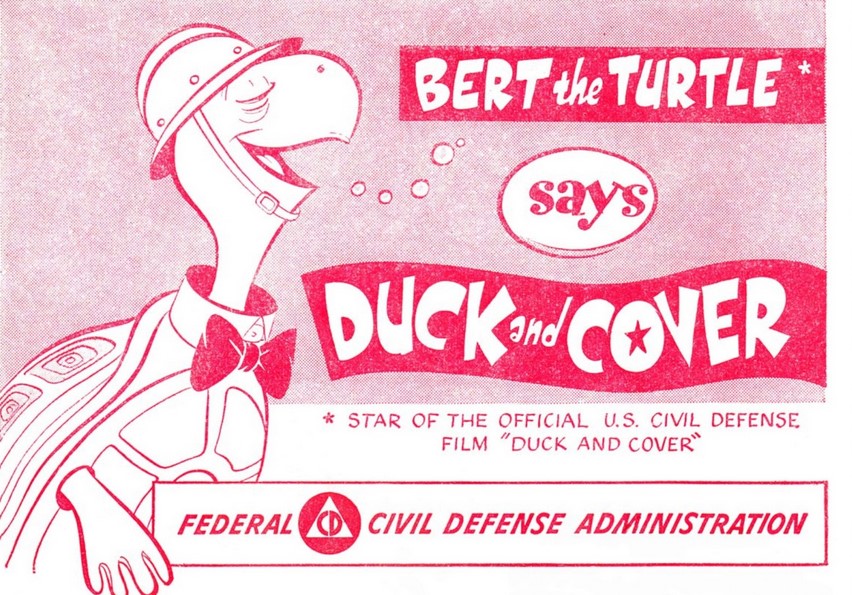
For the adults, this turn of events triggered alarms across the United States and Citrus County. Based on a message from the Florida State Civil Defense headquarters, local CD organizations were instructed to “proceed according to the planned procedure”. Predetermined plans for the protection of citizens and school children were put into effect. Since Citrus County was only 50 miles from the perimeter of damage caused by a 5-megaton bomb dropped at MacDill Field, officials knew there could be many casualties in our area. In addition, Citrus County was designated as a host for about 18,000 people who would be displaced as a result of an anticipated attack. It was estimated that about 10% of those guests would need immediate medical attention and the existing infrastructure would be overwhelmed. For that reason, Citrus County citizens had undergone first aid training since the 1950’s.
Fortunately, President John F. Kennedy and Soviet Premier Nikita Khrushchev were able to negotiate an agreement that defused the situation. While the world breathed a sigh of relief, the local Civil Defense program increased momentum.

Origin of the Civil Defense Program
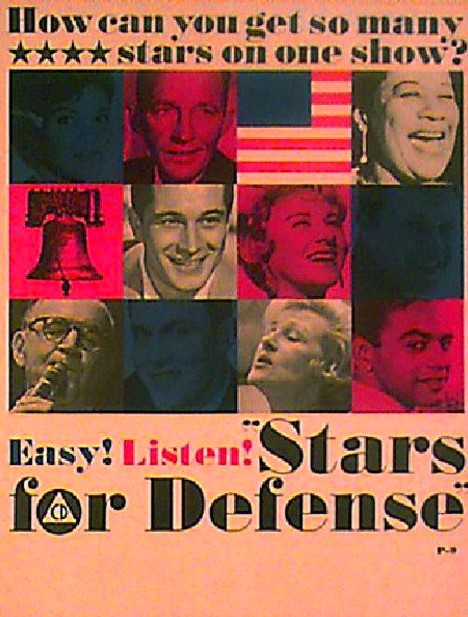
The Office of Civilian Defense was organized immediately prior to America’s involvement in World War II. The advent of nuclear weapons in the post-war period influenced government policy makers to expand the program throughout the 1950’s and 1960’s. The CD office provided information to individuals and communities that would enable them to survive a nuclear attack. The organization also handled recovery from natural disasters such as hurricanes and floods. The agency’s outreach included an annual release of messages and songs from popular musical artists of the day.
Citrus County’s Civil Defense Leader
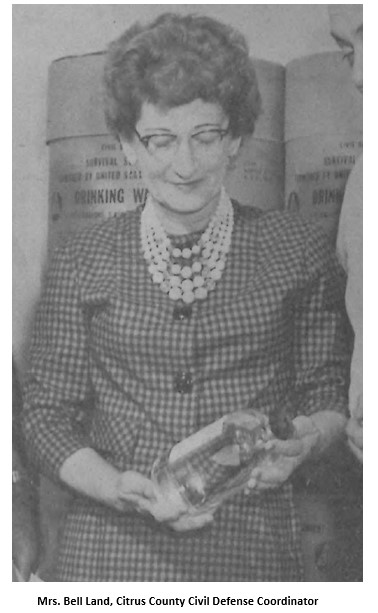
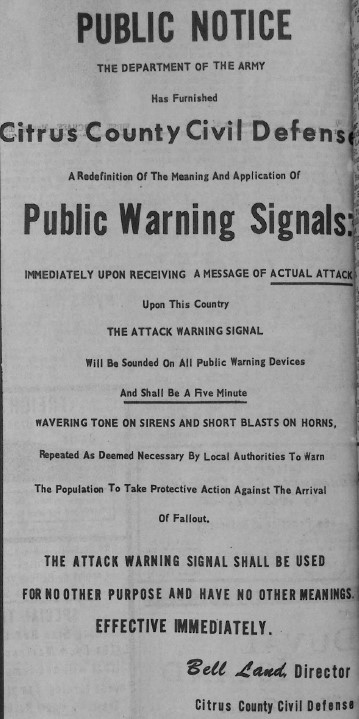
Each community was expected to appoint a leader for local preparedness issues. Mrs. Bell Land from Crystal River was assigned this task in Citrus County. She proved to be a tireless advocate for the CD program. She served for many years in this role and became the face of civil defense for our citizens. Mrs. Land appeared to be everywhere in the county. She regularly advocated for CD requirements at the Board of County Commissioners meetings. She traveled across the county to provide training and speak at civic group meetings. Mrs. Land was instrumental in obtaining federal grants for two-way radios and specialized vehicles to be used during Citrus County’s emergencies. The Chronicle carried her frequent articles. She personally attended working tests of the civil defense plans and procedures and even spent time in local fallout shelters to assess their readiness.
Civil defense training was responsible for saving the life of a toddler in Citrus County. In August 1961 two-year old Phillip Spooner from Hernando stopped breathing. His father, Josh Spooner, had attended a civil defense training film on “Rescue Breathing”. He applied mouth-to-mouth artificial respiration and the boy started breathing again. Emergency responders arrived and took young Phillip to Citrus Memorial hospital. The boy was found to have a respiratory infection. He recuperated and was quickly released. Spooner said: “I saw the civil defense film twice. I am thankful I knew what to do for my boy. I wish everyone could see and learn rescue breathing”.
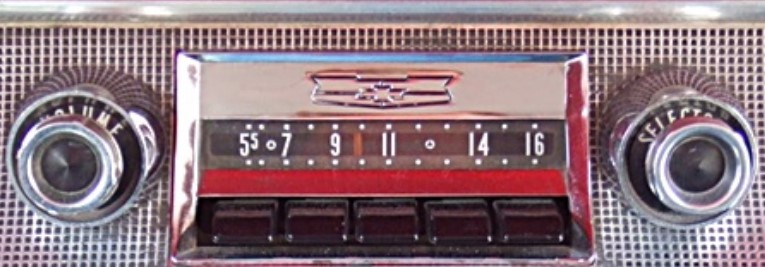
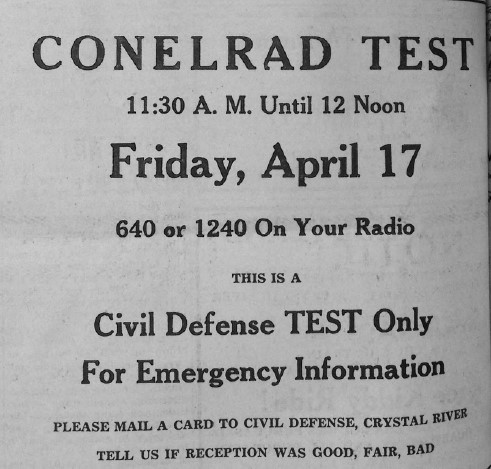
Mrs. Land reminded county residents that in the event of an emergency, people should tune to the nationwide CONELRAD frequencies 640 or 1240 on their radio dial. Radios produced during this time period usually had small “CD” symbols on the face that would lead listeners directly to the civil defense network without requiring memorization of the frequency. Transmissions from other radio stations may be unavailable in an emergency and the two CD stations would be sufficiently powered to reach most listeners.
Personal bomb shelters
The county civil defense agency established a 200-bed emergency hospital at the old Community Center in Crystal River. Mrs. Land also established public shelters in government buildings and leased space in school auditoriums and gyms. She negotiated shelter agreements with the owners of large commercial buildings. The Courthouse served as her command center and she was granted an office on the Second Floor.
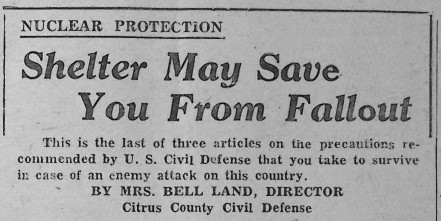
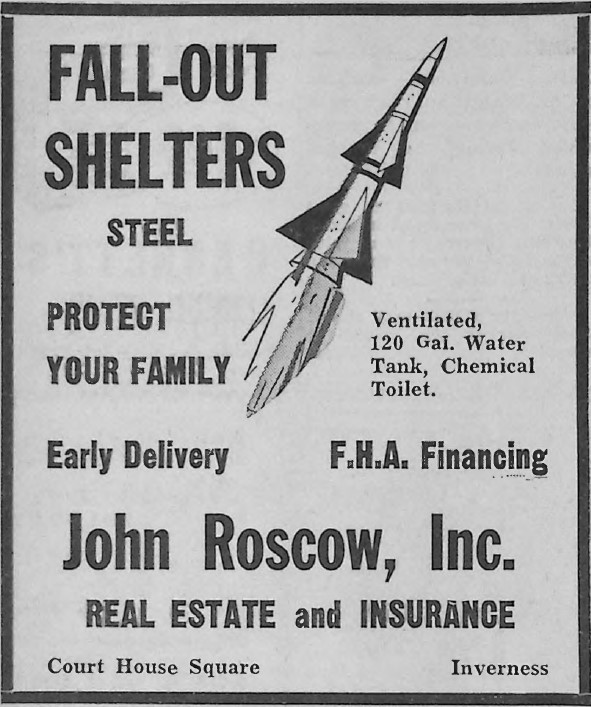
Civil defense leaders urged citizens to identify sites in their homes (and to construct a formal shelter, if possible) that could be used as a refuge for the family until the danger passed. Pamphlets were provided by Mrs. Land containing building plans for personal fallout shelters. High school students constructed hardened protective buildings as part of their class projects. Across the country, competition among families for the “best fallout shelter in the neighborhood” became popular. In Citrus County, local companies placed advertisements for shelter packages, complete with drawings of approaching Soviet missiles, in the Citrus Chronicle.
Given the topography of the County, Mrs. Land advised that digging an underground shelter would not be feasible. Building an above ground shelter, with the recommended three feet of earth covering all sides, would be too expensive for most local families and “…people would say we are nuts”. She gave instructions for hardening an interior room and stocking it with “…blankets, water, food, first aid kit, battery radio, books, especially The Book, games for children, and a 20-gallon garbage can for sanitary facilities.”
On a personal level, my family did not construct a new fallout shelter. In the spirit of Civil Defense recommendations, we did have an underground root cellar that was stocked with preserved tomatoes, pickles and pears from the preceding growing season. After eating pickles for two weeks in a windowless dank cellar, we would probably have been ready to go outside and take our chances with the Russians.
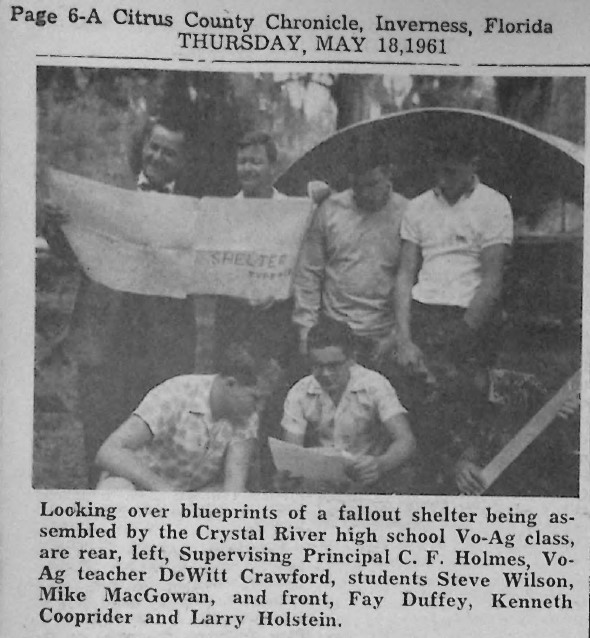
A Chicago company donated a new fallout shelter to Citrus County with the provision that the county provide some matching funds. They also stipulated that the construction had to be undertaken by local vocational school students. Members of the Crystal River Vo-Ag program used the project as a training exercise. The shelter was located at Mrs. Land’s home so she could use it for demonstration purposes.
Testing the Plans
Every disaster plan must be tested for effectiveness. A nationwide CONELRAD test of the two designated AM radio stations was held in April 1959. Residents were urged to tune into either of the two stations and send a postcard with a report regarding their reception to the CD office for evaluation. Every community in the county was able to successfully participate in the alert test, except Holder and Ozello. Authorities stated that they would send messengers to these areas to make them aware of any alerts or attacks.
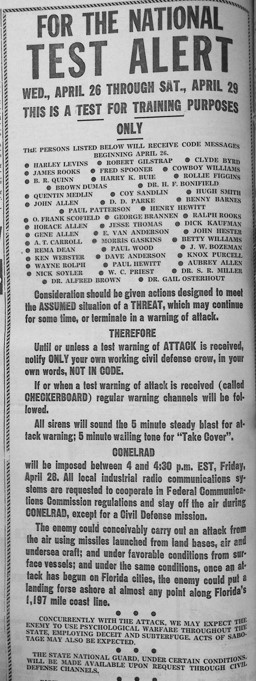
A more extensive test was held in 1961 that integrated the radio alerts with warning sirens and bells. Information about the test was published in the Chronicle and included a warning about the enemy’s potential to attack Florida’s 1,200 miles of coastline
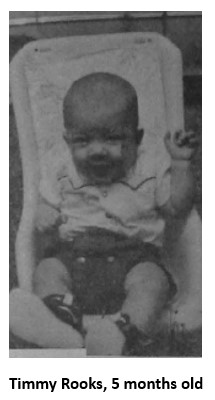
The ability of a public fallout shelter to accommodate large groups was put to the test in 1963 when 24 people agreed to stay in the old Community Center area for one overnight in 1963. The population included a mix of adults and children. County commissioners and other civic leaders also participated. Little Timmy Rooks represented the infant contingent. The Ralph Rooks family also brought Dena and “Bimbo”, their other two young children. All participants were required to sleep on the floor. Each meal consisted of eight graham crackers and a cup of water. Radio communication between the shelter and the CD Command Center in Inverness was successfully tested. While the exercise was deemed a success, I’m sure the group was relieved when they were released. They probably never ate graham crackers again.
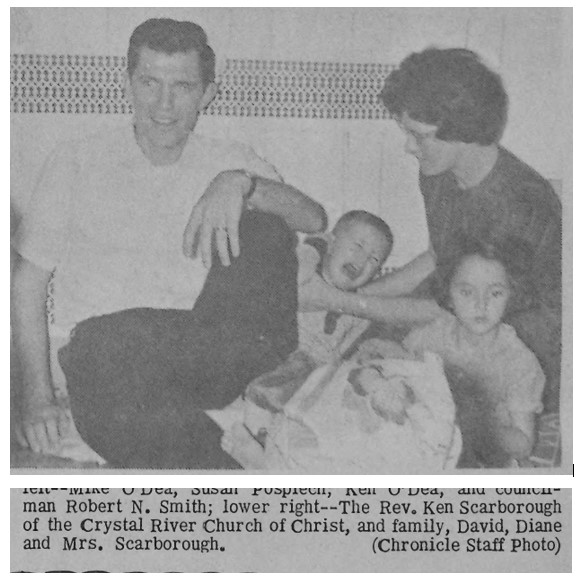
A similar test was held at Citrus High School in May 1965. There were 48 overnight guests for this exercise. Once again, families were encouraged to bring their children along to make the scenario as realistic as possible. The Rev. Ken Scarborough brought his wife and two children. Their daughter Diane appears to have happily spent the time with her doll, while son David was less than pleased to be participating.
Epilogue
The civil defense program gave ordinary citizens the chance to take positive steps to control their destiny – and protect their families – in the face of a nuclear attack. While the CD equipment and processes were never called upon to survive that scenario, the program successfully responded to several hurricane and flooding events in Citrus County. It gave people a sense of community and brought disparate groups together to face a common threat. The skills that people learned as part of the CD training saved more than one life over the years. We owe a special thanks to Mrs. Bell Land for her dedication to the people of Citrus County.