
D-Day : Citrus County Invades Normandy
By: Ken Marotte, Citrus County Historical Society
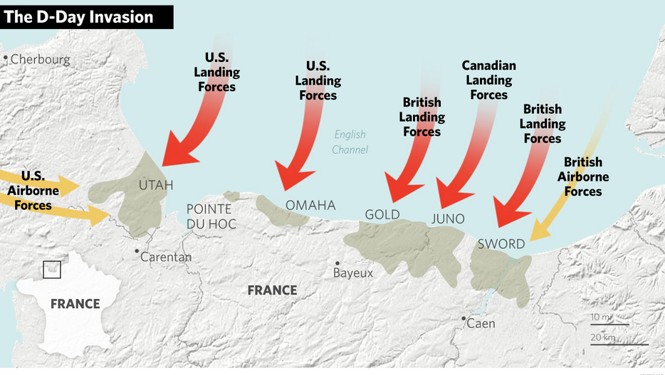
Next week, we mark the anniversary of the largest amphibious invasion in history – the D-Day landings on Normandy beaches on June 6th, 1944. This is the story of some of the soldiers and sailors who contributed to victory on that critical shoreline.
Genesis of the Normandy Invasion
The United States and our Allies knew that we must push the German Axis soldiers back from their European stronghold. While Russia fought the Germans on the “Eastern Front”, the Allies took preliminary steps toward taking back Western Europe by first attacking Rommel’s Afrika Corps in Casablanca followed by an Italian campaign that started in Sicily and pushed up the Italian peninsula.
Assembling the Citrus County Citizen Soldiers
Enlistments were brisk in Citrus County, especially after the initial shock of Pearl Harbor. The armed services would be challenged to match the civilian skills of the new enlistees with their expanding military needs. Prior to enlisting, the new servicemen were asked to list their current profession to determine if there was a way to utilize their talents.
Several of the new recruits were truck drivers in civilian life. In almost all cases, there were assigned to continue their vocation while in uniform.
Many of the recruits from the western side of the county were fishermen. They generally were given training as mechanics, truck drivers or riflemen.
Willie Lonon (Inverness) was previously in the dry-cleaning industry. Considering his experience with handling dangerous chemicals, the Army assigned him to work as a Decontamination Equipment Operator in Normandy. John J Adams entered service as a Railroad Hand, so he was designated to work as a longshoreman.
While reviewing the list of men who participated in the Normandy theatre, there were some military assignments that seemed odd. For example, Tom E Lisk listed his prior occupation as “cow puncher”. There must have been no cows to punch so the Army assigned him as Duty Soldier in the 44th Evac Hospital.
Fletcher Barnes from Lecanto was a truck driver in his previous life. Accordingly, the Army assigned him to work as a cook. George Holden was a livestock farmer which apparently qualified him to serve as a Postal Clerk. Harry McDonald was a civilian Sales Clerk and eventually became an Automotive Equipment Mechanic.
Some of the Citrus County men served on tank crews during the Normandy campaign. James C Ray, James O Strickland and Gordy A Strickland were assigned to light tanks.
Planning, Organizing and Training
Troops were trained for the massive European invasion with the utmost secrecy. Many of the Florida infantry soldiers were assigned to Camp Gordon Johnston (near Carrabelle, Florida) to hone their skills. The base was rapidly expanded and eventually covered 165,000 acres with 20 miles of frontage on the Gulf.
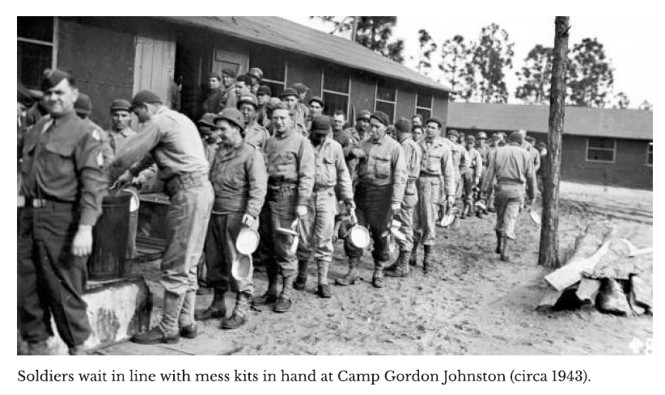
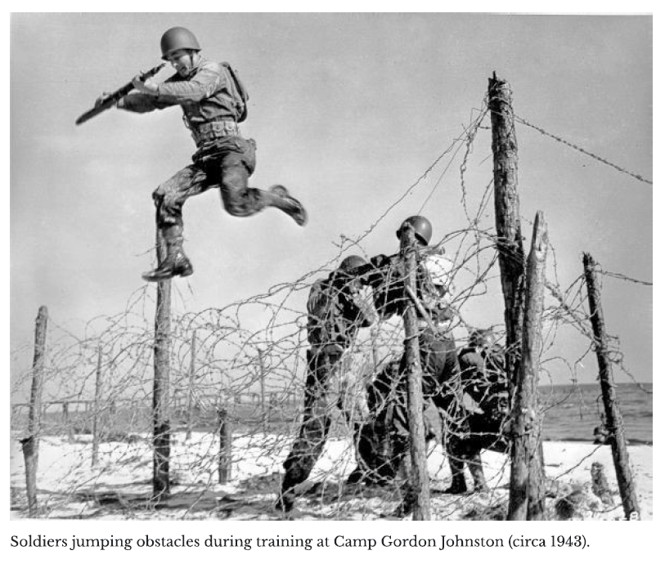
The conditions were bearable for the Florida boys, but the “Yankee” soldiers found the camp environment to be a shock. They penned the following verse:
The rattlesnake bites you, the horsefly stings,
The mosquito delights you with his buzzin’ wings.
Sand burrs cause you to jig and dance
And those who sit down get ants in their pants.
(Verse and training pictures courtesy of Florida Memory)
They would soon find that their training was invaluable for their survival on the beaches of Normandy and the push toward Germany.
A Many Faceted Attack
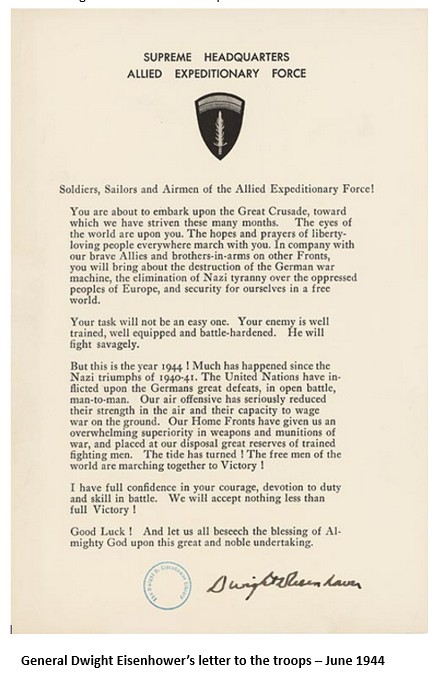
Thousands of men were stationed in advance of the anticipated invasion. On the eve of the attack, General Dwight Eisenhower sent a special communication to the entire force.
As part of developing the final plan, teams of demolition experts and reconnaissance squads went sent to prepare the beaches. Huge naval gunships lingered offshore and saturated the German defenders with naval artillery.
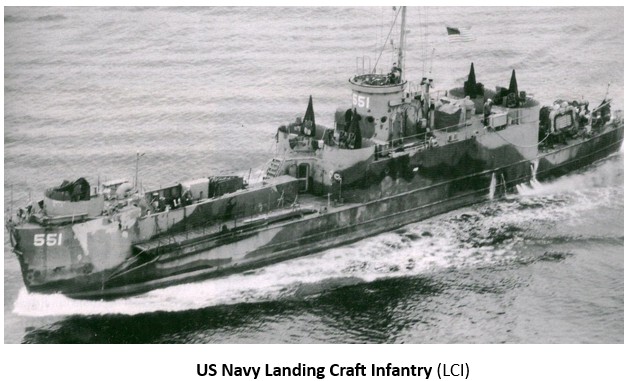
Hernando’s Lance M Watson was serving as Chief Motor Mechanic on a Landing Craft Infantry (LCI) on the eve of the Normandy invasion. According to a 1979 article in the Chronicle, the ship has experienced engine damage during previous sorties and was loaded with 300 soldiers ready to hit the beach. The craft was designed to accommodate only 200 passengers so the quarters were cramped and the men were restless after being sequestered for days on the ship.
Watson’s LCI chugged to the beach and opened the doors to release the soldiers in about 18 inches of water. He remembers the chaos and sights of death and destruction unfolding around him. As the last soldier left the ship, Watson reversed the engines for a quick escape from the battle. Other LCI’s were running amuck and Watson’s ship became fouled in the anchor of another vessel. After freeing the ship by some quick-thinking work with an axe, they were rammed by another LCI also trying to speed away. Damage was manageable and Watson’s LCI was able to make more trips to the beach later after repairs.
James J Hodge was one of the machine gunners in the 194th Glider Infantry. He was issued the devastating Browning Automatic Rifle (BAR) that rained fire down upon any German soldier who attempted to bring his glider down.
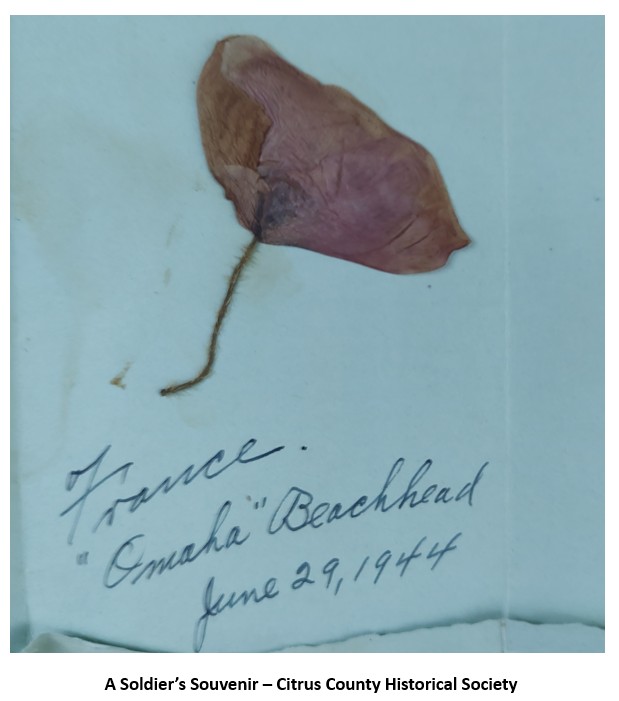
Crystal River’s Luther C Willis was killed June 14, 1944 as part of the battle for Normandy. He was a technician with the 238th Engineer Combat Battalion. He was buried in the American Cemetery, St Laurent-sur-Mer in France. His name is inscribed on the Citrus County WWII monument in the front of the Old Courthouse Heritage Museum in Inverness.
Normandy – Just the Beginning
While the Normandy invasion was successful, the conflict only opened the door for Allied soldiers to eventually push into the heart of Hitler’s empire. There would be numerous battles along the way. The Germans did not surrender and were intent on defending their conquests at all costs.
Supply and logistics became paramount. Ships like Watson’s LCI were loaded with tanks, artillery and ammunition as soon as the beachhead was secured. The Citrus County truck drivers, and thousands of their fellow soldiers, were ready to meet the supply ships. The trucks drove onto long floating docks called “Mulberries” to load and bring their goods to the shore. Eventually an expedited priority truck delivery system named the “Red Ball Express” moved the supplies to where they were needed most.
The official Discharge Certificates on file at the Museum provide the story of the journey that faced the Normandy survivors. Many of the men on file list a number of major battles on their service records. For example, Cecil Hanson was a truck driver who was engaged in most of the major battles on the war. He fought in all major battles of the war (Algeria, Tunisia, Sicily, Normandy, Northern France and the Rhineland).
Basil May Jr, the grandson of Judge E.C May, entered the service as an unemployed student and was trained as High-Speed Radio Operator. His duties brought him close the front lines and he was eventually wounded and awarded the Purple Heart medal. His service took him from Normandy, through Northern France, the Ardennes (where he was wounded), the Rhineland and into Central Europe. He proclaimed that he was the first Citrus County soldier to set foot in Germany.
Epilogue
It has been over 80 years since the D-Day landings spelled the beginning of the end of Hitler’s Germany. A force of varied talents and duties were coordinated and brought to bear upon the Normandy Beaches. Take a few silent moments on June 6 to remember the sacrifice of those brave Americans.
Ken Marotte writes for the Citrus County Historical Society. He can be reached via email at kenmarottejr@gmail.com if you have any comments, questions or suggestions.
Join the Citrus County Historical Society! Call 352-341-6428 or visit https://cccourthouse.org/ for more information.