
How old is Cooter Pond? Was Cooter Pond home to a Yacht Club? Did the pond save the old Citrus County Courthouse from flooding? Did the resident fish enjoy a moonshiner’s cache? Are there boxcars from a past train derailment still hidden under the waters?
Cooter Pond was once so impure it was called the “Rodney Dangerfield of local water bodies”. Did it finally get the respect it deserves? Challenge yourself to see how many of these 11 facts about Cooter Pond you can remember.
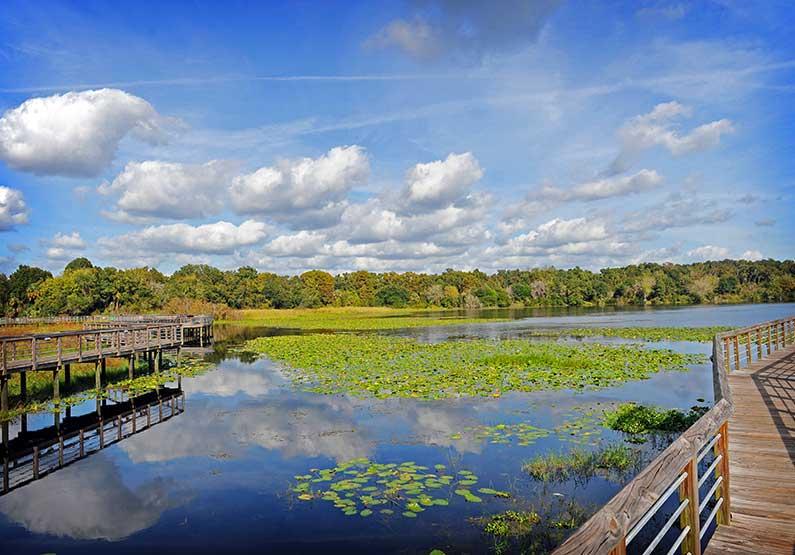
Photo Courtesy of Discover Crystal River
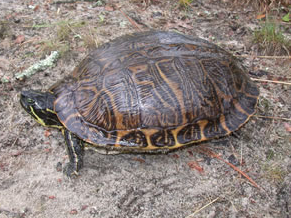
- Cooter Pond is named after the Florida Cooter, a type of turtle that is common in our area. You can see them basking in the sun along the edge of the pond. They usually grow to about 12 inches in size. Florida Cooters feed mainly on vegetation that is readily available in the pond. You’ll sometimes see them basking in groups on a log or along the shore.
- Cooter Pond was originally a cove on Henderson Lake. Up until the 1950’s, the area known as today’s Cooter Pond was simply an open cove on the larger Lake Henderson. Boats could easily move between the cove and the lake. Railroad tracks ran alongside the western shore and had to negotiate a sharp curve near today’s Route 41. In the early 1950’s, the eastern bank of the cove was filled in and railroad tracks moved to eliminate the curve in the train’s path. A 25 acre (MOL) landlocked pond was created and Cooter Pond was born. Pictured below are two USGS survey maps showing the change. The first image is from 1950 and the second image is from 1955.
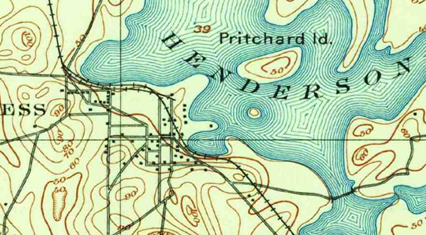
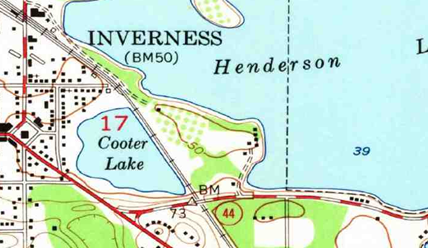
- Cooter Pond had different names over the years. As you can see from the USGS map above, the new area was called “Cooter Lake” after the turtles that lived in the cove – but given the small size of the lagoon, most locals called it “Cooter Pond”. A developer tried to rebrand the pond as “Sunset Lake” in the 1950’s and that name was used on some maps of the area. However, during a spirited Inverness City Council meeting in 1988, “Cooter Pond” was officially adopted as the pond’s name.
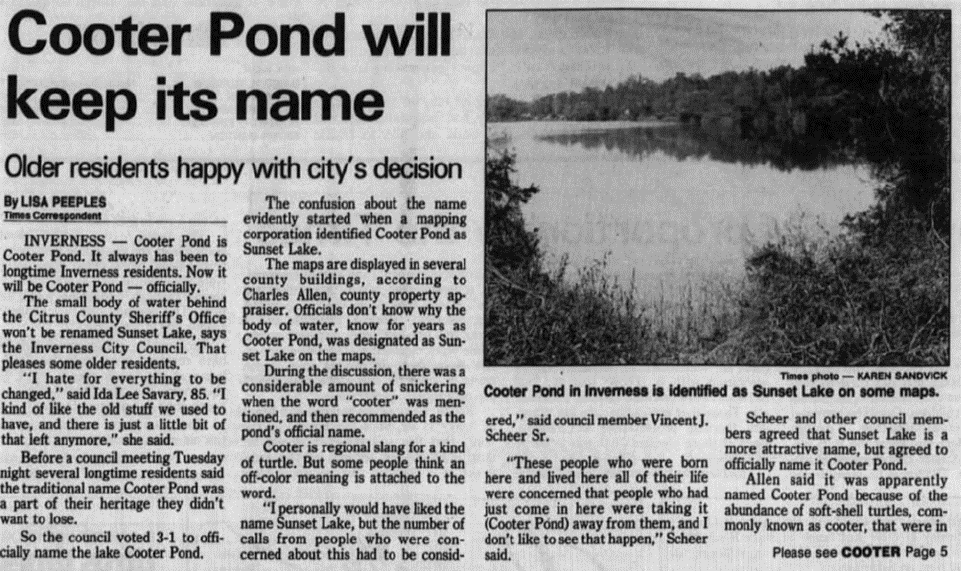
Tampa Bay Times, Thursday, March 3, 1988, via newspapers.com
- Inverness Mayor Elfred Lassiter moored his boat in the middle of Cooter Pond to celebrate Christmas. Mayor Lassiter decorated his personal cabin cruiser to welcome visitors to Inverness during the holiday season. In spite of vandals sinking the boat in 1975, Lassiter continued the tradition for several years during the 1970’s (with additional 24/7 security, of course).
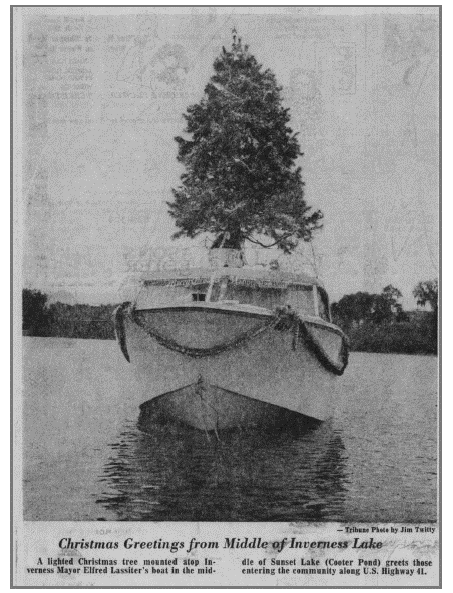
The Tampa Tribune, Tuesday, December 17, 1974 via newspapers.com
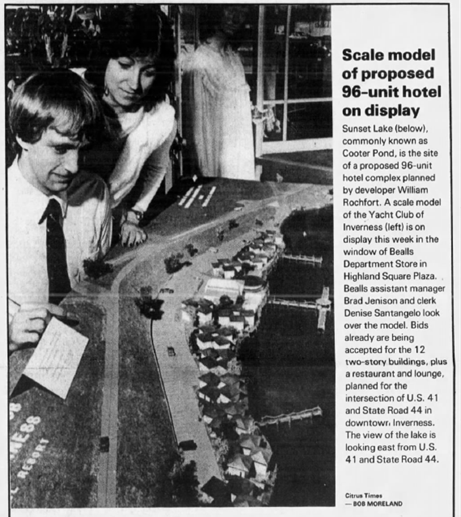
Tampa Bay Times, Tuesday, January 26, 1982, via newspapers.com
- A hotel called the “Inverness Yacht Club” was proposed by a developer in 1982. The plan called for 96 units and a 5,000-foot restaurant lounge on the shores of Cooter Pond. Unfortunately, there would be no yachts sailing on the waters of the small landlocked pond, unless you consider Mayor Lassiter’s cabin cruiser at Christmas time. Only paddleboats and canoes would ply these waters. The plan was ultimately unsuccessful and the city’s Yacht Club was never built.
- Downtown flooding would sometimes restrict access to the Citrus County Courthouse. Storm drains diverted waters to Cooter Pond. A huge storm drain was installed in 1971 to channel water away from the downtown area into the pond. The Highland Square Plaza was also subject to flooding, so Cooter Pond was used as a drainage solution for that problem in 1978. By 1989, officials realized that they had created an environmental challenge that resulted in stagnant water, uncontrollable plant growth and potentially harmful chemicals being dumped into the pond. Plans were developed to filter any ground water, drain the pond and clear all of the plants (and four feet of muck) from the pond. Unfortunately, the full plan did not secure the necessary government funding and a piecemeal approach was adopted to address some of the issues. Today Cooter Pond’s waters are cleaner than past years and visitors can enjoy a stroll along a boardwalk. More remains to be done to restore the pond to its original condition.
- Storm water runoff was a minor problem compared raw sewage flowing into Cooter Pond. There were no central sewage treatment plants in Citrus County’s early days. The problem became acute when the downtown Inverness septic tanks failed and dumped raw sewage into the pond. In 1957, the problem expanded to include the Tsala Apopka lakes, and the Florida State Department of Health declared the waters in our area unsafe for swimming and bathing. There were cases of typhus directly linked to the sewage and explosion of the mosquito population, especially the culex quinquefasciatus variety which has been known to be a carrier of encephalitis. The City Council took steps to replace the outdated septic system with a modern waste control system and the quality of the pond’s water improved.
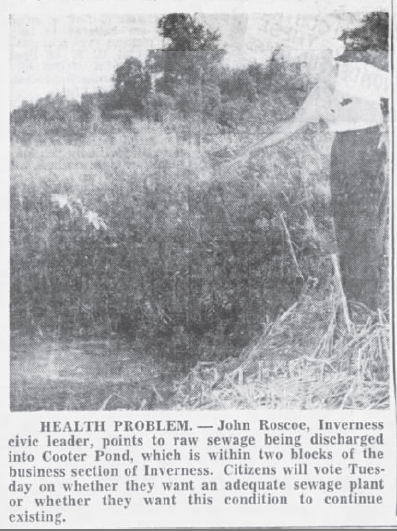
The Tampa Tribune, Sunday, October 13, 1957, via newspapers.com
- The U.S.S New Jersey once plied the waters of Cooter Pond. A five-foot model of the famous battleship was among the fleet of model boats that enthusiasts would sail on the pond every weekend in the early 1980’s. Their ships enjoyed the still waters but still fouled their propellers if they ventured too far into the weeds.
- A moonshiner’s stash was dumped into the pond. A Florida State Trooper stopped a truck in 1958 and discovered a sizable cache of illegal alcohol hidden in the back. Over 250 gallons of the high-proof beverage were dumped into the storm drain which led to – you guessed it – Cooter Pond. The aroma of the “hootch” wafted through the downtown Inverness area. The fish were said to enjoy their unexpected gift from the FHP.
- Home of the expanded Citrus County Jail? When it became apparent that the old county jail in Inverness was obsolete, the Board of County Commissioners embarked on a long project to identify a suitable location. Sheriff Charlie Dean argued that the best location would be on the shores of Cooter Pond due to its proximity to the Court House. The BoCC agreed and approved the plan. The Inverness City Council did not feel that the presence of 400 prisoners near the heart of downtown would not foster their plans to rejuvenate that area. The wrangling between the BoCC and Inverness Council lasted over a year. The BoCC tried to convince the Inverness Council several times, but the Council stood resolute against this proposal. In the end, the new facility was built in a rural section of Lecanto and the pond was left to custody of the turtles.
- Does Cooter Pond contain the remains of a train that derailed in the past? Stories arose in the 1980’s about a past railroad derailment that resulted in several railroad cars being left on the bottom of Cooter Pond. Local citizens recounted how they saw families venturing into the water to remove sides of beef from one of the overturned cars. Others remembered seeing a boxcar full of new cars being left at the bottom of the pond. Some old-time Citrus residents recalled wading near the site of the boxcars and pulling up random items with their feet. Finally, a local man developed a large waterborne metal detector and he claimed to have found a large magnetic anomaly off the eastern bank of the pond in 1983.
While there were many recollections published in those 1980’s newspaper articles, no one could pin down the approximate date of the event. Most of those quoted in the newspaper stories remember the train being derailed in the 1930’s, others recalled the incident occurring in the 1940’s, while others claimed the event happened in the 1960’s.
Railroads were the primary means of transportation for long-distance passengers and freight at that time. Derailments were significant events that were reported in the local newspapers, no matter how minor. Citrus County was no stranger to derailment events. Some examples include: In 1903, one of the cars on the Homosassa to Ocala train jumped the tracks; there was a report of the Dunnellon to Ocala train collision in 1906; Six people were hurt when an Atlantic Coast Line train left the tracks south of Floral City in 1942; A truck collided with a Dunnellon train in 1954 which resulted in the derailment of the engines (and killing the trucker); Over 100 people had to be evacuated from their homes when 13 cars in a train carrying chemicals left the tracks between Hernando and Inverness in 1972; A fiery head-on crash killed multiple people near Floral City in 1956 (see picture below). Curiously, there is no mention of a derailment in near Cooter Pond In any available newspaper resource. Representatives of the rail lines that ran through Inverness at the time had no records over any derailments near Cooter Pond nor are there any records related to an effort to salvage the lost freight.
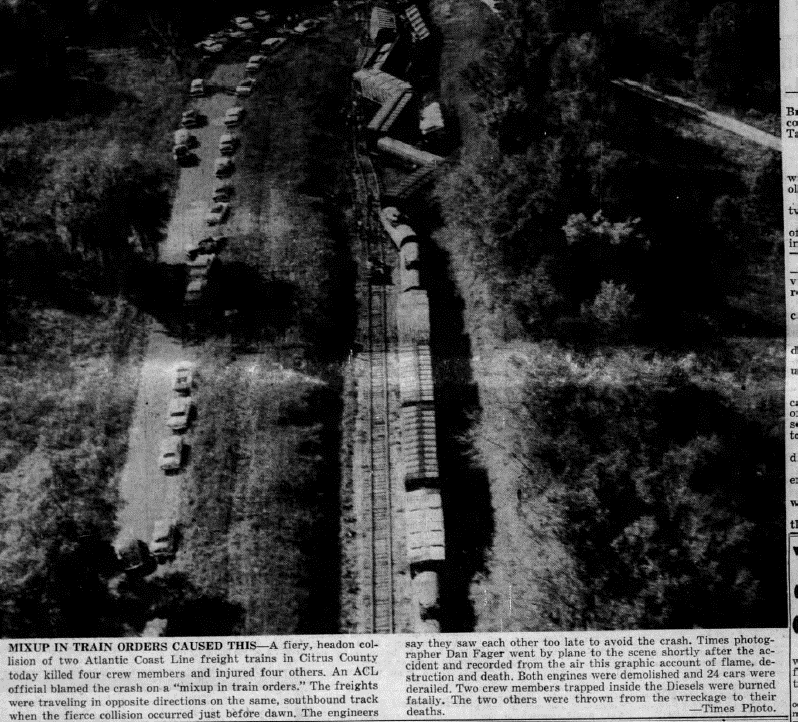
The Tampa Times, Thursday, October 18, 1956, via newspapers.com
The depth of Cooter Pond is reported to be 12 feet. The standard railroad 40-foot boxcar of the time was 9 ½ feet wide and 14 feet high. This means that any boxcar that fell into the pond would be clearly visible at all times unless it landed in a perfectly flat position on the bottom of the pond. During times of extreme draught, such as experienced during 1957 (see picture right, below), the water level of the Citrus lakes and ponds would have dropped by over 4 feet – which means that even a boxcar lying perfectly flat would be visible from the surface. It would be interesting to find any pictures of the boxcar remnants during those dry times.
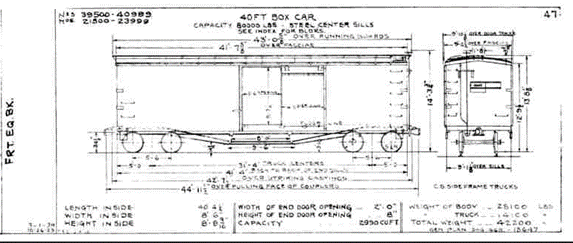
Photo Courtesy of Research the Northern Pacific
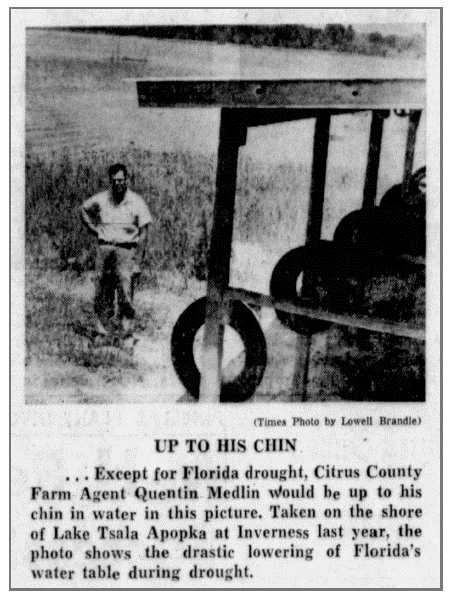
Tampa Bay Times, Saturday, April 20, 1957, via newspapers.com
What about the detection of a large magnetic target near the eastern bank of the pond in the 1980’s? Remember that the railroad tracks ran along the western shore of the pond up until the early 1950’s. So, any derailed cars from 1900 through 1951 would be in the opposite side of the pond from where the magnetic study was conducted. Does this mean that there could be two separate derailments on different sides of the pond?
The lack of hard evidence casts some doubt on the story of the Cooter Pond Railroad. Clearly something happened in the past that caused so many people to remember this event. Perhaps someone has pictures of the derailment hidden in a box in their closet. Maybe someone could use a modern submersible camera to scan the shallow waters of Cooter Pond and uncover the remains of the boxcars and automobiles. We could hold a treasure hunt as part of a future Cooter Festival and award a prize to the person who uncovers the largest railroad car. Until then, I view this story as another fascinating legend in Citrus County history. The turtles know the real story – and they aren’t talking.