
Citrus County’s Famous Contestants
By: Ken Marotte, Citrus County Historical Society
Would YOU like to be Queen for a Day? Or maybe you’d like to impress the nation with your extensive mathematical knowledge? How about winning a nation-wide journalism competition and then coming back to repeat the following year? This is the story about some Citrus County residents who were in the national spotlight in years past.
Queen For A Day
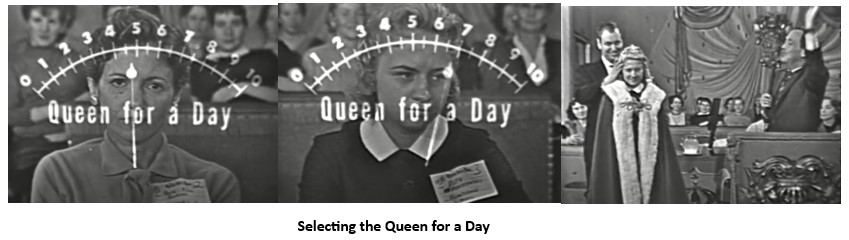
Host Jack Bailey steps out from behind a curtain. He booms into the microphone “Would YOU like to be Queen for a Day”? The cameras pan across the audience of 800 cheering women. A group of four contestants have been preselected and are brought before the audience for a chat with Bailey. Each of them in turn spins a tale of heartbreak and misfortune that usually leads them to tears. They make requests for medical supplies. appliances, or vehicle repairs that will make their lives less painful. After each woman pleads her case, the quartet sits down at a table for the moment of truth. Using a sophisticated sound measurement tool known as a “clap-o-meter”, the audience decides which contestant had the saddest story. The camera focuses on each contestant’s face as the results are superimposed. The winner (or saddest) is helped from her chair, wrapped in a royal robe and a crown is placed on her head. While being led to her throne, Pomp and Circumstance blared over the studio speakers. The new Queen sobs and listens as Bailey tells her that the requests are being granted by the TV show sponsors.
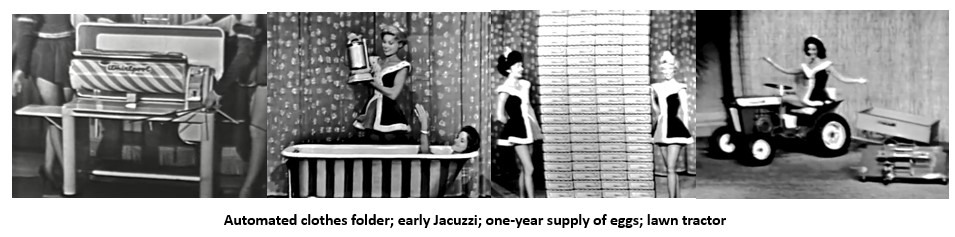
The show’s sponsors also shower her with a variety of items she didn’t ask for such as an automated laundry folder, lawn tractor and even a year’s supply of eggs. The three contestants who did not win are now even sadder but at least they leave with a home version of the show.
Queen for a Day started as a radio show in the 1940’s and made the transition to television in 1956. The program was based in Los Angeles but would occasionally visit other locations. Miami had recently invested $8,000,000 in their new Exhibition Center and officials were anxious to display their civic pride. They convinced the show’s producers to stage the program in Miami during the week of November 10, 1958. (The former Miami City Administrator happened to be emcee Jack Bailey’s brother-in-law). When the news was announced, an estimated 2,000 Florida women applied to participate in the show. Tampa television station WFLA decided to send four busloads of candidates for a daylong trip to Miami. Station management advertised that the first 175 women who could pay the bus fare ($12.70) would travel to Miami and be considered as contestants.
In Inverness, times were tough for Helen Watson Williamson. Her husband was killed in an automobile accident that year, leaving the young mother with three children to support. Their young son was in the car and was seriously injured (but was recovering). In addition, one of the sons had contracted polio and required intensive therapy in Tampa and at home. Williamson and her sister decided to reserve spots on the WFLA bus in the hopes of appearing on the program. Each applicant completed a brief life story and was asked how the TV show could improve their lives. The young widow asked for gasoline and a set of new tires for her car so she could drive her son to therapy sessions in Tampa. She also asked for a vibrating muscle stimulant device so she could continue treatments at home in Inverness.
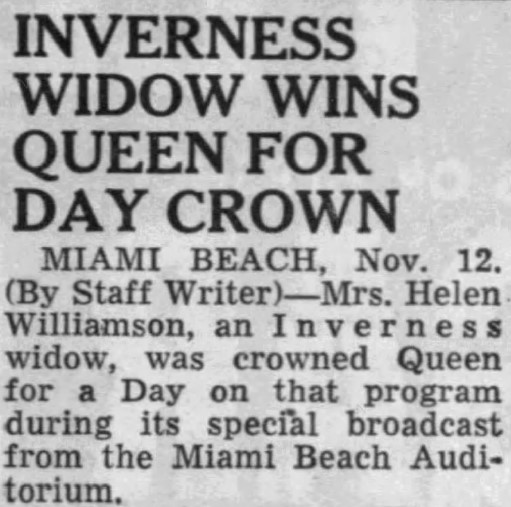
Williamson later remarked that she didn’t expect to be selected as a contestant given the number of other candidates. She was surprised when producers told her they were impressed by her story and asked her to recount her situation on camera to the entire country. She was overcome with emotion when the clap-o-meter results showed she had won the audience’s heart. Helen Williamson was presented to America as the “Queen For A Day” on November 13, 1958.
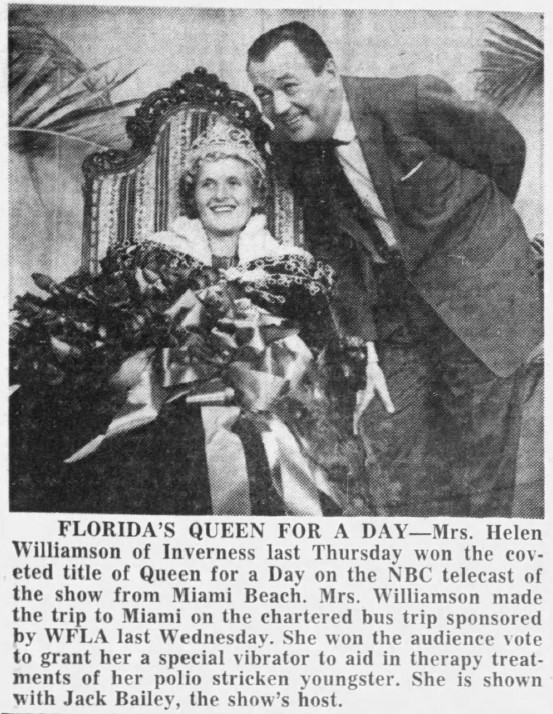
Mrs. Williamson later recounted to the Citrus County Chronicle that she was grateful that the producers provided her with new tires and 1,000 gallons on fuel so she could safely drive to Tampa for weekly therapy. They also made arrangements for the in-home vibration therapy machine she desperately needed. Williamson told the Chronicle was overcome when the shows advertisers also gave her a complete wardrobe, a wrist watch, a set of luggage, a Polaroid camera, aluminum cooking pans, an electric refrigerator, a $500 merchandise gift card, a fine rug, a mattress, a $1,000 bedroom suit, three boxes of jewelry, and perfume from Paris. She also won a fully-paid trip to Mexico City which she took with her sister.
Life slowly turned back to normal for Williamson. He remarried in 1959 and had two more children. She eventually decided to serve as a bus driver for Citrus County schools and became one of the lead drivers. She was responsible for training the newer drivers that joined the fleet. Her assigned route was in the Gobbler Drive area and she was beloved by the students who she brought back and forth to school every day. She was one of the bus drivers who agreed to participate in the Sheriff’s crime watch initiative that linked drivers directly to law enforcement if they observed a crime in progress
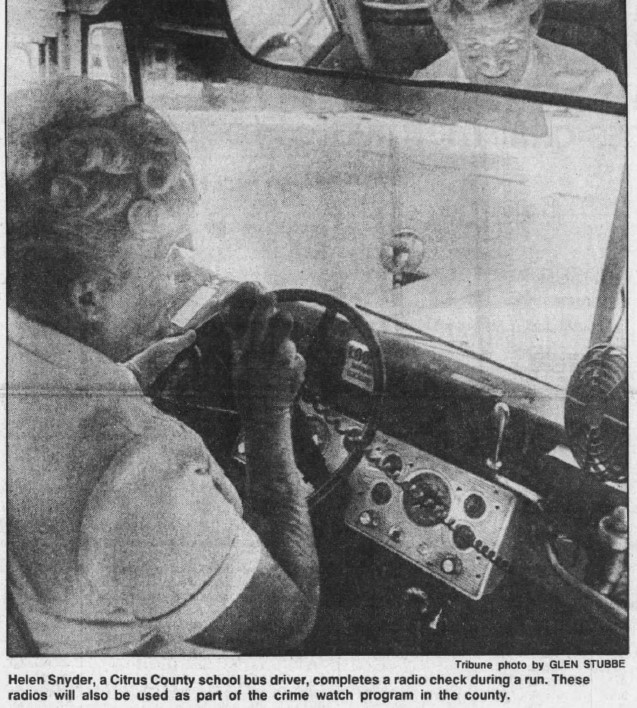
She remained in the Inverness area and lived close to her children and enjoyed watching her grandchildren grow. Helen Watson Williamson Synder retired after over 24 years of service as a driver for the county. Many of her students probably had no idea that she was once celebrated across the country for her grit and determination – wearing the royal robe of “Queen for A Day”. She passed away in 1999 at the age of 65.
G-E College Bowl
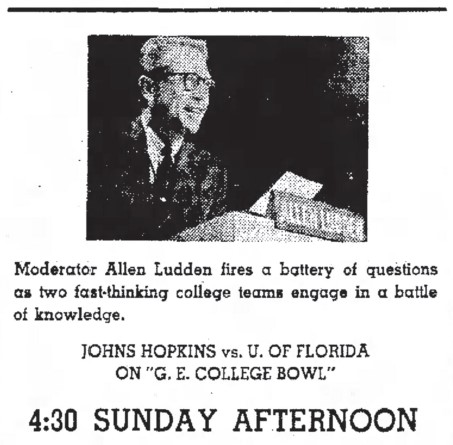
The General Electric College Bowl was a quiz show televised every Sunday in the late 1950’s and 1960’s. Institutions were invited to select four candidates from their student body to compete against students from other colleges. Scholarships were given to the winning participants. Host Allen Ludden would pose questions from various general knowledge categories and correct answers would be awarded points. There was no distinction between large universities and small colleges and audiences were thrilled when a “David versus Goliath” match would turn out in favor of the smaller institution.
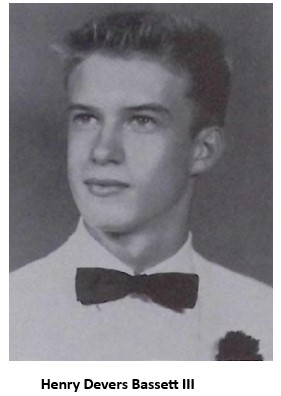
Henry Devers Bassett III (known to his friends as simply “H”) was a bright Citrus High School student from Floral City. When he graduated from CHS, his classmates voted him “Most Likely To Succeed”. His mother, Mrs. Flossie Bassett, was a longtime proponent of intensive Mathematics training in county schools. She appeared before the School Board and argued that every student should be subjected to four years of math classes. She also argued that mathematics teachers should make more money than coaches in sports programs. It should be no surprise that H.D. Bassett elected to become a mathematics major when he enrolled at the University of Florida in 1958.
Bassett continued to distinguish himself at Florida. When the school administrators announced that they were forming a “College Bowl” team in 1961, over 50 students applied for consideration. After a rigorous selection process, H.D. Bassett was selected as one of the University’s four representatives on the television show. Their opponent would be a team from Johns Hopkins that had demolished their past challengers for four weeks in a row. Their most recent match resulted in a lopsided 360 to 45 victory over the University of Montana.
The Florida team featured a balance of skillsets, including students specializing in literature, history and political science. Bassett was assigned to handle mathematics questions. While the Florida team fared better than past contestants, they eventually succumbed to Johns Hopkins in the final rounds. Readers across the state wrote to newspapers letting them know they were proud of their ‘Gators and that the team proudly represented the state to a national television audience.
The G-E College Bowl spawned a number of local television quiz show spinoffs involving local High School students. On a personal note, I was selected to match wits against other high school teams on one of those spinoff shows years ago.
National Journalism Award
An international High School journalism organization, known as the “Quill and Scroll”, was founded in 1926. Its goal is to encourage and recognize the achievements of High School journalism students. They hold annual competitions to assess student writing style and skills. They issue a limited number of awards every year to those students who excel at their craft. There are chapters in all 50 states and 44 countries.
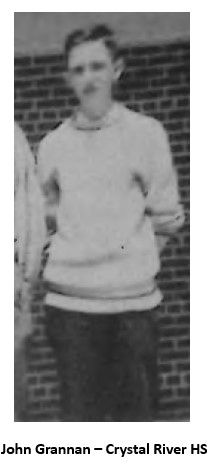
John Grannan was the editor of the student newspaper and literary magazine at Crystal River High School. He was a frequent contributor to those publications and the excellence of his articles were recognized by the national Quill and Scroll evaluation team. In 1964, Grannan won the only national current events award granted to a Florida student. He repeated the event in 1965, winning a national award for excellence in journalism. He received scholarships for his efforts. Grannan continued to distinguish himself at Central Florida Junior College where he was editor of the school newspaper (“The Confederate”)
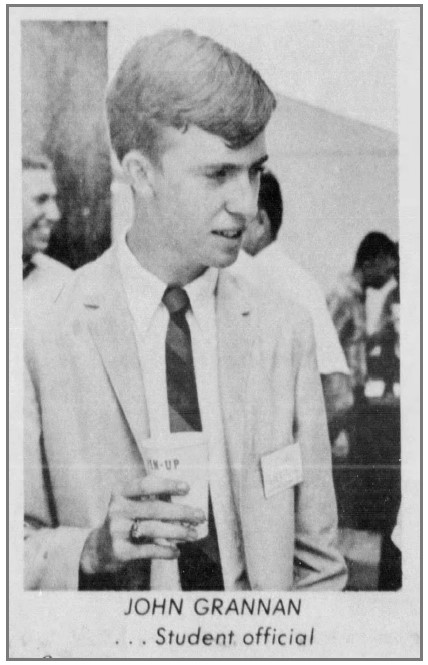
Grannan devoted his attention to local history after completing his college career. He served on the county Historical Advisory Board. He assumed leadership of the Citrus County Historical Society and continued his journalistic career with that organization. Gannan forged a closer partnership between the CCHS and county leaders. He was a daily visitor at the Old Courthouse Heritage Museum. He fell ill during one of those visits and passed away doing what he loved in 2018.
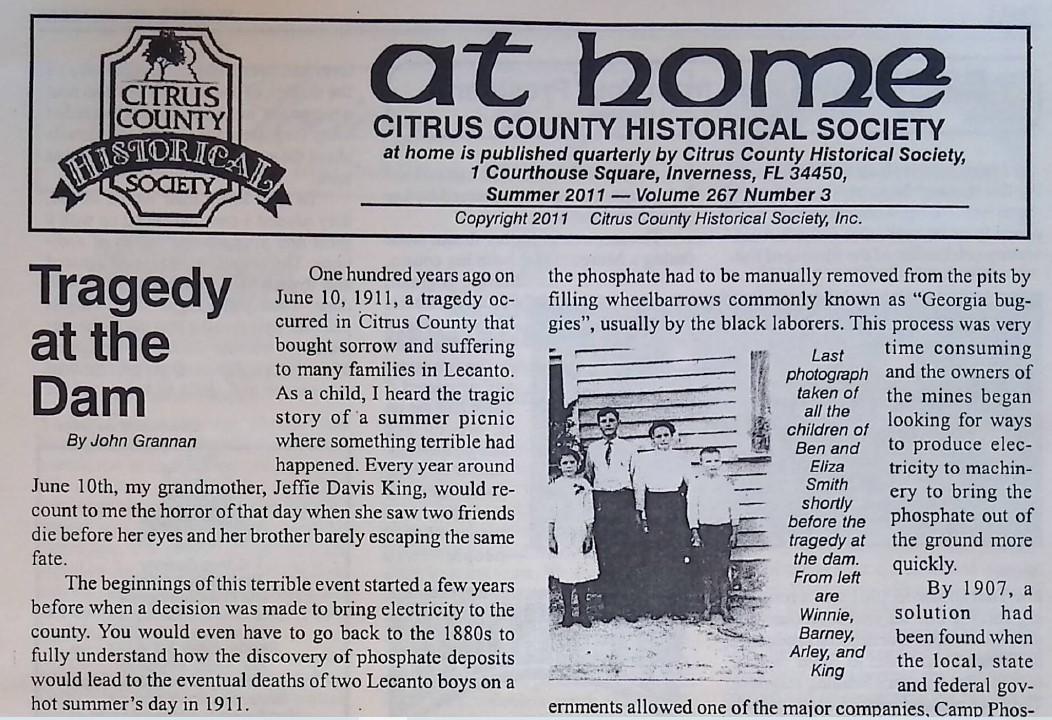
Ken Marotte writes for the Citrus County Historical Society. He can be reached via email at kenmarottejr@gmail.com if you have any comments, questions or suggestions.