
Citrus County’s Deputy Dawgs
By: Ken Marotte, Citrus County Historical Society
Canines have supported law enforcement long before the establishment of Citrus County. Primarily used as trackers in the past, their role has shifted to keep pace with the changing nature of society. In addition to their original duties of tracking missing persons and criminals, today’s K-9 units also assist with apprehension and detection of narcotics and explosives. This is a look at the history of canines as law enforcement partners in Citrus County.
A Hunter’s Haven
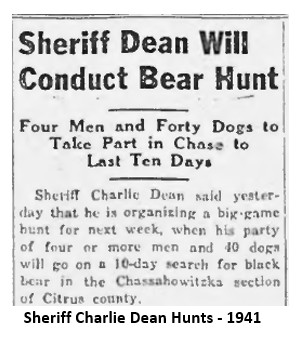
The newly-formed Citrus County quickly established a reputation as a paradise for sportsmen. Most of the local men enjoyed hunting and always owned a few hounds to help track game. The forests were rich with deer, bear, racoons as well as wildcats. They bred fearless trackers who could follow the scent of animals for long distances and then keep the quarry at bay until the hunters arrived.
Hunting could be a dangerous proposition for the hounds, especially when they cornered larger beasts. There were several newspaper accounts of dogs who succumbed during tussles with bears and larger wildcats.
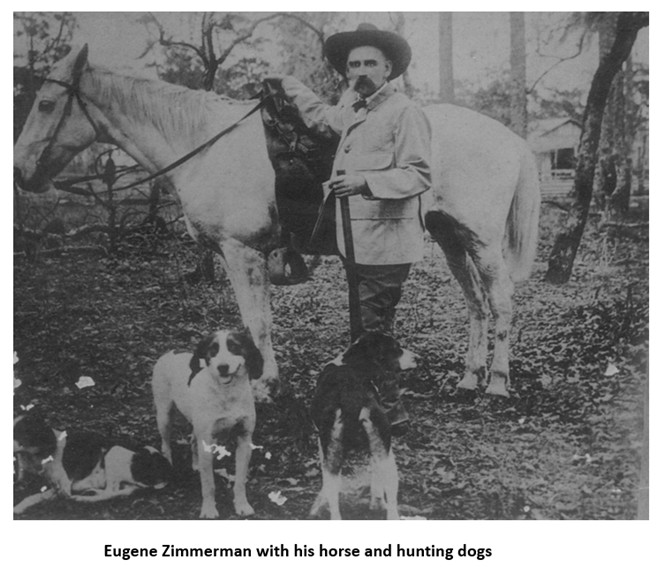
The men who served as Citrus County’s early Sheriffs had personal kennels of hunting dogs that could be relied upon to serve as trackers in a law enforcement pursuit.
The Largest Population of Convicts in Florida
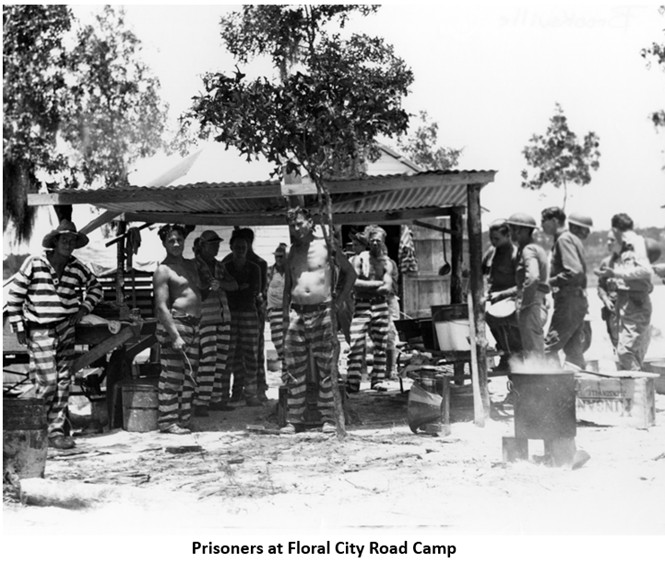
The discovery of extensive phosphate deposits and expansion of the turpentine industry in Citrus County led to the greatest period of business growth in our county’s history. Thousands of men were needed in the mines and forests to help fuel the needs of these business ventures. While many people migrated from Alabama, Georgia and other parts of Florida as day laborers, more workers were needed by the operators.
At the same time, the State of Florida and other counties decided to “lease” their convicts to the phosphate and turpentine companies. Government officials saw this as a win-win proposition where the they could make extra money leasing convicts and the businesses would have a source of cheap labor. In time, convict leasing became a self-perpetuating cycle where officials stepped up enforcement of obscure offenses and waiting judges quickly convicted the hapless defendant – and sentenced them to jail terms in Citrus County’s mines and fields.
During the early 20th century, there more convicts imprisoned in Citrus County than any other county in Florida.
More Convicts, More Escapees
The companies that leased the convicts were also responsible for maintaining security for the prisoners. Since there were so many convicts working in the local camps, it became almost impossible to ensure that none of the prisoners escaped. Local law enforcement was charged with tracking escapees and returning the convicts to their camps. Needless to say, the companies were billed for the Sheriff’s services.
The Sheriff’s personal hounds were enlisted as members of the “posse” to track the escapees. Sometimes canines from other deputies joined the hunt. While the searches were generally successful, hounds were sometimes thrown off the trail by prisoners who traveled on the water or hopped a passing train. If the escapee managed to grab a gun, the dogs were sometimes shot while on the run.
The Citrus County Jail was not immune from escape events. The bars became less stable as the jail aged and prisoners sometimes escaped by repeatedly tugging on the bars. Multiple prisoners escaped one night and the jailer found only a solitary inmate sitting in the cell the next morning. He lamented that he was too fat to fit between the gaps in the wall and would have joined the others if he had eaten a healthier diet. He eventually provided information that enabled the hound to track his skinnier friends.
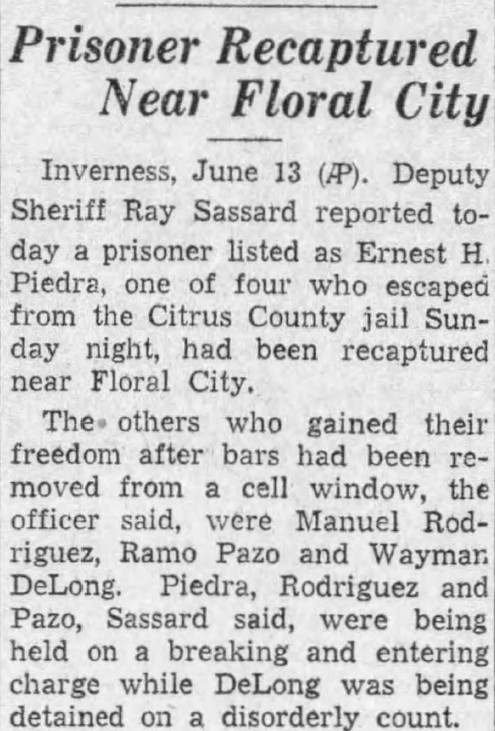
In other cases, convicts became “trustees” and were granted the privilege of working outside the gates. Sometimes they would make a break for freedom, but were quickly corralled by the Sheriff’s bloodhounds.
Not every crime-fighting dog was a hound. In 1931 Mrs. Charles Dean’s Boston Terrier heard a strange noise in the county jail and started to bark incessantly. The Sheriff decided to investigate and found prisoner A. J. Parsons sawing through the bars on the jail windows. Parsons had almost cracked every bar but had broken his saw blade when the diminutive pooch sounded the alarm.
The Hound who Rehabilitated a Convict
It was not unusual for wardens to assign dog training duties to selected prisoners in their jails. This practice was intended to foster the rehabilitation of the convict as well as reduce expenses for daily care of the canine. Sometimes this plan succeeded beyond expectations.
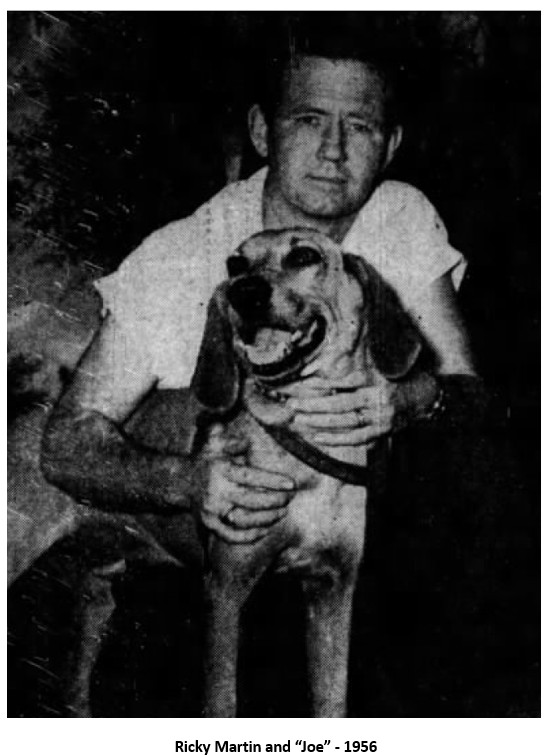
Richard “Ricky” Martin had a long criminal record before he was 20 years old. He was sentenced to the State Prison in Raiford for a number of robberies and assaults. He escaped multiple times and traveled cross-country before being arrested and returned to Florida. After being transferred to the Floral City State Prison Road Camp, he was given charge of a bloodhound pup named “Joe”. Martin and Joe developed a close bond.
That relationship gave Martin a new outlook and he decided to turn his life around. He later told a reporter “…as much as I fought against the law, I suddenly found myself wanting to help the law. I always figured that if prisoners who escaped were caught, they actually were being helped…that, like me, they maybe would learn that crime would not pay off”.
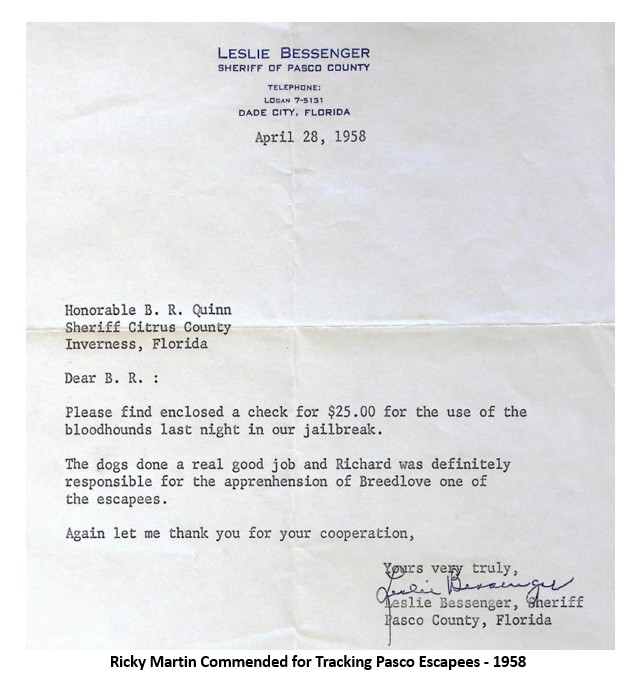
Martin was paroled in 1953, which meant that he would have say goodbye to his companion. At the same time, Citrus Sheriff B.R. Quinn needed a new bloodhound and purchased Joe to help track escapees. Sheriff Quinn quickly realized that Martin and Joe were an effective team and offered Martin a job as Joe’s handler working for Citrus County. The former prisoner jumped at the chance to rejoin his canine friend and serve the law enforcement community. The pair demonstrated immediate success and assisted Sheriffs in Marion, Hernando and Pasco Counties.
Quinn and County Clerk “Cowboy” Williams petitioned the court for Martin’s full pardon in 1956.
The news was bittersweet because Joe had been diagnosed with non-treatable leukemia later than year. After helping capture 32 escaped convicts, an accused murderer, bank robber, multiple moonshiners and host of other criminals, Martin had to say goodbye to the friend who helped turn his life around.
The granting of the pardon enabled Martin to become a formal employee of the county and he was eventually assigned to the role of night jailer at the County Jail in Inverness. He later became a hunting companion of Sheriff Quinn and other deputies.
Martin continued to train other bloodhounds, but still held a special place in his heart for Joe. He said “the others are good dogs, but they will never replace Joe”.
Professional K-9 Officers
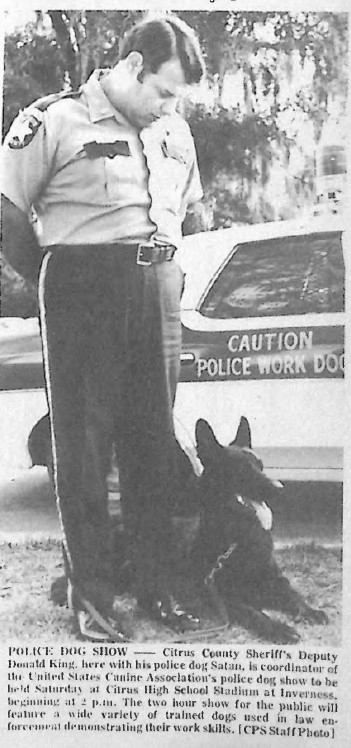
By the 1970’s, the Sheriff’s department had moved away from ad-hoc canine services that were only called upon to track and pursue criminals. Other breeds such as German Shepherd, Belgian Malinois, and Labrador Retriever began to supplement the traditional bloodhound as working law enforcement dogs. Additional roles such as attacking, guarding and drug detection were added to the repertoire of the dogs supporting K-9 officers. The service had advanced to the point where Citrus County hosted a Police Dog show in 1975 that highlighted the abilities of local canines as well as dogs from other agencies across the state.
Growing from a role devoted to tracking offenders, today the K-9 unit is recognized as a powerful tool supporting many law enforcement disciplines.
Ken Marotte writes for the Citrus County Historical Society. He can be reached via email at kenmarottejr@gmail.com if you have any comments, questions or suggestions.