
Citrus County Jobs That Have Faded into History
By: Ken Marotte, Citrus County Historical Society
There is a continual cycle of occupations that were once in demand but have faded into history. Each generation employed workers in roles that have largely disappeared today. This is a look back at some of the jobs that have diminished or disappeared entirely.
Coopers
You may have came across some rusty hoops of various sizes lying on the ground while walking in the woods. You may not know it, but you’ve encountered a historical artifact from the days of handmade barrels. Workers known as “coopers” fashioned barrels from strips of held together with metal straps.
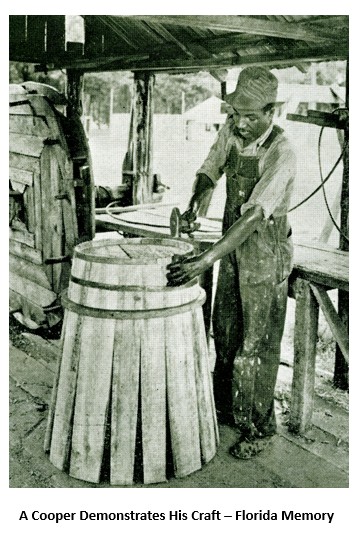
This was an important profession in Citrus County because many of the products produced here were stored and shipped using the cooper’s barrels. For example, fish and other marine products were loaded into wooden barrels, packed with ice, and sealed to ensure freshness. The Atlanta Fishing Club routinely caught more fish than they could use and filled several barrels with their fish and shipped back to their home city as a donation to the orphanages in that area.
During a time when turpentine production was a key industry, pine resin and turpentine were poured into wood barrels for use in the naval stores industry. The building of barrels was so important that many turpentine companies employed coopers as a key component of their workforce.
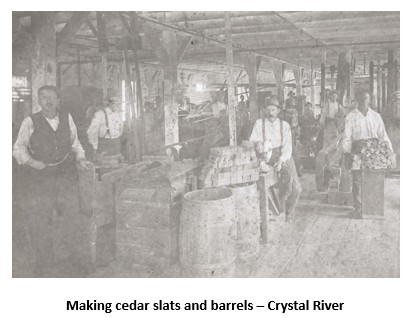
After the demise of the turpentine companies and the use of metal or plastic barrels for fish shipment, then need for coopers faded in Citrus County. By 1950, not a single person listed cooper as their profession.
If you have the surname “Cooper” in your family tree, chances are that one of your distant relatives made hand-fashioned wooden barrels.
Washerwomen
The large influx of workers in the phosphate and turpentine industries led to a business opportunity for local women. The men who worked in the forests and mines sometimes needed to clean their clothes but had neither the time nor the inclination to tackle that task. Women had historically “taken in laundry” for pin money but the demand had grown so much that “washerwoman” became a recognized job in the US Census.
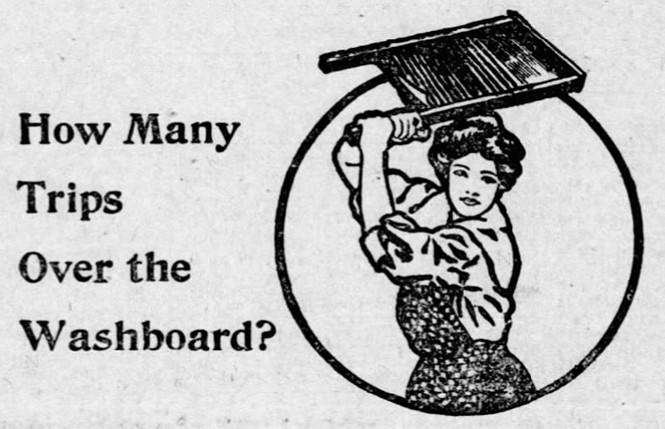
Washing clothes could be a grueling job in those days. Water had to be collected and poured into huge caldrons. Firewood was needed to fuel the flames that heated the water. Clothes had to be manually scrubbed using washboards and then rinsed in other caldrons. Then the clothes had to be wrung out before hanging on the line to dry. Finally, heavy irons were heated on stoves and passed over the clothes to eliminate wrinkles.
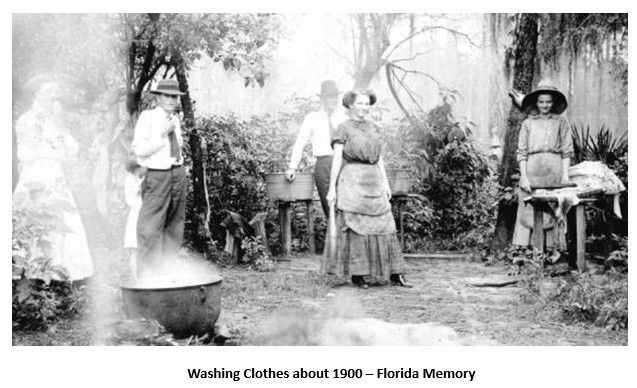
There were about 50 Citrus County women who identified as full-time “washerwomen” in 1900. The number had swelled to over 125 in 1920. These numbers do not include the women who occasionally washed clothes but considered their work to be a “side hustle”. By 1950, the term as a profession disappeared in Citrus County. The advent of labor-saving clothes washers enabled many people to handle their own laundry. The reduction in the workforce in the phosphate and turpentine industries also reduces the number of people needing their services.
On a personal note, my grandmother took in clothes from wealthy families for washing in order to supplement her meager wages.
Boarding Houses
In addition to providing employment for washerwomen, the men in the mines and forests needed a place to live. Many of them traveled from Georgia and the Carolinas as day laborers and did not have families in Citrus County.
During the height of the boom, almost 500 men indicated that they were living in private homes as boarders. This represented a significant source pf income for local homeowners. The number of boarders slipped to about 150 in 1920 and practically disappeared by 1950.
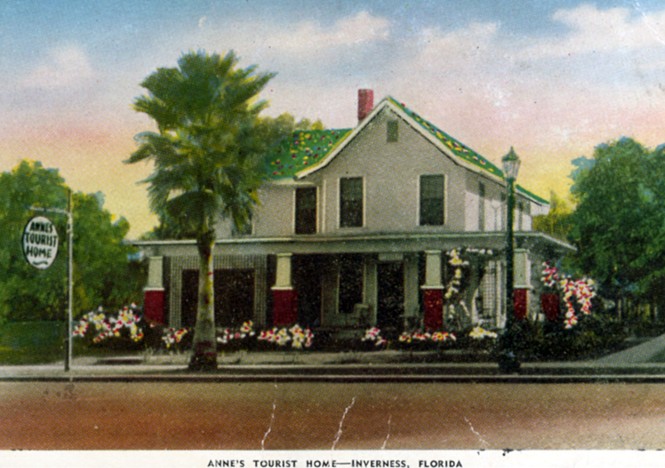
Some residents opened their homes to tourists to compensate for the loss of working boarders. Given the number of guests in the area and the shortage of hotel rooms, these local guest houses provided a valuable service to the travelers and community.
Door-To-Door Salesmen
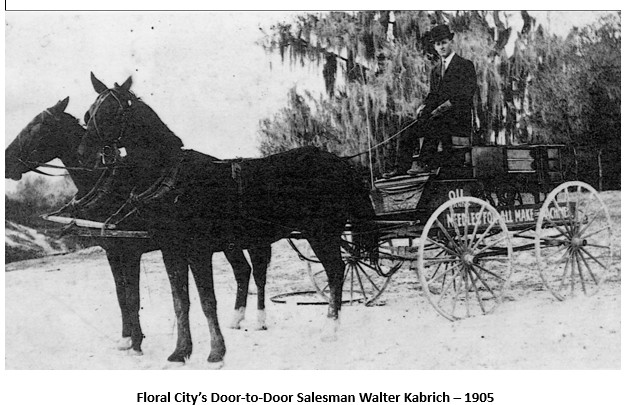
In a world where traveling was slow and mercantile stores were far away, the door-to-door salesman was a welcome sight. They would load their wagons with a variety of goods that people needed and bring to customers doorsteps. They would have pots and pans, food stuffs and even furniture for sale.
For example, Floral City’s Walter Kabrich would hitch up his wagon to a pair of horses every day and set out on the dirt roads of Citrus and Hernando Counties. Sewing machines had become an integral part of domestic life and Kabrich’s business was centered around sales and servicing those devices. He would provide periodic oiling and maintenance as well as replacing needles that had become worn out or broken during daily life. Since it was impractical for people to bring their machines to a shop in town, Kabrich provided a valuable service to his customers.
Kabrich had an long memory and recalled customers he hadn’t seen in 50 years. He told his son that he eventually replaced his team of horses with a Ford Model T. He was on his route when he was confronted with a swollen stream that was too deep to cross. Several of his customers, upon hearing about Kabrich’s dilemma, walked into the water, picked up the Model T and physically crossed the stream so Kabrich could visit them.
While door-to-door salesmen have practically disappeared today, many Citrus County residents can recall these workers knocking on their doors and offering items such as encyclopedias, vacuum cleaners, soaps and cookware.
Wagons and Livery Stables
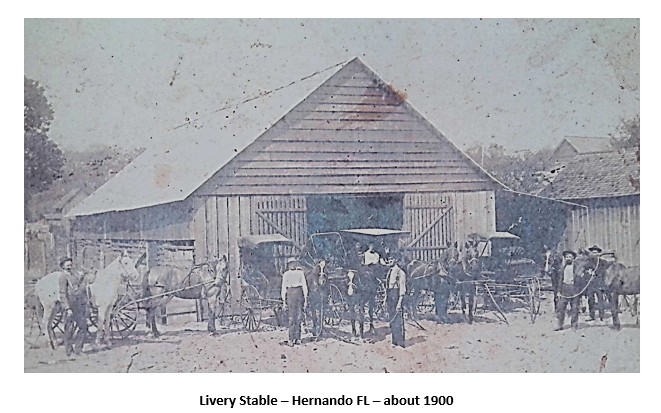
Horses and wagons were the only way for people to travel in early Citrus County. People needed carriages for personal travel and wagons were the “pickup trucks” of that era. Needless to say, the need for wagons and services related to horses was equivalent to today’s automobile dealer lots and repair mechanics.
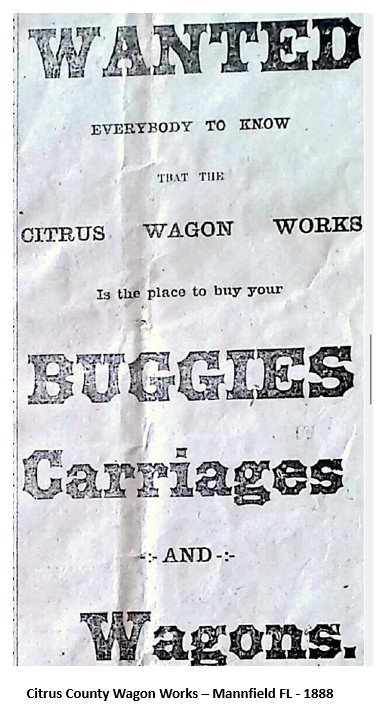
Citrus County had a number of buggy manufacturers in the county and nearby areas, such as G.P. Reid’s Citrus County Wagon Works in Mannfield. He promised “All kind of repairing, painting and blacksmithing at the lowest rates”. Wheels were made of wood and were particularly subject to splintering or breaking under daily usage load. He also offered a full line of light and heavy harnesses if needed. All of his work was warranted – his word was his bond – and I’m guessing that customers did not have to run the gauntlet of today’s automobile financing and warrantee department when purchasing their wagons.
There were quite a few men who listed their profession as “blacksmiths” in the Citrus County census. Some of them, like Mr. Reid, were independent businessmen who served the public. Others were directly employed by the railroad or phosphate industries. Phosphate mining involved more than simply digging in the ground by hand using “Georgia Buggies”. The largest phosphate mining operations needed a variety of cranes, dredgers and washers that required constant maintenance and metal repair.
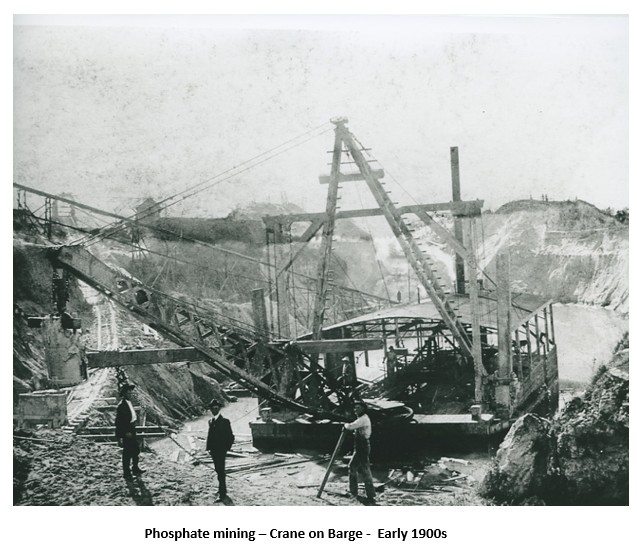
The number of industrial blacksmiths had fallen to less than a dozen by 1920 and had disappeared by 1950. The practice still lives on today through professionals known as farriers. They use time honored blacksmithing tools and techniques to fashion metal shoes for horses.
Citrus Farming
Any discussion of fading jobs would be incomplete without mentioning the citrus industry. At one time the number of orange and grapefruit trees was so extensive that the county adopted its name from the citrus trees when formed in 1887. Local businessmen, such as W.C. Zimmerman, planted 10,000 orange saplings for planting and export to other areas. Reports in Northern newspapers encouraged people to settle in Citrus County where you could simply plant the trees and watch the dollars roll in.
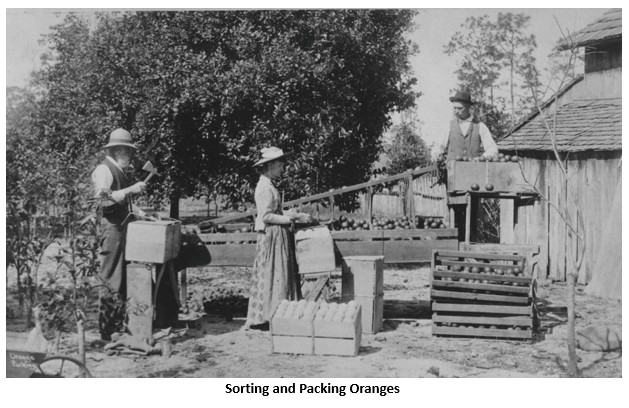
Just a few years later, the citrus industry was hit by unusually cold weather that irrevocably changed the landscape. In what became to be termed “The Big Freeze of 1894-1895”, a number of killing freezes hit orange groves across the South. The first wave occurred in December 1894, followed by a more dangerous event in February 1895. Any tree that was less than 18 inches in diameter was in danger of destruction due to the cold temperatures.
Many of the people who had flocked to Citrus County with expectations of easy profits left the area or found other ways to earn a living. There were frosts in subsequent years that impacted any young citrus trees. Finally, the outbreak of the “citrus greening” disease mandated the wholesale destruction of groves.
Some local growers, such as Ferris Groves in Floral City, resorted to heaters, spraying water or smudge pots to protect their trees.
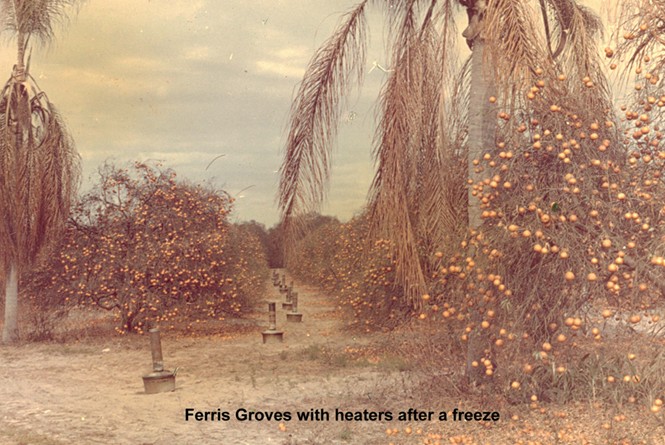
At this time, there are only a few local groves functioning as commercial enterprises and the dream of large-scale citrus farming has faded into history.
Epilogue
What other professions have been made obsolete over the years? What jobs that people in Citrus County hold today will be the next victim of technology, changing markets or diverging trends? Let us know and your comments will be used for a subsequent article.
Ken Marotte writes for the Citrus County Historical Society. He can be reached via email at kenmarottejr@gmail.com if you have any comments, questions or suggestions. Contact him if you’d like to participate in the ongoing CCHS Oral History Project.