
Citrus County Citizens Support Law Enforcement
By: Ken Marotte, Citrus County Historical Society
We’ve come to expect a trained staff of professional law enforcement officers in Citrus County. Many people do not realize that the shift from citizen-based law enforcement to a professional staff took place gradually over the growth of the county and there were substantial periods of overlapping responsibilities. Citizens have stepped up during those early days to provide protection for the county’s population. Today’s volunteers who support the Sheriff’s department through their time and energy continue the legacy of service.
Law Enforcement during Birth of Citrus County
Leaders of the newly formed Citrus County were faced with a monumental challenge in 1887. They were called upon to build a government infrastructure from the ground up. The county was to be divided into five districts and men were selected to fill the role of County Commissioner representing each district. A Tax Collector was appointed and W.C. Zimmerman was designated as the first County Clerk. James E. Priest was called upon to serve as Sheriff. In keeping with the times, Priest did not have any particular training in law enforcement but was a respected member of the community who had the fortitude to maintain order.
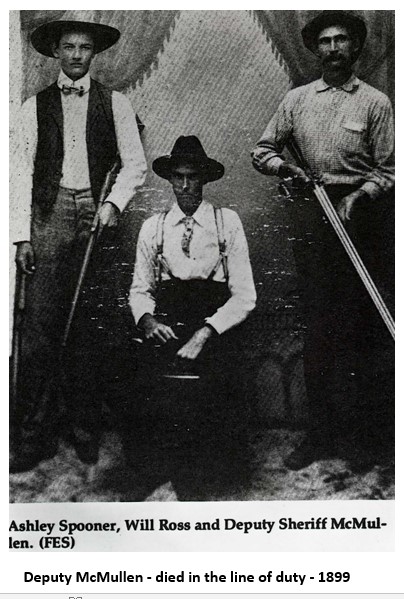
Each of the five districts were allotted additional roles for the maintenance of local law and order. Every district had a Constable that was expected to provide first-line law enforcement services. They also assisted the Sheriff and his Deputies as needed. Misdemeanor offenses would be referred to the district Justice of the Peace (JP) for trial and sentencing. As was the case with the Sheriff, early Constables were not particularly trained in policing techniques but were respected members of the community who had a personal stake in protecting their neighbors.
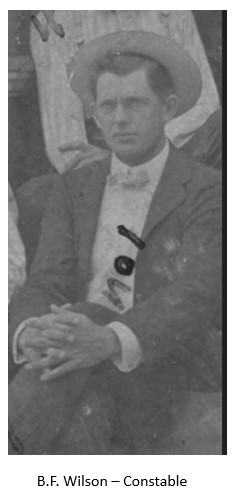
When law enforcement agencies became more sophisticated, the need for citizen Constables diminished. It became more of an honorific title in many of Florida’s counties. One of the Citrus County Constables in the later years was a well-known Ford automobile dealer. Since Constables could still officially perform some law enforcement activities, the counties were obliged to purchase insurance bonds for those people in that role. Under the terms of the Judicial Reform acts of 1972, the Constable role as a law enforcement officer was abolished as of January 1, 1973 and incorporated into existing professional agencies. Any Constable who wanted to continue their law enforcement career would be required to undergo all of the training and certification as other officers and deputies. In addition, the local judicial office of Justice of the Peace was eliminated and incorporated into the County Court system.
Town Marshals
Communities such as Crystal River, Hernando, Inverness and Floral City desired another level of local policing to accommodate their growth. The office of Town Marshal was created and filled through popular vote at each election. Far from being an easy assignment, serving as Town Marshall could be a dangerous proposition during the phosphate and turpentine boom times. These were the days of convict leasing – the practice of state, county and local governments “leasing” convicts to private companies – and Citrus villages and towns could become dangerous rough-and-tumble places. A reporter wryly noted that no respectable woman could be on the street after dark given the wanton activity of the miners.
Floral City had a number of convicts working in the phosphate mines and turpentine forests. A camp for convicts was established in that town which could make conditions perilous for law-abiding citizens. They employed a Town Marshall, J.W. Newsome, who found himself trapped in an ambush in a saloon in the center of town. He was gunned down and is remembered today as one of the Citrus County law officers who have died in the line of duty.
Some towns found that they needed a Night-time Town Marshall to ensure round the clock protection. The role could be a way to gain law enforcement experience and move into a position in the Sheriff’s department.
Sometimes the Town Marshal was required to take on additional duties not related to law enforcement. Inverness installed a municipal drinking water system and relied on residential meters to determine usage. The Town Marshall was required to read all of the meters on homes using city water and track billing and payments. Thankfully this additional duty was reassigned by the time Inverness established a formal police force.
Auxiliary Police
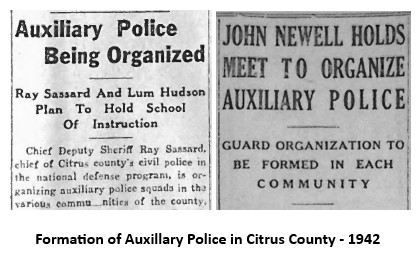
World War II sapped the strength of Citrus County’s law-enforcement agencies. Many of the young men who formed the backbone of those departments were called into service. A new group of citizens were requested to fill the gap on the home front. Men who were otherwise exempt from military service joined the Citrus Auxiliary Police. Organized by Deputy Ray Sassard, many people across the county responded. After being provided with training and uniforms, the members of this force were charged with “observe and report” duties since they were not part of the sworn law enforcement group. They held meetings and patrolled the towns of the county. The need for their volunteer service waned once Citrus County’s soldiers and sailors returned home.
Surveillance Units
Today the term “Surveillance Unit” conjures the vision of a team of undercover investigators covertly watching criminals from the shadows. Some people claim that the volunteers in the Surveillance Units were somehow related to the Coast Watchers of World War II. The truth is much simpler.
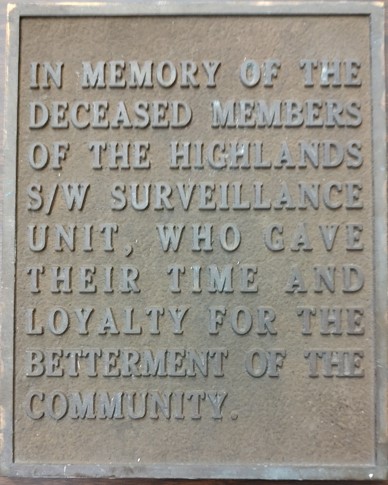
Beverly Hills experienced rapid growth during the 1960’s and 1970’s. Since it was primarily a retirement community, a number of people wanted to make sure that their neighbors felt safe in their Florida haven. The idea was spurred by a break-in and assault of an elderly woman in Beverly Hills in 1977. Since many of the retirees were former law enforcement officers, a group of residents approached Sheriff B.R. Quinn with an offer to help augment his Deputies. In exchange for a surplus police car and radio units, they would establish a formal citizen’s security force that would “observe and report” suspicious activities to the Sheriff. Quinn saw the benefit of enlisting a dedicated group of like-minded retirees to assist his agency.
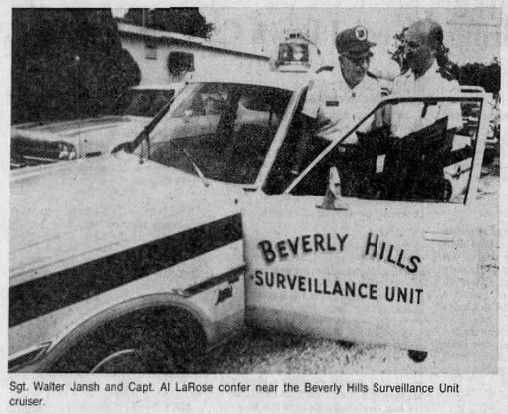
They immediately formed an organization to implement their plan. They solicited community members to either conduct routine patrols or monitor a communication station based at the Beverly Hills Community Center. They offered talks and lectures to residents regarding community safety and also contributed to neighborhood events. On February 20, 1978 the Beverly Hills Surveillance Unit started their first patrol.
The Surveillance Unit idea was so successful that civilian units were eventually established in other towns such as Inverness, Citrus Springs and Crystal River. By 1993 there were over 14 distinct Surveillance Units operating in Citrus County.
Crime Watch
The program was so successful that the Sheriff decided that all of the Surveillance Units would be consolidated into a new organization – “Crime Watch”. You have probably seen their surplus police cars slowly cruising through your neighborhood, greeting passerby’s with a friendly wave – or stopping to ask a few questions if something looks out of place.
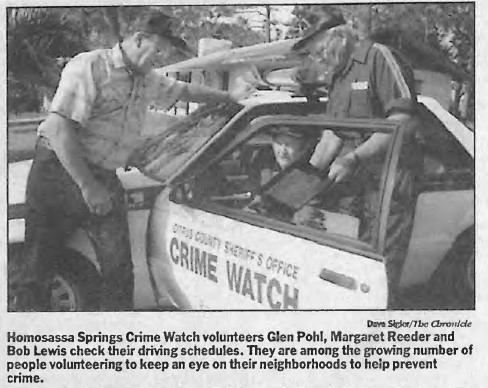
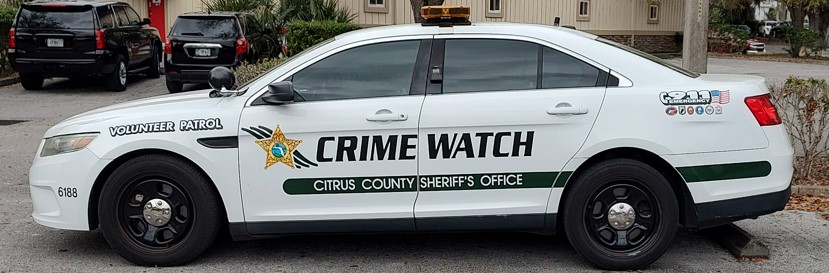
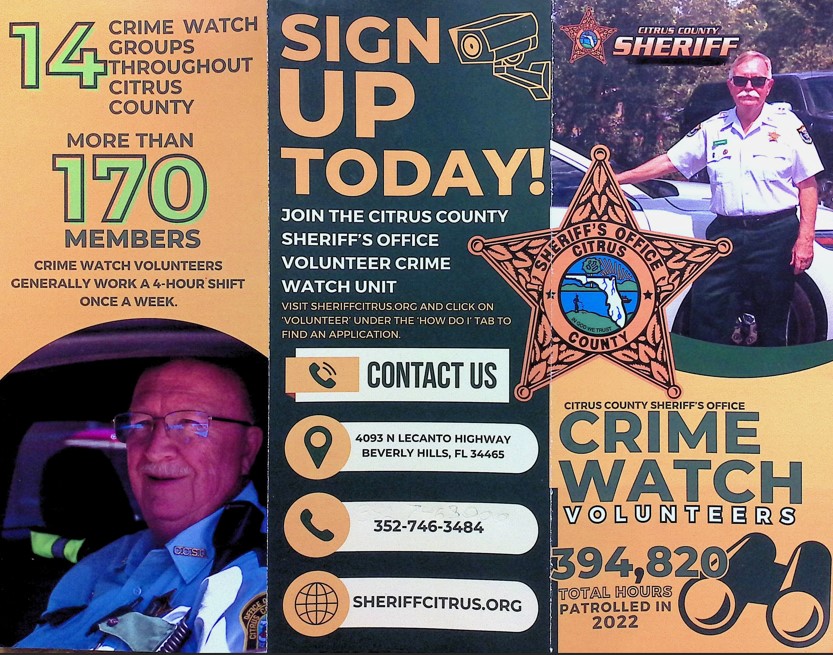
The Crime Watch team will even make arrangements to check your home while you’re away on vacation. There are 14 Crime Watch groups throughout the county with over 170 volunteers on duty. The Sheriff’s department also offers volunteer opportunities in such diverse fields as Community Emergency Response Team (“CERT”), Rails to Trails Patrol and (of course) the Sheriff’s Mounted Posse.
Epilogue
Citrus County has relied on the willingness of its citizens to step up and address law enforcement needs in our community. From the first tentative steps taken by brave, untrained men – determined to maintain law and order in the face of a rowdy and lawless environment – to the men and women who have offered their time to keep our neighborhoods safe, the spirit of citizen involvement and support of law enforcement continues to this day.
Ken Marotte writes for the Citrus County Historical Society. He can be reached via email at kenmarottejr@gmail.com if you have any comments, questions or suggestions Contact him if you’d like to participate in the ongoing CCHS Oral History Project.