
“Can Do” – The Seabees of Citrus County
By: Ken Marotte, Citrus County Historical Society
The leaders of the United States knew that they needed a specialized workforce to build the infrastructure required to win World War II. They developed an ingenious plan to tap the knowledge and experience of civilian tradesmen to meet their goals. Young men across the county, including many Citrus Countians, stepped forward and said “Can Do” to Uncle Sam’s call.
We Build, We Fight
The establishment of special Construction Battalions was first envisioned in the 1930’s. The original plan was to have a mixed force of naval officers/enlisted men to support the construction workers but the civilians would report to the Civil Engineers. The dual reporting line led to concerns within the Navy ranks and was eventually resolved by assuming the civilians into the military as “Seabees” (“C” for construction, “B” for battalion). The induction of the tradesmen into the Navy also solved a thorny problem with the rules of warfare. Civilians found supporting military on the battlefield could conceivably be considered guerillas or spies and summarily executed.
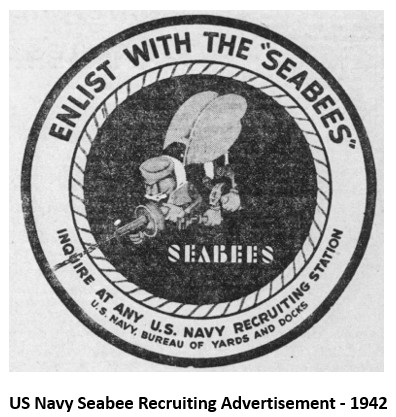
The Seabee program accelerated after the attack on Pearl Harbor. Men up to age 50 were encouraged to join the new organization as long as they could document their particular skills through references, job experience or tests. The pay grades were very attractive and many of the new Seabees entered into the service as the highest paid sailors in their rank. For example, typical recruits were paid between $1,100 and $2,500 per month – plus “dependents allowances” (in 2026 equivalent values).
Early inductees only had to pass general fitness tests during their basic training. The President’s staff reasoned that a 50-year-old may not be able to pass the same rigorous training as a 20-year-old draftee. However, that policy was reversed toward the end of 1942 since the Seabees were being placed in harm’s way and needed to be able to perform as regular sailors.
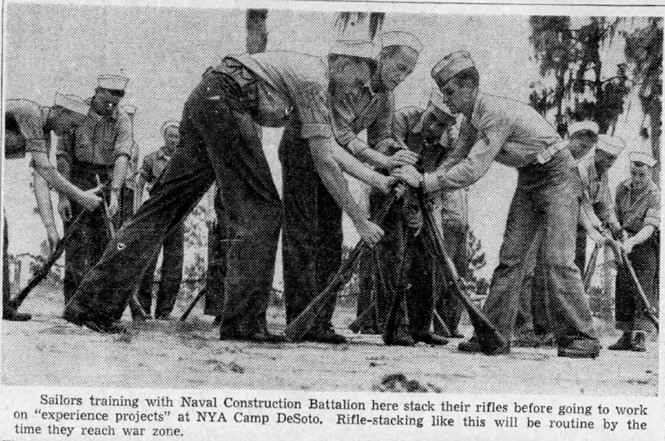
Some training took place locally at Fort DeSoto. Men were taught how to shoot and stack their rifles in neat pyramids near their work site in case they were needed if the enemy attacked. Standard basic training sites were eventually established at Quonset Point, RI and bases in the Fort Pendelton area in Southern California.
Expanding the Seabees Duties
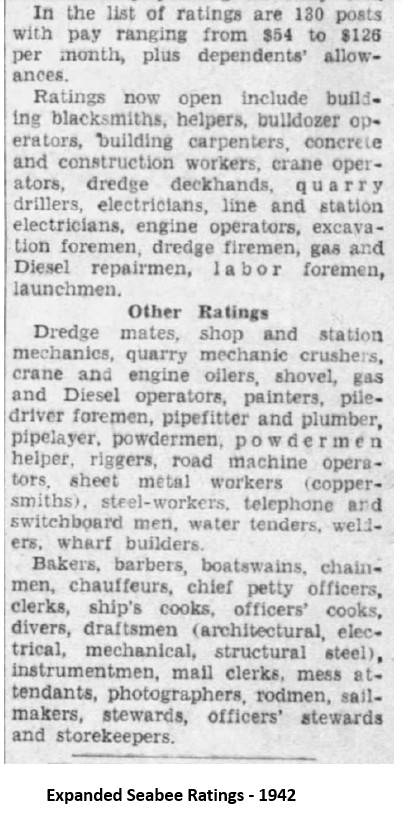
The Navy soon realized that the Seabees concept was so successful that they substantially expanded the skillsets recruited for the new group. A myriad of new ratings were added to the list of qualified tradesmen. In addition to the traditional construction categories, enlistment in the Seabees was opened to such diverse fields as underwater demolition, bakers, barbers, cooks, clerks, and drivers. By the end of the war, there were over 250,000 Americans serving in the Seabees.
Seabees soon found that their role was not always performed in rear echelons. Many men wrote letters home casually mentioning that they were under sniper fire on the front lines while working but trusted in their training and foxholes to keep them safe.
In the case of the underwater demolition parties, Seabees would be tasked with removing obstacles in advance of an invasion so our Marines and Army troops could gain a foothold. They would sometimes leave sarcastic signs on the beach asking Marines “What took you so long?” I found a humorous ditty among a former Seabee’s artifacts:
“Then we went back to the beach head, where we saw our first Marine
They had followed in behind us, though they said they got there first
We had everything completely fixed, they could even quench their thirst
From the Halls of Montezuma to the Shores of Tripoli
It used to be the leathernecks, but now it is all Seabees
And when we reach the Pearly Gates and stand at Heaven’s scene
There will be a Seabee waiting there to greet the first Marine”
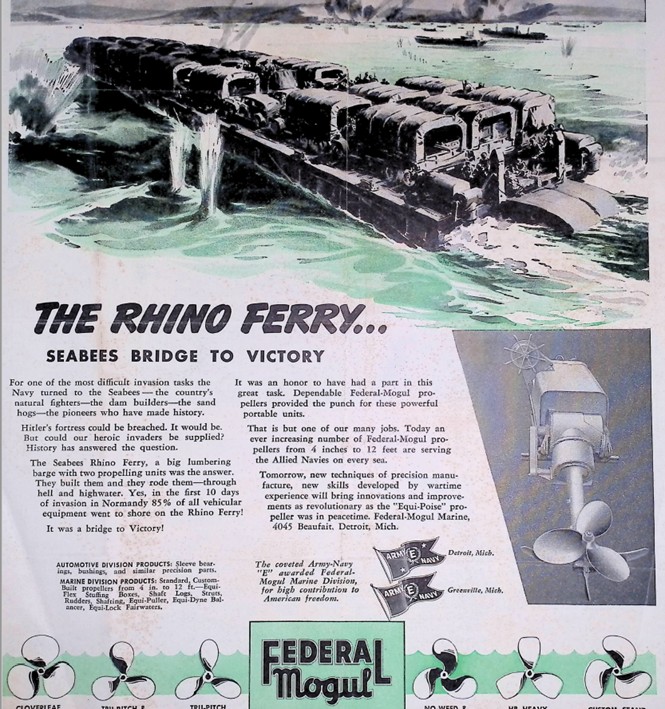
In spite of their friendly rivalry, the Marines and Seabees effectively coordinated to both clear the landing area and keep the troops supplied as they pushed forward.
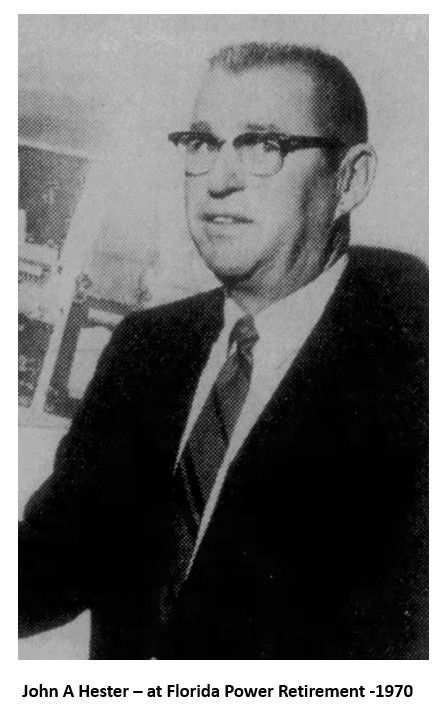
Citrus County Seabee – John A. Hester
John Hester had pursued a successful career with the Florida Power Company in the 1920’s By 1931 he was promoted to Manager in Wildwood and promoted to Manager of the Inverness office in January 1938.

Hester dutifully took his place in the 1940 Selective Service draft lottery and received a relatively high number of 496. In spite of the lottery outcome, Hester decided to enlist in the new Seabees unit in May 1942. He reported for duty later that Summer. His experience as a lineman and electrical manager made him a valuable member of the unit.
By the time his military commitment had ended, Hester had been stationed in New Zealand, the Solomons and New Caledonia. After the conclusion of the War, Hester was sent to the Aleutians to construct facilities for the military and civilians.
As was the case with many returning servicemen, Hester devoted himself to community service. He resumed his managerial duties at Florida Power and was promoted to District Manager in 1956. He led several programs for the American Red Cross and functioned as Commander of the local American Legion post. He was a leader of the Kiwanis Club and served on the Board of Directors for Citrus Memorial Hospital. Hester was active with the Boy Scouts and the development of the school now known as Withlacoochee Technical College.
Seabee John A. Hester passed away in December 1973
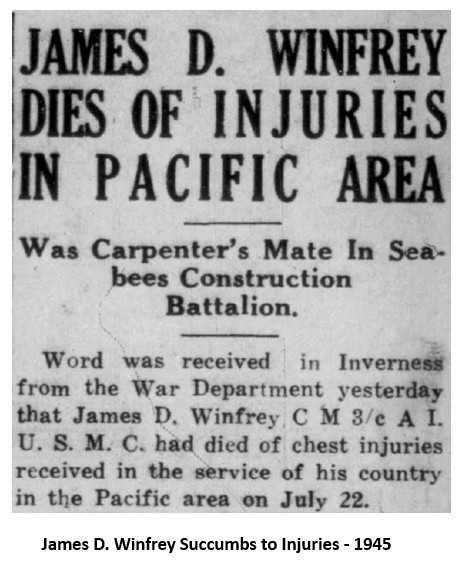
Citrus County Seabee – James D. Winfrey
Most of the local men who joined the Seabees returned home and resumed their pre-war lives. Unfortunately, James Winfrey’s family was not able to welcome their son at the end of the War.
Thirty-four-year-old James Winfrey joined the Seabees in August, 1942. After undergoing basic training, he was assigned to the Pacific theatre. In 1944 he sent a letter to the Citrus County Chronicle stating that he was proud to be part of “the workingest, fightingest bunch of men in the nation’s armed forces – the Navy Seabees”. His letter stated that every Construction Battalion has completed at least one tour of duty and many were working on their second tour.
Winfrey’s mother received the visit every family dreaded one month before the War ended in 1945. According to Navy reports, Winfrey had climbed atop a pile of lumber to weigh and measure the stack. The wood shifted when he climbed down and the lumber buried him. His companions rushed over to uncover him, but his ribs had been crushed and he suffered multiple broken bones. He was brought to the intensive care unit of the local hospital and a nurse watched over him around the clock.
He lingered in the hospital for a week. Worried that the unit would move forward without him, he told his commanding officer “Skipper, if you’ll just wait about ten days, I will be all right and go with you…but don’t leave me behind”.
Winfrey had enlisted with a friend from Inverness, Robert B. Register, who managed to travel to his bedside before he passed away. Register served as a pallbearer at the military funeral.
His commander told Winfrey’s mother that “…he was a good Christian and a regular member of the Bible Study Class. He had the right spirit and even injured as badly as he was, all he thought of was going forward. I certainly hated to lose a good man like your son and only wish that I had more like him.”
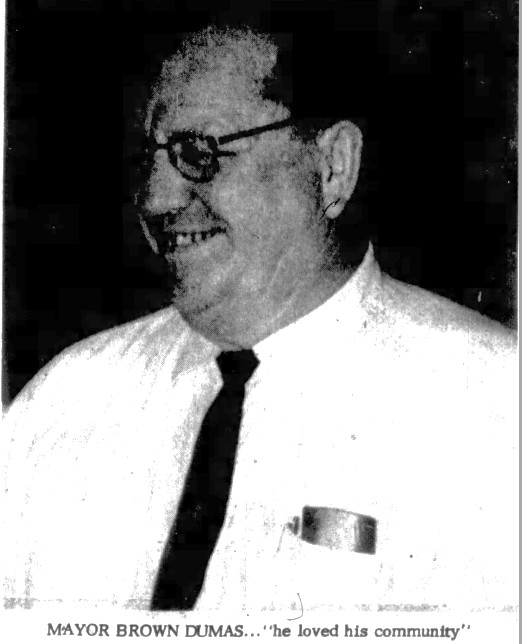
Citrus County Seabee – Morrow Brown Dumas
Many people will recognize Dumas as the long-term Mayor of Crystal River. He spent over two years in the Pacific Theater building roads and facilities for military units. His last assignment in the Pacific was in the Philippines while training for the final invasion of Japan. The Japanese surrender resulted in a change to the criteria for return to the United States and he rode the “Magic Carpet” back to Citrus County sooner than expected.
There were a large number of military personnel who had returned home in the years after the War ended. Many of them were entitled to government benefits intended to ease their transition to civilian life. However, the labyrinth of red tape to obtain those benefits could be daunting.
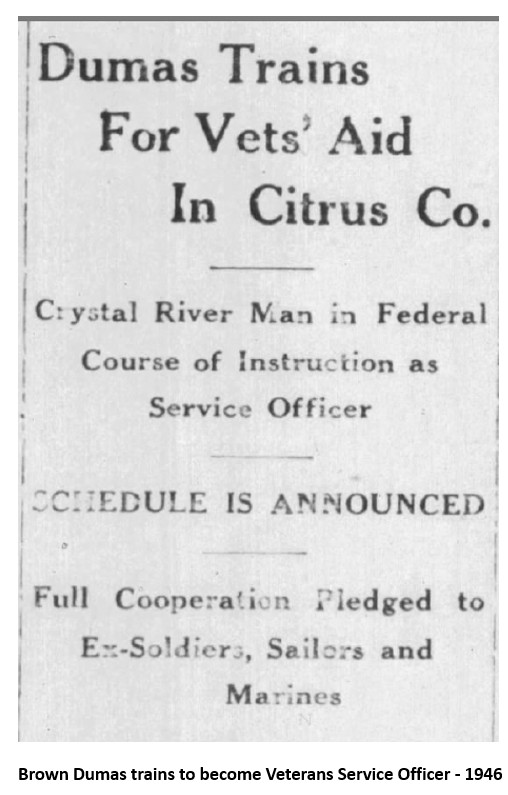
Citrus County decided to appoint Brown Dumas as the official Veterans Service Officer for the area. He spent three days in Inverness and the remaining three days in Crystal River helping veterans obtain their government compensation. This work was so important that the Board of County Commissioners voted to hire Dumas on a full-time paid basis for this important role. The duties of the position were so complex that he attended multiple weeks of training offered by the Federal government.
Dumas served as Mayor of Crystal River until his death in 1963.
Epilogue
The Seabees continue to provide critical support to our country today. They have worked to help recover from hurricanes, build roads, construct hospitals and go wherever they are needed. They have served in the Korean Conflict, Viet Nam and the Persian Gulf conflicts. While some of their missions have changed, the Seabees “Can Do” attitude remains as important today as it was during the dark days of WW2.
Do you have stories about other Seabees? We would like to hear them.
Ken Marotte writes for the Citrus County Historical Society. He can be reached via email at kenmarottejr@gmail.com if you have any comments, questions or suggestions.
Join the Citrus County Historical Society! Call 352-341-6428 or visit https://cccourthouse.org/ for more information.