
Bringing Power to Citrus County
By: Ken Marotte, Citrus County Historical Society
Power outages brought by recent storms caused major disruption for many Citrus County residents. How did we become so dependent on electrical power? How did our ancestors live without electricity and how did the power industry develop in a rural community? This is the story of the electrification of Citrus County.
Early Power Systems
Large cities enthusiastically adopted electric power in the late 1800’s. The boon spread to midsized Florida cities such as Lakeland, Jacksonville and Ocala. In most cases the power companies were small privately-run organizations that supplied service to a limited number of customers. As some of the companies failed, municipalities started taking over the operations of the power plants for street lighting and governmental offices. Coverage gradually expanded to private residences and businesses and availability of electricity became a source of local pride and was highlighted in commerce advertisements and brochures.
Servant of Industry
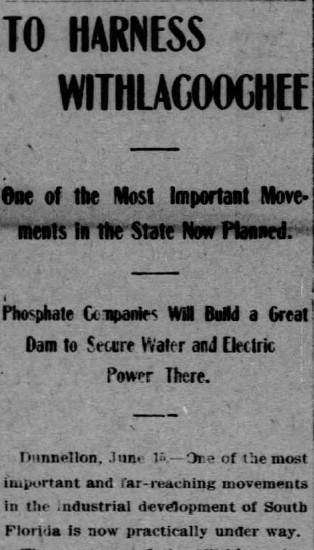
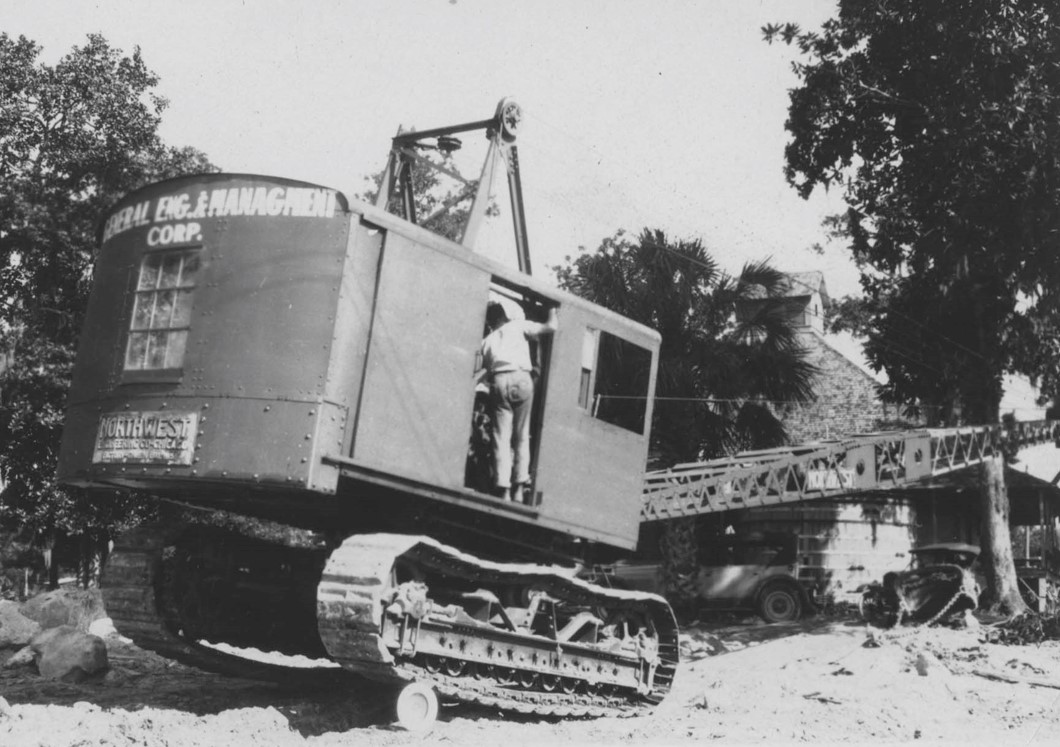
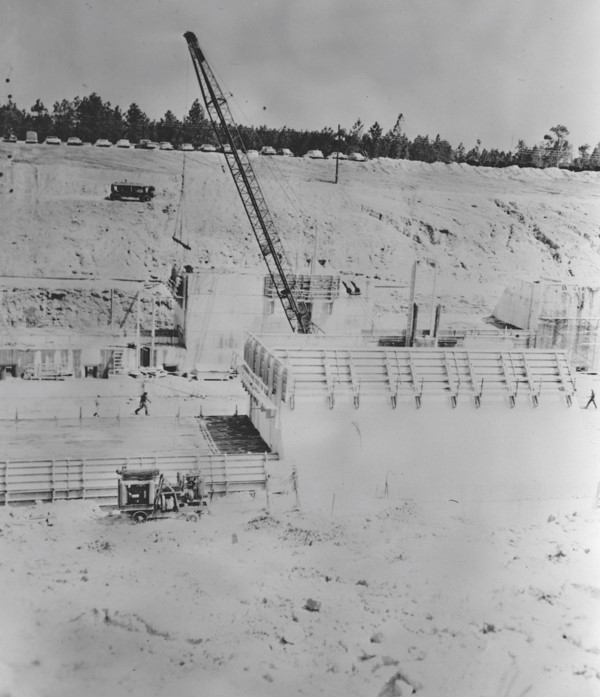
The first incursion of electric power in Citrus County was designed to serve the needs of the growing phosphate industry. Mine owners, particularly W.N. Camp, realized that they could significantly improve phosphate production by the implementation of electric powered equipment. He calculated that the vein of phosphate was so rich in the Withlacoochee River valley that it would be economically feasible to construct their own power plant. Plans were announced in 1904 for the erection of a huge dam across the river that could drive five immense turbines (with provision for two additional, if needed), each producing 1,800 horsepower. The facing dam was 600 feet wide, accompanied by two wings that were each over 1,000 feet in width. The dam wall was 20 feet high and required extensive blasting of underground rock to construct. Workers encountered a subterranean river that needed to be capped before the dam could be made operational. Over 125 men and state-of-the-art earthmoving machines required over two years to complete the project. The Camp Power Company was established as a separate entity and supplied power to the Camp Phosphate mines as far away as Brooksville, as well as other mining companies. Excess power was made available to nearby cities and villages but did not immediately service Citrus County’s population centers. The operation was eventually reconstituted as the Florida Power Company.
Private Power Generators
Many areas needed access to electric power that were not close to the large hydroelectric plant. Some residences and businesses purchased smaller generator units designed for household use. A typical configuration for James Allen’s Inverness store included a 4-horsepower engine and a 75-volt DC generator.
The Baum and Van Roy Crate Company in Crystal River required a more industrial strength generator for their lumber business and installed a setup that was reportedly more powerful than the local municipal plant in Ocala in 1914.
The Iceman Cometh
Refrigeration of perishable goods was essential for the Citrus County fishing, hunting and agricultural industries. Prior to the advent of electrical power, ice blocks were harvested from frozen lakes and ponds in Northern states using plows and teams of horses, packed in straw and stored in insulated ice houses. As warmer weather approached, the ice blocks would be repacked in more straw and loaded onto trains headed to Southern states. Upon reaching their destination, the precious ice would be stored in heavily insulated buildings and await delivery to homes and businesses via insulated wagons. Children would follow the wagons through the streets hoping for a cool treat of chipped ice provided by a kindly delivery man.
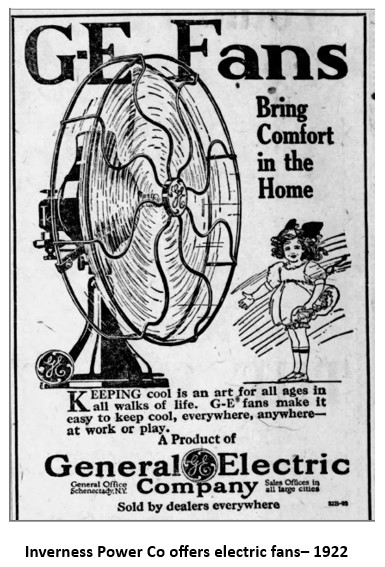
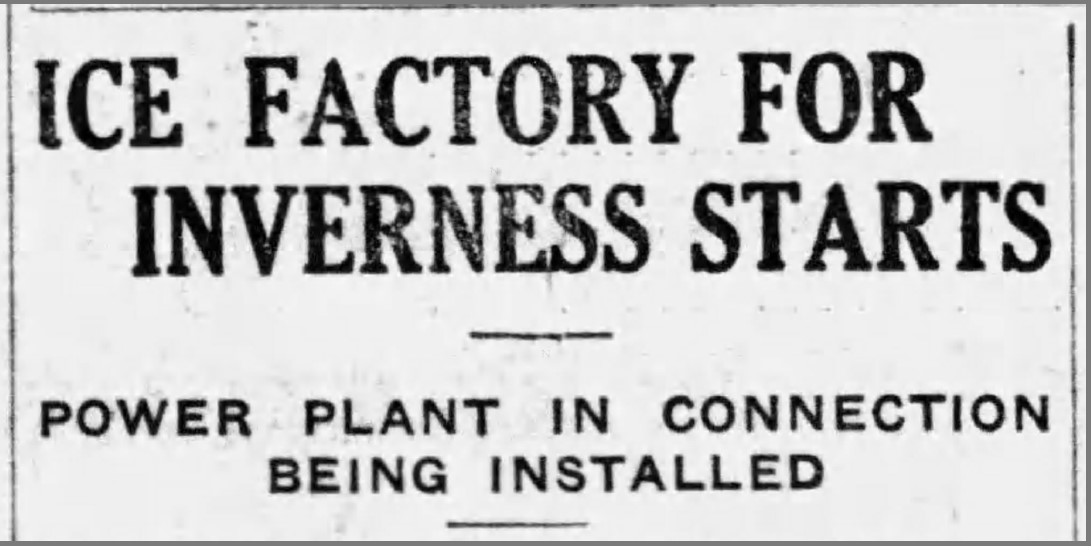
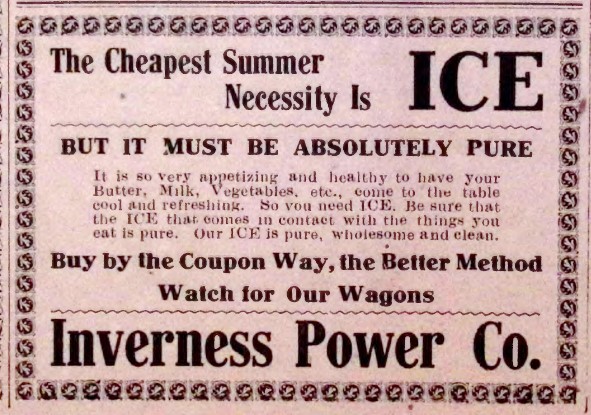
Communities such as Crystal River and Inverness took note of the potential use of electric power in their areas and formed local power companies. Rather than being supplied by huge hydroelectric dams, these installations would be supported by small gasoline generators and storage batteries. This was the case for the Inverness Power Company. Chartered in 1908, leaders of the enterprise envisioned changing the way that ice was produced for the local residents. Led by Baxter and Fletcher Morrison, Walter Warnock, F.M. Dampier, J.L. Connell and Walter Ray, the company built a ten-ton storage facility powered by an electric generator. They eventually upgraded the capacity of their generator and offered excess power to local residences and businesses. They received permission from the Citrus County Board of County Commissioners in 1912 to run water lines through the streets of Inverness and to erect more power lines through the village. Power was provided to the new Court House and Jail in 1913.
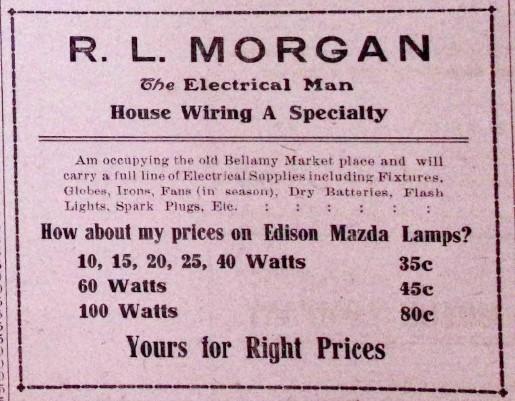
The Commissioners fully embraced the introduction of electricity into their facilities. They ordered four electric heaters to supplement the existing Courthouse fireplaces in 1913. Local electrician R.M. Morgan was hired to run electrical wires through the Courthouse and Jail. Morgan was well-known as an electrical contractor and provided services to many of the residences and businesses in Inverness. Pierce Electric of Tampa was awarded a contract to install 36 lights in the Courthouse for about $250 (equivalent of $8,000 in 2024 dollars).
The contract between the Commissioners and Inverness Power allowed the company to run water lines and install poles with some stipulations: water lines would eventually encompass the entire downtown area and fireplugs would be installed for fire protection purposes; in addition to soliciting customers for their electric power, the company would allow any Inverness resident with property near the water lines to connect for a nominal fee; the company would be allowed to install water meters at customer’s property and to charge an appropriate fee; provide a fountain with free drinking water outside the courthouse; and install arc lights on the streets at the discretion of the company.
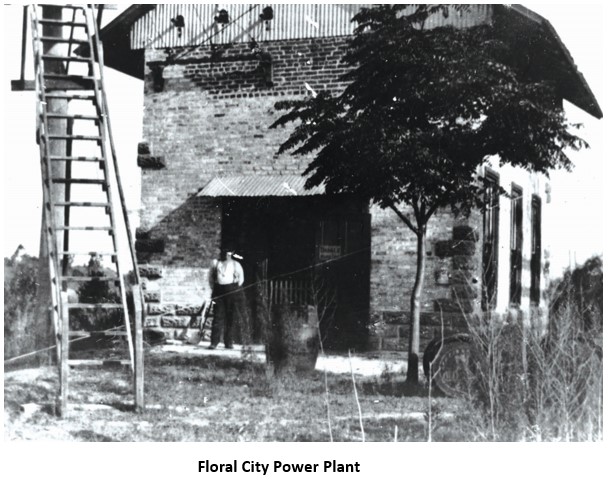
Similar small electric companies were also established in Floral City and Crystal River. Over time the Florida Power Corporation (FPC) consolidated all of the diverse local companies into today’s power grid. The Inverness and Crystal River power companies were assumed into the FPC in 1925.
The recently-incorporated City of Inverness contracted with the FPC to construct a lighted “white way’ along the present Route 44 in 1926. A series of 58 large lights was intended to improve visibility for drivers and customers of local stored. They also agreed to install a number of overhead traffic lights.
Let There Be Light
Electricity was typically installed near roads, railroads or commercial centers. Electric power was not an option for many farmers and others living in more remote locations in Citrus County. While Inverness had lights and running water in 1913, other residents remember a different experience. They continued to use hand pumps for water, wood and coal stoves for cooking, and oil lamps for lighting. Baths were in tubs that needed heated water from the stove.
There were two national programs that eventually provided power to people living in outlying areas. The Works Progress Administration (WPA) was a Franklin Roosevelt New Deal program designed to give public jobs to the unemployed during the Great Depression. As they built roads into rural areas, they required an electrical infrastructure to complete their projects. When they moved on, the power lines remained for local residents and that situation brought electricity to many Citrus County residents.
The other New Deal program that improved life for Citrus County was the Rural Electrification program. The government supported the establishment of electric co-operatives in 1936 as an alternative to large for-profit corporations. Local funding for the establishment of two co-ops for our area was granted in 1940. The Withlacoochee River Electric Cooperative (WREC) was charged with rural electrification in Hernando County and the southern portions of Citrus County. The Sumter Electric Cooperative (SECO Energy) was designated as the provider for the rest of rural Citrus County residents.
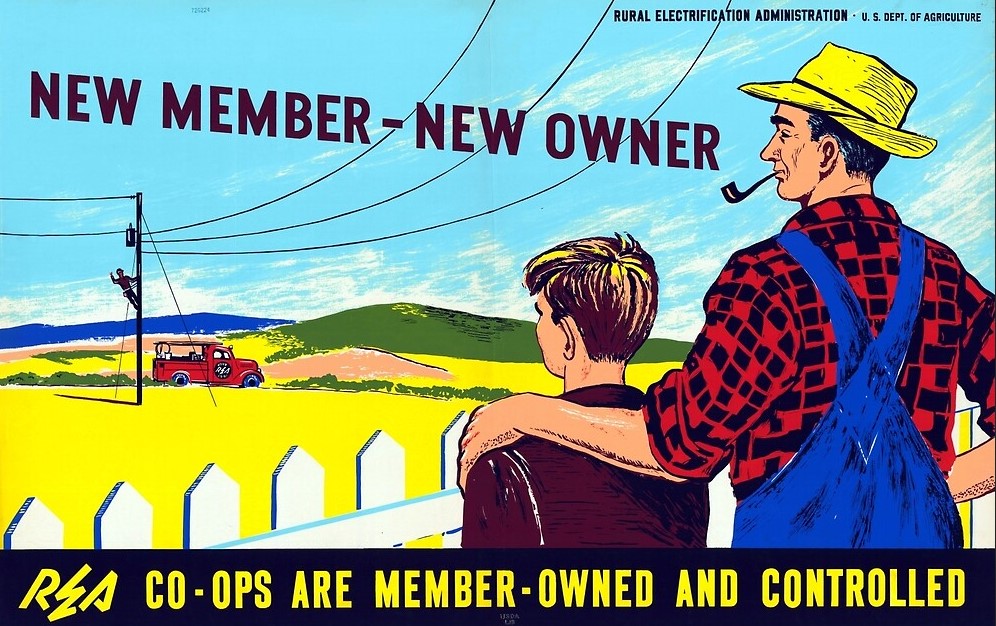
As a result of these two programs, the area has widespread coverage today. In the beginning people may have had only a few light bulbs and small appliances. Fixtures were limited in their houses so light bulbs would be unscrewed and appliances plugged into those receptacles. Everyone agrees, however, that life was much easier when you didn’t have to plug your radio into a battery and your pumps delivered water inside your home with a twist of a handle. That is, until a hurricane damages the power grid and we rediscover the usefulness of generators and battery-operated devices.