
Beware of the ‘Skeeters and Malary!
By: Ken Marotte, Citrus County Historical Society
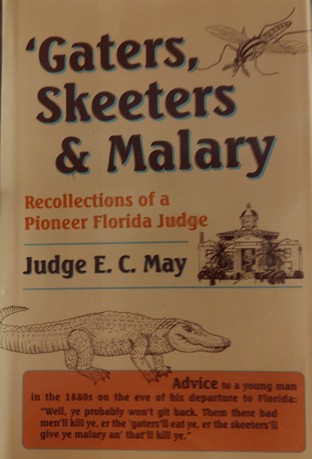
When late Judge E.C. May was a young man, he was warned to avoid the Citrus County area at all costs. An old timer told him “Them there bad men’ll kill ye, er the gaters’ll eat ye, er the skeeters’ll give ye malary an’ that’ll kill ye” This is the story about the county’s fight against malaria and how the mosquito program made the area safer for residents and an attractive destination for travelers and business leaders.
Malaria – An Ancient Disease
Malaria has plagued mankind for centuries. People were unsure of the causes but made some educated guesses. People seemed to contract the malady after visiting a lowland area with swamps and marshes. One of the leading theories was that the disease somehow lurked in the air surrounding the swamps. Others thought that the stagnant water that settled in the marsh was contaminated and victims contracted malaria after drinking the water.
Since several members of a family could be infected at the same time, people wondered if malaria could be communicated from person to person. Many others surmised that the sickness was somehow related to the bites of mosquitos, but were unaware exactly how the insects infected the hapless patient.
All could agree on one thing: the chills and fever of malaria could strike anyone and might cause death or lifelong relapse.
A Hundred Different Theories…
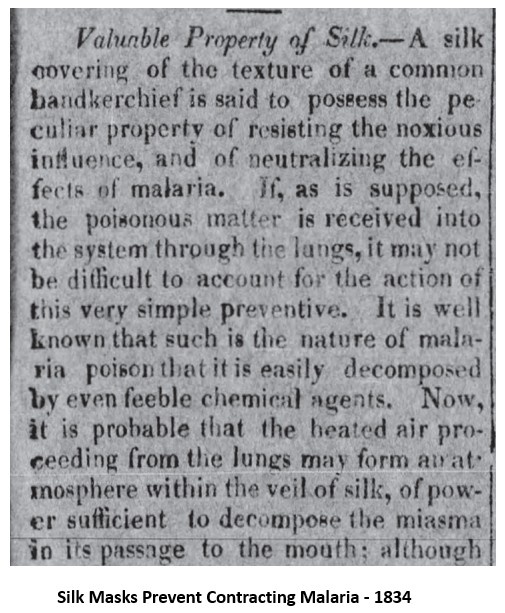
Since the true cause of malaria was not known, people guessed at how the disease could be prevented. Those who thought that the germs were transmitted through “impure air” fashioned masks that could be worn when working or traveling in marshlands.
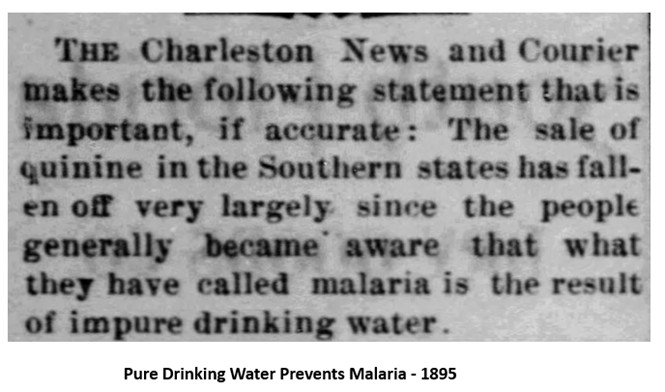
The people who believed that stagnant water was the cause of malaria petitioned local governments to use only springs and wells that were clear of any contaminants for drinking water. Water supplies that originated in questionable sources were to be avoided.
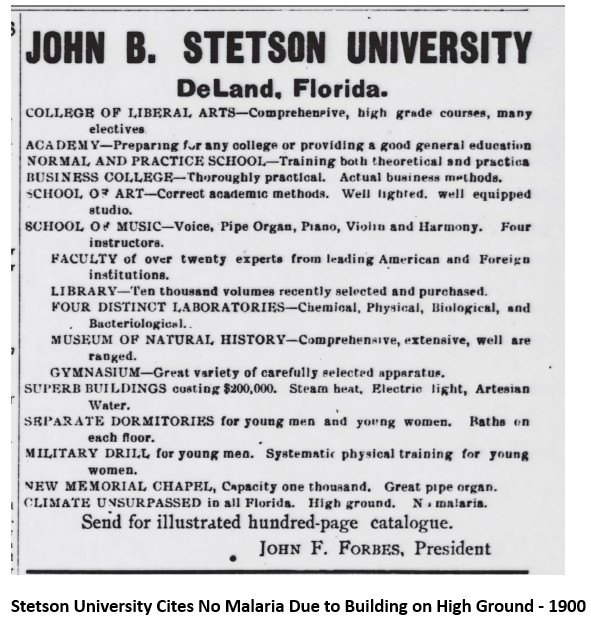
Builders deliberately avoided lowlands near water in an attempt to avoid the disease. Developers boasted that their houses were “high and dry” and away from malarial swamps. Businesses and educational institutions, such as Stetson University, cited their site location as a feature to combat infection.
…A Hundred Different Cures
Since people were unsure regarding the cause of malaria, the only preventative seemed to be avoidance of swamps and marshlands. There were a number of homegrown solutions that had been used to treat patients who contracted malaria over the preceding centuries. One of them was “colomel” which was a mercury chloride mineral. It was used into the twentieth century and some old time Citrus County residents recalled being administered colomel when they fell ill with chills and fevers. Ultimately colomel fell into disfavor because patients later suffered from a variety of reactions including mercury poisoning. Medical researcher Samuel Jackson found that colomel caused “…gangrene on the skin, loss of teeth, and deterioration of the gums.”
Quinine was another ancient drug that could be used to effectively treat mild cases of malaria. Manufactures of patent medicine were quick to capitalize on the relative success of the compound and included quinine in their anti-malarial medicines. The effectiveness of quinine was dependent on the seriousness of the individual’s case and the amount of quinine in the medicine. There were few early studies on how quinine affected the body and dosage was more or less trial-and-error.
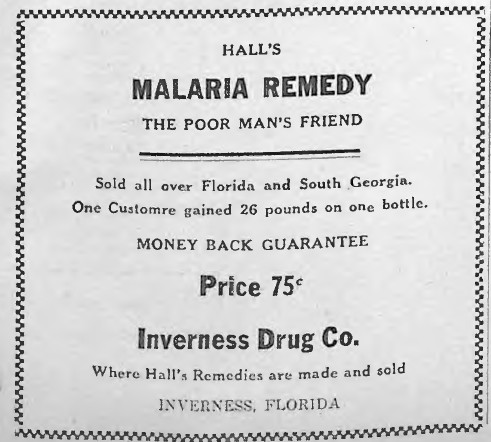
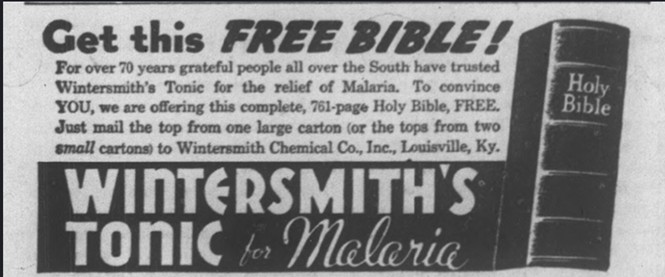
Quinine solutions were sold extensively across the country and Citrus County was no exception. One manufacturer of a mail order medicine advertised locally that they would send a free Bible to anyone who purchased their product. Customers could infer that if they used Wintersmith’s Tonic, they needed all the prayers they could get.
Use of quinine medicines were commonly reported as a malarial treatment by long-time Citrus County residents. Today quinine is authorized for limited controlled use as an anti-malarial by the FDA. They note that it should not be used as a preventative and Americans should never purchase their own supply through the Internet. A new generation of more effective treatments is available from medical professionals.
Malaria in Citrus County
The old timer’s prediction for E.C. May almost came true. He did contract malaria in 1893. The future judge reportedly bought his own supply of quinine (since he couldn’t afford a doctor) and dissolved the solution in his coffee. The home-grown treatment saved his life but he continued to suffer relapses from the infection for many years afterward.
As of 1934, Citrus County was ranked among the counties with the highest rate of malaria in Florida. The pages of the Chronicle routinely carried stories about the citizens who had contracted malaria and were recuperating under doctor’s care. Sheriff Charles S. Dean’s wife was prominent on the list of patients that year.
Turning the Tide
Deaths from malaria began to decline in 1935. According to the Florida Health Department, “…this reduction in malaria incidence was probably due to mosquito control activities, improved housing including screening, use of repellents, agricultural and other drainage practices, and the use of anti-
malarial drugs.”
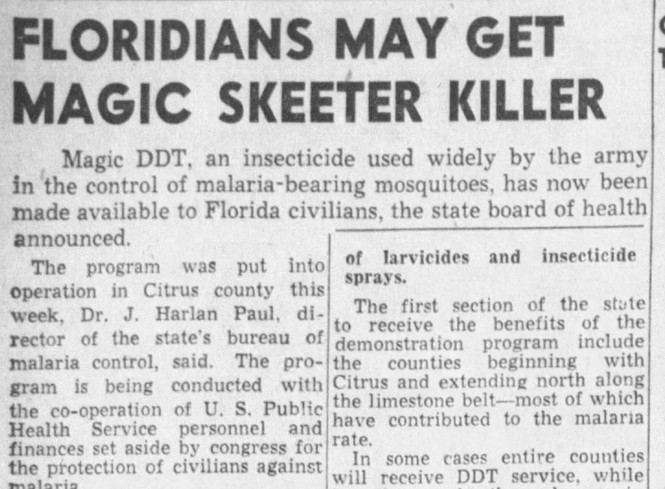
One of those solutions was the use of a new “magic” weapon against mosquitos called “DDT”. Citrus County became the first location for widespread testing of DDT in 1945. As is the case for some of the other remedies, it was later discovered that there were severe environmental impacts from DDT so alternative sprays were substituted.
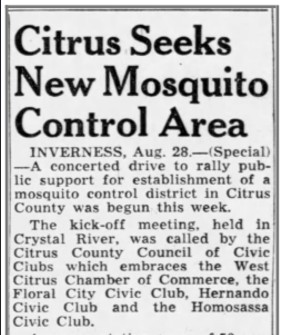
Citrus County leaders recognized that they needed to take increased measures at the local level. A grass-roots movement crystalized in 1952 calling for the establishment of a dedicated mosquito control district in the county. About 550 people formally petitioned the Board of County Commissioners to poll citizens regarding the creation of a special district. A county-wide vote was held in November 1952 and the Citrus County Mosquito Control District was born.
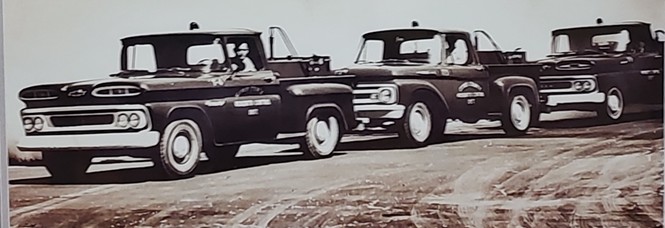
The State of Florida offered grants to counties that needed to fight the mosquito menace. Better drainage canals were built in our county to reduce the mosquito’s breeding grounds. Safer insecticides were loaded onto trucks and sprayed along the roadways where insect counts were highest.
Taking the Fight to the Sky
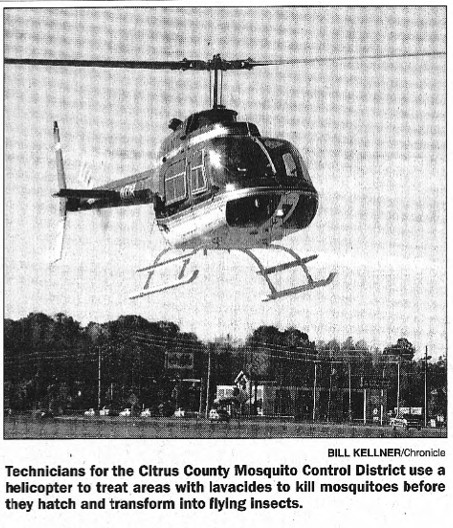
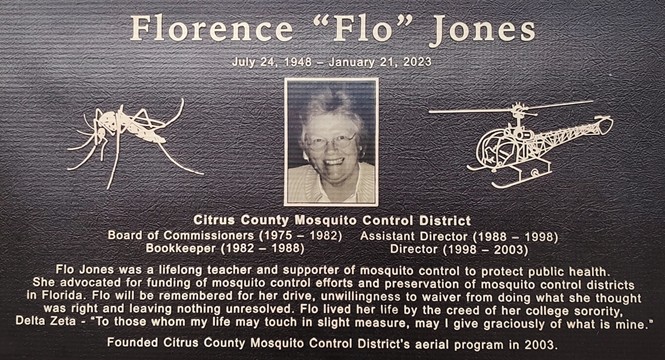
The late Florence “Flo” Jones was elected to the Citrus County Mosquito Control Board in 1974. She served in a variety of roles, including Director of Mosquito Control in 1998. She was largely instrumental in developing an arial assault on the dangerous insects. She convinced the county to allocate a helicopter to help concentrate spraying efforts in breeding grounds that were not accessible from the spraying trucks. Her efforts were memorialized through the naming of the helicopter hanger in her honor. When she passed away in 2023, the entire Mosquito Control staff attended her funeral to honor her legacy even though she had left the Mosquito Board twenty years earlier. (As an aside, I served on the Board of Directors of the CCHS with Flo Jones and remember her determination and organizational talents).
Mosquito Control Today
The Citrus County Mosquito Control District promotes the health, safety and welfare of residents and visitors through a program of integrated mosquito management. They perform inspections around the county to monitor breeding and populations. They perform their monitoring functions through trapping and sentinel chickens. Finally, they use a combination of biological and chemical applications to control larvae as well as adult mosquito populations.
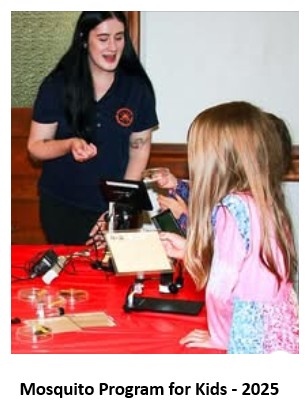
They also have a robust public outreach program. They recently offered a presentation on insect control for an adult audience and a special hands-on educational program for children a few days later.
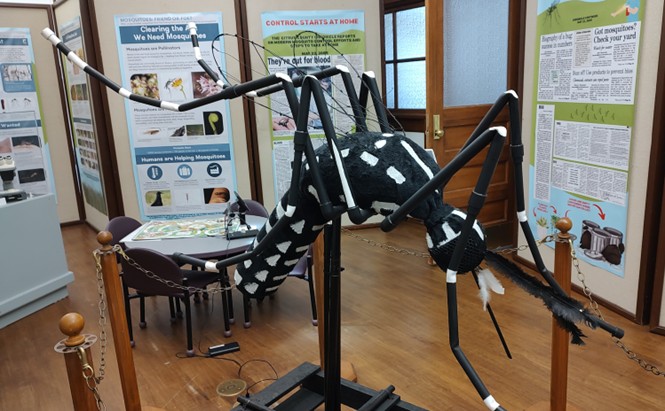
Citrus County Historical Society’s Mosquito Exhibit
Plan to visit the CCHS’s mosquito exhibit at the Old Courthouse Heritage Museum. Meet “Mo The Mosquito” – a giant replica of our enemy in the fight against malaria and other diseases. The exhibit is open now through October 10.
While you’re there, pick up a copy of Judge May’s “Gaters, Skeeters & Malary” book in our gift store. It’s a great eye-opening account of life in Citrus County during our rough-and-tumble days.
Ken Marotte writes for the Citrus County Historical Society. He can be reached via email at kenmarottejr@gmail.com if you have any comments, questions or suggestions. Contact him if you’d like to participate in the ongoing CCHS Oral History Project.