
Beware of the Fly!
By: Ken Marotte, Citrus County Historical Society
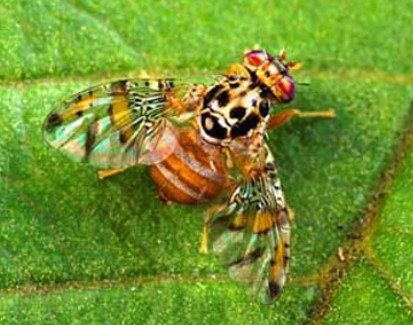
It sounds like a 1950’s horror movie. An insidious insect mysteriously appears in Florida. It threatens to destroy the livelihood of citizens across the state, including people here in Citrus County. No one knows where it came from or how to stop it. The Governor decides to mobilize the National Guard to help fight the invaders. Students at the University of Florida are released early to join the battle. The year is 1929. The enemy is the Mediterranean Fruit Fly.
An Unfortunate Discovery
J.C. Goodwin was the State of Florida Plant Board’s nursery inspector. He was performing a routine review of the US Department of Agriculture’s test grove in Orlando on March 30, 1929. He casually picked a few sample grapefruit and returned to his office in Gainesville. A few days later, Goodwin noticed that one of the fruits was badly deformed. He carefully opened the grapefruit and found that it had been hallowed out by the larvae of an insect he had never encountered before. He had read about a similar insect that had plagued Hawaii a few decades ago. After some research Goodwin confirmed that the mystery insect was the dreaded Mediterranean Fruit Fly. He immediately contacted Federal and State agricultural agencies to inform them about the danger. He sounded the alarm that an immediate response would be needed to save Florida’s fruit groves and vegetable farms.

The Enemy
According to the US Department of Agriculture, the Mediterranean Fruit Fly (or “Medfly”) is “…is considered the most important agricultural pest in the world. It can infest more than 300 hundred varieties of fruits, vegetables and nuts. Some hosts include: Almond with husk, Apple, Apricot, Avocado, Bell pepper, Cherry, Citrus, Coffee, Eggplant, Fig, Grape, Grapefruit, Kiwi, Lemon, Lime, Mango, Nectarine, Olive, Papaya, Peach, Pear, Persimmon, Plum, Pomegranate, Tangerine, Tomato, and Walnut.”
The insect is usually attracted to ripe fruit. The female will lay around 20 eggs per day and the larvae will immediately start to tunnel through the fruit while rendering it completely unsuitable for human consumption. Given the wide variety of potential host plants, entire crops are risk for destruction once the medfly is established in the area. Scientists today know that the medfly will periodically appear. They advise that the best way to combat the pest is to aggressively isolate any infected fruits and deprive the medfly of host plants through improved farm hygiene (removing dropped fruits, harvesting and processing early in the season). Biologists have found ways to sterilize male medflies and release them in affected areas to reduce the species ability to reproduce.
Florida’s Response
There was little reliable information regarding ways to combat the medfly in 1929. There were no proven pesticides. Scientists were not sure about which plants were most at risk from the insect and would only find out through trial and error. Sterilization of male medflies would only be dream for future agriculturists. Governor Doyle Carlton appointed Dr. Wilmon Newell to lead the state’s fight against the menace.
An immediate quarantine was imposed across the state. Fruits and vegetables could not be transported across county lines. Citizens were urged to remove overripe produce from their groves and farms and burn immediately. People were advised to clean and seal good produce, preferable through canning. The Governor activated the National Guard to rigorously enforce the quarantine and lead clean-up efforts in the field. Experiments with potential pesticides were accelerated and promising solutions were deployed by the troops. Agricultural Studies upper-classmen from the University of Florida were given leave to join the troops. A special Medfly Chief Inspector was appointed for each county. The Inspector would be charged with ranging throughout their area and issuing permits for sale of produce that were free of the Medfly. John Roscow was assigned as the Chief Inspector in Citrus County.
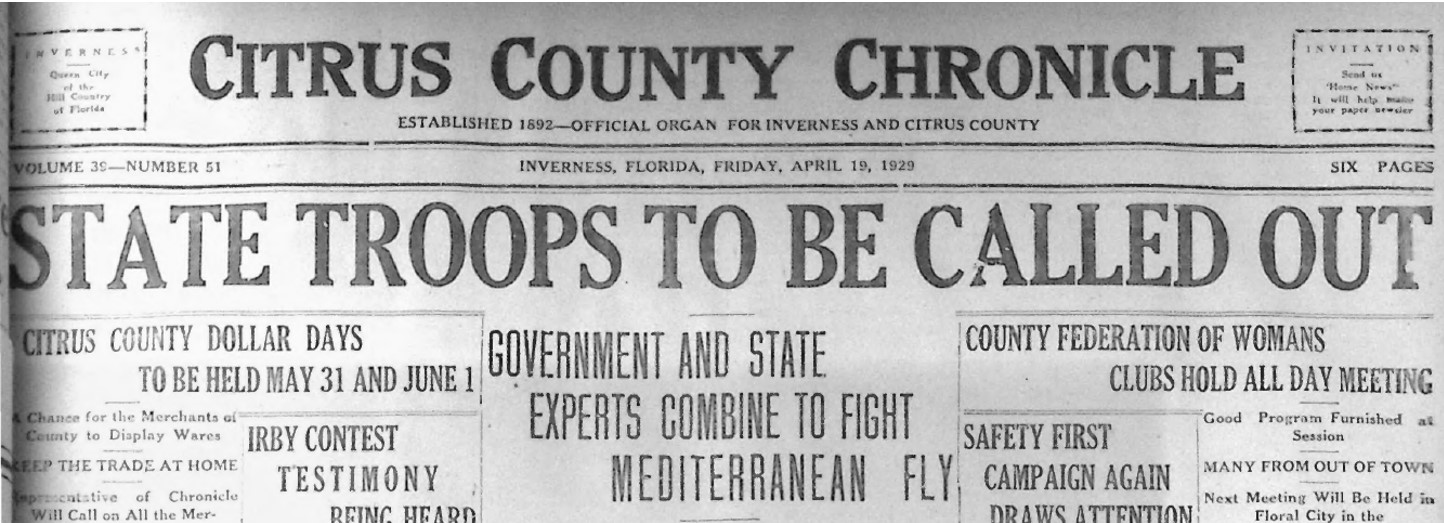
The Florida State legislature allocated $500K (the equivalent of $9MM today) to fund the Medfly fight. The US Congress added the equivalent of another $81MM for Florida’s eradication efforts. Legislators from other states (especially Texas and California) realized that the Medfly may soon spread to their doorsteps and assisting the Floridians would help ensure that the plague did not impact their constituents. In the meanwhile, most states refused to accept any produce from Florida within their borders.
Politicalization of the Crisis
The strict quarantine impacted farmers across the state. Most Floridians recognized the potential danger if the Medfly was left unchecked and accepted the strict rules necessary to combat the insect. However, a few newspapers and public figures denied that the impacts of the invaders were so catastrophic and felt that the government was overreacting. One Gainesville newspaper ran a headline stating that “Florida is Victim of Gigantic Plot in Mediterranean Fly Quarantine”. Other newspapers quickly replied that such fantastic claims may sell more papers, but were hindering the concerted effort of the federal, state and county authorities to control the menace.
Even in the pre-social media era, rumors swirled around the state regarding the origin and impact of the Medfly. Some people claimed that the Medfly had been residing in Florida for over forty years and never presented such a problem until 1929 when dry weather and failure to clean dropped fruits led to the rise of the fly population. Other newspapers published stories stating that the Medfly had never been in North America before. Some “expert” immigrant farmers from Italy and Africa actually claimed that the fruit trees produced better produce after being stressed by the Medfly and the insect should be viewed as a blessing rather than a curse. The Tampa Tribune carried a story that the insect may have been introduced by rum runners who were skirting prohibition laws. In response, an anonymous bootlegger told the Naples Transcript that he believed the Anti-Saloon League had inflated the Medfly scare to empower state troops to perform more intrusive automobile inspections.
As usual, land speculators tried to profit on the fear of another “crash” in property valuations due to the Medfly. They contacted owners of groves and large farms in Citrus County urging the locals to sell their property at discounted process while the land was still worth something.
Medfly in Citrus County
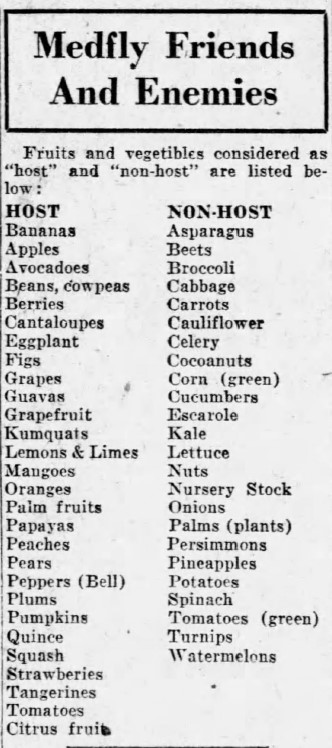
State inspectors visited each county and performed rigorous reviews of produce samples from local farms. As the months progressed, it was determined that heightened farm hygiene was one of the best tools to deny the Medfly a place to lay their eggs. Lists of produce that were likely targets and those that were considered “safe” were published in the Citrus County Chronicle and other newspapers. Troops were conducting inspections on county roads and progress was being made with insecticide sprays.
Reports of the state inspectors were published every week. Anxious Citrus County citizens watched as Medfly larvae were found all of the surrounding counties. When inspectors repeatedly failed to find any Medflies in our area, farmers were hopeful that the insects might bypass the county. Citrus County was a “Zone 3” community, which meant that there were no active infections. Leaders from neighboring Hernando County (which had active infections) spoke to county business leaders and advised them to renew their cleanup efforts if they wanted to remain insect-free.
Hopes were dashed on August 1, 1929 when the larvae were found in Inverness. Inspectors detected Medflies in guavas on the property of W.T. Williams. The county was immediately designated as the highest risk level by the Federal government (“Zone 1”) and a strict quarantine was imposed within a mile of the discovery. State resources descended on the area. Vehicles were stopped and thoroughly inspected in Route 5 (Now Routes 41/44). Prisoners from the county jail were detailed to help with the cleanup.
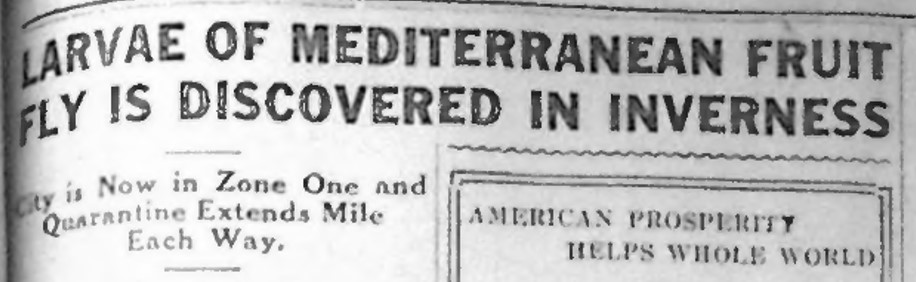
The Inverness City Council passed an emergency ordinance to address the threat. A long list of specific targeted vegetables and fruits were listed in the ordinance. All produce on the list were to be immediately picked, inspected and any affected items were to be destroyed. All grocery stores were to place screens around their produce stock to capture any Medflies that evaded initial inspection. Trucks and automobiles transporting produce within the area were to also be screened. Inspectors would have wide powers to perform inspections on private property and order the immediate destruction of any tree, plant, shrub or vine displaying signs of infection.
Florida counties were gradually deemed to be “commercially Medfly free” after undergoing rigorous inspections. Those areas that were impacted during the initial waves were also among the first to be cleared. By October, 1929 only eight counties (including Citrus County) remained on the embargoed list. Inspectors found no traces of the Medfly in our county in November and produce was once again allowed to be shipped outside county lines.
Epilogue
Floridians were faced with an unfamiliar threat to their livelihoods in 1929. Cooperation of governmental agencies at all levels – Federal, State, County and City – played a key role in providing a solution to the immediate danger. While there were some naysayers who detracted from the effort, an overwhelming number of citizens understood the risk and sacrificed to fight the insect invasion. While the Medfly has not been completely eradicated, the efforts and dedication of Floridians in 1929 provided a blueprint for successfully handling future infections