
Beverly Hills – That’s Where They Want To Be
By: Ken Marotte, Citrus County Historical Society
Beverly Hills is a testament to a man who was not interested in just building houses and hurrying away to the next big deal. This is the story of Samuel J. Kellner, a developer who continued spending his personal funds after the sale to build a community where residents could happily retire.
A New York Legend
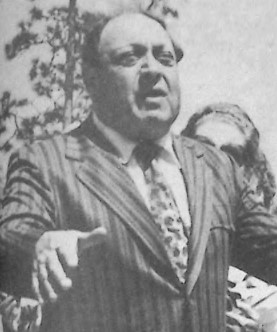
Samuel J. Kellner started building communities in Brooklyn NY during the 1920’s. Kellner and his brother successfully constructed a 70-home project in Flatbush when he was only 23 years old. This was the first in a number of successful business ventures. As New Yorkers tired of city life, they thronged to suburbs in Long Island. Returning WWII veterans required homes and Kellner provided them with a 546-home development in Merrick (Long Island). He featured small affordable homes that would serve as a model for later communities in Citrus County.
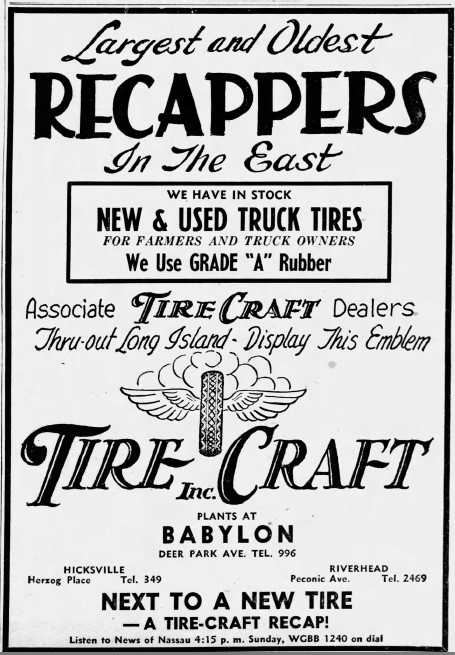
The cost of tires during the Great Depression and World War II was prohibitive because rubber was scarce. This led to an explosion of tire recappers – companies that would take a structurally sound tire with worn tread and use heat treatment to apply a new veneer over the existing tire. Kellner was President of Tire-Craft, the largest recapper in the East, headquartered in Long Island NY. In addition to his manufacturing plants, Kellner had a network of associated dealers to sell his products to the public. This venture made Kellner a wealthy man.
The Birth of Beverly Hills
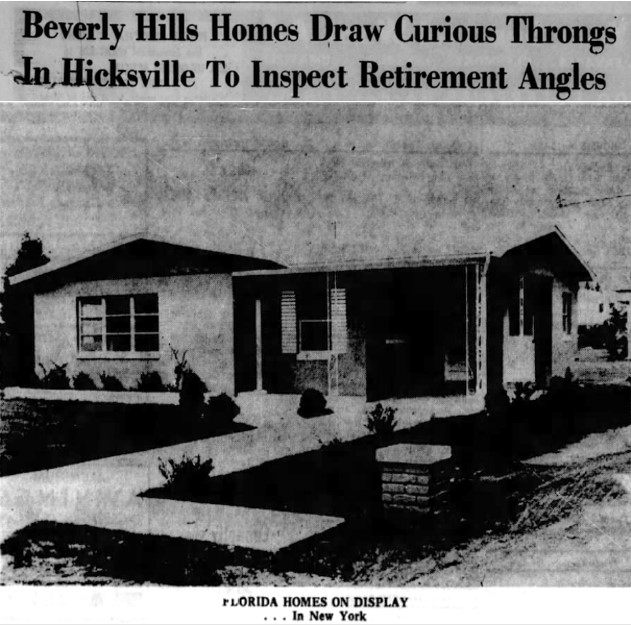
Kellner had a winter home in Dunedin FL. As he explored Florida’s West Coast, he became interested in an area of land between Holder and Hernando in Citrus County. After purchasing a large tract of undeveloped land, Kellner began marketing his idea to people contemplating retirement in Long Island. Rather than rely on printed advertising and television spots, he constructed two full sized model homes in Hicksville, Long Island in 1962. He knew that people would be more inclined to buy if they could see homes for themselves. Since his target audience – retirees – didn’t require large houses, Kellner’s homes were compact. One and two bedroom houses contained 925 square feet, a paved driveway, located on a 75×125 wooded lot with an attached carport. Priced at $8,370 (about $85,00 in 2024 dollars), the model homes brought large crowds during the opening weeks of the display. About 2,500 potential buyers per week toured his model homes. There were twenty-seven confirmed purchases in first couple of weeks
Selling A Community, Not Lots
Kellner’s vision for Beverly Hills was a true community of connected retirees rather than just a collection of houses. He realized that New Yorkers would not be likely to purchase homes without the amenities of suburban live. Kellner promised paved roads, a central water system, enhanced electric and telephone, a community center and a golf course. He delivered on all of those promises and exceeded everyone’s wildest expectations. He arranged for multiple full-sized swimming pool for residents, a small community store, a restaurant, and a service station
Kellner purchased a projector for movies that were shown in the community center. Friday night get-togethers became a regular event for the residents. Kellner purchased a shuttle bus and offered free shopping trips to Inverness, Crystal River and Ocala. He arranged a contract with a local pest control company for weekly preventative fogging.
He announced that an area would be set aside where churches and a synagogue could be established. Any church that would commit to building a church would be given an acre for the structure and parking lot.
More Gifts to Beverly Hills
By the end of 1962, about five houses per week were being completed. Wherever possible, local construction teams were employed which provided a substantial number of jobs in the area. Prospective buyers were brought to the Crystal Lodge Motel in Crystal River.
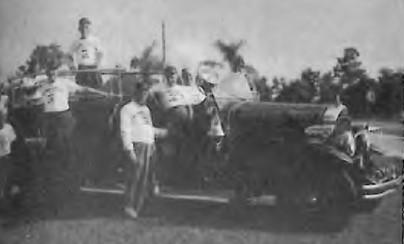
Kellner thought that the area needed better firefighting protection, so he organized a volunteer Fire and Ambulance corps. He found that the Westbury NY Volunteer Fire Dept was retiring their “Old Reliable” 1934 American LaFrance fire engine. Kellner offered the department $500 and made arrangements to ship the pumper to his new Beverly Hills community. The local volunteer firemen were proud of their new organization and new (to them) equipment. The engine could throw a stream of water over 200 feet which was to be quickly put to the test. After taking part in an Inverness parade in September 1962, the returning firemen saw that a landscaper had started a small brush fire in the community. The volunteers sprang into action and used their new pumper to quickly extinguish the blaze. The residents were justly proud of their new firemen. They offered backup services to Inverness, Holder and Hernando as well. An ambulance service was added a few months later.
Availability of water was another concern for the new community. Kellner employed a local company to drill a 400-foot deep well to address the need for a central source of clean water. Rated at 1,200 gallons per minute, pictures of the well were advertised in the New York newspaper as further evidence of Kellner’s commitment to Beverly Hills. He later purchased floor space in New York City’s Grand Central terminal and displayed a scale model of the new community. He offered free limousine rides to the full-size model homes in Hicksville to any city dweller interested in checking the amenities offered at a reasonable price.
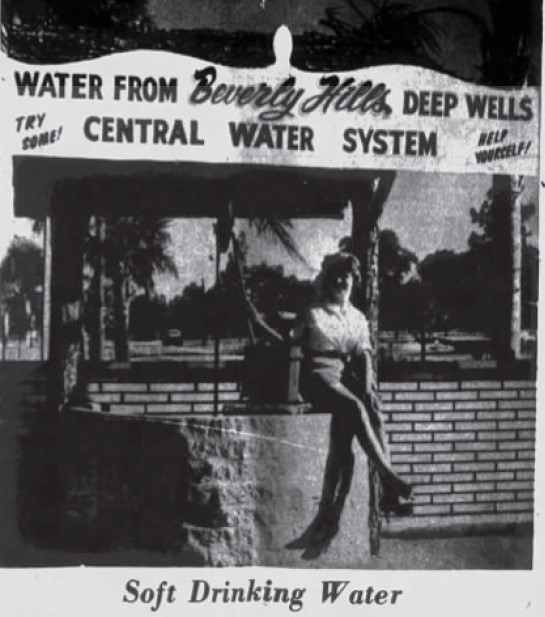
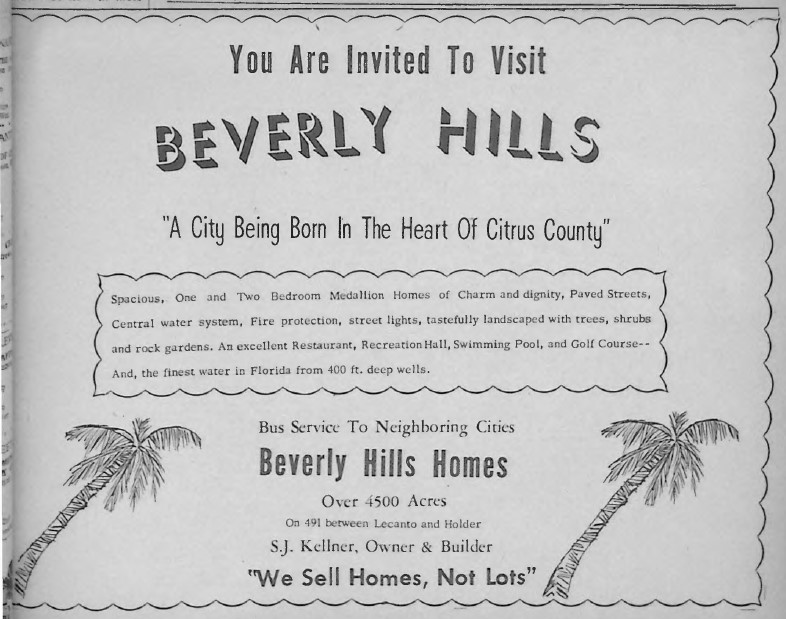
In 1962 the Beverly Hills Civic Association was formed. It was devoted to fostering a sense of community featuring Friday get-togethers and other special events. Updates in weekly newspaper articles brought news of who had recently bought a house and welcoming those who had recently moved to their new home.
Death of Sam Kellner
Kellner continued to add amenities to his prized community. A gas station and small motel were completed. A shopping center was established for the convenience of the retirees. By 1975, there were about 3,000 homes and over 5,000 residents which made Beverly Hills the largest community in Citrus County. (By contrast, the 1970 census indicates that Inverness had a population of 2,300).
Residents were shocked to learn that Sam Kellner had passed away in New York on December 29, 1975. Friends and relatives remembered his many accomplishments but his association with Beverly Hills was one of his most noteworthy ventures. He was eulogized in the Citrus Chronicle “…throughout his association with the community it was his intent that it appeal to and be affordable by retiring working people”.
Beverly Hills Renaissance
The demographics of Beverly Hills had changed by the dawn of the 1980’s. The original group of retirees was getting older and required more elder assistance. Younger families were attracted by the reasonable price of “starter homes” in the development and more children were living in the area.
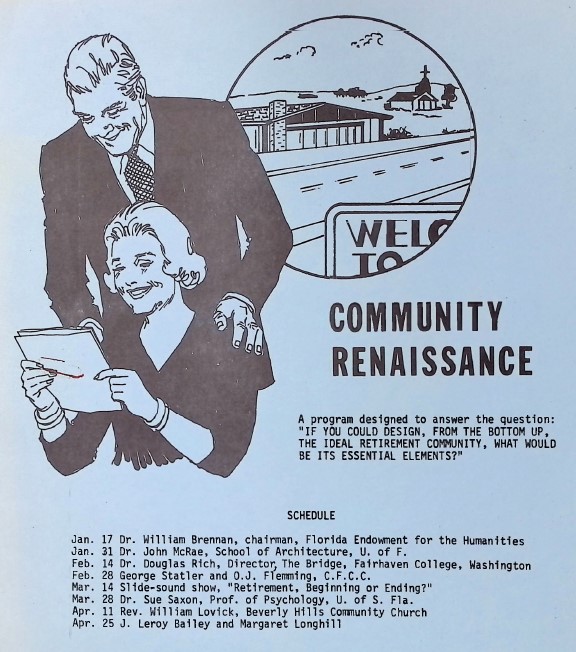
As part of a grant from the State of Florida, a “Community Renaissance” program was launched in 15 cities across the state. Beverly Hills was one of the communities selected to participate in 1979. A series of eight meetings were held in Beverly Hills to discuss the changing nature of the area and how the needs of elder retirees could be better met. The issue was examined from the perspectives of physical, emotional and spiritual needs. One of the outcomes from these meetings was a determination that the residents had to be more active politically and advocate for their interests.
One of the most noteworthy results from this program was the establishment of a SkillBank service. The innovative approach was an organized forum for exchange of services to meet needs within the community. Their motto was “Neighbors Helping Neighbors”. There are a few examples that highlight the types of assistance being provided. Two elderly women needed assistance lifting their invalid husbands out of bed. Volunteers stepped forward to give a helping hand every day. Some volunteers offered babysitting service, others completed small repairs and maintenance work, drove shut-ins to doctor visits, and acted as support for cancer patients.
Sam Kellner would have been proud to see how the residents of Beverly Hills continued his dream of a true community after his death.
The Beverly Hills SkillBank program is still going strong 45 years after it was initially conceived.