
A Bad Day for Ballooning
by Kenneth Marotte
INTRODUCTION
Balloon ascensions were the space trips of the latter 1700’s and 1800’s. In the pre-airplane period, balloons captured the world’s imagination as mankind’s only way to fly with the birds.
Balloons were used for commercial and military purposes since the 1780s. The technology became so ubiquitous that amateur “aeronauts” could fly their own lighter-than-air devices for personal enjoyment and experimentation by the end of the nineteenth century.
For one local man, a routine balloon trip in 1896 to check wind currents ended in Homosassa – and the dangerous journey almost cost his life.
THOSE BARNSTORMING BALLOONS
Balloon ascensions were pioneered in France in the 1700s. By 1795, a successful crossing of the English Channel by balloon was achieved.
By 1862, aeronauts had reached the amazing height of 39,000 feet and faced the same issues of pressurization and oxygen quality that would plague airplanes many years later.
People flocked to balloon exhibitions and the various performers added more and more dangerous stunts to delight the crowds. In 1797, a French aeronaut successfully leaped from a balloon and landed safely using a parachute. Increasingly dangerous feats became a part of every county fair and municipal extravaganza. One woman attached a horse to her balloon and rose into the sky riding sidesaddle. Another man parachuted from a balloon while riding a bicycle. Not to be outdone, A.T. Glasgow donned a parachute, loaded himself into a cannon, attached the cannon to a balloon and floated back to earth after being shot out of the barrel after rising on the balloon.
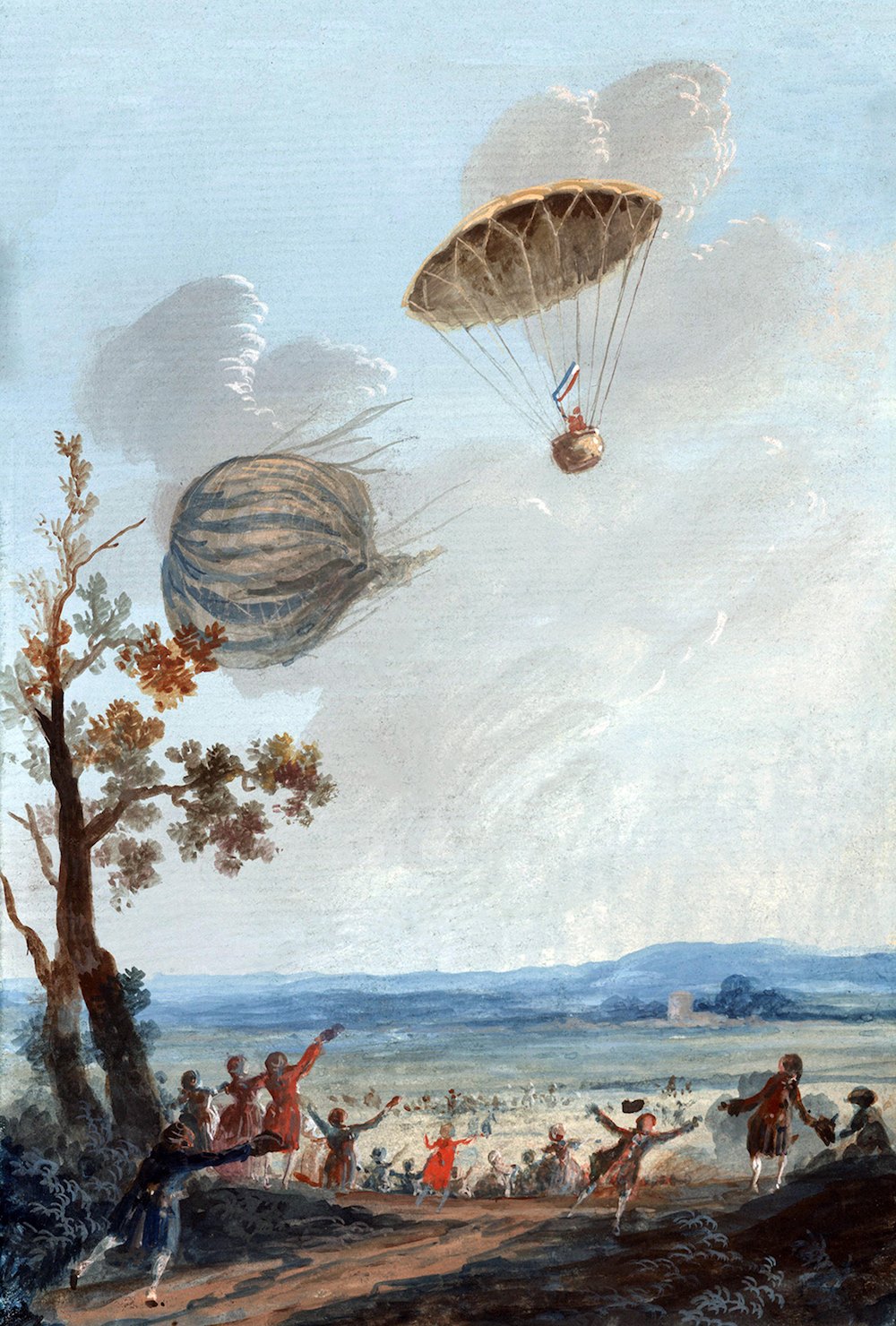
André-Jacques Garnerin made the first documented parachute jump in October of 1797, landing safely after exiting a balloon 3,000 feet above a park in Paris.
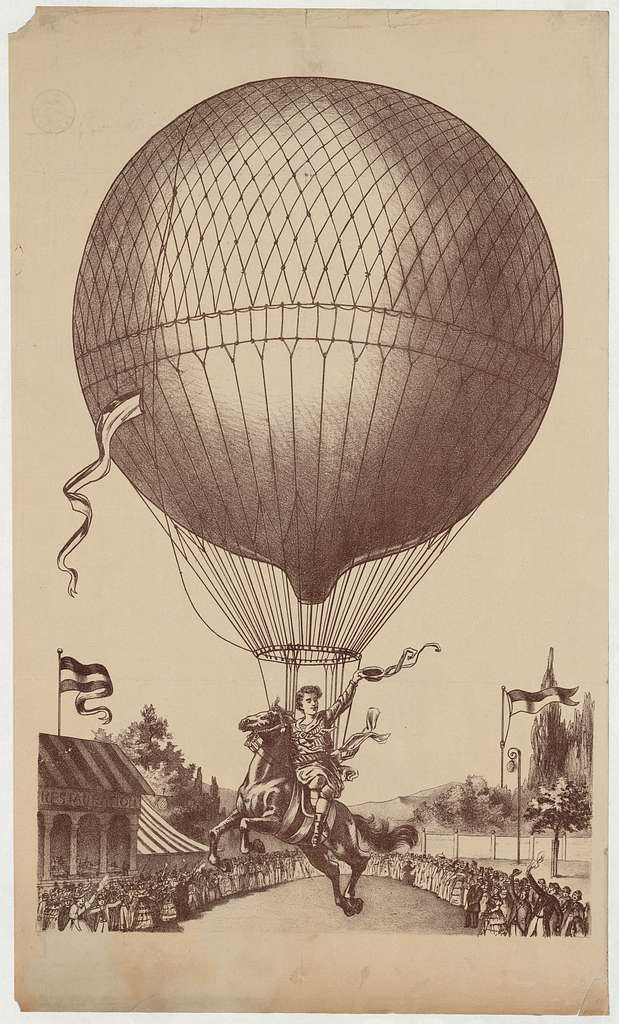
Victorian women would politely ride their horses side saddle into the air in a daring display of bravery and decorum!
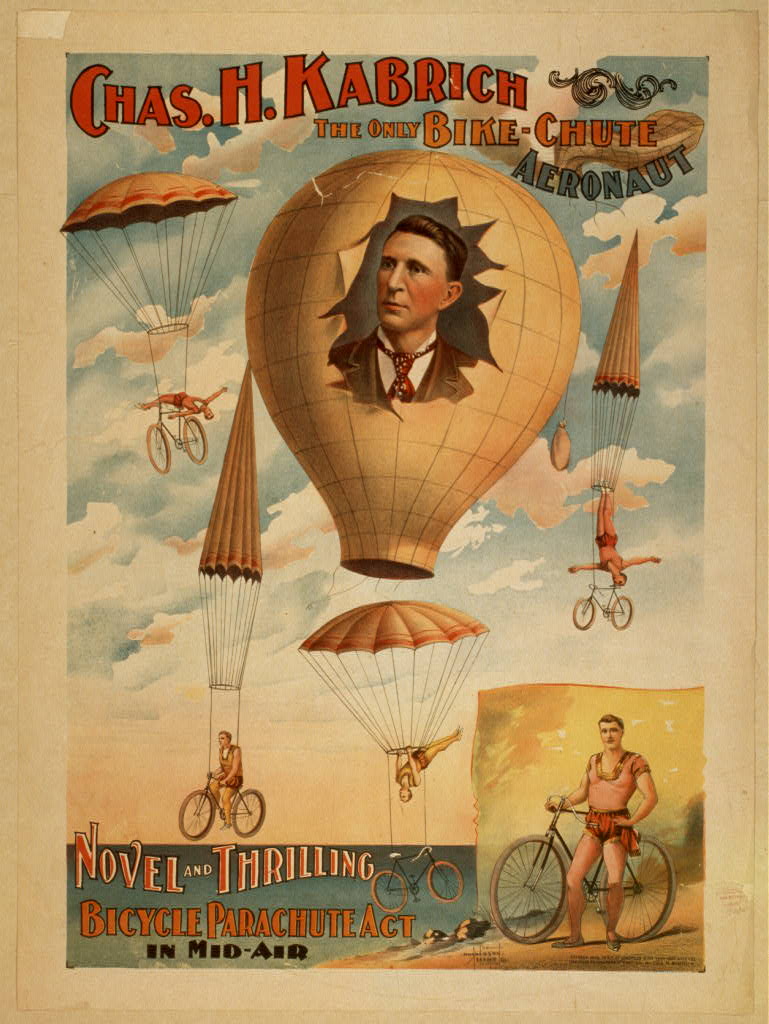
Chas. H. Kabrich, the only bike-chute aeronaut presents a novel and thrilling bicycle parachute act in mid-air!
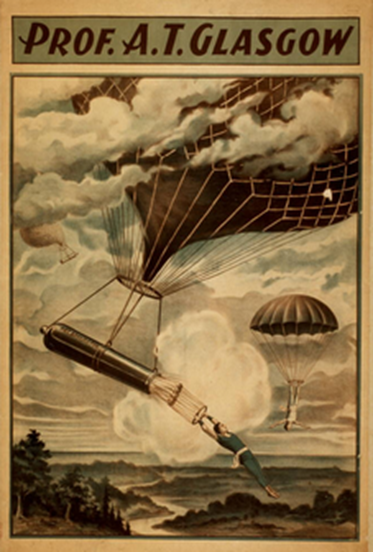
Not to be outdone, A.T. Glasgow donned a parachute, loaded himself into a cannon, attached the cannon to a balloon and floated back to earth after being shot out of the barrel after rising on the balloon.
BALLOONS REPORT FOR MILITARY DUTY
Military tacticians soon realized that an elevated observation platform could give them a chance to spy on the enemy from a long distance. Every country’s military, including the United States Army, took advantage of this tool. Balloons were prominently used in the American Civil War to help plan the next campaign
With the outbreak of the Spanish-American War in 1898, some of the barnstorming aeronauts wanted to join the action – and garner fame and fortune. One female aeronaut, Ida Le Roy, volunteered to float over Spanish positions in Havana and manually drop bombs on their troops. The US military politely declined. The reader can only imagine the Spaniards surprise to see a “Mary Poppins” look-alike wafting over their lines unleashing her own special “spoonful of sugar”.
A LOCAL MAN’S BAD DAYS ON HIS BALLOON
As you can see, ballooning had captured the imagination of ordinary Americans in the same way feats of the twentieth century astronauts engrossed that generation.
Dunnellon’s John Wells was no exception. He was described as an experienced amateur aeronaut. By all accounts, he wasn’t a barnstormer or thrill seeker. He wanted to obtain better information about wind currents near the Gulf coast and decided to use his balloon to obtain the data.
He ascended from Dunnellon on Thursday January 30, 1896. The weather was clear and fair after a typical overnight temperature of 47 degrees. Ominously, the water temperature in the Gulf averages about 60 degrees in late January.
An unexpected strong wind drove Well’s balloon toward the Gulf. Land was soon out of sight. He floated at elevation of about 1000 feet.
Around midnight, the balloon began a sharp descent and hit the water. At that point, Wells estimates that he was about 100 miles offshore.
Fortunately, he lashed himself to the buoyant gondola so he wouldn’t be completely lost at sea. Wells lost consciousness sometime on Friday. He was dragged through water for over 36 hours, clinging to the rigging of balloon.
He spent the day plunging over the waves being driven by the wind and then dunked underwater upon landing.
A ship carrying spongers saw him on Saturday about noontime. His balloon was about 40 miles offshore at that time. According to the crew, there appeared to be a corpse tangled in the lines and they prepared to recover the hapless castaway.
A small skiff was dispatched. The crew had to chase two sharks away from the balloon before they could approach.
An examination of the unlucky occupant indicated that there was still a flicker of life left in his body. Wells’ pants were torn to shreds by sea crabs which had attached themselves to his legs. His legs also had deep abrasions from the crabs that had reached his skin. The ropes that he used to lash himself to the gondola had become embedded into his skin.
He was quickly brought down into the sponger boat’s galley to be revived with liberal amounts of rum. The crew worked feverishly for several hours to revive him.
They immediately steered toward the dock in Homosassa so Wells could get the medical attention he needed.
Wells was reported to be so weak that he could not walk. As it turns out, he would need months of rehabilitation to recoup from the effects of his misadventure.
He was asked if he would remain an aeronaut in the future. Shaking his head, Wells said he learned his lesson and promised never to go ballooning again