
Convict Leasing in Citrus County

Convicts working turpentine forest 1903, courtesy of Florida Memory.
by Ken Marotte
We sometimes drive past some road work or clean-up projects accompanied by the “Prisoners Working” sign. Most people don’t think about the story of convict labor in Florida and Citrus County in particular.
Leasing State Convicts to Private Businesses
In aftermath of the Civil War, the 13th amendment was adopted to eliminate slavery. It read “Neither slavery nor involuntary servitude, except as a punishment for crime whereof the party shall have been duly convicted, shall exist within the United States, or any place subject to their jurisdiction”. Most people thought that this ended the matter. However, some post-Reconstruction citizens found a loophole: “…except as a punishment for crime whereof the party shall have been duly convicted…”. This led to an increasing number of people being subjected to convict leasing – which has been called “Slavery by another name”.
At first, there were a limited number of Florida State convicts being leased to external parties. The State did lease their prisoners, but it was a zero-sum proposition at that point. During the period from 1876 to 1890, the State of Florida realized only minimal “profits” from their convict leases. In Citrus County, there were only 7 prisoners in the county jail in 1893. It cost the county $92 per month for food, shelter, and medical services.
The explosion of the phosphate and turpentine industries changed all that. The State found that there was money to be made– and lots of it – by leasing convict labor to the private companies in those industries. Most of those jobs were right here in Citrus county. Of the 800 State convicts being leased in 1900, 700 were working in the Citrus County phosphate mines or turpentine forests according to the 1900 census.
The conditions experienced by the leased convicts in Citrus County were horrendous. Reports of cruel treatment and poor working environment reached the ears of the Florida State Legislature. They appointed a fact-finding committee to perform an inspection tour of the Citrus County convict camps. The committee’s report, issued in 1899, caused a sensation. It reads, in part:
A Prisoner’s Story – Miller Gardner
Miller Gardner was a Pensacola resident who snatched a pocketbook from a white woman in 1899. He was quickly apprehended by some passerby and brought to trial. He was sentenced to ten years of hard labor in the Citrus County camps.
“W.N. Camp phosphate camp, near Elliston, in Citrus County. Eighty convicts, seven white men and three women. Six deaths in the past year, including one killed in attempting to escape. Your committee found a deplorable condition of affairs at this camp, and cannot present in language the true situation. By inspection, observation, evidence and investigation we found a system of cruelty and inhumanity practiced at this camp that would be hard to realize unless it could be seen and heard direct. The prisoners presented a generally pitiable condition, and the complaint was general, universal and corroborative of what your committee observed. There was an insufficiency of food, as evidenced by the appearance of the prisoners; severe and cruel punishment as evidenced by the lash cuts on the prisoners. There was a failure to supply the sick with food; there was no hospital arrangements for the sick, the well prisoners being compelled to sleep all mixed in with the sick men in the cell which was entirely inadequate for the comfort of the men. There was a failure to supply any kind of bedding except a pine floor and one blanket for each person even during the severe weather last winter. There was abundant evidence that there had been bedding furnished this camp up to within two days of the arrival of your committee, as also abundant and corroborative evidence that the blankets had not been washed for more than a year, until about two days before the arrival of your committee. Your committee was present at the noon meal served to the prisoners at this camp, which was served to them in the hot sun, under no shade whatever. We found the stockade entirely too small for the accommodation of the number of prisoners, the stench and smell from the cell being nauseating, there being ten sick and disabled convicts in the cell, and no hospital facilities. The cooking arrangement was unsatisfactory to your committee. We found the general situation at this camp unsatisfactory in every respect, the punishment was unnecessarily frequent and cruel to the point of brutality, many of the men being bruised and cut by the lash to an extent that it was difficult and with pain that they could sit down. The condition of the camp was fully corroborated by competent outside evidence.”
“At the camp of J. Buttgenbach and Co near Floral City, it was found the men were harshly treated, forced to work on Sunday, and that food was both insufficient and badly cooked. In this and another camp of the same company at Cordeal, the men complained of being forced to handle hot rock which the superintendent of the mine admitted was severe upon them.”
Newspapers across the county reacted to this shocking report. A typical comment from the Chicago Tribune exclaimed that convict leasing was a “…foul blot upon Florida. Convict camps of that state are a disgrace to civilization”.
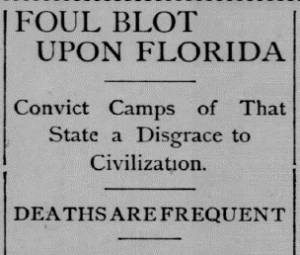
Courtesy of Newspapers.com
How did Florida respond to this criticism? Calls arose in the state’s newspapers for the elimination of the convict leasing system. The Ocala Banner called this practice “…a vicious system of brutality and slavery”. A large petition was submitted to the legislature asserting that the current leasing system actually hurts the Florida economy by depressing the value of phosphate due to oversupply; the current system is cruel and inhumane, and ordinary workers are put at a disadvantage competing with the cheaper convict labor. “If you will investigate the condition of affairs in Alachua, Marion, and Citrus counties, which such system is in operation, you will find that there are gross abuses, such as bringing false charges against laboring men for the purpose of forcing them into the convict camps”.
A Prisoner's Story - William Merchant
William Merchant is listed as the youngest convict in Dunnellon in the 1900 census. He was 5 years old at that time. His father, convict Jesse Merchant, was a 31-year-old widower who was working in the phosphate mines of Dunnellon. There is no information about their lives after their stint on the labor camp.
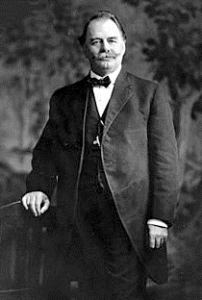
William Sherman Jennings
Governor William Jennings of Brooksville was not ready to abandon this lucrative arrangement. He appointed a new Superintendent for the Convict Leasing program. He noted that as of 1901, primary lessees paid the state about $26.40 per convict per year. The contractual rules required the primary lessees to assume the entire inmate population, including some men who were unable to work and women. They were responsible for guarding, feeding, and housing the inmates. The state contract allowed the lessees to subcontract convicts to other parties. So, the primary lessees would offer the strongest convicts with the longest sentences to sub-lessees for about $90 to $180 per convict per year. This was a lucrative arrangement for all parties in the convict leasing program – except for the convicts.
The Governor projected that the level of convicts during the period 1902-1905 would not fall below 900 and that the State could reasonably expect to adjust the value of the contracts to obtain $130 per convict annually which would yield about $104,000 profit to the State per year. (This equates to $1.4MM per year in 2022 dollars)
Jennings also proposed longer sentences for wayward children at the (now infamous) Florida State Reformatory School.
Finally, the system was changed to include profit-sharing with each county. Each county received a share of state convict leasing bounty based on the number of prisoners convicted in their courts.
Duval County (Jacksonville) sent an overwhelming number of convicts into the system, so they reaped a bounty of $24,510 per year (over $800,000 in 2022 dollars). Of the 43 counties receiving a state convict dividend, Citrus county was tied for # 33 with only $900 (about $29,000 in 2022 dollars).
By 1905, State convicts were being leased for $151.50 per year. The inmate population had grown to 1,174 convicts. The total profit to the State of Florida was over $5.7MM in 2022 dollars. Lessees had to take all convicts, regardless of sex, age, or disability. They estimated that 63% of the total population were able-bodied good workers, while the remaining were elderly, incapacitated, or female. The composition of the group was 12% white and 88% black
Average free worker wages were 25 cents per hour for a typical sixty-hour typical work week. This equates to a cost of over $25K per year per worker in 2022 dollars. A similar convict would cost the lessee about $5,000 in 2022 dollars. Of course, the lessee would have to provide food, lodging, clothes, guards, etc. for convict labor but the lessee would save significant costs by leasing a convict. The system also still allowed the primary lessee to sub-lease to others at a higher price, so they could profit by leasing to other companies.
Prisoners' Stories – Chessman Owens and Mary McLean / Willie Schaffer and Edward Hays
Chessman Owens and Mary McLean were convicted by a jury of “lewd and lascivious cohabitation” in 1909. The man was sentenced to a year of hard labor unless he could pay fines over $100. The woman showed up at court with an infant in her arms and said she had more children at home. The court suspended her sentence on the promise of better behavior in the future.
In 1906, a woman named Willie Schaffer (white) and a man named Edward Hays (black) were found guilty of the same crime in Pensacola. They were sentenced to six months of hard labor each.
Those couple’s experiences were mild compared to others accused of the same crime. The Ocala Evening Star reported that seven prisoners from Duval County passed through the city on their way to the Holder mines in 1905. A white woman from Charlotte, NC was part of the group. She had traveled to Jacksonville and “took up with a negro”. They were both convicted of living unlawfully together and each received a seven-year sentence in the phosphate mines.
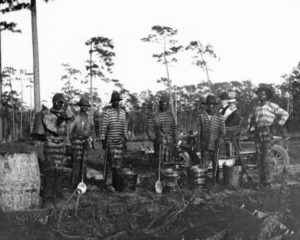
Convicts working turpentine forest. Courtesy of Florida Memory.
There were some minor reforms in the 1905-1909 period. The main intent of the State legislation was to prohibit the leasing of women, the disabled, and the elderly. They were to be sent to the State Prison farm and given appropriate work. The law also asserted control over counties leasing activities and rules. However, Florida’s leaders stubbornly clung to the convict leasing program and even postulated that leasing was a positive benefit to the prisoners. In 1909 Governor Gilchrist cited improved conditions and reforms since the damning report of 1899. He said: “Our prisoners work in the open air and in the open sun. They also enjoy conversation and singing and music among themselves. At night, the negroes make the camps ring with their songs. None of them are shackled”. The editor of the Florida Star editorialized “It is best for the negroes and most of the prisoners to work turpentining. There is no healthier plan of living, especially out of doors in Florida”. I’m left to wonder why Gilchrist and the other leasing advocates didn’t leave their professions for the healthy life in the sunshine that the turpentine forests offered.
It should be noted that the convict leasing contract signed in 1909 added over $31 million in 2022 dollars to the State coffers over a four-year term.
The End of State Convict Leasing
By 1910, the other Southern States had eliminated the practice of leasing state convicts to private entities. There was growing moral outrage against the scheme. The Tampa Tribune noted : “…the main charge is true, be in admitted to Florida’s shame. We ARE continuing the institution of slavery in this infamous system.” The number of State convicts being leased (and the total population of convicts) shrank as the decade wore on. The total number of prisoners declined from 1,621 in 1917 to 1,219 two years later. Of the 1,219 prisoners, only about 1/3 were being leased.
The State Legislature passed a landmark bill outlawing the leasing of state convicts in 1919. The law would take effect in January 1920 and would invalidate any existing leases. State prisoners could be leased to counties for road work but the counties were prohibited from sub-leasing to private parties. However, counties were still free to lease their own convicts (sentenced in local courts) to external parties.
Had the government developed a sense of conscience and decided to end this inhumane practice? That may be a naïve conclusion. There were several other factors that contributed to the demise of the state convict leasing program. First, the labor-intensive operations that employed convicts had declined significantly by 1919. The phosphate boom was over and prices had declined. The demand for turpentine for naval stores was also reduced as more ships transitioned from wood to metal construction. The former lessees simply didn’t need the large convict workforce. Since the lessees were required to sign long-term contracts, they were faced with the specter of still having to pay for resources they did not need and could not easily be disposed of based on business conditions. Keeping the convicts busy would result in the production of more goods than were needed, so the market price continually declined due to oversupply.
The second reason that leasing of state prisoners was eliminated was related to the need for internal infrastructure – hardtop roads – by the growing Florida population. The washboard limestone roads may have been sufficient in the past, but Florida needed to drastically improve the state of its highways and roads to compete for industry and accommodate the growing tourist visitors. The newspapers of the day had argued this case for years and the Florida legislature and Governor finally listened. For that reason, able-bodied State convicts were either set to work on the chain gangs constructing State roads or offered to counties with the understanding that the prisoners would be working on the local county roads.
A Prisoner’s Story – Shadrach Bardwell
Shadrach Bardwell was a black brakeman on a railroad in Pensacola. He was involved in an altercation in 1896 with some white men on the train when one of them drew a pistol on Bardwell. He grabbed the gun but unfortunately, it discharged and struck a Postal Agent who was standing nearby. A witness confirmed Bardwell acted in self-defense and the brakeman was freed. His luck ran out two years later when Bardwell was convicted of stealing about $20 worth of goods from one of the freight cars. Bardwell was sentenced to six years hard labor as a result of that charge.
Citrus County Convict Leasing
Throughout the period, counties also leased the convicts in their local jails. State convicts were preferred by the lessees because longer state prison sentences meant that the workers would be committed for a longer period in their employ. County convicts were generally sentenced to terms of less than a year and they were released after a few months. As a result, county convicts commanded a lower demand than state convicts. Large corporations in the phosphate and turpentine fields would also rather negotiate a contract with a single entity at the State level rather than a myriad of separate contracts with each county.
Citrus County leased its small roster of jailed prisoners since the early 1890s. In 1896, the Citrus County BoCC leased all county prisoners to C.C. Todd of Hernando for road work. The number of convicts involved was minimal. For example, in March 1896 only 5 convicts were delivered. They were leased for a term of fewer than 90 days at a rate of 20 cents per day.
Large phosphate companies leased prisoners directly from Citrus County in the early 1900s. J. Buttgenbach and Company was the lessee in 1909 when the State legislature passed a bill restricting the leasing of women and disabled prisoners. The Citrus BoCC ordered the Sheriff to immediately send all female and disabled prisoners to Buttgenbach prior to the effective date of the new law. The BoCC noted, “This action being taken on the contract to lease these prisoners before the passage of the law prohibiting the same”.
The following year, the Citrus BoCC decided that “…any citizen of the County desiring the service of any of these be allowed the use for their keep and maintenance, and the Clerk was directed to enter into contracts for their services”. Consider that statement in the context of the old practice of slavery. A Citrus County resident could have a convict work on whatever they wished for free and all they had to do was provide room and board for the prisoner.
In 1915, the Citrus BoCC was advised by lessee P.L. Weeks that one of the county prisoners was unable to do any manual work and wanted to return him to the jail. The BoCC advised P.L. Weeks that he could keep the disabled prisoner for no charge and “…let him do such work as he could.”.
The Demise of County Convict Leasing Martin Tabert, who death contributed to the end of county convict leasing. Courtesy of Florida Memory.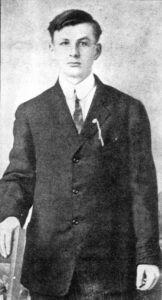
While the lucrative convict leasing practice had been outlawed at the State level, but for some reason, not in the counties. The end of the county convict leasing system was precipitated by the death of Martin Tabert. He was a white 22-year-old male from North Dakota who rode the rails from his native state to Florida as an adventure. He was arrested and convicted on a charge of vagrancy and sentenced to pay of fine of $25- or three months hard labor if payment of the fine was not received. His parents sent money to cover the cost of the fine, but Sheriff J.R. Jones of Leon County refused to accept the payment. Talbert was leased to the Putnam Lumber company for three months. He soon fell ill and could not work. As a result, he was whipped over 96 times by his overseer. He died a few days later. It was later discovered that Sheriff J.R. Jones and Judge B.F. (Ben) Willis had a deal to funnel defendants to the lumber company after being paid a “bounty” of $20 by the company for every convict leased to them. The case focused national attention on Florida’s convict leasing program (and the collusion of some law enforcement and judicial officials to ensure the continuation of this profitable practice).

Frederick Van Roy, of Crystal River, Florida State Representative
The Florida Legislature formed a joint committee to investigate and report on how this situation was allowed to occur. Citrus County’s newly elected Florida Representative Frederick Van Noy was one of five legislators selected to work on this committee. Their report shocked the nation. They found that the Leon County Sheriff had arranged for the railroad to make a stop within the county. At that point, any people “riding the rails” would be ejected from the train by the railroad detectives into the waiting arms of the Sheriff and his deputies. They would immediately bring the suspects to the complicit judge and convict the hapless prisoners during a midnight session. The judge literally conducted some court sessions in his nightshirt. The newly enlisted convicts would be delivered to the lessee lumber company by the next morning.
Van Roy and the committee recommended that all leasing of prisoners to external parties by counties must stop. In addition, whipping as a form of punishment was banned. Both houses of the Florida legislature overwhelmingly passed the bill outlawing all convict leasing to external parties as of January 1, 1924.
What became of Sheriff J.R. Jones? Surely, he must have been punished for engaging in this nefarious scheme and pocketing bribes of $70K (2022 value) during a seven-month period. He was removed from his position of Sheriff by the Governor. Jones was indicted on criminal charges but the case was dropped by the United States AG office without explanation. Ultimately, there was a position waiting for him on the Tallahassee Police Department where he served until his retirement in 1949.
A Prisoner’s Story – James Wallace
James Wallace (a.k.a. Jim Wylie) was a boarder who had a disagreement with his landlady in 1898. Wallace decided to exact revenge by spiking her tea and snuff with a poison called “Rough On Rats”. She survived, but the judge was “Rough on Wallace” and sentenced him to ten years hard labor in the work camps.
Convict Labor in the Post-Leasing Period
Florida’s state and county convicts were still being used to construct an extensive system of hard roads throughout the state. Conditions faced by these prisoners varied from the chain gangs in the blazing sun to landscape maintenance along roads. Up until July 1, 2021, the University of Florida was still using convict labor and had logged over 156,000 labor hours supplied by the Florida Department of Corrections (FDC) work camp prisoners over a four-year period. In 2000 UF President Kent Fuchs released a statement that the university will not renew its contract with the FDC for the supply of this prison labor as of the expiration of the current contract in 2021.
While today’s prisoners sometimes face unpleasant conditions, they are no longer subjected to the cruel and unusual punishment doled out during the heyday of the convict leasing to the phosphate and turpentine industries. Many of those unfortunate convicts were assigned to Citrus County work camps. In the end, a courageous fight by a Citrus County legislator proved decisive in eliminating convict leasing across the State of Florida.